
- Release Year: 1988
- Platforms: Amiga, Apple II, Apple IIgs, Atari ST, DOS, Macintosh, Windows
- Publisher: Kingstill International Software Services Ltd., Sierra On-Line, Inc., Sunlight Games GmbH
- Developer: Sierra On-Line, Inc., Software Farm, Inc., The, Sunlight Games GmbH
- Genre: Adventure
- Perspective: Third-person
- Game Mode: Single-player
- Gameplay: Graphic adventure, Puzzle elements
- Setting: Western
Description
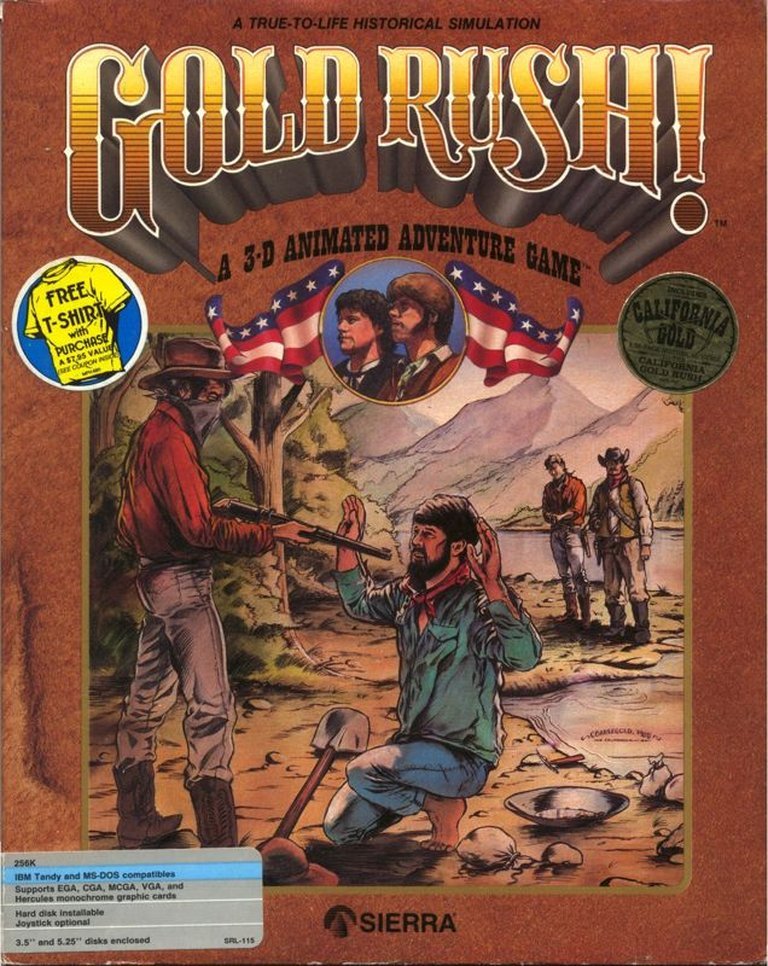
In Gold Rush!, set during the 1849 California Gold Rush, player Jerrod Wilson leaves his life as a Brooklyn newspaper editor after receiving a letter and gold nugget from his estranged brother, who was wrongfully convicted, prompting a perilous journey to Sacramento. With three hazardous routes—overland, via Panama, or around Cape Horn—featuring dangers like cholera and shipwrecks, and a timed mechanic where delays raise costs, Jerrod must race against time to reunite with his brother and seek fortune in this classic Sierra adventure.
Gameplay Videos
Where to Buy Gold Rush!
PC
Gold Rush! Free Download
PC
Gold Rush! Guides & Walkthroughs
Gold Rush! Reviews & Reception
choicestgames.com : It’s definitely one of the better looking AGI engine adventures I’ve ever played.
starlingdb.org : the challenge set here was to ensure close-to-100% historical, cultural, and stylistic accuracy
Gold Rush! Cheats & Codes
Gold Rush (PC)
Type ‘bird man’ during gameplay to enable cheat mode. The version number will be displayed to confirm correct code entry. Then type one of the following codes:
| Code | Effect |
|---|---|
| bird man | Enable cheat mode and display version number |
| set var | Set variable to new value |
| position | Change current X/Y coordinates |
| show mem | Display memory usage |
| get object [number] | Get indicated object |
| reset flag | Reset indicated flag |
| set flag | Set indicated flag |
| show pri | Show priorities, press [Esc] |
| show flag | Show indicated flag |
| show var | Shows indicated variable |
| tp | Teleport |
Gold Rush!: A Frontier Adventure Forged in the AGI Crucible
Introduction: The Call of the Wild (West)
In the pantheon of classic adventure games, few titles capture the raw, desperate allure of the American frontier quite like Sierra On-Line’s 1988 release, Gold Rush!. It is a game that transcends its technical limitations—the aging AGI engine, the parser interface, the 16-color EGA palette—to deliver an experience that is at once a perilous survival trek, a historical simulation, and a deeply personal quest. At its heart lies a simple, powerful premise: a mundane life in Brooklyn is upended by a letter from a long-lost brother and a single gold nugget, propelling the player on a 2,500-mile journey into the unknown. This review argues that Gold Rush! is a pivotal, if flawed, landmark. It represents the ambitious last gasp of Sierra’s AGI era, pushing the engine to its limits with unprecedented choices and atmospheric depth, while simultaneously laying foundational design pillars—notably meaningful route divergence and systemic time pressure—that would influence adventure and immersive sim design for decades. It is not merely a game about striking it rich; it is a profound meditation on risk, loss, and the terrifying, tantalizing possibility of rebirth.
Development History & Context: The Last AGI Hurrah
The MacNeills’ Vision and Sierra’s Transition
Gold Rush! was conceived and developed by brothers Ken and Doug MacNeill, veterans of Sierra’s seminal King’s Quest series. By 1987-1988, Sierra was in a state of transition. The new SCI (Sierra’s Creative Interpreter) engine, debuting with King’s Quest IV, offered vastly superior graphics, sound, and mouse-driven interfaces. Against this tide, the MacNeills, working within the confines of the AGI 3.0 engine, chose to double down on design innovation rather than graphical fidelity. Their vision was clear: create an adventure game that simulated the harrowing, choice-driven reality of the 1849 California Gold Rush. This required meticulous historical research; the team studied diaries, maps, and visited historical sites like Sutter’s Fort to authenticate the journey’s geography, dangers, and daily life.
Pushing AGI to the Breaking Point
Technologically, Gold Rush! is a masterclass in working within constraints. It is one of the very last major Sierra titles built on AGI, and it exploits the engine’s capabilities in novel ways:
* Sprite Enlargement: A technical trick not seen before in AGI, where sprites (like the protagonist Jerrod) could scale larger as they moved toward the “front” of the screen, creating a rudimentary sense of depth.
* Expanded Palette & Detail: The graphics, hand-drawn by Doug MacNeill, are widely praised as the most beautiful and detailed in any AGI game, effectively depicting 19th-century architecture and landscapes within the 160×200, 16-color EGA resolution.
* Parser & Music: The core interaction remains the text parser, but it introduced a dynamic music cue that plays a short melody upon earning points, shifting to a longer theme later—a subtle but effective audio innovation for the engine.
The game’s development coincided with a competitive market where Sierra’s ownSCI titles were setting new standards. Gold Rush!’s commitment to a complex, multi-path narrative within the AGI framework made it a unique, somewhat anachronistic, proposition at launch.
Narrative & Thematic Deep Dive: The Weight of a Letter
Plot and Protagonist
The narrative is deceptively simple. Jerrod Wilson, a young newspaper editor in 1848 Brooklyn, lives a comfortable but emotionally hollow existence following the death of his parents and the mysterious disappearance of his brother, Jake, years prior. The inciting incident is a letter from Jake, postmarked from Sutter’s Fort, California. It contains a plea for help and a single, glittering gold nugget—proof of the rumors circulating eastward. This isn’t just a call to adventure; it’s a catalyst for identity. Jerrod’s decision to liquidate his house, quit his job, and gamble everything on a trek to the unknown is framed not merely by greed, but by a deep-seated yearning for family and purpose. As one player review notes, his “deep yearning for his dead parents and lost brother” makes the impulsive decision “plausible.”
Themes of Risk, Reinvention, and Historical Force
Gold Rush! operates on two thematic planes:
1. Personal Drama: Jerrod’s journey is a proxy for a universal fantasy—the clean break from societal constraints. The game brilliantly forces the player to sell all assets, sever all ties, and step into a world where past credentials mean nothing. You are a blank slate, a “forty-niner” reborn.
2. Historical Simulation: The game is steeped in the authentic peril and promise of the era. The three routes aren’t just gameplay branches; they are historical documents made interactive. The Panama crossing teaches of tropical disease and jungle hazards. The Cape Horn voyage instills the dread of scurvy and storms. The overland wagon train embodies the brutal attrition of land travel. The manual, a 96-page booklet titled California Gold: Story of the Rush to Riches, is packed with real history, making the game an early example of edutainment. You learn about claim staking, the role of Sutter’s Fort, and the tragic displacement of Native Americans (though the game itself simplifies these complex social horrors).
Dialogue and Pacing
The narrative’s weakness lies in its sparse, functional dialogue. Jerrod’s abrupt job resignation lacks context, and conversations with NPCs are mostly monologues delivering exposition or puzzle clues. This diminishes character depth but reinforces the game’s focus on environmental storytelling and systemic challenge over conversational drama. The plot serves as a vessel for the journey itself.
Gameplay Mechanics & Systems: The Perilous Path
Core Loop: Preparation, Peril, Prospecting
The gameplay is structurally brilliant, divided into three clear phases:
1. Brooklyn Precursor (The 14-Minute Timer): Upon starting, a hidden timer begins. News of the gold discovery will be announced publicly after approximately 14 minutes of gameplay. This triggers dynamic economic shifts: stagecoach fares to California skyrocket, making the cheaper routes potentially unavailable, and properties devalue. This creates immense, early-game pressure. You must sell your house, quit your job (a point-sensitive action), and acquire route-specific supplies (e.g., a mosquito net for Panama, a fishing kit for Cape Horn). This timer is a masterstroke of diegetic tension, simulating the inflationary frenzy of the actual gold rush.
2. The Journey (Three Divergent Paths): This is the game’s legendary core. Each route is a self-contained, hazardous corridor:
* Overland (Stagecoach/Wagon Train): The most straightforward but still deadly. Requires managing wagon supplies, handling oxen/mules, navigating geography (locking wheels for downhill descents), and avoiding dysentery. A key puzzle involves timing your departure with grass growth for animal feed.
* Panama (Sea + Jungle Trek): A mid-cost, mid-risk option. Involves ship travel, then a treacherous jungle hike where a mosquito net is mandatory to prevent malaria. Players must navigate quicksand, alligator-infested swamps, and “killer ants,” often via trial-and-error pathfinding (a classic Sierra “Gotcha!”).
* Cape Horn (All-Sea Voyage): The longest, most endurance-based route. Features a famously brutal sequence: after a storm jettisons cargo, you must craft a fishing pole from a paper clip and string to catch fish before starving or succumbing to scurvy. This section is notoriously difficult due to the parser’s lack of pause during typing.
All routes feature random, unavoidable deaths—cholera, shipwreck from icebergs, being trampled—mirroring the real 10-15% mortality rate of the era. Save-scumming is not just recommended; it’s required.
3. California (Prospecting & Resolution): Upon reaching Sacramento, the game shifts to mining puzzles. You must trade for or pan for gold dust to buy tools (shovel, pan, lantern), decode a biblical clue (Psalm 23 → “Green Pastures” for a hotel room), stake a claim at least 10 miles from Sutter’s Fort, and engage in repetitive “pan” commands (up to 50 times) to find gold. The climax involves navigating a dark mine shaft with a limited-oil lantern, following Jake’s trail to the “Mother Lode.”
Inventory, Parsers, and “Fake Difficulty”
The text parser is both a tool and a barrier. Commands must often be specific (“tie magnet to string” not just “get key”). The inventory system is simple (TAB to access) but crucial. However, the game is infamous for dead-end puzzles and “last lousy point” precision.
* Critical Examples: Failing to buy a single essential item in Brooklyn (like a specific tool) can render the game unwinnable hours later. Finding a single hidden gold coin in Brooklyn is mandatory for later tool purchases; missing it means eventual failure, with zero in-game indication it exists.
* The Timer’s Flaw: While brilliant in concept, the timer’s implementation shows its seams. It counts “game time,” not in-game time-of-day, breaking immersion. More damningly, it can be easily cheesed by setting the game speed to “Fast,” a quirk that literally breaks a core mechanic—a significant design oversight.
Branching Paths: Illusion or Innovation?
The three routes are Gold Rush!’s most celebrated feature. Each offers unique vignettes, hazards, and minor point variations (Panama grants 5 extra points). However, as critics note, convergence is absolute. Regardless of path, you lose all money and goods (save a cleverly hidden gold coin and the Bible), arrive in Sacramento, and face identical mining puzzles. This means the paths are mechanically distinct but narratively convergent. This is a pragmatic compromise for AGI’s scope but slightly diminishes the “choose your own adventure” promise. Still, the mere existence of three full, challenging pathways in a 1988 graphic adventure was groundbreaking and massively boosted replay value.
World-Building, Art & Sound: Authenticity in 16 Colors
Visual Design and Atmosphere
Against all technical odds, Gold Rush! achieves a cohesive, immersive period aesthetic. Doug MacNeill’s art uses the 16-color EGA palette with remarkable subtlety. Brown, tan, and muted greens dominate, evoking the dusty, rugged frontier. Details are crisp: the clapboard houses of Brooklyn, the dense foliage of the Panama jungle, the storm-tossed decks of the Cape Horn ship, and the muddy mining camps of California all feel authentic. The sprite enlargement trick, while occasionally awkward, adds a dynamic layer to scenes like Jerrod’s house, making interiors feel more three-dimensional. The fixed, flip-screen perspective suits the deliberate, exploratory pace perfectly.
Sound Design: Period and Platform
Sound is minimalist by today’s standards but contextually impressive. Anita Scott’s compositions are simple, melodic tunes played via PC speaker, with a faintly folk, period-inspired feel. The real upgrade comes for players with a Tandy/PCjr, which supports 3-voice polyphony, giving the music a richer, more harmonious texture. Sound effects are basic beeps and bloops, but they serve their purpose. The overall audio design prioritizes atmosphere over melody, complementing the game’s serious, educational tone.
Reception & Legacy: Cult Classic of the AGI Era
Contemporary Reception (1988-1989)
Critics were generally positive but not effusive. The aggregate MobyGames score is 69% based on 9 reviews. Highlights included:
* Computer Gaming World praised it as a successful blend of “historical simulation” and Sierra adventure gameplay.
* Dragon magazine awarded 4.5/5 stars, commending its historical accuracy and engaging design.
* German magazine ASM (72%) noted its appeal to Sierra fans but criticized the “word-karg” (taciturn) parser.
* The British Amiga Format was scathing (38%), calling graphics “crude,” gameplay “tediously slow,” and the interface “unhelpful.”
The polarizing reception stemmed from its niche appeal: it was less a fantastical romp like Space Quest and more a serious, demanding historical trek. The timer, random deaths, and parser were frequent pain points. Its commercial performance was likely hampered by arriving late in the AGI lifecycle, as Sierra’s new SCI games (King’s Quest IV, Space Quest III) overshadowed it.
Retrospective Reappraisal and Cult Status
In the decades since, Gold Rush! has undergone significant reappraisal:
1. Historical Significance: It is now recognized as a pioneer of meaningful route divergence in graphic adventures. Its commitment to depicting the Gold Rush’s logistical and mortal challenges is seen as a unique and valuable achievement in “serious games” or edutainment.
2. Nostalgic Value: For retro enthusiasts, it represents the apex of AGI ambition—a game that used every last pixel and trick of the aging engine to tell a mature, expansive story. Player reviews often cite its “feeling of freedom” and memorable journey as key strengths.
3. Rankings: Adventure Gamers ranked it #96 on their Top 100 All-Time Adventure Games list (2011), cementing its canonical status.
4. Modern Accessibility: Its inclusion on Steam as Gold Rush! Classic (2014) and support in ScummVM have preserved it for new audiences. The Steam “Very Positive” rating (86% from ~74 reviews as of late 2025) indicates enduring appreciation from a dedicated niche.
Legacy, Re-releases, and Influence
The game’s legacy is maintained by its original creators and dedicated fans:
* The Software Farm: Run by the MacNeills, they released a Collector’s Edition (1998) in a hand-crafted wooden box, complete with a period map and historical booklet—a love letter to the original’s physical packaging.
* Gold Rush! Anniversary (2014): German developer Sunlight Games produced a full remake with HD pre-rendered graphics, 3D characters, voice acting, and a point-and-click interface alongside the parser. While the remake received mixed reviews (Adventure Gamers: 1.5/5), it introduced the title to a new generation.
* Sequel: Gold Rush! 2 (2017) continued the story of Jerrod and Jake in 1869, blending adventure with strategy elements.
* Influence: Its most significant influence is in demonstrating that branching, consequential paths were viable in a parser-based adventure. This design philosophy can be traced forward to later Sierra titles and, more broadly, to the immersive sim genre’s emphasis on systemic solutions and player agency.
Conclusion: A Flawed Gem of Historical Ambition
Gold Rush! is not a perfect game. Its text parser is obtuse, its reliance on save-scumming can feel punitive, its random deaths often feel cheap, and its narrative delivery is sparse. Yet, these flaws are inextricably linked to its era and its daring design. It asks the player to endure real hardship—the same hardship as the Forty-Niners—and in doing so, it earns its emotional and historical weight.
Its true genius lies in the synthesis of gameplay as history. The 14-minute Brooklyn timer is not just a puzzle; it’s an economic lesson. The three routes are not just gameplay branches; they are interactive history lessons on migration. The constant threat of cholera or shipwreck is not just “hard mode”; it’s a simulation of mortality that gives the player’s success true meaning.
In the grand timeline of adventure games, Gold Rush! is the ambitious, idiosyncratic bridge between Sierra’s text-parser infancy and its SCI-driven maturity. It is a cult classic precisely because it wears its heart—and its historical research—on its sleeve. It is a game that believes, against all technical evidence, that a journey across a continent in 1848 can be as compelling as any fantasy quest. It succeeds more often than it fails, leaving an indelible mark as one of the most atmospherically authentic and mechanically ambitious adventures of the 8-bit era. For those willing to grapple with its archaic interface and brutal difficulty, it offers an unparalleled, sobering, and ultimately triumphant journey into the heart of the American dream. Verdict: A seminal, if rugged, historical adventure that remains a touchstone for design ambition over graphical polish. 8/10.