
- Release Year: 1993
- Platforms: Genesis, iPhone, Linux, Macintosh, Wii, Windows
- Publisher: SEGA Enterprises Ltd., SEGA Europe Ltd., SEGA of America, Inc.
- Developer: SEGA Enterprises Ltd.
- Genre: Action
- Perspective: Side view
- Game Mode: Co-op, Single-player
- Gameplay: Beat ’em up, brawler, Hack and Slash, Magic Spells, Path selection, Power-ups, Team attacks
- Setting: Fantasy
- Average Score: 65/100
Description
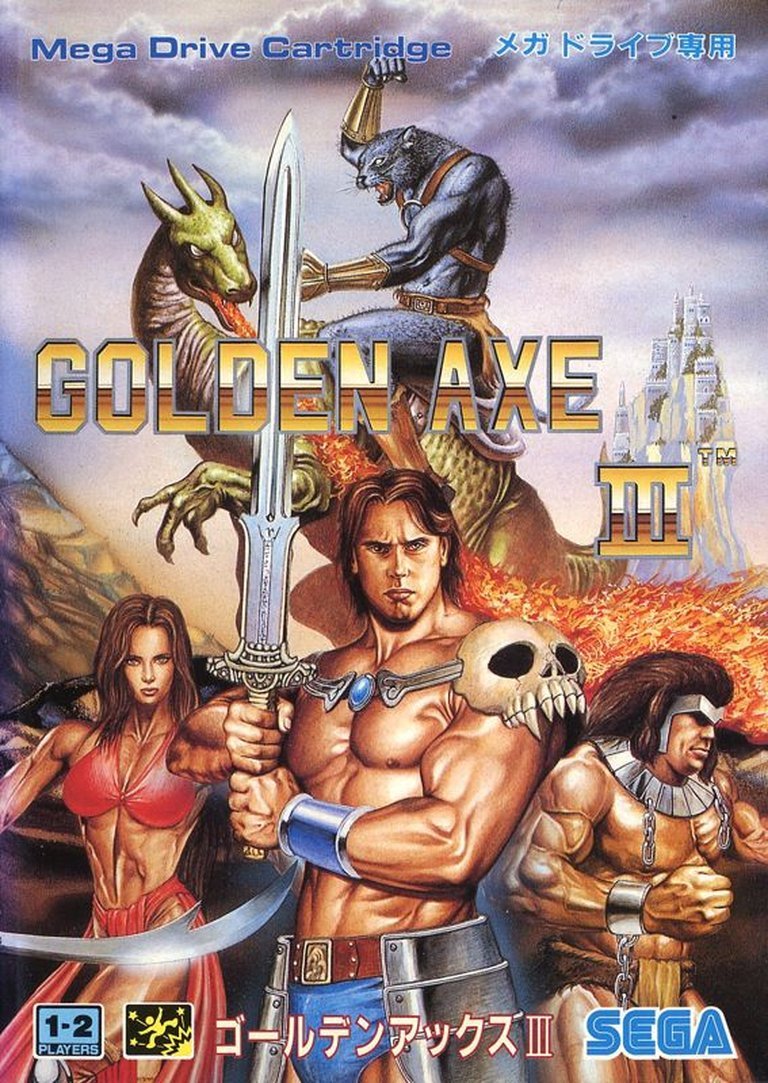
Golden Axe III is a fantasy beat ’em up set in a medieval realm where players control heroes, including returning warriors Kain Grinder and Sahra Burn alongside new allies Chronos Raid and Proud Cragger, on a quest to defeat Damud Hellbringer, the Prince of Darkness. He has stolen the Golden Axe and cursed the land’s warriors, but one hero, freed from the curse, must journey to lift the curse from others, vanquish villains, and restore the Golden Axe to save the kingdom through hack ‘n’ slash combat with path choices and unique magic spells.
Gameplay Videos
Golden Axe III Free Download
Genesis
Golden Axe III Patches & Updates
Golden Axe III Mods
Golden Axe III Guides & Walkthroughs
Golden Axe III Reviews & Reception
imdb.com (80/100): Golden Axe 3 is one of those projects that leave fond memories of the 16-bit era of gaming.
ign.com (50/100): A game you almost certainly missed in its first appearance, though you didn’t miss much.
Golden Axe III Cheats & Codes
Sega Genesis
| Code | Effect |
|---|---|
| A, A, A, A, Start, C, C, C, C, C, C | Level select |
| Up, C, Up, C, Up, C, C, C, B, A, Left, Down | Secret Message |
| Up, Down, Left, Right, Up, Down, Left, Right, Up, Down, Left, Right, Up, Down, Left, Right, Up, Down, Left, Right, A, B, C, A, B, C, A, B, C, A, B, C, A, B, C | SEGA License Screen |
| PAHA-AETE | 1 Hit Kills Enemy |
| ATHA-AA2E | 1 Hit/Use Magic Kill All Enemies/Bosses |
| AX6A-AA76 | 1 Hit/Use Magic Kill All Enemies/Bosses |
| ATHA-AA5Y | 1 Hit/Use Magic Kill All Enemies/Bosses |
| B55A-AA2N | Always Do Level 3 Magic |
| CX4T-AA8W | Always Do Level 4 Magic |
| RFRA-C6X6 | Enable Level Select |
| FFF18B:0001 | Enable Level Select |
| FFC8E2:0004 | Always Have 4 Rescued Allies (Player 1) |
| FFCA42:0004 | Always Have 4 Rescued Allies (Player 2) |
| FA3T-GAC4 | Bird Can’t Block |
| DT6T-AA2R | Control Enemies (Alternate) |
| GT6T-AA3W | Control Enemies (Alternate) |
| AA6T-AADL | Control Enemies (Alternate) |
| RY6T-A6TR | Control Enemies |
| RE4A-A6XR | Dinosaurs Never Escapes When Get Hit |
| FFD024:0000 | Dinosaurs Never Escapes When Get Hit |
| FA4A-AYTL | Dinosaurs Never Escapes When Sleeping |
| FFD022:013B | Dinosaurs Never Escapes When Sleeping |
| AM5A-AA5Y | Dont Loose Mp After Casting Super Magic |
| AM5A-AA56 | Dont Loose Mp After Casting Super Magic |
| FEFA-BNVA | Each Magic Pick-Up (Vial) Is Worth 3 |
| B1TT-AYD0 | Go To Cursed City After Ride The Whirlwind |
| BXTT-ATDY | Go To Death Mountain After A Voyage To Castle |
| A9TT-AJDT | Go To Dim Jungle After Cave Of Crystal |
| ASTT-AFDP | Go To Tender Hamlet After Ancient Mound |
| BLJA-AA2T | Guards Drop Meat |
| ALJA-AA3A | Guards Drop Meat |
| REHT-A618 | Hit Anywhere |
| FFC77C:0005 | Infinite Credits |
| AKKA-AAF2 | Infinite Double Jump For Sara Baan And Kuronosu Reito |
| FFC8E6:0033 | Infinite Energy |
| FFCA46:0033 | Infinite Health (Player 2) |
| FFC8E0:0002 | Infinite Lives (Player 1) |
| FFCA40:0002 | Infinite Lives (Player 2) |
| FFC84C:00FF | Invincibility |
| FFC9AC:00FF | Invincibility |
| DBFT-AA72 | Jump in Midair |
| AA5T-GGHR | Kain Gurindaa Walks Faster Horizontally |
| AA5T-GGHT | Kain Gurindaa Walks Faster Vertically |
| FA4T-GAF2 | Knights Can’t Block |
| BT7T-CA9E | Region Bypass (1 of 2) |
| AA7T-CA9R | Region Bypass (2 of 2) |
| AJHA-AA5Y | Infinite Health |
| BHWA-AABC | Start with 9 lives instead of 2 |
| AKYT-AA54 | Infinite Lives |
| ASWA-AAD8 | start each life with more magic |
| A5WA-AAD8 | start each life with full magic |
| AM5A-AA44 | Infinite Magic |
| FFC8E2:04 | Always have four rescued allies (Player 1) |
| FFCA42:04 | Always have four rescued allies (Player 2) |
| FFC77C:05 | Infinite Continues |
| FFC8E6:33 | Infinite health (Player 1) |
| FFCA46:33 | Infinite Health (Player 2) |
| FFC8E0:02 | Infinite Lives (Player 1) |
| FFCA40:02 | Infinite Lives (Player 2) |
| FFC84C:80 | Invincibility (Player 1) |
| FFC9AC:80 | Invincibility (Player 2) |
Nintendo Wii
| Code | Effect |
|---|---|
| A, A, A, A, Start, C, C, C, C, C, C | Level Select |
| Up, C, Up, C, Up, C, C, C, B, A, Left, Down | Secret Message |
| forward, up, back, down, forward, C+B | Special attack 2 |
PC
| Code | Effect |
|---|---|
| A, A, A, A, Start, C, C, C, C, C, C | Level select |
| Up, C, Up, C, Up, C, C, C, B, A, Left, Down | Secret Message |
Golden Axe III: A Flawed but Ambitious Finale to Sega’s Medieval Mayhem
Introduction: The Black Sheep of a Beloved Series
In the pantheon of 16-bit beat ’em ups, Sega’s Golden Axe trilogy holds a unique, if uneven, position. The arcade original was a genre Defining spectacle, Golden Axe II a competent but conservative sequel, and Golden Axe III—the series’ swan song on the Sega Genesis—arrived in 1993 as a game shrouded in obscurity and controversy. Never released in American stores, only available via the limited Sega Channel service, and consistently panned by mainstream Western critics while defended by a fiercely loyal niche audience, Golden Axe III is a paradox. It is simultaneously regarded as the franchise’s nadir and its creative peak. This review will argue that Golden Axe III is a profoundly ambitious, mechanically rich, but visually compromised entry that represents a critical juncture: a team straining against hardware limitations to evolve a classic formula, ultimately producing a game that is more than the sum of its widely criticized parts. Its legacy is not one of industry-changing innovation, but of passionate, if flawed, iteration.
Development History & Context: The Genesis of a Cult Oddity
The Studio and the Vision: Developed in-house by Sega Enterprises Ltd., Golden Axe III was crafted by a team including key planners Kazuma “Fuzzy” Fujii and Takashi “Iiz” Iizuka, with music by the esteemed Naofumi Hataya and Tatsuyuki Maeda. Following the release of the arcade-based Golden Axe: The Revenge of Death Adder (1992) and the domestically-focused Golden Axe II (1991), this final Genesis entry was poised to synthesize the series’ arcade grandeur with deeper home console mechanics. The team’s vision, as gleaned from game mechanics, was to expand the tactical canvas of the brawler—adding character diversity, branching paths, and a vastly enriched moveset—while recapturing the “mischievous” spirit of the original via the return of the gnome-thieving interludes.
Technological Constraints and the Geneforlated Landscape: The Sega Genesis, while powerful, was entering the twilight of its lifecycle by 1993. Developers were acutely aware of its color palette limitations (64 on-screen, 512 total) and sprite scaling restrictions. This context is essential for understanding the game’s most consistent criticism: its graphics. Compared to the lush, detailed sprites and vibrant backgrounds of Streets of Rage II (1992), Golden Axe III often appears sparse, with washed-out palettes and simpler stage designs. The team appears to have prioritized sprite size and animation fluidity for the playable characters (each with distinct move animations) at the expense of background richness, a trade-off that defines its visual identity. The gaming landscape was also shifting; while beat ’em ups remained popular, the genre was being eclipsed by fighting games and emerging 3D adventures. Golden Axe III was a last, earnest stand for the side-scrolling fantasy brawler.
The Great American Absence: The most infamous chapter in the game’s history is its cancellation in North America. Planned for a cartridge release, it was instead exclusively distributed via the Sega Channel modem service in 1995. The consensus, fueled by contemporary magazines like Electronic Gaming Monthly, was that Sega of America deemed the product unfit for retail, citing “plain” graphics and a lack of advancement. This decision cemented the game’s cult, import-only status and created a mythology of “what could have been,” a shadow that still hangs over its reception.
Narrative & Thematic Deep Dive: A Curse of Repetition with a Twist
Plot Deconstruction: The narrative, typical for the series, is a vessel for gameplay. The villain is Damud Hellbringer (sometimes “Hellstrike”), the “Prince of Darkness,” who has stolen the Golden Axe, kidnapped Princess Yuria, transformed the King into the griffin-like minion Eve, and placed an evil curse upon the land’s warriors. The twist: Gilius Thunderhead, the dwarf from the original, returns not as a fighter but as a quest-giver, having broken the curse on the player’s chosen hero (or heroes, in co-op). The quest is a linear progression through a branching map to defeat Hellbringer and rescue the princess.
Character Redesigns and Thematic Resonance: Thematically, the game explores possession, redemption, and the burden of legacy. The core heroes of the first two games return under new, slightly altered names—Ax Battler becomes the swordsman Kain Grinder, Tyris Flare becomes Sahra Burn—while two new replacements join the roster: Chronos Raid, an agile panther warrior, and Proud Cragger, a lumbering giant. This shift is significant. The original trio (barbarian, amazon, dwarf) represented classic fantasy archetypes. Their replacements lean into more exotic, almost monstrous physiques (panther, giant), subtly emphasizing a world where “hero” is a fractured concept amidst a curse. Gilius’s removal from playable status reinforces the theme of a passing torch; the old guard can only guide, not fight.
Dialogue and Cutscenes: The sparse cutscenes and minimal dialogue (all in English, even on the Japanese cartridge) serve their purpose efficiently. The story is told through introductory text, brief character selects, and a final confrontation with Eve and Hellbringer. The lack of deep narrative is a conscious design choice common to the genre, keeping focus on the action. The “good ending,” requiring a high score to unlock a second form for Hellbringer and a more conclusive castle collapse, adds a faint layer of replay-driven narrative completionism.
Gameplay Mechanics & Systems: Evolution or Regression?
Core Loop and Combat Engine: At its heart, Golden Axe III is a side-scrolling beat ’em up. Players traverse stages, defeating waves of enemies with melee attacks, magic, or mounted Bizarrian creatures. The fundamental loop is satisfying: approach, attack, dodge, repeat. Where the game distinguishes itself is in the sheer density of its move set, a direct response to competitors like Streets of Rage.
Expanded Moveset and Character Diversity: This is the game’s strongest pillar. Each of the four characters has a unique feel, bolstered by exclusive moves:
* Proud Cragger (Giant): Slow, powerful, with an devastating airslam throw. His special move is a ground-shaking stomp.
* Chronos Raid (Panther): Fast, agile, with double-jump and wall-jump capabilities. His super move is an unstoppable screen-crossing lunge.
* Kain Grinder (Swordsman): A balanced all-rounder. His special moves include a multi-hit spin attack.
* Sahra Burn (Amazon): Also balanced, with a fire-based magic spell that scales from fireball to dragon.
All characters gain: a dedicated block (Back + Attack), a low sweep to trip enemies, multiple jump attacks, and an updated grappling system with two distinct throws. The inclusion of projectile attacks (like Kain’s sword beam) adds a crucial ranged option missing from earlier entries.
Branching Paths and Replayability: A major systemic addition is the junction system. At the end of most stages, players choose between two divergent paths (A & B), leading to different subsequent levels, enemy configurations, and boss encounters. Some paths feature easier enemies but fewer items (magic potions, food, hostages to rescue for extra lives), while others are harder but more rewarding. This non-linearity, reminiscent of The Revenge of Death Adder, significantly boosts replay value, encouraging players to see all routes and the different “cursed hero” boss fights that await on certain paths.
Magic System and Cooperative Play: The magic system reverts to the original’s “all-or-nothing” mechanic—collecting potions increases the power of a single, full-capacity cast. This was a step back from GA II‘s chargeable, doseable magic, a point of contention among fans. Co-op is enhanced with team attacks (a “human slingshot” move) and a powerful combined magic spell activated when both players cast simultaneously with 10+ shared potions. These features foster coordination, a notable improvement.
Flaws and Exploits: The expansion comes at a cost. The move complexity taxes the Genesis’ three-button controller, making some inputs (like the full-circle backward + Jump + Attack for a ranged strike) clumsy. Some special moves are wildly unbalanced; Chronos’s lunge is nearly unblockable, allowing for easy exploitation. Enemy AI, while improved (no longer walking off cliffs, some use shields), is not calibrated for the new move pool, leading to repetitive, exploitable strategies against bosses. The magic system’s lack of granularity makes hoarding potions pointless, discouraging strategic resource management.
World-Building, Art & Sound: A Tale of Two Aesthetics
Visual Direction and sprite Work: The game’s aesthetic is its most divisive element. The playable character sprites are a high point: large, detailed, and with noticeably more animation frames than in GA II, lending them a satisfying weight and fluidity. The magic spells are spectacularly animated, with each character’s element (fire, lightning, etc.) having unique, colorful effects that scale impressively with power level.
Conversely, the backgrounds and enemy sprites are frequently criticized as “bland,” “washed-out,” or “generic.” Stages like “Tender Hamlet” and “Bloody Street” are cited as particularly uninspired, lacking the atmospheric depth of the original’s forest or desert stages or the gothic flair of Revenge of Death Adder. The color palette seems constrained, and enemy variety is low—a handful of base models (spearman, club soldier, etc.) repeated with palette swaps. This stark contrast between detailed heroes and simple environments creates a visual dissonance that undermines the fantasy world’s immersive potential.
Sound Design and Musical Score: This is the game’s most universally praised aspect. The soundtrack, composed by Hataya, Maeda, and Oguro, is considered the best in the series. Tracks like the ominous “The Gate of Fate” boss theme or the adventurous “Ride the Whirlwind” are not only memorable but actively enhance the atmosphere, blending heroic melodies with tense, rhythmic drive perfectly suited to the Genesis’ FM synthesis capabilities. Sound effects are crisp and satisfying—the clang of weapons, the explosion of magic, and the distinctive crunch of breaking barrels (a fan-favorite detail) are all exceptionally well-realized. In an era where Genesis soundtracks were often dismissed as inferior to SNES, Golden Axe III stands as a formidable counter-argument.
Reception & Legacy: The Cult of the “Lost” Gem
Critical Reception at Launch: The critical response was overwhelmingly mixed-to-negative, particularly in the West where the game was an obscure import. Aggregators show a score of ~60%. Reviews were polarized:
* The Harsh Pan: Publications like Computer and Video Games and Sega-16 savaged the graphics as a “downgrade,” calling it “mechanically decent but lacking in pace and care,” and “an inferior clone” of its predecessors. IGN’s retrospective review called it “the worst of its franchise trilogy,” citing a lack of advancement and the removal of GA II‘s magic system.
* The Qualified Praise: European magazines like Sega Force (76%) and Video Games (74%) acknowledged its expanded moveset and branching paths, calling it “the best of the series on Megadrive” despite noting it was “too easy” or visually uneven. SEGA-Mag (7/10) explicitly stated it was “more abouti than its two great brothers.”
Player Reception and Cult Status: Player scores tell a different story. On MobyGames, user reviews average 3.7/5 (significantly higher than the critic average), with multiple five-star reviews hailing it as “the best of the series.” Players consistently praise the fluid controls, character diversity, branching paths, and phenomenal soundtrack, glossing over the graphical shortcomings as a trade-off for deeper mechanics. This disconnect suggests the game found its true audience: dedicated fans willing to look past technical flaws for a richer gameplay experience. Its status as an unobtainable US cartridge only fueled this cult fascination.
Legacy and Influence: Golden Axe III had negligible direct influence on the industry. The beat ’em up genre was waning, and Sega itself moved on from the series with the poorly received Golden Axe: The Duel (1994) and later attempts. However, its legacy is as a case study in ambitious iteration. The character-specific movesets and branching path design were concepts more fully realized in later action-RPGs and brawlers. Its most lasting impact is within the series’ own canon—for many retro enthusiasts, it represents the creative apex of the classic Golden Axe formula, a “what if” scenario where Sega of America’s supposed quality concerns denied Western players a technically imperfect but mechanically rich title. Its inclusion in later compilations (Sega Genesis Collection, Sonic’s Ultimate Genesis Collection) finally gave it a proper, if belated, worldwide audience, allowing reappraisal and burning its cult status into retro gaming lore.
Conclusion: The Undiscovered Country of a Fantastical Trash Heap
Golden Axe III is not a great game by any conventional metric. Its graphics are often drab, its enemy variety thin, its design choices sometimes baffling (the magic system regression), and its balance easily broken. It is, in the parlance of its genre, a “budget title” in spirit if not in price.
Yet, to dismiss it solely on these points is to miss its substantial, hard-won virtues. It possesses the most sophisticated combat system in the trilogy, with a breadth of moves that reward player agency and mastery. Its branching path structure was genuinely innovative for a Genesis brawler, offering a semblance of world exploration. Its soundtrack is a masterpiece of 16-bit composition, one of the console’s finest. And its four distinct characters, each with unique mechanics, create a foundation for varied play that its predecessors lack.
This is the game’s ultimate paradox: it is both the series’ technical decline and its mechanical zenith. It represents a team trying to do more—more moves, more paths, more characters—while wrestling with a hardware ecosystem that was no longer yielding easy beauty. The result is a game that feels ambitious and unfinished in equal measure. For the historian, it is a fascinating document of a franchise trying to evolve before its genre expired. For the player, it is a deeply playable, if flawed, brawler that delivers a specific, satisfying kind of medieval mayhem.
Final Verdict: Golden Axe III does not deserve the title of “classic” in the way its arcade predecessor does. But it absolutely earns the title of “essential” for any serious student of the Sega Genesis library or the beat ’em up genre’s evolution. It is a flawed, fascinating, and fun artifact—a game whose sum is greater than its parts, and a testament to the fact that sometimes, the most compelling history is written by the projects that got away. Its place in history is not as a pinnacle, but as a poignant, ambitious, and deeply human last stand.