
- Release Year: 2023
- Platforms: PlayStation 5, Windows, Xbox Series
- Publisher: Team17 Digital Limited
- Genre: Special edition
- Average Score: 57/100
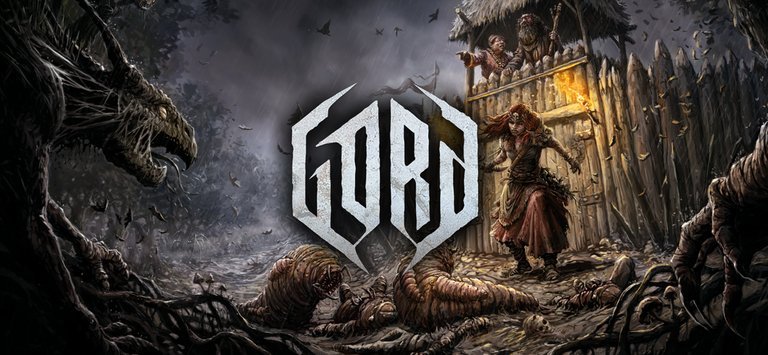
Description
Gord (Deluxe Edition) is a dark fantasy strategy game combining real-time strategy, city-building, and role-playing elements. Set in a haunted forest inspired by Slavic mythology, players manage a fortified settlement (gord) under constant monster threat. The Deluxe Edition includes the base game, ‘Hold Your Ground’ DLC, digital artbook, original soundtrack, and Chronicle eBook/audiobook. Gameplay involves expanding within limited space, managing resources, and balancing villagers’ health, sanity, and faith during combat and quests.
Where to Buy Gord (Deluxe Edition)
PC
Gord (Deluxe Edition) Cracks & Fixes
Gord (Deluxe Edition) Mods
Gord (Deluxe Edition) Guides & Walkthroughs
Gord (Deluxe Edition) Reviews & Reception
metacritic.com (59/100): Gord interprets the construction genre differently. It relies on story instead of complexity, with all the strengths and weaknesses that entails.
ign.com (40/100): Gord is, in its most outstanding moments, a mediocre colony sim/RTS/RPG hybrid. The rest is just boring.
mobygames.com (66/100): Lead the people of the Tribe of the Dawn as they venture deep into forbidden lands. Complete quests that shape their personalities, impact their wellbeing, and decide the fate of their community.
opencritic.com (64/100): Gord is a richer and more complex game than it first appears. There are interesting layers of moral ambiguity and mental health to consider.
Gord (Deluxe Edition): Review
1. Introduction
In the shadowed corners of video game history, few settings evoke the primal dread of Slavic folklore—a realm where ancient deities whisper from gnarled trees, and sanity frays like tattered cloth. Gord (Deluxe Edition) arrives as a testament to this untapped wellspring of terror, plunging players into a world where survival hinges on balancing the macabre with the mundane. Developed by Polish studio Covenant.dev and published by Team17, this ambitious blend of city-building, real-time strategy (RTS), and role-playing elements promises a harrowing journey through a sunless, monster-plagued wilderness. Yet, despite its compelling foundation, Gord ultimately emerges as a cautionary tale: a game of striking atmosphere undone by systemic flaws. This review dissects Gord as a landmark of dark fantasy world-building and a cautionary study in unfulfilled potential, arguing that while its Slavic-infused terror and narrative ambition leave indelible marks, its gameplay execution collapses under the weight of its own complexity.
2. Development History & Context
Covenant.dev, a studio founded by former The Witcher 3 developer Stan Just, conceived Gord as a love letter to Eastern European mythology. Just’s vision was explicit: to craft a strategy game where horror wasn’t merely aesthetic but systemic, weaving Slavic folklore into every facet of gameplay. The team leveraged Unreal Engine 4 to achieve a gritty, photorealistic aesthetic, a technological choice that allowed for dense, oppressive environments but strained performance on consoles. Released on August 17, 2023, Gord arrived during a crowded strategy genre landscape dominated by polished titles like Northgard and They Are Billions. While the city-builder revival was in full swing, Gord dared to differentiate itself with a darker, thematically richer approach. Team17, known for publishing indie darlings like Overcooked and Hollow Knight, positioned the Deluxe Edition—bundling the base game, the Hold Your Ground DLC, an artbook, soundtrack, and a mythology ebook—as a definitive experience for hardcore strategy fans. However, the release was marred by technical hiccups, particularly on consoles, where the UI and frame rates struggled with the game’s real-time demands.
3. Narrative & Thematic Deep Dive
Gord’s narrative unfolds in a world where the sun is dead, and humanity clings to existence in fortified settlements called “gords.” Players assume the role of a southern kingdom’s emissary tasked with forging alliances with northern tribes, only to discover a land consumed by ancient horrors and moral rot. The story’s strength lies in its Slavic-inspired cosmology: the “Chronicle,” a lore compendition, weaves real-world myths (e.g., rusalki water spirits, zmey dragons) into a tapestry of dead gods and warring factions. Quests demand agonizing choices—sacrificing children to placate a Horror or trading sanity for forbidden knowledge—but these decisions lack consequence, reducing moral dilemmas to binary, regrettable chores. Characters are archetypes: the weary chieftain, the fanatical priest, the traumatized villager. Their dialogue, conveyed via a text-heavy journal system and sporadic voice acting, leans into pseudo-archaic prose that feels stilted rather than immersive. The overarching plot—predicting a kingdom’s conquest of the north—fails to escalate beyond grim fatalism, leaving the narrative’s rich potential unrealized. Yet thematically, Gord excels: it interrogates the cost of survival, the fragility of faith, and the cyclical nature of oppression, mirroring real-world historical tragedies of cultural subjugation.
4. Gameplay Mechanics & Systems
At its core, Gord demands players balance three interwoven systems: settlement management, RTS combat, and RPG progression. Each villager’s survival hinges on three meters—health, sanity, and faith—a mechanic that initially feels innovative but devolves into tedious micromanagement. Sanity depletes as villagers stray from the gord or witness horrors, driving them to flee or sabotage efforts; health is managed via mead and bandages; faith fuels spells but wanes with moral compromises. The settlement-building loop, constrained by limited palisade space, forces strategic choices (e.g., prioritize hunters or fishermen), but later wall expansions nullify this tension. Resource management is shallow, with only five resources (wood, food, gold, reeds, faith) and repetitive build orders dominating scenarios. Combat, controlled like an RTS, relies on unit positioning (axes for melee, bows for range) but lacks depth—monsters behave predictably, and battles devolve into attrition unless bolstered by generic spells. The UI is a critical flaw: a three-page character sheet per villager bloats menus, and inventory swapping requires excessive navigation. Procedurally generated maps offer replayability, but scenarios feel homogenous, lasting 90 minutes each with negligible variation. While personality quirks (e.g., “afraid of plants”) hint at emergent storytelling, they’re rarely impactful, reducing villagers to interchangeable cogs in a grim machine.
5. World-Building, Art & Sound
Gord’s world is its masterpiece. The northern wilderness is a character unto itself: swamps choked with skeletal trees, mist-shrouded forests, and ruins whispering of forgotten gods. The art direction, led by Tomasz Larek, marries realism with grotesquerie—monsters like the multi-limbed Leshy or the serpentine Žmij are visceral, their designs rooted in folklore. Environments are oppressive, with a monochromatic palette punctuated by gore and fungal blooms that underscore decay. Sound design, composed by Arkadiusz Reikowski, amplifies dread: creaking wood, distant wails, and the crunch of bone underfoot create an immersive soundscape. The soundtrack blends Slavic folk melodies with industrial dissonance, evoking both sorrow and terror. Yet, this artistry is undermined by technical execution. Cluttered visuals obscure vital UI elements, and camera angles in forests force tedious rotations to see past dense foliage. The Deluxe Edition’s extras—the artbook and soundtrack—highlight the team’s passion, but in-game, the atmosphere struggles to compensate for gameplay frustrations. When winter blankets the land in snow, the game’s bleak beauty briefly shines, but these moments are too rare to sustain the experience.
6. Reception & Legacy
Upon release, Gord received mixed-to-poor reviews, with Metacritic scores of 59 (PC) and 74 (PS5). Critics lambasted its execution: IGN awarded a scathing 4/10, calling it “as miserable as its downtrodden villagers,” citing “monotonous micromanagement” and a “poor interface.” PC Gamer (48/100) deemed it a “middling blend,” while Rock Paper Shotgun lamented its failure to master any genre. GamesRadar+ (3/5) praised the atmosphere but flagged repetition. Conversely, some outlets lauded its ambition—COGconnected (82/100) celebrated its “moral ambiguity,” and Polish media highlighted its cultural authenticity. Commercially, Gord underperformed, overshadowed by genre titans. Its legacy is thus bifurcated: it’s remembered for its atmospheric world-building and Slavic innovation, yet criticized as a case study in design overreach. The Hold Your Ground DLC added narrative depth, but couldn’t salvage the core experience. In strategy gaming, Gord stands as a cautionary example: a game that dared to be grim but faltered in execution. It influenced few directly, but its niche following celebrates it as a flawed but fascinating artifact of dark fantasy.
7. Conclusion
Gord (Deluxe Edition) is a paradox—a game of haunting beauty and profound frustration. Its Slavic-inspired world, rich with mythological terror and moral complexity, elevates it beyond a mere strategy title. Yet, this potential is shackled by systemic shortcomings: the sanity system devolves into a chore, combat lacks depth, and the UI actively fights against the player. Covenant.dev’s vision of a “Darkest Dungeon for colony sims” remains unrealized, as Gord’s grim tone never translates into compelling gameplay. The Deluxe Edition’s extras artbook and soundtrack underscore the passion behind the project, but they can’t salvage the core experience. Ultimately, Gord is a footnote in video game history—a valiant, flawed attempt at blending horror and strategy that will resonate with a niche audience but fails to dethrone genre giants. For all its ambition, it’s a gord built on shifting sands: a testament to atmosphere’s power, but a reminder that a beautiful world is meaningless without solid foundations. Verdict: A compelling failure—worth exploring for its world, but not its gameplay.