
- Release Year: 2020
- Platforms: Android, iPad, iPhone, Nintendo Switch, PlayStation 4, PlayStation 5, Windows
- Publisher: Aether Sky OÜ, Coconut Island Games, Maximum Entertainment AB, Mixed Realms Pte Ltd, Modus Games, LLC
- Developer: Mixed Realms Pte Ltd, Swag Soft Holdings Pte Ltd
- Genre: Role-playing
- Perspective: Side view
- Game Mode: Online Co-op, Single-player
- Gameplay: Cards, Deck-building, Roguelite, Tactical grid combat, Tiles, Turn-based
- Setting: Fantasy
- Average Score: 78/100
Description
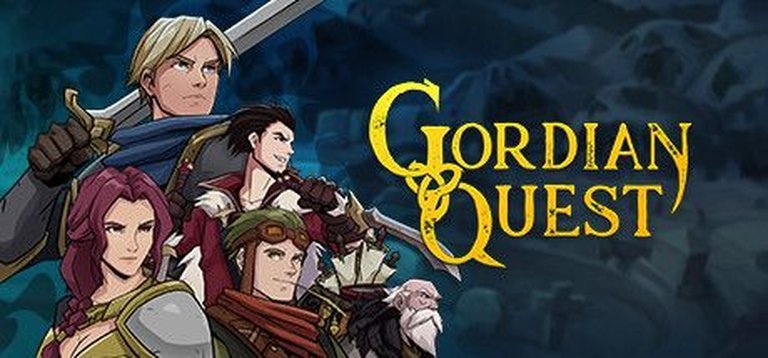
Gordian Quest is a tactical fantasy RPG that blends deck-building mechanics with classic pen-and-paper RPG elements like character classes, stats, and skill trees. Players explore a 2D side-scrolling world, engaging in turn-based combat on grid-based maps where cards represent attacks, abilities, and items, all wrapped in a rich fantasy narrative inspired by Dungeons & Dragons-style progression.
Gameplay Videos
Where to Buy Gordian Quest
Gordian Quest Free Download
Gordian Quest Mods
Gordian Quest Guides & Walkthroughs
Gordian Quest Reviews & Reception
opencritic.com (50/100): It’s deeply disappointing to play Gordian Quest and encounter the amount of UI-driven issues that permeate its menus, because it has some really cool stuff going on beneath its bristly, frustrating outer shell.
metacritic.com (95/100): Gordian Quest is a trio of genres that show what a good and balanced game looks like.
store.steampowered.com (90/100): Gordian Quest is a rare gem of an RPG that somehow manages to blend multiple genres into one game without making anything feel unwieldy.
Gordian Quest Cheats & Codes
PC
Press tilde key in-game to open developer console and enter commands.
| Code | Effect |
|---|---|
| setdaysleft | |
| fullparty | |
| passturn | |
| addcard | |
| ac | |
| addcampcard | |
| acc | |
| addtodeck | |
| listinventory | |
| listdeck | |
| removefrockdeck | |
| addquest | |
| removequest | |
| addtalent | |
| setconsumable | |
| hideui | |
| showui | |
| addgold | |
| setgold | |
| sethp | |
| addstatus | |
| setfate | |
| addfate | |
| addsupplies | |
| setsupplies | |
| act1_breachinthewall | |
| act1_moorsandvalewoods | |
| nextmap | |
| prevmap | |
| camp | |
| shrine | |
| testevent | |
| testreward | |
| additems | |
| ais | |
| addskillgrid | |
| rest | |
| restock | |
| additem | |
| ai | |
| addmagic | |
| addrare | |
| addunit | |
| clear | |
| fight | |
| town | |
| unlockallvendors | |
| clearall | |
| createportal | |
| clearnode | |
| clearpath | |
| cleartotier | |
| idall | |
| togglecodex | |
| acceptquests | |
| clearquests | |
| rerollworld | |
| win | |
| wincampaign | |
| losecampaign |
Gordian Quest: A Monumental Hybrid in the Deckbuilder Pantheon
Introduction: The Gordian Knot, Reimagined
In the crowded landscape of post-Slay the Spire deckbuilders, where every new release promises to “revolutionize” the genre, Gordian Quest emerges not as a disruptor, but as a monumental consolidation. It is a game that looks backward with profound reverence to the isometric RPGs of the 1980s and 90s—specifically the gauntlet-running ethos of Ultima and the tactical dice-driven storytelling of Dungeons & Dragons—while looking forward with the modern, compulsive loops of roguelite deckbuilding. The result is not a seamless fusion, but a deliberate, often sprawling, marriage of two design philosophies. This review argues that Gordian Quest’s legacy will be defined by its audacious scope and its role as the most extensive, mechanically rich “RPG-first” deckbuilder ever attempted, even as its narrative and accessibility shortcomings prevent it from achieving true genre-defining status. It is a game that solves some of the medium’s deepest strategic problems while creating a unique set of its own, a true Gordian Knot of design that players must cut through with blade, spell, and card.
Development History & Context: A Three-Year Odyssey from Singapore
Gordian Quest is the brainchild of Mixed Realms Pte Ltd, a Singapore-based indie studio, in collaboration with Swag Soft Holdings Pte Ltd. The development story is intrinsically linked to the global pandemic. As detailed in a Screen Rant interview with the team (CEO Aldric Chang, Game Lead Chalit Noonchoo, Creative Director Edi Torres), production began in late 2019, with an Early Access launch in March 2020—just as COVID-19 lockdowns began. This forced a fully remote work environment for a project where “teamwork was crucial,” extending the development cycle to nearly three years before its full 1.0 release on June 23, 2022.
The studio’s vision was explicit: to create an “RPG game before it is a deckbuilder.” They cite the classic party-based computer RPGs (Ultima, Wizardry) and the action RPG looter Diablo/Path of Exile as primary inspirations, aiming to inject the deep character building, skill tree progression, and loot variety of those games into a deckbuilding framework. The dice-rolling and narrative choice mechanics of D&D were also foundational. This context is critical; Gordian Quest was not conceived in a vacuum reacting to Slay the Spire (2019) or Monster Train (2020), but as a modern reinterpretation of a much older RPG lineage. The technological constraint was Unity, which powered both the 2D side-view art and the complex grid-based tactical systems. The game’s journey through Early Access was a conscious choice to iteratively balance this immense mechanical complexity based on player feedback—a process the developers committed to even after launch, with plans for controller support and further content.
Narrative & Thematic Deep Dive: The Curse of Consequence
The narrative of Gordian Quest is its most frequently criticized element, and the criticism is largely merited. Set in the high-fantasy world of Wrendia (formerly Brendia), the plot follows a classic “save the world” structure: a cataclysmic event known as the “Rift” is consuming the land, and a party of heroes must journey through four distinct Acts (Westmire, Azul Desert, Faded Peak, Sky Imperium) to confront the source of the curse.
Plot Architecture: The story is told through a combination of text-driven quests, NPC interactions in town hubs, and branching event choices on the world map. These choices often involve a dice roll based on a hero’s Strength, Agility, or Intelligence stat, directly tying character progression to narrative outcomes—a clear nod to tabletop RPGs. However, as multiple critics (from Beta Network, Screen Rant, and Gamer Journalist) note, the story is “basic,” “formulaic,” and “uninspiring.” Character motivations are superficial, and the overarching plot lacks the depth or twists to make the journey memorable beyond its mechanical purpose.
Themes and Missed Opportunities: The game touches upon themes of arrogance and divine punishment (the ancient Banai civilization), redemption, and heroic Bonds (with a hinted-at but underdeveloped relationship system planned for the full release). The lore, as parsed from the NamuWiki and official descriptions, suggests a rich history, but it is rarely woven organically into gameplay. The “Relationship System” mentioned in the Steam store description—where bonds of friendship or rivalry could unlock combo abilities—was a planned feature that never materialized in the 1.0 launch, leaving a significant thematic and mechanical hole. The narrative primarily serves as a scaffolding for progression, a means to gate new areas, heroes, and map gimmicks. It is the game’s weakest link, a conventional fantasy tale that fails to leverage its own D&D-inspired event system to create meaningful, persistent consequences or character-driven drama.
Gameplay Mechanics & Systems: The Apotheosis of Tactical Deckbuilding
Here, Gordian Quest achieves its masterpiece. It transcends the “Slay the Spire clone” label through a succession of layered, interlocking systems that create a uniquely deep and customizable tactical RPG.
Core Loop & Progression: Players lead a party of three heroes from a roster of ten (Lucius, Catherine, Bertram, Alphonse, Pierre, Aida, Naran, Kudo, Zendaya, Stroud). The game is structured around a Campaign Mode (4 Acts), an Endless “Realm Mode” (roguelite), an Adventure Mode, and a Skirmish PvP mode. Progression occurs via a meta-cache system in Campaign, allowing item carryover, and through hero-specific skill grids.
The Hero Skill Grid: A Masterclass in Customization: This is the game’s central innovation. Upon leveling up, each hero gains nodes on a sprawling grid. These nodes include:
* Stat Nodes (Strength/Agility/Intelligence): The three core attributes that not only boost health but, crucially, scale specific card effects. Red cards (Strength) gain damage, Blue cards (Intelligence) may boost healing or debuff potency, etc.
* Skill Card Nodes (Levels I, II, III): The heart of deckbuilding. Here, players “draft” new cards from their class pool, choosing one of three presented options. Higher-tier nodes (II, III) offer more powerful cards. This replaces random draft rewards with a deliberate, controllable form of progression.
* Card Enhancement & Level-Up Nodes: Cards can be leveled up (improving base stats) and then strengthened (resetting level but adding powerful bonuses like extra effects, cost reduction, or synergy). Fully upgrading a III-tier card can require up to 9 nodes, creating a massive long-term investment.
* Card Deletion & Copy Nodes: Essential for deck thinning and redundancy. Deleting weak cards is as important as acquiring powerful ones.
* Talent Nodes: Passive abilities unlocked based on reaching stat thresholds (e.g., Tier 1 at 10-14 stat points). These provide crucial systemic bonuses.
This system creates an immense build space. A “Spellbinder” (Pierre) can be built as a fire (Strength) bruiser, ice (Intelligence) controller, or lightning (Agility) speedster, each with entirely different card pools and synergies. The equipment system further deepens this, with “link cards” added to a hero’s deck when certain gear is equipped, creating direct gear-to-deck synergies.
Combat: Positioning, Resources, and Synergy: Battles occur on a 2D grid (2-4 rows x 3 columns). This spatial element is fundamental. Line-of-sight, back-row targeting, and area-of-effect spells make positioning a primary strategic concern, unlike many single-lane deckbuilders.
Resources are AP (Action Points) and SP (Skill Points).
* AP is the basic movement/action currency, refreshed each round (base 3, upgradeable).
* SP accumulates when AP cards are played or movement occurs, carrying over between rounds to fuel powerful Synergy Cards. These cards often require specific SP amounts and represent a “meter” build-up mechanic, encouraging efficient AP usage across rounds.
Card Mechanics & Keywords: The design is dense with keywords that create internal logic:
* Initiate: Reduces the cost of other cards when played first in a turn, enabling powerful “tempo” plays.
* Finish: Consumes all remaining AP to multiply damage, perfect for “clean-up” turns.
* Concentration (Spell Charge): Many spell cards require “concentration” counters applied by other cards to reach full power.
* Stealth (Alphonse): Grants bonuses when in the back row or under specific effects.
* Cache (Bertram): Places traps/turrets that grant effects when allies step on them.
* Soul Connection (Aida’s Summons): Summons take damage when the summoner is hit, creating a fragile but powerful link.
* Golem Tag (Zendaya): A separate deck used by her golem companion, Loki, who has his own HP and can be directly controlled.
Buff/Debuff Ecology: The status effect system is sophisticated. Armor is a temporary buffer consumed before HP. Prevention counters are literal invincibility frames that block attacks and first negate damage-over-time effects like Burn/Poison. Immune blocks debuff application. Bound prevents movement. This system rewards predictive play—stacking Prevention to counter an enemy’s predictable wide-area attack.
Difficulty & Modes: The game offers a spectrum of difficulty (Easy to “Persecution”) and permadeath variants (Standard, Roguelite, Roguelike). The NamuWiki details how higher difficulties increase enemy stats, traits, and loot rarity, but the core challenge often lies in deck construction and resource management rather than raw enemy damage. A common critique (from Checkpoint Gaming, God is a Geek) is that the campaign can become too easy once a powerful deck is assembled, though higher difficulties and Realm Mode mitigate this.
Flaws in the Machine: Despite its depth, the system has pain points.
1. Information Overhead: The sheer number of nodes, card types, and synergies can be overwhelming, with the tutorial system widely panned (by Gamer Journalist and Gaming Nexus) as insufficient. Players often have to consult external wikis or guides.
2. Balance Issues: Certain hero builds, like Bertram’s “Artillery Commander” turret build or Catherine’s “Executor” armor tank, are noted as exceptionally strong (NamuWiki, player guides). Some difficulty spikes feel artificial.
3. UI/UX Shortcomings: The interface, designed for mouse, suffers on console ports (Nintendo Switch reviews from Nintendo Life and Gaming Nexus are scathing about text size, menu navigation, and control schemes). The lack of a manual save function (highlighted by Gamer Journalist) is a significant flaw in a game with punishing permadeath modes and long campaigns, forcing reliance on a sometimes-flawed autosave.
World-Building, Art & Sound: A Hand-Drawn Masterpiece
If the narrative is its weakness, presentation is its undeniable strength. The art direction, led by Creative Director Edi Torres and Art Lead Kenny Ng, successfully fuses anime charm with western comic book inking. The result is a visually cohesive, highly expressive 2D side-scroller aesthetic.
- Character & environmental design is uniformly excellent, with a vibrant color palette that clearly delineates the four Acts: Act I (Westmire) uses eerie greens/blues for its undead theme; Act II (Azul Desert) employs warm yellows/oranges; Act III (Faded Peak) is monochrome white/blue for its arctic bleakness; and Act IV (Sky Imperium) introduces purples for its ancient, technological vibe (per the PC Gamer interview).
- Animations are detailed and impactful, especially for attack spells and special abilities. The card art itself is a standout, with hundreds of unique, themed illustrations that make deckbuilding visually rewarding.
- Sound design is robust, with satisfying clangs, spells, and monster roars. The dynamic soundtrack, while not revolutionary, effectively adapts to combat intensity and exploration.
- This visual and auditory commitment elevates the entire experience, making the world feel lived-in and the battles weighty. It is the primary driver of immersion, compensating for the narrative’s lack of depth. As GamingTrend stated, “Truthfully, it’s the sort of AAA artwork I’d expect out of a far larger house.”
Reception & Legacy: A Cult Classic with Strings Attached
Critical Reception: Gordian Quest holds a Metacritic score of 84 (PC) and a MobyGames average of 79% from 20 critics. The consensus is strongly positive but qualified.
* Praise: The depth of tactical combat, hero customization, replayability, and artistic presentation are universally lauded. Digital Chumps (95%) called it “one of the better gaming experiences of 2022.” Hey Poor Player hailed it as a title that “boldly blazes its own trail.”
* Criticism: The weak, perfunctory story and poor console UI (especially on Switch) are the most common negatives. The tutorials are inadequate, and the game’s length/content bloat is noted as both a strength (tons of value) and a weakness (unwieldy, repetitive, Worth Playing).
* The Switch port is particularly problematic, with scores ranging from 50% (Nintendo Life) to 80% (Pure Nintendo), mainly due to control and readability issues.
Player Reception: On Steam, it holds a “Very Positive” rating (87% of 1,796 reviews). Players echo critic praise for the deep, addictive gameplay and the feeling of building a powerful, synergistic party. The active community on Steam and the dedicated Fandom wiki (with 105+ articles) testify to its cult following and the need for external resources.
Legacy and Influence: Gordian Quest does not have the paradigm-shifting impact of Slay the Spire, but its influence is in its demonstration of scale. It proved that a deckbuilder could support the complexity and progression systems of a full-blown party-based RPG—skill grids, equipment link cards, deep class hybridization, a 4-act campaign—without collapsing under its own weight. It carved a niche for the “tactical deckbuilder RPG”, influencing a certain strain of hybrid design that prioritizes systemic depth over streamlined arcade fun. Its most direct successor in spirit is likely Monster Train 2, which itself added party-based combat and deeper progression.
Its legacy is that of a consummate craft project: a game built by passionate fans of classic RPGs for other fans, willing to sacrifice narrative elegance and user-friendly polish at the altar of mechanical depth. It is the most comprehensive “D&D simulator” in deckbuilder form, successfully translating the feel of managing a tabletop party—with all its tactical positioning, resource management, and character-building—into a digital, card-based format.
Conclusion: The Definitive Verdict
Gordian Quest is a flawed masterpiece of synthesis. It is the most ambitiously scaled and mechanically intricate fusion of deckbuilding and classic RPG to date. Its skill grid system is a revelation, offering a customizable progression path that makes each hero feel like a unique project. The grid-based tactical combat is consistently engaging, demanding forethought about positioning, AP/SP economy, and card synergy. The art and sound are top-tier, creating an immersive fantasy world that punches far above its indie budget.
However, these achievements are tethered to significant weaknesses. The story is an afterthought, serving only as a loose connector between battles. The user interface is often hostile, especially on consoles, and the tutorials fail to prepare players for the depth ahead. The campaign’s difficulty curve can flatten once a powerful deck is established, and some hero builds clearly outclass others.
Final Verdict: Gordian Quest is not for everyone. It is for the patient strategist, the tabletop veteran, the player who finds joy in poring over skill trees and optimizing card synergy for dozens of hours. It is a game whose greatest content is in its systems, not its story. For those willing to cut through its narrative knot and UI thorns, it offers one of the most rewarding and expansive strategic experiences in the deckbuilder genre. It may not be the genre’s pinnacle (Slay the Spire still holds that crown for purity), but it stands as its most ambitious, RPG-saturated monument—a testament to the idea that the deckbuilding format can, with enough meticulous design, contain the sprawling depth of a classic computer RPG. Its place in history is secured as the definitive tactical deckbuilder RPG, a dense and demanding game that asks for investment and amply repays it, even if it leaves you wishing its world had as much heart as its systems have depth.