
- Release Year: 2022
- Platforms: Windows
- Publisher: Fengu Studio
- Developer: Fengu Studio
- Genre: Sports
- Perspective: 1st-person
- Game Mode: Single-player
- Gameplay: Direct control, Motion control
- Setting: Fantasy
- Average Score: 83/100
Description
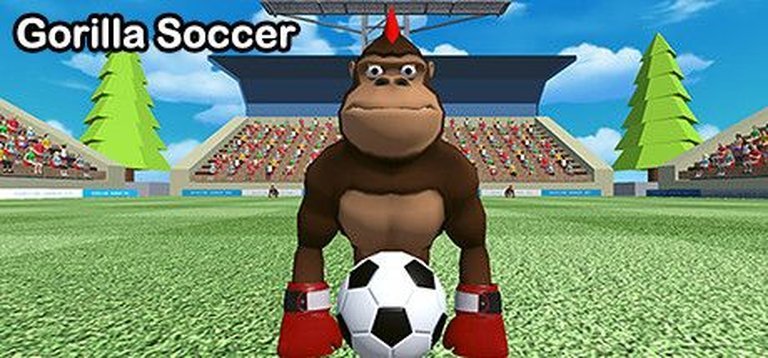
Gorilla Soccer is a unique sports game where players take on the role of gorillas competing in a fast-paced, physics-based soccer match. Inspired by the locomotion mechanics of Gorilla Tag, the game allows players to run, jump, and strike the ball using only their hands, blending VR-style movement with traditional soccer gameplay. Players can face off against AI-controlled bots or challenge other players in multiplayer matches, all within a whimsical, fantasy setting that reimagines the sport with primate athleticism.
Gameplay Videos
Gorilla Soccer Guides & Walkthroughs
Gorilla Soccer Reviews & Reception
steambase.io (74/100): Gorilla Soccer has earned a Player Score of 74 / 100.
queststoredb.com (92/100): This is an interesting VR sports competitive game. You play as a gorilla.
Gorilla Soccer: A Primal, Playful, and Problematic VR Experiment
Introduction: The Birth of a Beastly Beautiful Game
In the vast, often repetitive landscape of VR sports games, Gorilla Soccer (2022) emerges as a bizarre, brilliant, and deeply flawed experiment—a game that dares to ask: What if soccer was played by gorillas, with no feet, and only the raw, unfiltered chaos of primal motion? Developed by the obscure but ambitious Fengu Studio, this title is a love letter to the physicality of virtual reality, drawing heavy inspiration from the cult phenomenon Gorilla Tag while carving its own niche in the competitive VR space.
At its core, Gorilla Soccer is a game about movement, instinct, and absurdity. It strips away the polished trappings of traditional sports simulators, replacing them with a raw, almost uncanny experience where players must climb, swing, and punch their way to victory. Yet, for all its innovation, the game is plagued by technical woes, limited accessibility, and a lack of mainstream recognition—making it a fascinating case study in VR’s potential and pitfalls.
This review will dissect Gorilla Soccer from every angle: its development, its gameplay mechanics, its world-building (or lack thereof), its reception, and its legacy. By the end, we’ll determine whether this is a hidden gem or a missed opportunity—and what it means for the future of VR sports games.
Development History & Context: The Rise of the VR Gorilla
The Studio Behind the Swinging Simians
Fengu Studio, the developer and publisher of Gorilla Soccer, is a relatively unknown entity in the gaming industry. Unlike major VR studios like Beat Games (Beat Saber) or Stress Level Zero (Boneworks), Fengu operates in the shadows, with Gorilla Soccer being one of their few notable releases. Their previous works—such as Gorilla Kareshi (2015) and Gorilla Unko (2019)—suggest a fascination with primate-themed absurdity, but none have gained significant traction.
The studio’s obscurity raises questions: Was Gorilla Soccer a passion project? A quick cash-in on the Gorilla Tag craze? Or an earnest attempt to innovate in VR sports? Given the game’s unique locomotion system and multiplayer focus, it’s clear that Fengu Studio had ambitions beyond a simple novelty title.
The Gorilla Tag Influence & VR’s Evolution
Gorilla Soccer owes much of its identity to Gorilla Tag (2021), the breakout VR hit that popularized climbing-based movement in virtual reality. Gorilla Tag’s success proved that players were hungry for physical, intuitive VR experiences—games that didn’t rely on traditional controller schemes but instead embraced full-body motion.
Fengu Studio took this concept and applied it to soccer, a sport that, in real life, is dominated by footwork. The result? A game where players cannot kick the ball—instead, they must punch, slap, and headbutt it into the goal. This design choice is both brilliant and baffling, forcing players to rethink how soccer is played while also limiting the game’s appeal to traditional sports fans.
Technological Constraints & VR’s Growing Pains
Released on August 13, 2022, Gorilla Soccer arrived at a time when VR was still fragmented across platforms. The game was initially Oculus-exclusive, alienating players on SteamVR, Valve Index, and other headsets. This decision—likely due to development constraints or financial incentives—hurt its potential reach.
Additionally, the game suffered from technical instability, with reports of:
– Missing executables (players finding 0B files)
– Controller compatibility issues (Index and Quest 2 users struggling to play)
– SteamVR connection failures
These problems suggest that Gorilla Soccer was either rushed to market or lacked the resources for proper QA testing—a common issue for indie VR developers.
The Gaming Landscape in 2022: A Crowded VR Playground
By 2022, VR had moved beyond its early experimental phase but was still far from mainstream. Major titles like Half-Life: Alyx (2020) and Resident Evil 4 VR (2021) had proven that VR could deliver AAA experiences, while indie darlings like Blade & Sorcery and Boneworks pushed physics-based interaction.
Gorilla Soccer entered this space as a niche curiosity—a game that didn’t fit neatly into any established genre. It wasn’t a realistic sports sim (like FIFA VR), nor was it a cartoonish arcade game (like Rocket League). Instead, it occupied a strange middle ground: a competitive, physics-driven VR experiment that demanded physical skill over button-mashing.
Narrative & Thematic Deep Dive: The Absence of Story (And Why It Works)
A Game Without a Plot—And That’s Okay
Gorilla Soccer has no narrative, no characters, and no dialogue. There is no campaign mode, no lorem ipsum backstory, and no gorilla king to overthrow. The game is pure gameplay—a digital playground where the only objective is to score goals and outmaneuver opponents.
This minimalist approach is both a strength and a weakness:
✅ Strengths:
– No distractions—players focus entirely on mastery.
– Universal appeal—no language barriers or complex lore.
– Pure competition—the game thrives on skill expression.
❌ Weaknesses:
– Lack of personality—no memorable characters or world.
– No progression—no unlockables, no story beats to chase.
– Limited replayability—without a narrative hook, some players may lose interest.
Themes: Primal Play, Physicality, and Absurdity
While Gorilla Soccer lacks a traditional story, it oozes thematic personality through its gameplay and aesthetics. The core themes include:
-
Primal Movement as Gameplay
- The game rejects traditional controls in favor of gorilla-like climbing and swinging.
- Players must use their arms to propel themselves, mimicking real gorilla locomotion.
- This creates a visceral, almost animalistic connection to the game.
-
The Absurdity of Sports
- Soccer is a highly regulated, foot-based sport—Gorilla Soccer flips this on its head.
- The game embraces chaos, with balls flying unpredictably and players bouncing off walls.
- It’s less FIFA and more Jackass meets sports physics simulator.
-
VR as a Fitness Tool
- The game markets itself as “a kind of fitness”—and it delivers.
- Players sweat, dodge, and exert themselves in ways few VR games demand.
- This aligns with the growing “VR fitness” trend (e.g., Thrill of the Fight, Beat Saber).
The Silent Protagonist: You Are the Gorilla
Since there’s no story, the player becomes the narrative. Your personal journey—from flailing newcomer to apex predator gorilla striker—is the only progression.
This player-driven storytelling is reminiscent of classic arcade games (Pong, Pac-Man), where mastery itself is the narrative. However, in an era where single-player campaigns dominate, Gorilla Soccer’s lack of structure may feel jarring to some.
Gameplay Mechanics & Systems: The Beautiful Chaos of Gorilla Ball
Core Gameplay Loop: Climb, Punch, Score
At its heart, Gorilla Soccer is a physics-based sports game with three core mechanics:
-
Locomotion (Gorilla Tag-Style Climbing)
- Players grab, pull, and swing using VR controllers.
- Movement is momentum-based—the faster you swing, the faster you go.
- No teleportation or joystick movement—this is pure arm-powered traversal.
-
Ball Interaction (No Feet Allowed!)
- The ball cannot be kicked—only punched, slapped, or headbutted.
- Physics are weighty but unpredictable—balls can bounce wildly off walls and players.
- No “assists”—passing requires precise timing and spatial awareness.
-
Scoring & Game Modes
- Standard Soccer (5v5, 3v3, 1v1)
- Penalty Shootout (High-pressure 1v1 showdowns)
- Corner Kick Mode (A chaotic, goal-focused variant)
- Multiplayer & Bot Matches (With cross-platform support)
Combat? More Like “Ball Combat”
While not a fighting game, Gorilla Soccer has physical confrontation baked into its DNA:
– Body-blocking opponents to steal the ball.
– Punching the ball out of mid-air in heated duels.
– Using the environment (walls, ceilings) to ricochet shots.
This aggressive, high-energy playstyle makes matches feel like a mix of soccer, dodgeball, and wrestling.
Character Progression: The Illusion of Growth
One of Gorilla Soccer’s biggest missed opportunities is its lack of progression systems:
– No unlockable cosmetics (despite the potential for funny gorilla hats or jerseys).
– No skill trees or upgrades (your gorilla is as strong on Day 1 as Day 100).
– No ranked ladder or seasons (multiplayer is casual-only).
This static design means that mastery is the only reward—which will appeal to hardcore competitive players but may alienate casual gamers who crave tangible progression.
UI & Controls: Minimalist to a Fault
The game’s user interface is barebones:
– No tutorial (new players must figure out movement themselves).
– Basic menus with limited customization.
– No in-game stats or replays.
While this streamlined approach keeps the focus on gameplay, it also frustrates newcomers who struggle with the steep learning curve.
Innovative Systems: What Works (And What Doesn’t)
✅ What Works:
– Physics-based ball interactions (unpredictable but satisfying).
– Full-body VR immersion (few games make you feel like an athlete).
– Multiplayer chaos (matches are hilarious and intense).
❌ What Doesn’t Work:
– No proper onboarding (new players are lost).
– Technical instability (broken executables, controller issues).
– Lack of content (only a few modes, no single-player depth).
World-Building, Art & Sound: The Jungle Aesthetic (Or Lack Thereof)
Setting: A Sterile Soccer Cage
Gorilla Soccer takes place in abstract, floating arenas—there is no “world” in the traditional sense. The environments are:
– Minimalist stadiums with basic textures.
– No spectators, no crowds, no atmosphere.
– A few cosmetic variants (grass, concrete, etc.), but no real personality.
This lack of world-building is a double-edged sword:
✔ Pros:
– No distractions—players focus on pure gameplay.
– Performance-friendly (runs smoothly on most VR headsets).
✖ Cons:
– Feels soulless—no sense of place or identity.
– Missed opportunity for funny gorilla-themed arenas (e.g., a jungle stadium, a zoo breakout scenario).
Art Style: Functional but Forgettable
The game’s visual design is clean but unremarkable:
– Cartoonish gorilla models (simple, not detailed).
– Bright, flat colors (easy to read in VR).
– No animations beyond basic movements.
Compared to stylish VR games like Population: One or Echo VR, Gorilla Soccer lacks visual flair.
Sound Design: The Silent Treatment
The audio experience is almost nonexistent:
– No commentary (unlike FIFA or Rocket League).
– Basic sound effects (ball hits, gorilla grunts).
– No dynamic music (just ambient stadium noise).
This minimalist audio approach reinforces the game’s “pure gameplay” philosophy but also makes it feel empty compared to more atmospheric VR experiences.
Reception & Legacy: The Game That Could Have Been
Critical Reception: A Mixed Bag of Bananas
Gorilla Soccer has no professional critic reviews on Metacritic or major gaming sites—a sign of its niche appeal and lack of marketing. However, player reception on Steam and Quest Store tells a divided story:
✅ Positive Feedback:
– “The most fun I’ve had in VR sports!” (Players who love the physicality).
– “A great workout disguised as a game.” (Fitness-focused gamers).
– “Hilarious with friends.” (Multiplayer chaos is a major selling point).
❌ Negative Feedback:
– “Broken on launch, still broken now.” (Technical issues plague the experience).
– “No content, gets boring fast.” (Lack of progression or variety).
– “Oculus-only at launch was a mistake.” (Fragmented player base).
Steambase Player Score: 74/100 (Mostly Positive) (156 reviews)
Quest Store Rating: 4.6/5 (4.7K ratings)
Commercial Performance: A Cult Hit, Not a Blockbuster
Given its indie status and technical problems, Gorilla Soccer was never a commercial juggernaut. However, it found an audience among:
– VR fitness enthusiasts
– Gorilla Tag fans looking for something new
– Multiplayer VR gamers who love chaos
The game’s free-to-play model on Quest helped boost its player count, but its Steam version struggled due to technical issues.
Legacy & Influence: A Footnote or a Pioneer?
Gorilla Soccer’s biggest contribution to gaming is its proof of concept:
– VR sports don’t need to mimic real life.
– Primal, physics-based movement can be fun.
– Multiplayer chaos > realistic simulations.
However, its lack of polish and accessibility means it won’t be remembered alongside VR classics like Beat Saber or Echo VR. Instead, it serves as:
– A cautionary tale (what happens when innovation outpaces stability).
– A cult favorite (beloved by a small but passionate community).
– A blueprint for future VR sports games (if a bigger studio refines the idea).
The Future: Will Gorilla Soccer Evolve?
As of 2025, Gorilla Soccer has received minor updates (new maps, bug fixes) but no major overhauls. The game’s future depends on:
1. Whether Fengu Studio continues support.
2. If a bigger publisher picks it up for a sequel.
3. Whether VR sports games become more experimental.
For now, it remains a flawed but fascinating experiment—one that could have been great with more resources and polish.
Conclusion: A Flawed Masterpiece of VR Absurdity
Gorilla Soccer is not a perfect game. It’s janky, unfinished, and lacking in content. Yet, beneath its technical struggles and barebones presentation, there’s something magical—a raw, physical, and hilarious take on sports that no other game has replicated.
Final Verdict: 7.5/10 – “A Wild, Unpolished Gem”
✔ Play It If:
– You love VR fitness games and want a workout disguised as soccer.
– You enjoy chaotic multiplayer experiences with friends.
– You’re a fan of Gorilla Tag and want more climbing-based VR games.
❌ Avoid It If:
– You expect a polished, AAA sports sim.
– You hate steep learning curves with no tutorials.
– You don’t own an Oculus/Quest headset (SteamVR support is spotty).
Its Place in Gaming History
Gorilla Soccer won’t go down as one of the greatest VR games ever made, but it deserves recognition for:
– Pushing VR sports in a bold new direction.
– Proving that movement-based gameplay can be **just as engaging as traditional controls.
– Creating a unique, if flawed, multiplayer experience.
In the end, Gorilla Soccer is a game that swings for the fences—sometimes hitting a home run, other times face-planting in the dirt. But in a world of safe, repetitive VR experiences, its willingness to be weird is refreshing.
Final Thought: If Gorilla Tag and Rocket League had a chaotic, unkempt baby, it would be Gorilla Soccer—messy, unpredictable, and impossible to look away from.
Would I recommend it? Yes—but with caveats. If you can look past its flaws, you’ll find one of the most unique VR experiences on the market. If you demand polish, you might want to wait for a sequel—or hope that a bigger studio takes the concept and runs with it.
Now, if you’ll excuse me, I have a soccer ball to punch into orbit. 🦍⚽