
- Release Year: 2005
- Platforms: Windows
- Publisher: CD Projekt Sp. z o.o., JoWooD Productions Software AG
- Genre: Compilation
- Game Mode: Single-player
- Average Score: 92/100
Description
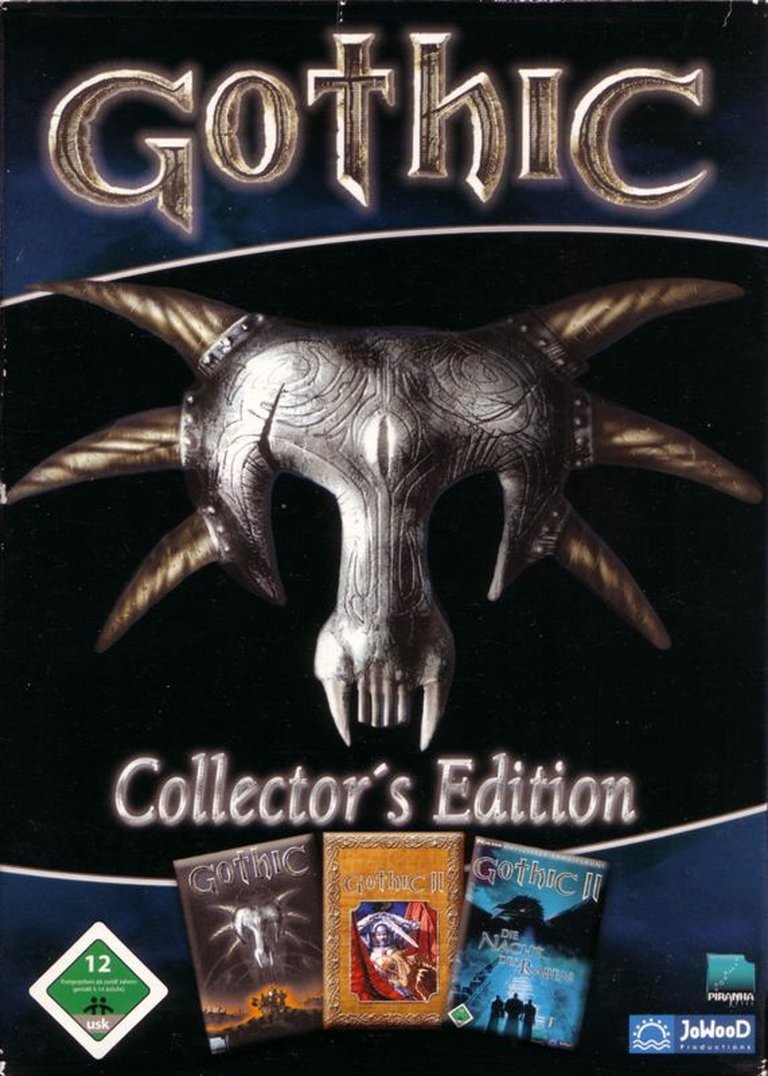
Gothic: Collector’s Edition is a compilation of the critically acclaimed RPG series that immerses players in a harsh medieval fantasy world. The collection includes Gothic, Gothic II, and the expansion Gothic II: Night of the Raven – combining brutal combat, deep character progression, and a richly detailed open world filled with factions, orcs, dragons, and political intrigue. Set in the atmospheric mining colony of Khorinis and its surrounding wilderness, players assume the role of a nameless hero navigating dangerous conflicts while reshaping the world through their choices.
Gothic: Collector’s Edition Cracks & Fixes
Gothic: Collector’s Edition Mods
Gothic: Collector’s Edition Guides & Walkthroughs
Gothic: Collector’s Edition Reviews & Reception
mobygames.com (92/100): Critics Average score: 92% (based on 3 ratings)
Gothic: Collector’s Edition Cheats & Codes
PC
Type ‘marvin’ in the game menu to enable cheat mode or edit ‘gothic.ini’ to set ‘test mode 1’. Press [F2] during gameplay to open the console.
| Code | Effect |
|---|---|
| marvin | Enable test/cheat mode |
| cheat god | God mode |
| cheat full | Restore health |
| hurtswampschark | Hurt shark |
| harpie | Harpie |
| lurker | Lurker |
| lichtbringer | Get artifact for quest |
| autocomplement | Toggle all cheats |
| load position | Load position |
| load game | Load game |
| save | Save game |
| Take screenshot | |
| version | Display game version |
| goto waypoint | Teleport to waypoint |
| goto pos | Teleport to castle |
| insert [item name] | Spawn indicated item/monster |
| marin | Gain 1000 ore nuggets |
| sodom | Gain 1000 ore nuggets |
| taki | Full health and mana |
| 42 | Disable test mode |
| godzilla | Enlarge all NPCs |
| kingkong | Shrink all NPCs |
| garfield | Make NPCs fat |
| shrike | Make NPCs thin |
| grommit | Flatten NPCs |
| clock | Display clock on screen |
| clerks | Enable slow-motion |
| southpark | Increase movement and attack speed |
| F8 | Full health and mana |
| H | Harm player character |
| Z | Character spins around |
| K | Character sinks into ground |
| F5 | Fixed camera view |
| F6 | Free-floating camera view |
| F7 | Cycle through game sections |
| edit abilities | Modify character attributes |
Gothic: Collector’s Edition Review
Introduction
In the pantheon of CRPGs, few titles command the cult reverence of Piranha Bytes’ Gothic series. Released between 2001–2003, the original Gothic duology redefined immersive storytelling and reactive world-building, carving a path for later giants like The Witcher. The 2005 Collector’s Edition—a definitive compilation of Gothic, Gothic II, and the Night of the Raven expansion—isn’t merely a bundle but a time capsule of ambition. This review argues that the collection crystallizes a rare alchemy: a world dense with consequence, atmospheric dread, and mechanical depth that remains unmatched today.
Development History & Context
Studio & Vision: Founded in 1997 by Mike Hoge and Alex Brüggemann, Piranha Bytes sought to create an RPG unshackled from genre conventions. Leveraging their tabletop roots, they envisioned a reactive, systemic world where NPCs lived schedules, wildlife hunted realistically, and factions warred dynamically. The studio’s ZenGin engine—built from scratch—prioritized environmental interactivity over graphical polish, a gamble that paid dividends in immersion.
Constraints & Landscape: Developed amid Germany’s post-reunification tech surge, Gothic faced daunting limitations. Hardware restrictions forced ingenious solutions: textures were hand-painted to conserve memory, while AI routines mimicked “life” through 50+ daily animations per character. Released in a 2001 market dominated by Diablo II and Baldur’s Gate II, Gothic stood apart with its organically gated progression—no loading screens, no quest markers—a design ethos that refused compromise.
Narrative & Thematic Deep Dive
Plot & Characters: The Collector’s Edition spans three self-referential arcs:
– Gothic I introduces the Nameless Hero, imprisoned within a magic-sealed mining colony (The Barrier) ruled by warring factions. The Old Camp’s mercantile tyranny, the New Camp’s rebellious idealism, and the Swamp Brotherhood’s fanatical cult of the Sleeper create a powder keg of alliances.
– Gothic II escalates as dragons, summoned by the slain Sleeper’s final curse, besiege the island of Khorinis. Night of the Raven weaves a parallel thread through the lost city of Jharkendar, where the cultist Raven wields Beliar’s Claw.
Themes:
– Imprisonment & Power: The colony mirrors Hobbesian anarchy—guard armor repurposed by convicts, king’s magicians enslaved by their own Barrier. Factions weaponize faith (Brotherhood), ore (Old Camp), and hope (New Camp), exposing cycles of exploitation.
– Divine Morality: Innos (order/light), Beliar (chaos/darkness), and Adanos (balance) frame a theological war. Xardas—the necromancer mentor—embodies Dark Is Not Evil, manipulating Beliar’s power to banish the gods themselves in Gothic II.
Dialogue & Choice: Branching allegiance (join militia, mages, or mercenaries) locks content but rewards replayability. Rejecting Bloodwyn’s extortion or delivering Ian’s list to the New Camp ripples through faction reputations.
Gameplay Mechanics & Systems
Core Loop:
– Combat: A precursor to Souls-likes—deliberate, weighty, skill-dependent. Early-game clumsiness evolves into fluid combos (30%/60% mastery unlocks). Night of the Raven sharpens difficulty with stamina management and enemy aggression.
– Progression: Learning points unlock training from faction masters (e.g., 2H swords require templar mentors). Magic circles demand rare rune stones, while alchemy crafts stat-boosting elixirs from scavenged herbs.
Innovations & Flaws:
– Living World: NPCs eat, sleep, and brawl autonomously. Steal armor? Guards attack. Target merchants with a bow? They duck.
– Anti-Grinding: Finite foes and XP force strategic investment—a Master of None build risks soft-locking lategame. The Claw of Beliar trades HP for OP damage, embodying high-risk power.
– Controls & UI: Tank-style movement polarizes players. Inventory management is chaotic, yet its cluttered realism fits a prisoner’s scavenged existence.
World-Building, Art & Sound
Setting: The Colony morphs from Gothic I’s claustrophobic prison to Gothic II’s ruined monasteries and storm-lashed coasts. Jharkendar’s Mayincatec ruins (Night of the Raven) layer temporal decay.
Atmosphere:
– Visuals: Low-poly models age poorly, but environmental storytelling persists—gibbets line Old Camp walls; dragon nests scar volcanic peaks. Weather shifts from fungal swamp mists to Khorinis’ downpours.
– Sound Design: Kai Rosenkranz’s score merges melancholic choirs with diegetic tavern lutes. Orcish drums and screech owl cues heighten tension. Notably, German voice acting (reductive in English dubs) sells the script’s gallows humor.
Reception & Legacy
Launch Reception: Critics lauded the series’ ambition but roasted its bugs (92% avg. MobyScore). PC Powerplay hailed Gothic II as “a perfect RPG,” while GameStar praised its “uncompromising freedom.” Player reviews echoed cult adoration—4.7/5 stars—despite jank.
Evolution: Post-2005 patches stabilized crashes, but Gothic 3’s troubled launch (2006) fractured the fanbase. Yet Collector’s Edition cemented Piranha Bytes’ legacy:
– Industry Influence: CD Projekt RED’s The Witcher owes debts to its faction depth and morally gray arcs.
– Modding Surge: 20+ years later, Polish/Russian communities churn total conversions like Chronicles of Myrtana.
– Modern Revival: THQ Nordic’s 2019 teaser for a Gothic Remake reclaimed its DNA—proving the design endures.
Conclusion
Gothic: Collector’s Edition isn’t a relic—it’s a manifesto. In bundling the trilogy, it preserves a watershed moment when RPGs embraced systemic friction over hand-holding. Flaws—quirky controls, uneven difficulty—are outshone by its dense reactivity, where a guard’s idle gossip might foreshadow a dragon’s lair. For historians, it’s a blueprint for open-world immersion; for players, a brutal, beautiful odyssey. German engineering meets Rimbaudian poetics—a classic that still demands your sweat and faith.
Final Verdict: Indispensable. A cornerstone of RPG history, flaws and all.