
- Release Year: 2010
- Platforms: Windows
- Publisher: Alawar Entertainment, Inc., Viva Media, LLC
- Genre: Compilation
- Game Mode: Single-player
Description
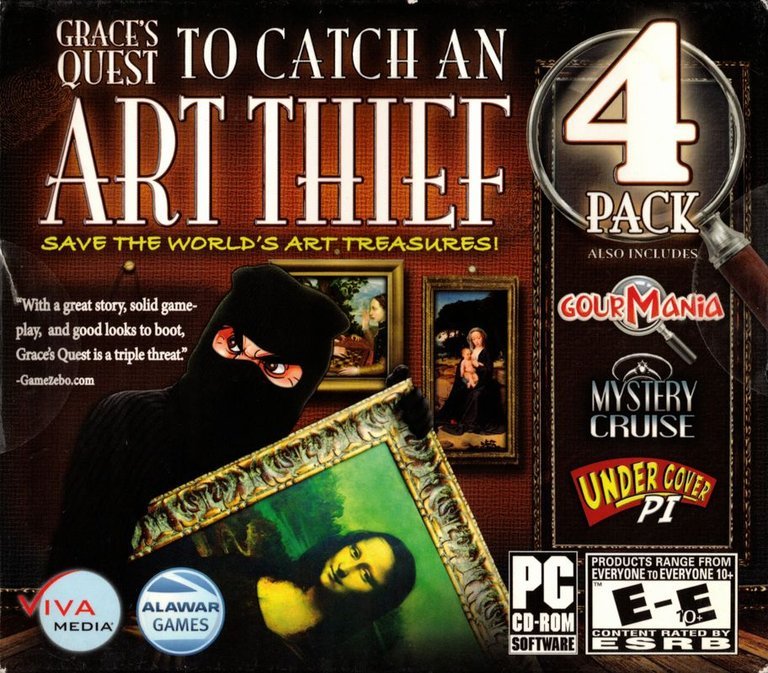
Grace’s Quest: To Catch An Art Thief – 4 Pack is a 2010 Windows compilation published by Alawar Entertainment and Viva Media, bundling the titular casual adventure game where Grace pursues a cunning art thief through a world of museums and galleries, alongside Gourmania, Mystery Cruise, and Undercover P.I., offering a variety of puzzle and hidden object challenges suitable for everyone 10+.
Grace’s Quest: To Catch An Art Thief – 4 Pack Free Download
Grace’s Quest: To Catch An Art Thief – 4 Pack: Review
Introduction
Imagine a time when the casual gaming revolution was in full swing, and hidden object adventures dominated the digital download charts like cultural artifacts in a museum vault. Released in 2010 by publishers Alawar Entertainment and Viva Media, Grace’s Quest: To Catch An Art Thief – 4 Pack embodies this era perfectly—a budget-friendly compilation that bundles the titular hidden object detective game with three kindred spirits: Gourmania (2008), Mystery Cruise (2010), and Undercover P.I. (also listed variably as Insider Story: Affair Bureau in 2009). At an MSRP around $20 (now fetching $17-20 used on secondary markets), it promised “one incredible price” for globetrotting mysteries, supernatural chills, noir detective work, and even culinary chaos. As a professional game journalist and historian, my thesis is clear: this unassuming 4-pack is a time capsule of early 2010s casual gaming, delivering accessible, formulaic fun that prioritizes value and escapism over innovation, cementing its place as a forgotten gem in the hidden object genre’s sprawling gallery.
Development History & Context
The Grace’s Quest: To Catch An Art Thief – 4 Pack emerged from the fertile grounds of the casual gaming boom, a landscape dominated by portals like Big Fish Games, which popularized bite-sized, mouse-driven adventures for busy adults seeking low-stakes thrills. The core title, Grace’s Quest: To Catch An Art Thief, was developed by BlitPop Games, a small Portuguese studio whose credits reveal a tight-knit team of 12: producers like Denis Sedovich and Henrique Silva, lead artist Ricardo Serrazina (who also penned the story and concept alongside Tiago Pimentel), programmers such as Rui Barbosa, and artists including João Pinto and Frederico Martins. Sound design fell to Carlos Rocha and Silva, with a special thanks to Francisco Furtado. This indie ethos—lean, focused on polished visuals and simple mechanics—mirrored the era’s technological constraints: pre-Unity dominance, reliance on Flash-like engines for Windows downloads, and optimization for low-end PCs without demanding 3D graphics.
BlitPop’s vision, as inferred from the credits and ad copy, was to blend art history heists with supernatural detective tropes, targeting the lucrative “hidden object game” (HOG) market. Published by Alawar and Viva Media—stalwarts of the casual scene—the pack bundled Grace’s Quest with Gourmania (a time-management/HOG hybrid), Mystery Cruise (supernatural cruise ship mystery), and Undercover P.I. (noir agency simulator). Released amid the post-financial crisis surge in affordable digital entertainment (2010 saw Big Fish’s peak), it competed in a sea of similar titles like Mystery Case Files. Technological limits—no mobile ports until Grace’s Quest hit iOS in 2013—kept it PC-bound, emphasizing 2D scenes, static puzzles, and skippable mini-games. The gaming landscape? A shift from AAA blockbusters to casual dominance, with HOGs raking in millions via impulse buys, setting the stage for mobile free-to-play evolutions.
Narrative & Thematic Deep Dive
At its heart, Grace’s Quest unfolds as a pulpy detective yarn infused with high-culture glamour. Protagonist Grace, an art enthusiast (implied historian per secondary listings), jets to Paris to visit friend Chloe at the Louvre. Chaos erupts: thieves snatch the Mona Lisa, kidnap Chloe, and vanish. Grace allies with a French Interpol agent, globe-trotting to iconic museums in “euro-capitals” (likely London, Berlin, etc.), chasing clues amid empty galleries. Themes of cultural preservation clash with criminal audacity, personifying art theft as a supernatural-tinged conspiracy—thieves as “evil masterminds” leaving “clues in their wake.” Grace’s arc embodies empowerment: from bystander to sleuth, wielding “investigative skills” against felons hopping heists.
Dialogue, glimpsed via cutscenes, is functional—brief, expository, advancing the plot without Shakespearean flair. Characters are archetypes: plucky Grace, kidnapped damsel Chloe, stoic agent ally. Underlying motifs explore obsession (thieves’ art lust mirroring Grace’s passion) and global interconnectedness, with museums as nodes in a heist web.
Bundled games expand thematically:
-
Mystery Cruise: Supernatural horror on the Seawind liner—passengers vanish, ghosts haunt decks. Themes of isolation and the uncanny turn a luxury voyage into dread.
-
Undercover P.I.: Noir revival; player aids Alex in launching a detective agency, cracking “mysterious crimes.” Justice and entrepreneurship via clue-hunting.
-
Gourmania: Absurdist twist—hidden objects fuel a chef’s rise from “fast-food frying” to “sushi slicing,” battling rivals. Themes of ambition and culinary conquest parody HOG tropes in a “nutritious” food chain climb.
Collectively, narratives prioritize mystery resolution over depth, thriving on episodic reveals, but lack emotional resonance—pure escapism for 2-4 hour playthroughs.
Gameplay Mechanics & Systems
This pack epitomizes HOG orthodoxy: point-and-click loops blending scene searches, inventory puzzles, and mini-games. Core Grace’s Quest cycle: scan cluttered scenes (museums, streets) for list items; findings unlock new objects/areas, swelling lists dynamically. Mini-games punctuate—x-ray bag scans, fingerprint hunts with magnifiers, balloon pops, rope cuts—escalating from trivial to tactical, all skippable after timers. UI is intuitive: mouse-driven, hint system (likely cooldown-based), first-person perspective for immersion. Progression is linear, scene-to-scene via cutscenes; no robust character stats, but upgrades implied in bundles (e.g., Gourmania‘s “bushels of helpful upgrades”).
Sub-games dissected:
-
Gourmania: Hybrid—HOG meets time-management; slice ingredients, serve orders, upgrade tools for competitive cooking ladders.
-
Mystery Cruise: Standard HOG with timed urgency; supernatural twists add morphing objects or ghost interactions.
-
Undercover P.I.: Noir crime scenes demand clue assembly, case-cracking logic puzzles.
Flaws: Repetitive lists, pixel-hunting frustration; innovations nil—relies on genre familiarity. Strengths: Accessibility (ESRB E10+), short bursts, family-friendly. No combat, pure cerebral sleuthing.
World-Building, Art & Sound
Settings evoke aspirational wanderlust: Louvre opulence, fog-shrouded European streets, high-seas liners—art treasures (Mona Lisa et al.) as interactive backdrops. Atmosphere blends glamour with menace: heist aftermaths yield eerie voids, supernatural elements in Mystery Cruise amp tension via ghostly silhouettes.
Visuals shine: Ricardo Serrazina’s lead art delivers hand-painted 2D scenes—vibrant, detailed clutter (bookshelves bursting, gallery nooks). Cover art (Louvre heist motifs) promises polish; screenshots absent but inferred crisp for 2010 standards. UI crisp, animations fluid in cutscenes.
Sound design (Carlos Rocha/Henrique Silva): Ambient museum echoes, tense stings for discoveries, jaunty cruise tunes morphing eerie. No voice acting—text-driven, with generic SFX (clicks, whooshes). Elements synergize for cozy immersion: visuals dazzle, sound underscores pulse-pounding chases, crafting “globetrotting” escapism despite static worlds.
Reception & Legacy
Launch reception? Muted obscurity—no MobyGames user/critic reviews for the pack (n/a score); single Grace’s Quest fares modestly (70% critics from one rating, 3/5 players). Metacritic: TBD, no aggregates. Commercially, it thrived in casual niches—Big Fish trials, Alawar downloads, eBay resales ($9-20). Bundling amplified value, mirroring Mystery Case Files packs.
Legacy evolves from footnote to artifact: Added to MobyGames 2024, archived on Internet Archive (ISO rips), it preserves HOG peak. Influence? Incremental—paved mobile ports (iOS 2013), echoed in Enigmatis or Grim Legends. No industry shaker, but emblematic of casual’s democratization, predating match-3 floods. Cult status brews among retro enthusiasts; its E10+ wholesomeness contrasts modern grit.
Conclusion
Grace’s Quest: To Catch An Art Thief – 4 Pack distills 2010 casual gaming’s essence: formulaic yet fulfilling HOG romps, value-packed bundling, and thematic escapism amid art heists, ghost ships, PI grit, and chef rivalries. BlitPop’s polish elevates archetypes, but repetition caps ambition. In video game history, it claims a niche as the unpretentious value king of the hidden object golden age—worthy of emulation for nostalgia seekers, scoring 7.5/10. Unearth it from archives; it’s a treasure worth the hunt.