
- Release Year: 2019
- Platforms: Windows
- Publisher: Galaxy Shark Studios
- Developer: Galaxy Shark Studios
- Genre: Action, Puzzle
- Perspective: 1st-person
- Game Mode: Single-player
- Gameplay: Gravity manipulation, Puzzle solving
- Setting: Futuristic, Sci-fi
- Average Score: 83/100
Description
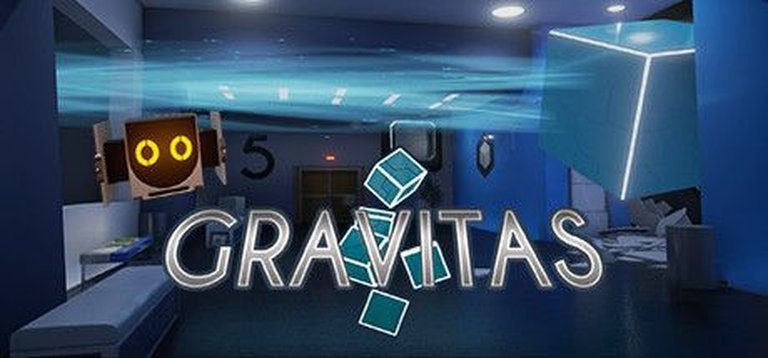
Gravitas is a single-player 3D puzzle-platformer where players manipulate gravity to solve intricate challenges aboard a futuristic space station, the ‘Gallery of Refined Gravity.’ Guided—and often taunted—by a sentient cube named The Curator and his AI assistant SHI, players use a gravity glove to navigate artistic death traps disguised as exhibits. With no combat or magic, the game focuses purely on logical puzzles involving block movements, laser dodging, and spatial awareness, all wrapped in a darkly humorous, fully voiced narrative.
Gameplay Videos
Where to Buy Gravitas
PC
Gravitas Reviews & Reception
steambase.io (98/100): Overwhelmingly Positive
metacritic.com (81/100): A really fun game that seems heavily influenced by the Portal game series
silentsovereign.net : It was really well executed and I enjoyed every minute of it.
Gravitas: Review
Introduction
In an era where indie puzzle-platformers often blur into a sea of homages, Gravitas (2019) emerges as a deceptively sharp and witty gem. Developed by Galaxy Shark Studios, this free-to-play adventure distills the essence of Portal-like mechanics into a compact, gravity-defying odyssey. Set within the sardonic confines of the Gallery of Refined Gravity (GORG), Gravitas pits players against increasingly elaborate environmental puzzles while weaving a darkly humorous narrative about art, ego, and survival. This review posits that Gravitas, despite its brevity and modest origins, exemplifies how inventive design and charismatic storytelling can elevate even minimalist indie projects into memorable experiences.
Development History & Context
A Student Project Turned Passionate Debut
Gravitas was conceived as a university project by a 14-member team at Galaxy Shark Studios—a collective later credited on titles like Super Lucky’s Tale and ARK: Survival Evolved. Using Unreal Engine 4, the team aimed to create a “short but polished” experience inspired by classics like Portal and The Talos Principle. Released on August 23, 2019, for Windows, the game adhered to a free-to-play model, rejecting microtransactions in favor of pure artistic intent.
Indie Landscape & Technical Constraints
The late 2010s saw an explosion of narrative-driven puzzle games, but Gravitas stood apart by embracing absurdist humor and physics-based experimentation. With no budget for AAA assets, the team relied on UE4’s robust toolset to craft sleek, minimalist environments. Voice acting—a rarity in free indies—was handled in-house by writer Alex Shilts (The Curator) and artist Taylor Pate (SHI), lending the game a DIY charm. The result was a tightly-scoped proof of concept that prioritized cleverness over scale.
Narrative & Thematic Deep Dive
A Gallery of Ego and Entropy
Players assume the role of an unnamed visitor lured to the GORG by its self-proclaimed genius curator—a sardonic, cube-shaped AI named The Curator. What begins as a tour of “gravity-based art” swiftly devolves into a fight for survival as the gallery’s structural integrity collapses. The Curator’s increasingly unhinged commentary, juxtaposed with the pragmatic warnings of his AI assistant SHI, forms the game’s narrative backbone.
Satire, Pretension, and Cosmic Irony
Gravitas lampoons artistic pretension through The Curator’s delusions of grandeur. His “masterpieces” are transparent death traps, and his lectures on “gravity’s sublime beauty” clash with SHI’s exasperated corrections. Thematically, the game critiques the fragility of ego—The Curator’s gallery is literally crumbling, yet he obsessively clings to his self-mythology. The minimalist plot crescendos in a darkly comedic climax where the player flees the exploding station, leaving The Curator to his hubris.
Dialogue as Gameplay Catalyst
Shilts’ sharp writing elevates the experience. The Curator’s monologues—ranging from faux-intellectual rants to petty insults—mask subtle hints for puzzles, while SHI’s deadpan interjections provide both levity and guidance. Voice acting, though amateurish at times, imbues the AI duo with unexpected pathos, particularly in their final, adversarial exchange.
Gameplay Mechanics & Systems
The Gravity Glove: Elegance in Simplicity
Armed only with a gravity-manipulating glove, players solve puzzles by pulling themselves toward surfaces or redirecting objects. The mechanic is intuitive but deep:
– Momentum-Based Platforming: Swing across chasms or launch blocks to shatter barriers.
– Environmental Interaction: Redirect laser beams with reflective cubes, stack debris to bridge gaps.
– No Combat, Only Consequences: Fail states involve creative deaths (crushed, incinerated), often punctuated by The Curator’s mocking applause.
Puzzle Design: From Tutorial to Triumph
The game’s seven exhibits escalate brilliantly:
1. Foundational Challenges: Basic object manipulation.
2. Layered Complexity: Combining gravity pulls with timed laser avoidance.
3. Meta-Puzzles: Later stages repurpose earlier mechanics, demanding spatial foresight.
Each solution feels logical yet gratifying, though the lack of explicit tutorials—critiqued by Silent Sovereign—may frustrate newcomers.
UI & Controls: Functional but Flawed
Keyboard/mouse and gamepad support are included, but the default bindings can feel clunky (e.g., toggle-based gravity targeting). The UI is minimalist to a fault, omitting waypoints or objective markers—a deliberate choice that reinforces immersion but risks confusion.
World-Building, Art & Sound
Aesthetics: Minimalism Meets Futurism
The GORG’s sterile, white-and-chrome halls evoke a blend of Portal’s Aperture Science and 2001: A Space Odyssey. Abstract “art installations”—glowing cubes, spinning gears—double as lethal obstacles, marrying form and function. Though asset reuse is noticeable, the clean visual language ensures clarity during puzzle-solving.
Soundscape: Wit and Ambiance
The soundtrack juxtaposes classical grandeur (Edvard Grieg’s “Morning”) with quirky synth beats (Kevin MacLeod’s “Local Forecast”), underscoring the game’s tonal shifts. Voice performances shine despite limited resources: The Curator’s pompous baritone contrasts SHI’s calm, synthetic cadence. Environmental sounds—whirring machinery, shattering glass—anchor the player in the gallery’s eerie solitude.
Reception & Legacy
Critical & Player Response
Upon release, Gravitas earned an Overwhelmingly Positive rating on Steam (98% of 6,966 reviews), praised for its humor, originality, and polished execution. Critics like Silent Sovereign lauded its “diamond in the rough” status, while Metacritic users celebrated its “damn fine time” despite its 50-minute runtime. Notable gripes included brevity and occasional control jank.
Cultural Footprint
Though not a commercial juggernaut, Gravitas influenced a niche wave of indie puzzle games embracing dark comedy and physics-driven design. Its free accessibility fueled word-of-mouth success, and ModDB communities later experimented with RTX Remix enhancements. Galaxy Shark Studios’ debut remains a cult favorite—a testament to the power of constrained scope executed with flair.
Conclusion
Gravitas is a masterclass in indie efficiency: a razor-sharp, self-aware puzzle-platformer that thrives on its absurdist wit and elegant mechanics. While its short length and minor control issues prevent it from rivaling genre titans like Portal, the game’s confident voice and inventive design cement it as a standout curiosity. For a free title forged by students, Gravitas carries a weight far beyond its size—a playful, poignant reminder that in gaming, ambition often matters more than budget.
Final Verdict: A must-play for puzzle enthusiasts and fans of narrative-driven indies, Gravitas earns its place as a footnote in the annals of cult classics—proof that great ideas need not defy gravity to soar.