
- Release Year: 2021
- Platforms: Nintendo Switch, PlayStation 5, Windows, Xbox Series
- Publisher: Team17 Digital Limited
- Developer: Navegante Entertainment
- Genre: Action
- Perspective: Side view
- Game Mode: Single-player
- Gameplay: Metroidvania, Platform, Puzzle elements
- Setting: Fantasy
- Average Score: 72/100
Description
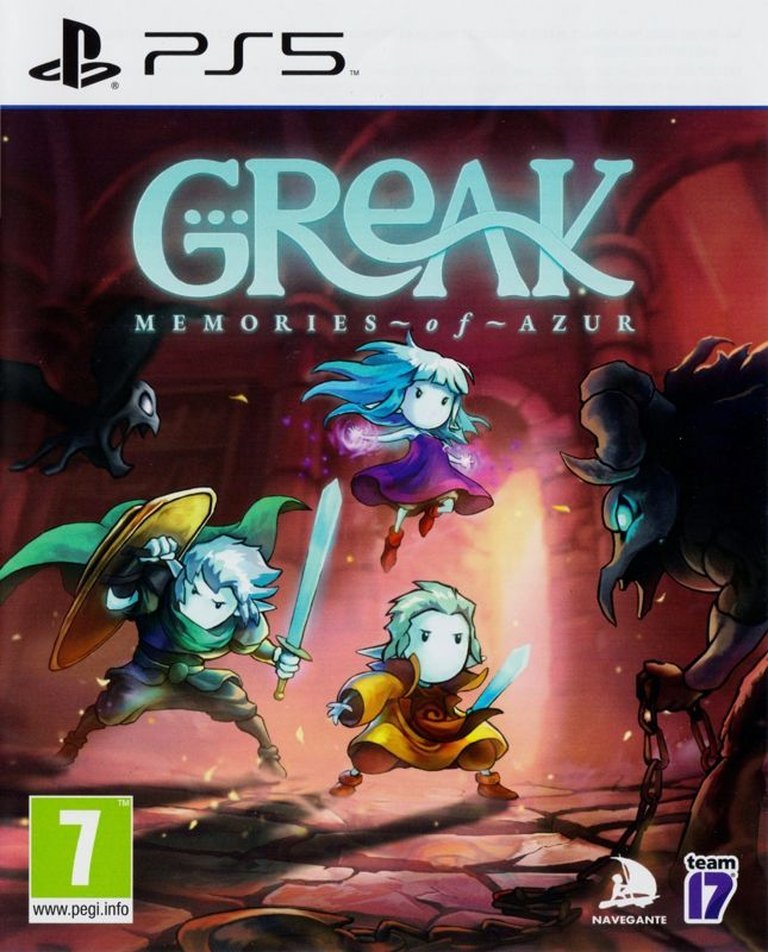
Greak: Memories of Azur is a 2D side-scrolling metroidvania set in a fantasy world, where players control the young hero Greak on a journey to reunite his family and uncover the mysteries of the Azur kingdom through platforming, puzzle-solving, and combat.
Gameplay Videos
Where to Buy Greak: Memories of Azur
Greak: Memories of Azur Free Download
Greak: Memories of Azur Mods
Greak: Memories of Azur Guides & Walkthroughs
Greak: Memories of Azur Reviews & Reception
opencritic.com (72/100): Greak: Memories of Azur is a solid platformer by Navegante Entertainment, delivering a well realised world with interesting characters, gorgeous hand-crafted visuals, and intriguing environments that beg to be explored.
waytoomany.games : It’s that distinct pop of colour from the latter that sets it apart and in some cases, above the big boy releases.
slantmagazine.com : This rapid-paced approach makes Greak an unfulfilling game, one that underutilizes its colorful, hand-drawn locations and occasionally creative tandem puzzles.
vgamingnews.com : For such a sweet looking game, there’s a certain sense of doom and gloom about the place, which is a credit to the character design and writing in making you care about these little people in such a short space of time.
Greak: Memories of Azur: Review
Introduction
In an era dominated by photorealistic AAA spectacles, Greak: Memories of Azur emerges as a radiant outlier—a hand-painted tapestry of melancholy and hope. Developed by Mexican studio Navegante Entertainment and published by Team17, this 2021 indie title invites players to guide three Courine siblings through a plague-ravaged fantasy realm. While its watercolor aesthetic and orchestral crescendos evoke Studio Ghibli’s warmth, the game’s genius lies in its deceptively simple premise: unite Greak, Adara, and Raydel to escape the Urlag invasion. Yet, beneath this charming façade lies a poignant thesis: Greak is a masterclass in artistic ambition constrained by mechanical imperfections. It dazzles the senses but stumbles in execution, leaving players captivated yet yearning for more.
Development History & Context
Navegante Entertainment’s debut was a labor of love, spearheaded by brothers Gustavo and Rodrigo Alcalá Perea. As a small Mexican studio, they faced no technological constraints but embraced Unity’s flexibility to craft a cross-platform experience spanning PC, consoles, and even mobile. Their vision was clear: to revive the spirit of 16-bit classics like The Lost Vikings through a modern lens. Released amid 2021’s indie renaissance—a period defined by Hollow Knight’s atmospheric depth and Ori’s fluid artistry—Greak stood out for its painterly visuals. Team17’s publishing muscle ensured wide visibility, positioning the game as a contender in the hand-drawn Metroidvania niche. Yet, its development cycle, while meticulous, couldn’t fully resolve the inherent complexities of controlling three characters simultaneously, a challenge that would haunt its final design.
Narrative & Thematic Deep Dive
The narrative unfolds as a bittersweet fable of familial bonds and displacement. Greak, the youngest Courine, flees his besieched hometown of Drendle, embarking on a quest to reunite with his siblings—Adara, the mystic Oracle, and Raydel, the stoic Warrior. Their shared goal: scavenge airship parts to evacuate Azur, now doubly threatened by the Urlag invaders and an ancient plague that mutates the land into monstrous Blighted horrors.
The plot, while structurally sound (“textbook” as one critic noted), excels in character nuance. Greak’s impulsiveness, Adara’s serene wisdom, and Raydel’s burdened pragmatism are etched through subtle interactions and idiomatic speech (e.g., “Courine luck” for misfortune). NPCs react dynamically to the party’s composition, introducing newly recruited siblings and shifting routines—blacksmiths pause their work to gossip, scouts discuss strategy—breathing life into Raven’s Road Camp, the last Courine bastion.
Themes of home and sacrifice permeate the story. The Urlag invasion parallels colonialism, while the Blighted plague symbolizes nature’s retribution against hubris. Yet, the narrative’s greatest flaw is its abrupt conclusion. As one review lamented, the ending is a “wet fart,” leaving threads like the Courines’ ancestral homeland and Urlag motivations dangling. The lore, rich with legends and class distinctions (Scouts, Oracles, Warriors), feels underexplored in a six-hour runtime, hinting at a grander vision truncated by scope.
Gameplay Mechanics & Systems
Greak’s core innovation lies in its simultaneous character control, blending puzzle-platforming with real-time strategy. Players switch between Greak (agile, crawls through tight spaces), Adara (levitates, swims, wields magic), and Raydel (armored, uses a hookshot and shield). Their abilities interlock elegantly: Raydel’s shield deflects lasers while Greak activates hidden switches, or Adara’s buoyancy allows her to retrieve submerged keys.
However, the tag-team mechanic, while ingenious in theory, falters in practice. Holding a button binds siblings in an aura, syncing their jumps and actions. Yet, execution is marred by three critical flaws:
1. Unfair Deaths: If one sibling falls—e.g., Raydel drowns or Adara lags during jumps—the game ends abruptly. AI companions offer minimal defense, leading to off-screen kills.
2. Delayed Healing: Consuming items requires a 1–2 second digestion animation, punishing players mid-combo and encouraging panic-driven pausing.
3. Movement Dissonance: Adara’s floating is slower than Greak/Raydel’s double jumps, making group navigation clunky.
Combat prioritizes hit-and-run tactics over depth. Bosses like Ivekt, the Urlag Conqueror, rely on pattern recognition but feel trivial when exploited with Adara’s ranged attacks. Progression is minimal: one HP upgrade per sibling and a handful of utility skills, with missable techniques for Greak that see little use. The mission-based structure—fetch quests for airship parts—streamlines progression but stifles exploration, turning Azur into a “tiny” world with “scant areas” to revisit (as Play Critically observed).
World-Building, Art & Sound
Azur is a character in its own right. Navegante’s hand-drawn art blends Hollow Knight’s gothic grandeur with Ghibli’s whimsy. Cascading waterfalls glow with bioluminescence, Blighted creatures writhe in viscous darkness, and character animations—Greak’s triumphant leaps, Raydel’s shield slams—brim with personality. Environments shift from decaying forests to labyrinthine tombs, each backdrop a testament to the team’s illustrative prowess.
The live orchestral score, composed by Oscar Alcalá, elevates every scene. Brass fanfares underscore Raydel’s heroism, while melancholic piano melodies echo Adara’s sorrow. Ambient sounds—rain pattering on leaves, nocturnal crickets—immerse players, earning praise for their “authenticity” (Way Too Many Games). Yet, technical hiccups like frame rate drops during cutscenes (VGamingNews) occasionally disrupt the magic. Despite this, the art and sound synergy creates an unforgettable atmosphere, transforming Azur from a setting to a living, breathing entity.
Reception & Legacy
At launch, Greak polarized critics. MobyGames aggregates a 74% score, with highlights like Cat with Monocle’s 90% (“fun and challenging”) and Capsule Computers’ 65% (“reaches for the stars but never quite leaves orbit”). Praised for its art and sound, it was criticized for “clunky combat” (Video Chums) and “forgettable” storytelling. Players on Steam awarded it “Very Positive” (80%), lauding its replayability but noting control frustrations.
Its legacy is one of unfulfilled potential. Compared to The Lost Vikings, it innovates but fails to master its premise. The game’s “seed” metaphor—rich lore, beautiful worlds—hints at a sequel’s promise, yet none has materialized. It stands as a cult favorite, influencing indie devs to prioritize hand-drawn aesthetics but cautioning against ambitious mechanics without polish. As Slant Magazine concluded, Greak is a “pretty but featherweight” affair—a beautiful reminder that artistry alone cannot sustain gameplay.
Conclusion
Greak: Memories of Azur is a study in contrasts: a triumph of artistic vision hampered by design compromises. Its hand-drawn vistas and familial heart resonate deeply, while the tag-team mechanic’s flaws—unfair deaths, disjointed control—frustrate equally. Navegante crafted a world players will long to return to, yet its brevity and abrupt ending leave a lingering void. For Metroidvania fans, it’s a must-experience for its aesthetic splendor, but one tempered by the knowledge that its brilliance is fleeting. In the pantheon of indie games, Greak endures not as a classic, but as a poignant reminder of the magic—and pain—of chasing dreams.
Verdict: 7.5/10
A beautifully flawed gem, Greak: Memories of Azur is essential for art-game enthusiasts but demands patience from players seeking mechanical perfection.