
- Release Year: 2006
- Platforms: Windows
- Publisher: IQ Publishing s.c., Nobilis France, Russobit-M, Strategy First, Inc.
- Developer: Indie Games Productions
- Genre: Strategy, Tactics, Wargame
- Perspective: Top-down
- Game Mode: LAN, Online Co-op
- Gameplay: Diplomacy, Economic management, Military management, Real-time, Religious conversion
- Setting: Medieval Europe, War
- Average Score: 56/100
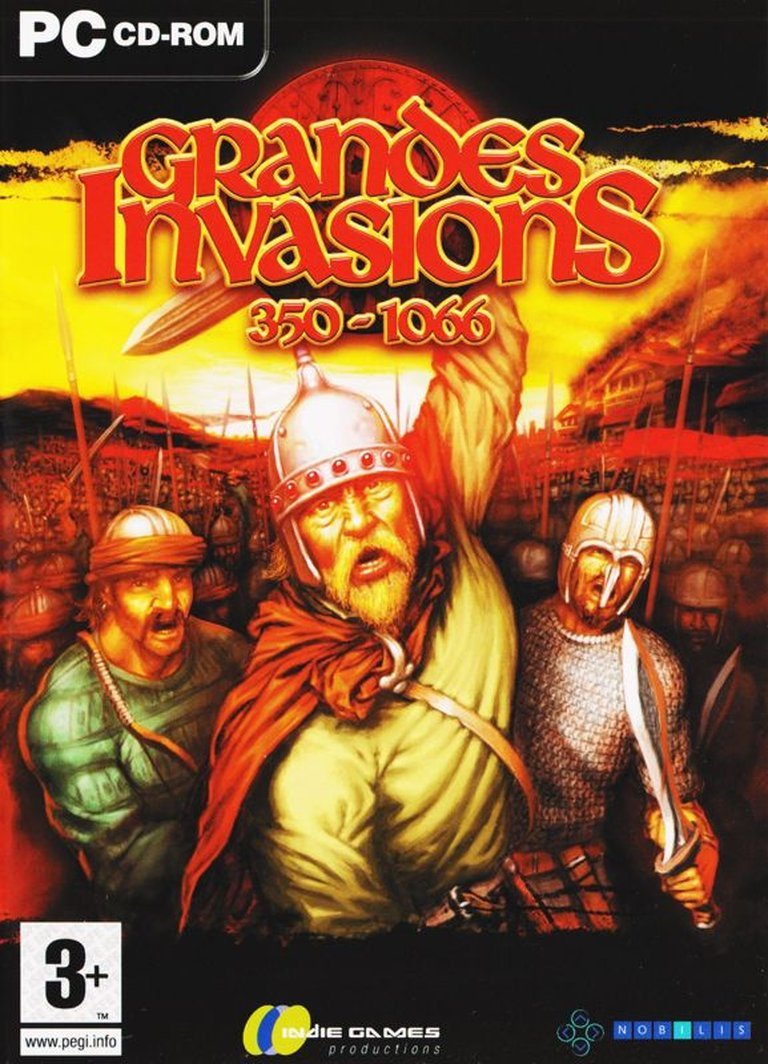
Description
Great Invasions: The Darkages 350-1066 AD is a real-time strategy game set in medieval Europe during a turbulent seven-century span. Players lead one of 80 historically inspired nations through conquest, settlement, and empire-building phases, managing military campaigns, diplomacy, economic systems, and religious dynamics (including four faiths with conversion mechanics). Featuring pre-scripted historical events and the ability to control up to 10 short-lived nations simultaneously, the game emphasizes survival through transitions from nomadic barbarian tribes to complex imperial administrations while balancing stability through temple construction and missionary activities.
Great Invasions: The Darkages 350-1066 AD Free Download
Great Invasions: The Darkages 350-1066 AD Patches & Updates
Great Invasions: The Darkages 350-1066 AD Mods
Great Invasions: The Darkages 350-1066 AD Reviews & Reception
metacritic.com (85/100): If you are looking for an intelligent and very deep strategy experience in an under-explored time period, look no further.
metacritic.com (74/100): That the developers have endeavoured – and succeeded – in modelling the social turmoil of the period makes this a unique, rewarding, and dense experience that demands dedication and will reward players with weeks, if not months, of unique historical wargaming.
metacritic.com (65/100): A diamond in the rough. It is apparent that a great deal of research and design went into the creation of this title, but unfortunately, the same cannot be said for the documentation and tutorial.
metacritic.com (65/100): While there is a lot of complexity in the game play it is hard to grasp the many aspects due to the unpleasant interface.
metacritic.com (60/100): A very large game with a large amount of strategy, if you have the patience to learn how to play. To really be a great game, the interface needs to be totally redesigned, along with the manual.
metacritic.com (58/100): This RTS has great historical flavor and scope, though the documentation and overall playability leave something to be desired.
metacritic.com (57/100): This title succeeds in its mission to be one of the most detailed and historically accurate recreations of the Dark Ages. But a clunky interface and lack of tutorial made an already complex game almost impossible for new players to pick up and enjoy.
metacritic.com (50/100): Great Invasions offers a great tribute to retelling history, offers loads of options, but its almost unavoidable complexity leaves it unapproachable to all but the most determined history and strategy fans.
metacritic.com (50/100): Underdeveloped niche title will only appeal to a special few.
metacritic.com (50/100): I don’t want to discourage the intrepid few who might find some real pleasures here or are so excited about the time period that they’re willing to endure Great Invasions’ abundant frustrations.
worthplaying.com : A clever mix of strategy and action, Great Invasions plunges you back into Europe of the Dark Ages, a time in history where hundreds of nations and barbarian tribes rush to assault the civilized world.
gamespot.com (58/100): This RTS has great historical flavor and scope, though the documentation and overall playability leave something to be desired.
gamespot.com (27/100): Finally gave up on it.
gamespot.com (30/100): This game nearly drove me to insanity.
Great Invasions: The Darkages 350-1066 AD: Review
Introduction
Great Invasions: The Darkages 350-1066 AD is a game that dares to tackle one of history’s most tumultuous eras—a period of fractured empires, migratory tribes, and existential chaos. Released in 2006 by Indie Games Productions, this real-time strategy (RTS) title ambitiously simulates seven centuries of European turmoil, from the twilight of Rome to the Norman Conquest. Yet, despite its grand vision, the game remains a polarizing artifact: a deep but forbidding experience that rewards patience as much as it frustrates accessibility. This review argues that while Great Invasions is a historian’s playground, its execution often betrays its potential, leaving it a niche curiosity rather than a genre-defining classic.
Development History & Context
Studio Vision & Challenges
Designed by Philippe Thibaut—known for his work on Pax Romana—Great Invasions aimed to fill a gap in historical strategy gaming. The Dark Ages were seldom explored in detail, and Thibaut sought to create a “living history book” with dynamic systems reflecting migration, religious conflict, and political decay. Developed by the small team at Indie Games Productions, the game faced significant constraints:
- Technological Limitations: Built on a rudimentary 2D engine, the game’s visuals lagged behind contemporaries like Europa Universalis II (2001).
- Market Landscape: Released during the mid-2000s RTS boom dominated by Age of Empires and Medieval II: Total War, Great Invasions struggled to stand out despite its unique scope.
- Design Philosophy: Thibaut prioritized historical accuracy over accessibility, resulting in dense systems that alienated casual players.
Critics noted the studio’s ambition but questioned its ability to balance complexity with playability—a tension that would define the game’s reception.
Narrative & Thematic Deep Dive
A Continent in Flux
Great Invasions spans 350–1066 AD, simulating the rise and fall of 80 nations, including Goths, Franks, and Byzantines. Key historical events—such as Attila’s death or the Viking invasions—are pre-scripted but interact with player decisions. The narrative isn’t driven by characters but by emergent geopolitical drama:
- Religious Strife: Players navigate four religions (Christianity, Islam, Paganism, and Judaism), deploying missionaries to convert provinces and stabilize realms.
- Nation Lifecycles: Nations progress through three stages—Barbarian (nomadic conquest), Kingdom (settled governance), and Empire (fragile hegemony)—each demanding distinct strategies.
- Themes of Survival: The game underscores the transience of power, with nations often collapsing under economic strain or external invasions.
While lacking traditional storytelling, the game’s emergent narratives—like a resurgent Rome or a pagan Scandinavia—reward players invested in its systemic depth.
Gameplay Mechanics & Systems
A Symphony of Systems, a Cacophony of Controls
Great Invasions combines grand strategy with real-time management, but its complexity often overwhelms:
- Multi-Nation Control: Players juggle up to 10 nations simultaneously—a novel but exhausting mechanic. Managing diplomacy between rival factions under your control adds strategic tension but demands micromanagement.
- Four Pillars of Rule:
- Military: Raise armies, besiege provinces, and navigate terrain penalties. Combat is automated but influenced by commander stats and unit composition.
- Economy: Construct farms, mines, and trade routes. Taxation must balance expansion with population loyalty.
- Diplomacy: Forge alliances, arrange marriages, or bribe rivals—though AI responsiveness is erratic.
- Religion: Convert regions to stabilize rule or provoke heresies.
- Stratagems: Over 60 situational actions—like assassinations or spy deployments—add tactical flexibility but lack clear tutorialization.
Flaws & Frustrations
- UI Chaos: Menus are cluttered, tooltips overflow with text, and critical information is buried. One critic lamented, “Finding the ‘build’ button feels like an archeological dig.”
- Learning Cliff: The 25-page manual and broken tutorial (patched post-launch) leave players stranded.
- Real-Time Pacing: The game’s relentless pace forces constant pausing, undermining its flow.
World-Building, Art & Sound
Aesthetic Austerity
Great Invasions’ presentation is functional but dated:
- Visual Design: The top-down map uses color-coded provinces (military, economic, religious views) but lacks detail. Units are tiny sprites, and battles are abstracted to icons.
- Sound Design: Composed by Dopsound Studio, the soundtrack features period-appropriate chants and drums but loops repetitively. Sound effects are sparse, reducing immersion.
- Atmosphere: Despite its plain visuals, the game evokes fragility through event pop-ups (plagues, rebellions) and a stark interface.
While not visually striking, the art serves its purpose—though comparisons to Crusader Kings (2004) highlight its deficiencies.
Reception & Legacy
Mixed Praise, Lasting Niche
Upon release, Great Invasions earned a lukewarm 53% Metacritic average, with critics split:
- Praise: “A diamond in the rough for history buffs” (WorthPlaying) applauded its depth and period authenticity.
- Criticism: “Unnecessarily complicated” (PC Powerplay) condemned its interface and lack of guidance.
- Commercial Performance: Poor sales relegated it to bargain bins, though Strategy First’s re-releases found a small audience.
Influence & Retrospection
Though overshadowed by contemporaries, Great Invasions influenced later titles like Age of Charlemagne (2015) with its focus on migration and cultural shifts. Today, it’s a cult classic among hardcore strategists but remains a cautionary tale about balancing complexity.
Conclusion
Great Invasions: The Darkages 350-1066 AD is a game of contradictions: a meticulously researched historical simulator hamstrung by poor accessibility and technical limitations. Its ambition to model the Dark Ages’ chaos is commendable, yet its execution often veers into frustration. For historians and masochistic strategists, it offers unparalleled depth; for others, it’s an artifact best left to retrospectives. In video game history, it stands as a flawed but fascinating experiment—a testament to the perils and promises of grand design.
Final Verdict: A niche relic for the patient, not the curious.