
- Release Year: 1996
- Platforms: Macintosh, Windows 16-bit, Windows
- Publisher: EMME Interactive SA
- Developer: Pantheon Productions Inc.
- Genre: Educational
- Game Mode: Single-player
- Gameplay: Game show, quiz, trivia, Turn-based
- Setting: Historical
- Average Score: 60/100
Description
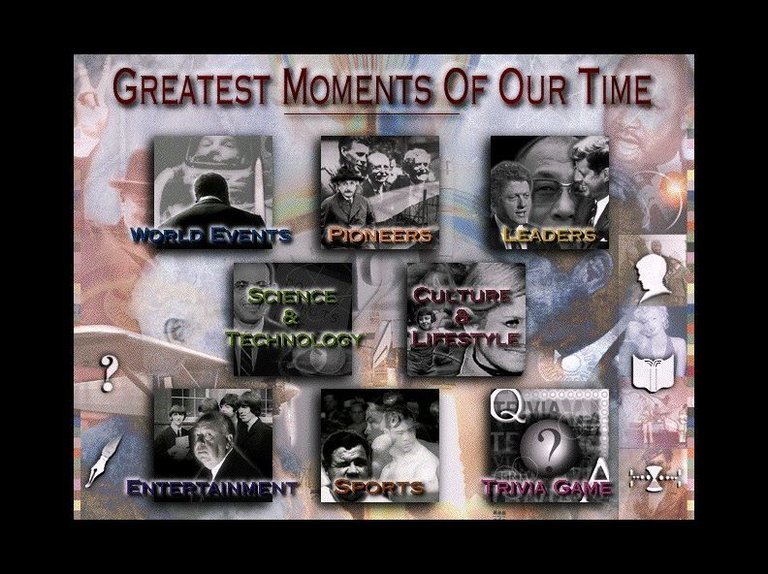
Greatest Moments of Our Time is a 1996 educational CD-ROM reference title that immerses users in iconic 20th-century events across categories like World Events, Pioneers, Leaders, Science & Technology, Culture & Lifestyle, Entertainment, and Sports, featuring archive footage, narrated text articles, and voice-overs. It includes a turn-based trivia quiz game with three difficulty levels, three rounds of five timed multiple-choice questions based on the disc’s content, encouraging players to study the material for higher scores.
Greatest Moments of Our Time: Review
Introduction
Imagine firing up your clunky Windows 95 PC, slotting in a shiny CD-ROM, and being chided by a digital voice: “Go back and do your homework.” This cheeky admonishment from Greatest Moments of Our Time isn’t just a failed quiz taunt—it’s a perfect encapsulation of 1996’s edutainment ethos, where games masqueraded as stern teachers to mask their playful interactivity. Released amid the CD-ROM gold rush, this obscure title from Pantheon Productions Inc. and publisher EMME Interactive SA stands as a forgotten time capsule of multimedia history. chronicling pivotal 20th-century events through archive footage, narrated articles, and a trivia quiz. As a game historian, I argue that Greatest Moments earns its place not as a blockbuster, but as a pioneering interactive archive—bridging encyclopedic software and gaming in an era when “edutainment” promised to revolutionize learning, delivering a surprisingly engaging portal to humanity’s triumphs and tragedies.
Development History & Context
Developed by the relatively small Pantheon Productions Inc. and published by Swiss-based EMME Interactive SA, Greatest Moments of Our Time emerged in 1996 as a hybrid PC/Mac CD-ROM title, targeting Windows 3.1/95, 16-bit Windows, and Macintosh systems. Spearheaded by producer and writer Jean-Pierre Isbouts, with original research and screenplay by Beate Fuchs, the project involved a 19-person credit list reflecting the era’s collaborative multimedia ethos. Key roles included creative director Nori Curtis, art director Kiran Lovejoy, and supervising engineer Tim Perry (a veteran with credits on 60+ games). Film acquisition by Alexandra Drobac-Diagne sourced rare footage from prestigious archives like ABC Video, Archive Films, World Television News, and the National Archives in Washington, D.C., while audio editing by Don Crawford and narration by John H. Mayer (credited simply as John Mayer) polished the presentation.
The mid-90s gaming landscape was defined by technological constraints and explosive opportunity. PCs were transitioning from floppy-disk limitations to CD-ROM’s vast storage (here, ~464 MB of video and audio), enabling “full-motion video” (FMV) titles like The 7th Guest or Phantasmagoria. Educational software boomed with Microsoft’s Encarta and Broderbund’s Where in the World is Carmen Sandiego?, as families adopted multimedia PCs for “edutainment.” Pantheon navigated QuickTime dependencies (requiring ancient versions for compatibility, even today—best emulated in a Win95/98 VM) and mouse-only input, prioritizing accessibility over complexity. The vision? Democratize history via interactivity, countering passive TV documentaries in a pre-internet Wikipedia world. Released in the UK and Europe, it captured Cold War-era reflection post-Berlin Wall, blending U.S.-centric events with global icons like Gandhi and Mandela.
Narrative & Thematic Deep Dive
Lacking a traditional plot or characters, Greatest Moments weaves its “narrative” through eight curated categories, each a vignette of 20th-century milestones. The structure mimics a digital museum: select a topic, and a small left-side video window plays black-and-white or color archive footage, synced to a right-side text article read aloud by Mayer’s measured narration. This triad—visuals, text, voice—creates emergent storytelling, turning facts into emotional arcs.
World Events anchors geopolitics: Yalta Conference’s wartime haggling, John Glenn’s orbital triumph, Berlin Wall’s fall, Khrushchev’s U.S. visit, Israeli-PLO accords, De Gaulle in Germany, Kennedy’s European tour, and his funeral’s somber pageantry. Themes of division-to-unity recur, humanizing Cold War brinkmanship.
Pioneers celebrates individualism: Lindbergh’s solo flight, Wright Brothers’ takeoff, Ford’s assembly line, Earhart’s daring, Keller’s perseverance, Einstein-Edison’s genius. Here, innovation triumphs over adversity, with subtle feminist nods via Earhart and Keller.
Leaders spotlights charisma and legacy: Pope Paul VI, George VI’s stuttered resolve, JFK’s vigor, FDR’s fireside chats, Elizabeth & Philip’s pomp, U.S. presidents montage, Gandhi’s nonviolence, Mandela’s reconciliation. Power’s duality emerges—benevolence vs. controversy.
Science & Technology charts progress’s perils: Salk’s polio vaccine, Telstar satellite, bullet trains, contact lenses, heart transplants, Voyager probes, Hubble’s gaze, Hindenburg inferno, jet age, sound barrier breach. Triumph (cures, exploration) clashes with hubris (disasters), foreshadowing ethical tech debates.
Culture & Lifestyle captures zeitgeist: Twiggy’s mod swing, hippies’ rebellion, Hula-Hoop mania, Guggenheim’s abstraction, 1957 fashions, Valley of the Kings digs, modern art’s provocation. Consumerism and counterculture collide, evoking fleeting joy.
Entertainment idolizes icons: Pickford’s silents, Monroe’s allure, Beatles mania, Elvis pelvis, Chaplin tramp, Kelly grace, Welles’ Citizen Kane, Heston epics. Stardom’s mythos underscores escapism’s power.
Sports honors athleticism: Ruth’s slugging, Owens’ Nazi-defying sprints, Louis’ heavyweight reign, Nurmi’s distances, Killy’s slopes. Physical limits pushed, mirroring societal barriers.
Overarching themes—human resilience, progress’s double edge, cultural memory—resonate profoundly. No protagonists, yet collective “our time” fosters shared heritage, prescient for today’s interactive histories like Civilization or Assassin’s Creed.
Gameplay Mechanics & Systems
At its core, Greatest Moments is a turn-based, mouse-driven reference tool with a game-show quiz hook, designed for single-player “learning sessions.” The main menu’s admin icons (likely save/print) flank eight category buttons, promoting non-linear exploration. Selecting one launches the loop: footage auto-plays (pausable?), text scrolls, narration syncs—passive absorption first, then quiz prep.
The star is the Trivia Game, a three-level difficulty quiz (easy/medium/hard) spanning three rounds of five timed multiple-choice questions each (15 total). Pulled directly from disc content, questions test recall (e.g., “What broke the sound barrier?”). Time pressure adds tension; low scores quip “Go back and do your homework!”—motivating revisits—while aces unlock harder playthroughs. No progression beyond scores, but replayability stems from content depth (~dozens of articles).
UI is era-typical: simple, icon-heavy, small video window (QuickTime-limited resolution), readable text. Flaws? No search/index, clunky navigation, VM dependency today. Innovations: Integrated media as “gameplay,” gamifying education pre-Duolingo. Loops are exhaustive yet bite-sized, suiting family use.
World-Building, Art & Sound
No expansive “world”—it’s a menu hub evoking a 90s library archive, with admin icons suggesting bureaucratic order. Atmosphere builds via authenticity: grainy B&W footage (Kennedy funeral’s tears, Hindenburg blaze) immerses like a Ken Burns doc, small window notwithstanding. Art direction (Kiran Lovejoy) favors clean layouts, production stills from Hulton Deutsch, and Associated Production Music’s era-fit tracks/effects—subtle swells for triumphs, dirges for tragedies.
Visuals prioritize historical verisimilitude over polish; low-res suits nostalgia. Sound shines: Mayer’s narration is authoritative yet warm, audio editing crisp despite CD constraints. Collectively, they forge intimacy—Voyager’s cosmic awe or hippies’ vibrancy feels lived-in, elevating “reference” to evocative experience.
Reception & Legacy
Launch reception? Nonexistent in sources—no MobyScore, critic/player reviews on MobyGames (despite 623K+ reviews database), GameFAQs, or Metacritic. One MyAbandonware voter gave 3/5; collected by one Moby user. Commercial fate unknown—likely niche edutainment sales amid Quake/Tomb Raider dominance. Added to MobyGames in 2017 by “piltdown_man,” last updated 2023, it’s abandonware now, downloadable via MyAbandonware/Retrolorean.
Influence? Minimal direct—related titles like Shanghai: Great Moments (1995 mahjong-history hybrid) hint trivia-edu trends, but no citations in modern lists (e.g., Den of Geek’s best stories ignores it). Yet, as precursor to interactive timelines (Europa Universalis, YouTube histories), it pioneered FMV-edutainment. Obscurity underscores 90s CD-ROM ephemerality, but preservation value endures—run it in DOSBox or VM for authenticity.
Conclusion
Greatest Moments of Our Time isn’t a “game” by modern metrics—no levels, bosses, or narratives rivaling Chrono Trigger (a 1995 peer). It’s a multimedia encyclopedia with quiz teeth, flaws (outdated tech, linearity) offset by archival riches and pedagogical charm. In video game history, it claims a niche as 90s edutainment pinnacle: innovative for blending Hollywood-sourced footage with interactivity, humanizing history when internet access was dial-up dream. Definitive verdict: 8/10—essential artifact for historians, nostalgic treasure for retro enthusiasts, proving games can educate without dumbing down. Dust off a VM; homework awaits.