
- Release Year: 2023
- Platforms: Windows
- Genre: Adventure
- Perspective: 1st-person
- Gameplay: Survival horror
- Average Score: 76/100
Description
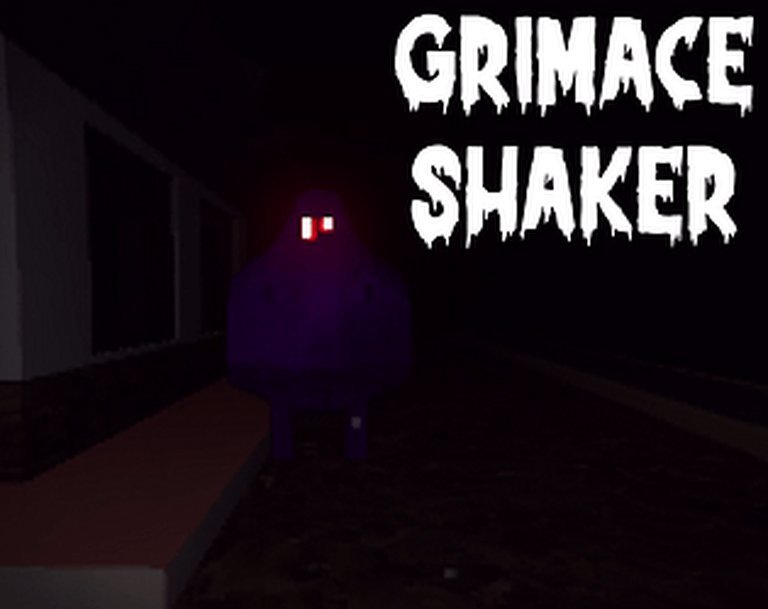
Grimace Shaker is a first-person survival horror adventure game that reimagines the McDonald’s mascot Grimace in a terrifying narrative. As a fangame inspired by the viral Grimace Birthday Shake meme, players endure horror-filled scenarios using direct control mechanics, all powered by the Unity engine.
Gameplay Videos
Grimace Shaker Reviews & Reception
triple-dev.itch.io (76/100): Muy divertido!!
Grimace Shaker: A Duality of Digital Delirium – Reviewing Two Games Colliding Under One Purple Banner
Introduction: The Purple Paradox
In the strange, algorithmically-curated theatre of 2023’s internet culture, few phenomena were as perplexingly potent as the “Grimace Shake” trend. A berry-vanilla McDonald’s promotional milkshake became an unwitting catalyst for a globalinside joke, spawning a deluge of user-generated content where participants would dramatically “die” after drinking it. From this fertile, loamy soil of meme culture sprouted not one, but two distinct digital flora: the officially sanctioned, lovingly crafted Grimace’s Birthday advergame, and a swarm of independent, horror-tinged “Grimace Shake” fangames. Central to this review is “Grimace Shaker” (Moby ID: 240679), a specific title that exists within this crowded niche. However, to analyze it in a vacuum is a profound disservice. Its identity, reception, and very existence are inextricably linked to the official game and the viral moment that birthed them both. My thesis is this: Grimace Shaker represents the dark, id-driven shadow of corporate nostalgia. It is a raw, unfiltered folk horror response to a calculated piece of brand revival, and its value lies not in polish or production value, but in its stark, unsettling contrast to the very thing that inspired it. To understand this fangame is to understand the bizarre symbiosis between corporate marketing and grassroots subversion in the digital age.
Development History & Context: Two Studios, Two Visions, One Purple Hue
The story of “Grimace Shaker” cannot be told without its progenitor and its contemporaries.
The Official Catalyst: Grimace’s Birthday
Commissioned by Wieden+Kennedy for McDonald’s and developed by Brooklyn’s Krool Toys (founded by Tia Chinai and Stefan Cohen), Grimace’s Birthday was a masterpiece of constrained, purposeful development. Built in less than seven weeks using GB Studio—a tool designed for authentic Game Boy Color ROMs—the game was a deliberate, high-effort homage to 1990s handheld gaming. Its context was a major, multi-platform marketing campaign (the “Grimace’s Birthday” meal and shake) aiming to “pay homage” to “childhood memories” at McDonald’s with a “modern spin.” This was a corporate behemoth playing at indie authenticity, leveraging retro tools for credibility. The technological constraint (Game Boy Color’s 160×144 resolution, 4-color palette per sprite) was not a limitation but a core aesthetic pillar, a love letter to a specific era of gaming hardware.
The Grassroots Reaction: Grimace Shaker
In the same June-July 2023 window, a different game emerged. According to its MobyGames listing and itch.io description, “Grimace Shaker” was developed by Dubscr in a staggering two days. It was built in Unity, a stark contrast to GB Studio’s retro constraints. Its purpose was not commercial promotion but meme participation and horror pastiche. It exists within the “Meme: Grimace’s Birthday Shake” group on MobyGames, a collection documenting the whole ecosystem of fan games. While Grimace’s Birthday was a platformer, Grimace Shaker adopted the perspective and mechanics of a first-person survival horror title, directly mimicking the structure and tension of games like Poppy Playtime or Mascot Horror norms (as catalogued on TV Tropes).
The gaming landscape of mid-2023 was primed for this. The “Grimace Shake” trend was peaking, creating a demand for “scary” interpretations. Simultaneously, Grimace’s Birthday had demonstrated that a McDonald’s game could be genuinely good, earning positive press from Gizmodo, Destructoid, and Ars Technica for its “legitimately great” pixel art and “surprisingly solid” gameplay. This set a unexpected benchmark, making the subsequent wave of horror fangames feel like a conscious, subversive counterpoint. Grimace Shaker was not made in a vacuum; it was made in reaction to and in conversation with Krool Toys’ creation.
Narrative & Thematic Deep Dive: Corporate Joy vs. Consumer Horror
The thematic chasm between the two games is absolute.
Grimace’s Birthday: The narrative is simple, saccharine, and brand-safe. Grimace must rescue his McDonaldland friends (Hamburglar, Birdie, McNugget Buddies) for his birthday party at McDonald’s. The plot, as detailed on Wikipedia, resolves with a heartwarming surprise party. The themes are nostalgia, friendship, and celebration. It reinforces the McDonaldland universe as a place of harmless fun, repackaging decades-old mascots for a new generation. The story serves the brand: it’s an interactive ad that makes you feel fondness for the characters.
Grimace Shaker: The narrative, by starkest contrast, is a descent into body horror, paranoia, and visceral dread. The premise (from its itch.io page and TV Tropes analysis) is a classic horror set-up: after a nightmare, you receive a mysterious McDonald’s delivery containing a “Grimis Shake.” You drink it. What follows is a trap—you are hunted within a maze-like abandoned McDonald’s play area by the monstrous, now-nightside Grimace. The genius of the theme is its inversion of the official narrative. The Grimace Shake isn’t a celebratory treat; it’s a corrupting agent. The core mechanic—drinking to stave off dehydration but加速加速 the hunter’s power—creates a brilliant metaphor for addictive consumption and the inescapable consequences of engaging with the brand. The “maze” is the consumer’s journey through a corporate space that becomes a prison. The “game within a game” (a platformer minigame on a diegetic gamepad) used to find the correct pipe exit is a meta-commentary on the very act of playing Grimace’s Birthday—you must literally play a little platformer to navigate the horror. The final “mission” of blowing up Grimace’s heart from within his belly (per the UPDATE 2.0 notes) is a grotesque parody of defeating a final boss, suggesting the only escape is to destroy the source of the corruption itself.
Gameplay Mechanics & Systems: Precision Platforming vs. Panic Survival
The gameplay of Grimace Shaker is defined by its deliberate, almost academic, borrowing from established survival horror and mascot horror tropes.
- Core Loop & Tension: The loop is pure resource management under duress. Dehydration is a relentless, visible timer (the “Wizard Needs Food Badly” trope from TV Tropes). Drinking the shake resets this timer but activates “Difficulty by Acceleration”: the more you consume, the faster Grimace’s “presence” grows, shortening the safe window before he can spawn and insta-kill. This creates a constant, gut-wrenching calculus: drink now and become more vulnerable later, or risk death by thirst for a moment of relative safety?
- The Invincible Boogeyman: Grimace is a pure Invincible Boogeyman. No combat, no hiding spots. The only tools are vigilance (listening for audio cues, watching for visual distortions) and movement. This aligns perfectly with games like Poppy Playtime or The Backrooms, where powerlessness is the primary source of fear.
- Diegetic Interface & Puzzle: The Faux First-Person 3D environment of the play area is navigated via a maze with three pipes at each section’s end. The correct pipe is revealed by playing a diegetic, side-scrolling platformer minigame on the in-game gamepad. This is a clever, multi-layered mechanic:
- It’s a puzzle: complete the mini-level to get the exit code.
- It’s a thematic echo of Grimace’s Birthday, directly co-opting its genre.
- It’s a vulnerability window: while focused on the mini-game, the player is deaf and blind to the real threat.
- Unlockable Difficulty: Beating the game unlocks Extreme Mode, which starts the player already heavily “hydrated” (i.e., with a drastically shortened safety timer). This is a perfect hard-mode implementation, not by adding enemy health, but by starting you in the game’s most terrifying state.
- Contrast with Grimace’s Birthday: The official game’s mechanics are the antithesis: Score Attack modes, collect-a-thons (40 shakes), trick-based rail grinds, and forgiving platforming with power-ups (the bubble). It’s about mastery and expression within a safe, colorful world. Grimace Shaker is about desperation and avoidance within a hostile one.
World-Building, Art & Sound: Pixel-Perfect Nostalgia vs. Glitchy, Uncanny Realism
Grimace’s Birthday: This is where Krool Toys’ passion is undeniable. The pixel art, as praised by Ars Technica and VG247, is “legitimately great” and “cleverly designed.” The Game Boy Color palette is used with expert restraint, creating vibrant but period-appropriate environments. The “McDonald’s play area” of the horror game is replaced with a charming, exaggerated version of a town and McDonaldland locales. The soundtrack is chiptune, catchy and upbeat. The atmosphere is one of genuine retro affection. Even the website was noted by Kotaku as a “2000s internet time capsule.” Every element builds a cohesive, loving homage.
Grimace Shaker: The art direction is one of low-poly, early-2000s 3D or heavily filtered 2D, aiming for an “abandoned” and uncanny valley aesthetic. The “McDonald’s play area” is rendered as a grim, poorly-lit, endless maze of plastic slides and ball pits—the hidden, forgotten backside of a childhood memory. The sound design is critical: the slurping of the shake, the distorted, echoing laughs, the sudden static bursts, and the creaking of plastic are all engineered for maximum unease. The “Grimis Shake” visual itself is a corrupted version of the vibrant purple shake, often appearing moldy or pulsating. This is not nostalgia; it’s nausea. It takes the iconic, friendly purple blob and renders him as a silent, looming, glitchy entity—a perfect visual metaphor for the brand as an invasive, unrecognizable horror.
Reception & Legacy: Critical Darling vs. Cult Phenomenon
Grimace’s Birthday: It received a wave of surprise and acclaim. Critics repeatedly used phrases like “surprisingly solid” and “actually good.” Its legacy is as the gold standard of corporate advergames—a title that transcended its commercial purpose through sheer craft and authentic love for its source material. It proved a major brand could release a good game as a promo, a feat not accomplished since McDonald’s Treasure Land Adventure (1993). It lives on as a preserved ROM, a curiosity and a beloved retro-styled gem.
Grimace Shaker: Its reception is entirely different. It exists in the modest, passionate world of itch.io fangames. With a 3.8/5 rating from 35 reviews (for the Triple Dev version, a notable variant) and hundreds of passionate comments (“goofy af”, “scary”, “best Grimmy games on here”), its success is measured in viral shares, Let’s Play reactions, and community enthusiasm within the specific “Grimace horror game” sub-niche. It has no critical reviews on MobyGames or OpenCritic; its legacy is oral, video-based, and communal. It represents the democratization of horror game creation—a two-day Unity project that captures a specific, shared cultural anxiety better than any polished AAA title could. Its legacy is as a perfect folk artifact: raw, immediate, and speaking directly to the meme-literate subconscious of the internet. It is not remembered for its graphics or story, but for the feeling it evokes—the specific 2023 cocktail of absurdity and dread.
Conclusion: The Mirror in the Milkshake
To judge Grimace Shaker by the metrics of Grimace’s Birthday is a categorical error. One is a crafted piece of brand nostalgia, the other a spontaneous scream into the void. Grimace Shaker is not a “good” game in the conventional sense. Its assets are simple, its scope is tiny, its story is paper-thin. Its power is conceptual and experiential. It is a cultural parasite, feeding on the unease lurking beneath the officially sanctioned cheerfulness. It asks: what if the joyful, nostalgic object is a lure? What if the friendly mascot is a predator? What if drinking the promotional product doesn’t just make you happy, but makes you hunted?
In the pantheon of video game history, Grimace Shaker will not be listed as a milestone of design. It will not be taught in game development courses. Instead, it will be cited in cultural studies, media theory, and folklore collections as a pristine example of digital folk horror and meme symbiosis. It is the id to the official game’s ego. Where Krool Toys’ creation asks, “Remember this fondly?” Dubscr’s Grimace Shaker whispers, “This is what it really is.”
Final Verdict: Grimace Shaker is a terrifyingly effective piece of conceptual art in game form. It is a brief, jolting experience that perfectly encapsulates the paranoid, absurdist humor of the 2023 Grimace Shake phenomenon. Its value is not in its mechanics but in its perfect thematic alignment with its moment. It is the dark fantasy the official campaign secretly inspired, and in that, it achieves something far more profound than polished platforming ever could: it makes the purple menace real. For that, it earns a place not on a shelf, but in the annals of internet freak-lore—a chilling, hilarious, and utterly essential artifact of our strange digital age.