
- Release Year: 1993
- Platforms: Arcade, Genesis, Linux, Macintosh, Windows
- Publisher: Bitwave AB, Tengen Inc., Tengen Ltd., Toaplan Co., Ltd.
- Developer: Toaplan Co., Ltd.
- Genre: Action, Scrolling shoot ’em up
- Perspective: Top-down
- Game Mode: Single-player
- Gameplay: Bombs, Power-ups, Shooter, Vertical-scrolling
- Setting: Sci-fi, Space
- Average Score: 80/100
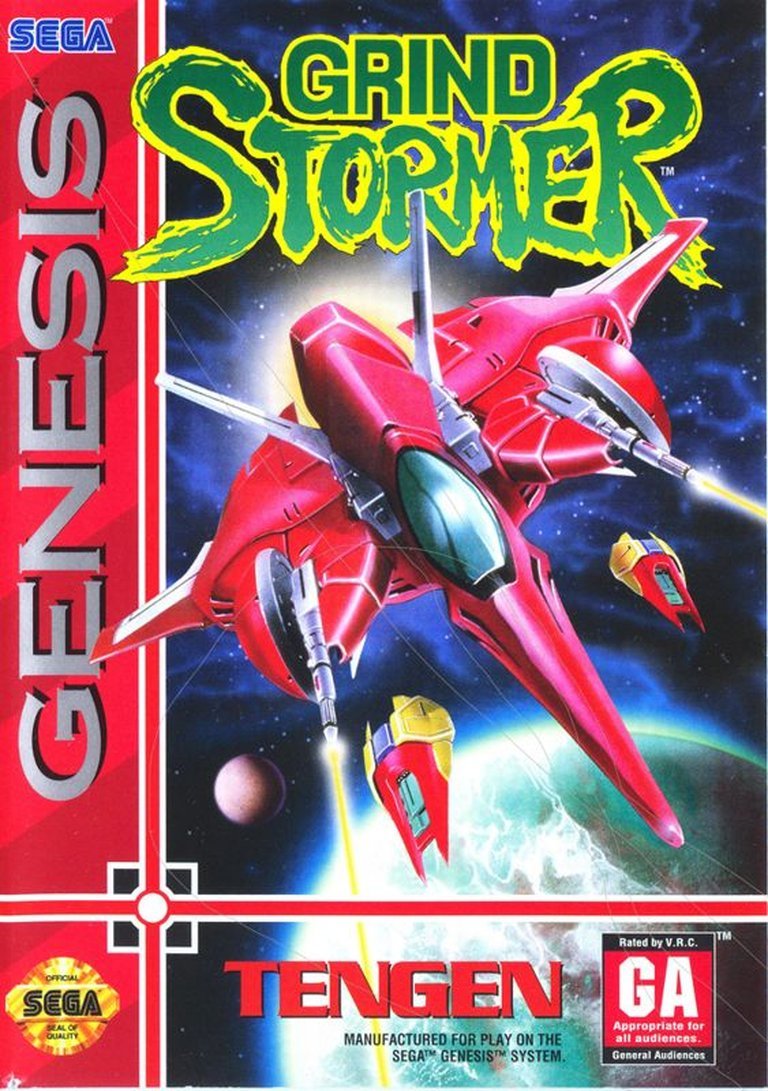
Description
Grind Stormer is a fast-paced, top-down, vertically-scrolling shooter originally released in arcades in 1993, featuring two distinct gameplay modes: Grind Stormer and V Five. In Grind Stormer, players control a high-speed ship with unlimited firing and collectable bombs for screen-clearing attacks, while V Five adopts a Gradius-style power-up system where tokens are spent to upgrade speed, weapons, and shields. Both modes offer the same levels and enemies but differ in strategy, with Grind Stormer emphasizing speed and immediate power-ups, and V Five requiring tactical decisions on power-up allocation. The game is known for its intense bullet-hell action, vibrant 2D visuals, and challenging gameplay, making it a standout in the shoot ’em up genre.
Gameplay Videos
Where to Buy Grind Stormer
Grind Stormer Free Download
Grind Stormer Mods
Grind Stormer Guides & Walkthroughs
Grind Stormer Reviews & Reception
metacritic.com (80/100): A triumphant return to form for the series.
metacritic.com (80/100): Toaplan’s 1993-released vertically scrolling shmup Grind Stormer, considered a successor to Slap Fight, has been one of the biggest surprises so far from Bitwave’s releases.
Grind Stormer Cheats & Codes
Genesis/Mega Drive (USA)
Enter codes using Game Genie or Action Replay.
| Code | Effect |
|---|---|
| RE3A-A60N | Enable Debug Mode Settings In The Training Selection In Options |
| AE3A-A2GW | Enable Debug Mode Settings In The Training Selection In Options |
| AT3A-AAGY | Enable Debug Mode Settings In The Training Selection In Options |
| AJ3A-A480 | Enable Debug Mode Settings In The Training Selection In Options |
| JE3A-AE02 | Enable Debug Mode Settings In The Training Selection In Options |
| AA2T-AAHW | Enable Free play Credit Limit Option |
| AA2T-AAGY | Enable Free play Credit Limit Option |
| AYYA-AAJT | Free play Credit |
| ALHT-AA3E | Freeze Time Continue |
| RHGT-A60W | Hit Anywhere |
| BXGT-AA9E | Hit Anywhere |
| RHJT-A6VG | Hit Anywhere |
| AC2A-AAH4 | Infinite Bombs |
| AL2A-AA92 | Infinite Bombs |
| ALHT-AA5W | Infinite Credits |
| ADAA-AACR | Infinite Lives |
| SDAA-BCWN | Infinite Lives |
| FFD944:0009 | Infinite Ships |
| R1LA-A6Z4 | Invincibility |
| FF00D94D:00FF | Invincibility |
| RHHA-A6VT | One Hit Kill |
| FFD946:0006 | Infinite ‘B’ (Explosive Blasts) |
| FFD947:06 | Infinite ‘B’ (Explosive Blasts) |
Grind Stormer: A Definitive Retrospective on Toaplan’s Underrated Shooter Masterpiece
Introduction: The Last Roar of a Dying Studio
In the twilight of the golden age of arcade shooters, as the industry teetered on the precipice of 3D revolution, Grind Stormer (known as V・V in Japan) emerged as a defiant, brilliant swan song from Toaplan—a studio that had already cemented its legacy with classics like Truxton, Twin Cobra, and Batsugun. Released in 1993, Grind Stormer was more than just another vertically scrolling shooter; it was a transitional artifact, a bridge between the methodical, power-up-driven shooters of the late ’80s and the manic, bullet-hell frenzy that would dominate the late ’90s. It was also the professional debut of Tsuneki Ikeda, the programmer who would later co-found Cave and redefine the genre with DonPachi and DoDonPachi.
This review aims to dissect Grind Stormer in exhaustive detail, exploring its dual identities (Grind Stormer and V・V), its mechanical innovations, its narrative quirks, and its troubled yet enduring legacy. Through interviews, critical reception, and modern reappraisals, we will argue that Grind Stormer is not merely a footnote in shmup history but a pivotal, underappreciated masterpiece that deserves reevaluation.
Development History & Context: The Birth of a Bullet Hell Prototype
The Studio in Transition
By 1993, Toaplan was a studio in flux. Founded in 1984, it had spent nearly a decade perfecting the art of the scrolling shooter, but financial troubles loomed. The company would declare bankruptcy the following year, leading to the formation of offshoot studios like Cave, Gazelle, and Takumi Corporation. Grind Stormer was developed by a small team of newcomers, including Ikeda, who were given a “training exercise” by senior staff: a sample shooter engine to build upon. This engine, as Ikeda later revealed in interviews with Monthly Arcadia and Shmuplations, contained an unusually small hitbox for the player’s ship—a feature that went unnoticed until playtesting.
The senior programmers at Toaplan, including those who had worked on Truxton II, were impressed by how the small hitbox enhanced the bullet-dodging experience. Ikeda and his team were encouraged to lean into this design, which inadvertently laid the groundwork for the “bullet hell” subgenre. The game was originally titled Bakuretsu Wing before being rebranded as V・V in Japan and Grind Stormer in the West.
Technological Constraints and Creative Workarounds
Grind Stormer was one of the last Toaplan games to use FM synthesis for its soundtrack, a decision driven by business rather than artistic choice. Composer Masahiro Yuge, working under a mere 128KB memory limit for the sound driver, had to employ clever programming tricks to maximize the hardware’s potential. The result was a soundtrack that, while not as lush as later PCM-based scores, pulsed with a raw, urgent energy that perfectly complemented the game’s frenetic action.
The arcade hardware also imposed limitations on sprite and bullet counts, but the team pushed these boundaries relentlessly. The screen is often filled with so many projectiles that it borders on visual overload, yet the game remains playable—a testament to the precision of its design.
The Gaming Landscape of 1993
The early ’90s were a period of rapid evolution for shooters. Gradius III (1989) and R-Type II (1989) had already expanded the genre’s visual and mechanical complexity, while Raiden (1990) and Strikers 1945 (1993) introduced more aggressive bullet patterns. Meanwhile, fighting games like Street Fighter II (1991) and Mortal Kombat (1992) were siphoning attention away from shooters in arcades.
Grind Stormer arrived at a crossroads. It wasn’t the first game to experiment with dense bullet patterns—that honor arguably belongs to Batsugun (1993), also by Toaplan—but it refined the concept in a way that felt both accessible and punishing. Its dual gameplay modes (V・V and Grind Stormer) offered players a choice between strategic depth and chaotic intensity, a rarity in the genre at the time.
Narrative & Thematic Deep Dive: A Game Within a Game
The Arcade Version: A Meta Commentary on Addiction
The arcade version of Grind Stormer is framed as a “game within a game.” Set in the year 2210, it follows a government agent tasked with investigating Grind Stormer/V・V, a hyper-realistic VR arcade machine that has ensnared players in its virtual world. Those who fail to beat the game are trapped inside it, unable to return to reality. The agent’s mission is to beat the game, rescue the abducted players, and uncover the machine’s true purpose.
This meta-narrative is more than just window dressing. It reflects the game’s own punishing difficulty and the addictive nature of high-score chasing. The VR conceit also allows for a surreal, almost dreamlike progression of stages, which shift from mechanical landscapes to organic, alien environments. The game’s final stages, in particular, feel like a descent into a digital underworld, reinforcing the idea that the player is fighting not just enemies, but the game itself.
The Genesis Version: A Conventional Sci-Fi Rescue Mission
The Sega Genesis port, localized by Tengen, jettisons the meta-narrative in favor of a more straightforward sci-fi premise. Players take on the role of the last surviving pilot of the Terran Defense Force, battling the Zeta Reticulli, an alien race invading Earth. This version lacks the arcade original’s thematic depth but retains its mechanical brilliance.
The disparity between the two narratives highlights the challenges of localization in the ’90s. While the arcade version’s story was ambitious and self-referential, the Genesis version opted for a safer, more marketable premise. This shift also reflects the different audiences: arcade-goers were more likely to appreciate the meta-commentary, while console players expected a traditional shooter experience.
Themes of Obsession and Mastery
At its core, Grind Stormer is a game about obsession. The arcade narrative literalizes this with its VR trap, but even the Genesis version’s alien invasion plot serves as a metaphor for the player’s struggle against the game’s relentless difficulty. The loop system, where completing the game once unlocks a harder second loop, reinforces this theme. Beating Grind Stormer isn’t just about skill—it’s about endurance, pattern recognition, and an almost masochistic willingness to keep trying.
The game’s scoring system, with its hidden bonuses and secret 1UPs, further encourages obsessive play. Like Dogyuun and Gun Frontier, Grind Stormer rewards players who explore every inch of its stages, memorize enemy spawns, and exploit its mechanics. This design philosophy would later become a hallmark of Cave’s shooters, where mastery is as much about knowledge as it is about reflexes.
Gameplay Mechanics & Systems: Dual Identities, One Brutal Experience
The Two Modes: Strategy vs. Survival
Grind Stormer is unique in that it offers two distinct gameplay modes, each with its own power-up system and pacing:
-
V・V (Japanese Version):
- Power-Up System: A Gradius-style power meter at the bottom of the screen. Players collect diamond-shaped tokens to advance the meter, then press a button to activate the selected upgrade.
- Weapons:
- Shot: A spread shot that can be focused into a powerful beam.
- Search: Homing drones that lock onto enemies.
- Missile: Non-homing rockets with high firepower.
- Shield: A single-use shield that protects against one hit.
- Pacing: Slower, more methodical. Players must plan their upgrades carefully, balancing speed, firepower, and defense.
-
Grind Stormer (Western Version):
- Power-Up System: Instant, direct upgrades. Players collect icons that immediately enhance their ship’s weapons or speed.
- Bombs: A screen-clearing bomb that also acts as a temporary shield.
- Pacing: Faster, more chaotic. The emphasis is on survival and quick reactions rather than long-term strategy.
The two modes cater to different playstyles. V・V rewards patience and foresight, while Grind Stormer is all about instinct and adaptability. Both are brutally difficult, but in different ways.
Core Mechanics: Precision and Punishment
- Hitbox and Movement: The ship’s tiny hitbox is both a blessing and a curse. It allows for precise dodging but demands pixel-perfect accuracy. The movement is tight and responsive, a hallmark of Toaplan’s shooters.
- Wing Options: The player’s ship is flanked by two (or four, when powered up) wing options that fire in sync with the main weapon. Their behavior changes based on the equipped weapon:
- Shot Mode: Wings adjust their angle based on the ship’s vertical movement, creating a dynamic spread.
- Missile Mode: Wings follow the ship in a “snake” pattern, firing rockets.
- Search Mode: Wings act as homing drones, locking onto enemies.
- Scoring and Secrets: The game is filled with hidden bonuses, from point capsules that cycle through values to secret 1UP locations. Mastering these is essential for high scores and extra lives.
The Loop System: A Test of Endurance
Like many Toaplan shooters, Grind Stormer loops after the final stage. The second loop is significantly harder, with denser bullet patterns and “suicide bullets” (extra projectiles spawned when enemies are destroyed). Beating the second loop unlocks the true ending, a rare feature in arcade shooters of the era.
This loop system is both a blessing and a curse. It extends the game’s lifespan but also amplifies its difficulty, making it accessible only to the most dedicated players. The lack of a proper ending for casual players was a common criticism in contemporary reviews, but it also added to the game’s cult appeal.
The Genesis Port: A Flawed but Faithful Adaptation
The Sega Genesis port, while commendable for including both V・V and Grind Stormer modes, suffers from technical limitations:
– Sprite Flicker: The Genesis hardware struggles to render the game’s dense bullet patterns, leading to frequent flickering that can obscure projectiles.
– Color Palette: The reduced color palette results in recolored sprites and less vibrant visuals.
– Audio: The FM soundtrack is compressed and lacks the punch of the arcade original.
– Difficulty: The port is arguably harder due to choppier movement and less precise hit detection.
Despite these flaws, the Genesis version remains a sought-after collector’s item, with copies fetching over $160 on the secondary market. Its rarity is due to a defective cartridge print run, adding to its mystique.
World-Building, Art & Sound: A Feast for the Senses
Visual Design: Clarity in Chaos
Grind Stormer‘s art direction is a masterclass in readability. Despite the screen often being filled with bullets, enemies, and explosions, the visual hierarchy is impeccable:
– Enemy Design: Each enemy type is distinct, with clear silhouettes and color-coding to indicate behavior.
– Bullet Patterns: Projectiles are brightly colored and easy to track, even in the densest moments.
– Backgrounds: The stages shift between mechanical, organic, and surreal environments, each with its own aesthetic identity. The later stages, in particular, feel like a descent into a digital hellscape.
The Genesis port, while visually inferior, retains the core design principles. The sprite flicker is its biggest flaw, but the underlying artistry remains intact.
Sound Design: FM Synth at Its Finest
Masahiro Yuge’s soundtrack is a standout feature. Working within the constraints of FM synthesis, he crafted a score that is both urgent and melodic. Key tracks include:
– Stage 1 Theme: A driving, upbeat tune that sets the tone for the game’s relentless pace.
– Boss Theme: A heavy, funk-infused track that amplifies the tension of boss battles.
– Stage 4 Theme: A darker, more atmospheric piece that reflects the game’s shift into surreal territory.
The sound effects are equally impressive, with satisfying weapon sounds and explosive feedback. The Genesis port’s audio, while compressed, retains the essence of the arcade original.
Atmosphere: A Digital Nightmare
Grind Stormer excels at creating a sense of escalating tension. The early stages feel like a standard shooter, but by Stage 4, the game descends into madness. The bullet patterns become overwhelming, the music grows more intense, and the backgrounds shift from mechanical to organic to outright alien.
This progression is no accident. The game’s meta-narrative—where players are trapped in a VR game—is reinforced by the visual and auditory design. The later stages feel like a digital nightmare, a place where the rules of reality no longer apply. It’s a testament to the game’s world-building that it can evoke such a strong atmosphere without a single line of dialogue.
Reception & Legacy: A Game Ahead of Its Time
Contemporary Reception: Mixed but Respectful
Grind Stormer was well-received in arcades, with Game Machine listing it as the eighth most-popular arcade game in Japan in April 1993. Critics praised its fast-paced action, tight controls, and challenging gameplay. However, the Genesis port received more mixed reviews:
– Positive Reviews:
– Mean Machines (82%): “A solid—if unimaginative—shoot ’em up… nevertheless welcome.”
– GamePro (80%): “You’ll still be puttin’ your nose to the Grindstormer for hours.”
– Power Unlimited (80%): “A straightforward shooter with increasing difficulty.”
– Mixed Reviews:
– Electronic Gaming Monthly (68%): “Good shooter with standard weapons and power-ups, but no new gimmicks.”
– MAN!AC (67%): “Solid vertical scroller without spectacular highlights… difficulty is unfair at times.”
– Negative Reviews:
– The Video Game Critic (42%): “Ugly graphical glitches and lame music… won’t appeal to casual gamers.”
– Sega-16.com (60%): “Sprite break-ups hurt the game the most… hardcore fans will get a kick out of it.”
The Genesis port’s technical flaws, particularly the sprite flicker and difficulty spikes, were frequent points of criticism. However, even detractors acknowledged its appeal to hardcore shooter fans.
Retrospective Reappraisal: A Cult Classic
In the decades since its release, Grind Stormer has undergone a critical reevaluation. Modern reviewers and shmup enthusiasts now recognize it as a pivotal title in the evolution of the genre:
– TouchArcade (2024, 80%): “One of the biggest surprises from Bitwave’s releases… the gameplay is the real star.”
– Den of Geek: “One of the titles from Toaplan which intensively pushed the formula established by their previous endeavors.”
– Time Extension: “Historically significant to the evolution of the bullet hell format.”
The 2024 PC re-release by Bitwave Games, which includes both V・V and Grind Stormer modes with modern quality-of-life features (rewind, save states, leaderboards), has introduced the game to a new generation of players. This version is widely regarded as the definitive way to experience Grind Stormer, free from the technical limitations of the Genesis port.
Influence on the Genre
Grind Stormer is often cited as an early example of a “manic shooter,” a subgenre that would later be perfected by Cave with DonPachi and DoDonPachi. Its small hitbox, dense bullet patterns, and emphasis on precision dodging set a template that many later shooters would follow.
The game’s dual modes also influenced later titles. Gradius V (2004), for example, offered multiple difficulty settings and power-up systems, allowing players to tailor the experience to their preferences. Grind Stormer‘s approach to weapon variety and strategic depth can be seen in modern shooters like Jamestown and Danmaku Unlimited 3.
The Legacy of Toaplan
Toaplan’s bankruptcy in 1994 marked the end of an era, but its legacy lives on through its offshoot studios. Cave, in particular, carried forward the design philosophies seen in Grind Stormer, refining them into the bullet-hell masterpieces of the late ’90s and early 2000s.
Today, the rights to Grind Stormer and many other Toaplan IPs are owned by Tatsujin, a company founded by Masahiro Yuge in 2017. Tatsujin’s acquisition of these properties has led to modern re-releases and compilations, ensuring that Toaplan’s games remain accessible to new audiences.
Conclusion: A Masterpiece of Transition
Grind Stormer is a game of dualities. It is both a product of its time and a harbinger of the future. It is a game that rewards strategy and instinct in equal measure. It is a narrative about obsession and a mechanical test of endurance. It is a cult classic that was overlooked in its day but revered in retrospect.
In the pantheon of shooters, Grind Stormer occupies a unique space. It is not as polished as R-Type or as iconic as Gradius, but it is arguably more influential than either. It is the missing link between the classic shooters of the ’80s and the bullet-hell frenzy of the ’90s. It is a game that demands respect, not just for its difficulty, but for its ambition and innovation.
For modern players, the 2024 PC re-release is the definitive way to experience Grind Stormer. It preserves the game’s original challenge while adding the quality-of-life features that make it accessible to a new generation. Whether you’re a hardcore shmup fan or a curious newcomer, Grind Stormer is a game that deserves your attention.
Final Verdict: Grind Stormer is a transitional masterpiece, a brutal yet brilliant shooter that bridges the gap between classic and modern design. It is essential playing for any fan of the genre and a testament to Toaplan’s enduring legacy. 9/10