
- Release Year: 2011
- Platforms: Windows
- Publisher: Headup Games GmbH & Co. KG
- Developer: Silent Dreams GbR
- Genre: Role-playing
- Perspective: 3rd-person
- Game Mode: Single-player
- Gameplay: Ability unlocking, Action points, Exploration, Faction choices, Hexagonal grid, Questing, Turn-based combat
- Setting: Fantasy
- Average Score: 55/100
Description
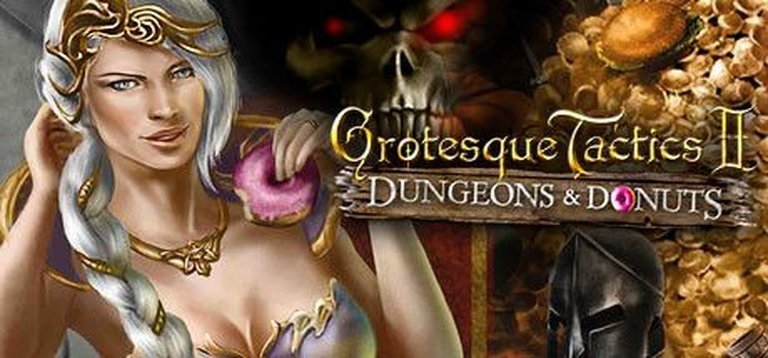
Grotesque Tactics II: Dungeons & Donuts is a humorous fantasy RPG that picks up after the first game, where a mysterious mist teleports people into grim catacombs. Players control Drake as they recruit up to six quirky companions, engage in tactical turn-based combat on hexagonal fields with action points and unique abilities, and complete quests for three rival guilds—mercenaries, elves, and Holy’s Groupies—with choices that subtly affect the story and ending, all wrapped in bizarreSituations and pop-culture references.
Gameplay Videos
Where to Buy Grotesque Tactics II: Dungeons & Donuts
Grotesque Tactics II: Dungeons & Donuts Patches & Updates
Grotesque Tactics II: Dungeons & Donuts Reviews & Reception
metacritic.com (48/100): Even the best moments of parody are undermined by the fact that it simply isn’t as good as the games it mocks. Shame.
Grotesque Tactics II: Dungeons & Donuts Cheats & Codes
PC
During gameplay, type ‘ZAPHOD’ (case-sensitive) to open the developer console. Then enter the cheat code and press Enter. After the console has been opened once, it can be reopened by pressing the ‘~’ (tilde) key.
| Code | Effect |
|---|---|
| god | God mode |
| set charlevel |
Set character level |
| healall | Heal group |
| kill | Kill selected target |
| goto |
Teleport selected character to other indicated character |
| toggle important | Disable dialogs |
Grotesque Tactics II: Dungeons & Donuts: A Flawed but Fervent Love Letter to RPGs
Introduction: The Jester in the Dungeon
In the crowded annals of indie role-playing games, few titles wear their heart—and their absurdity—on their sleeve quite like Grotesque Tactics II: Dungeons & Donuts. Released in November 2011 by the German studio Silent Dreams, this sequel arrived as a deliberate, if uneven, continuation of its predecessor’s mission: to parody the conventions of the tactical RPG genre while simultaneously embracing them. The game’s thesis is clear from its title and premise: it intends to be a grotesque, humorous, and mechanically familiar romp through fantasy dungeon tropes, all wrapped in a distinctive European indie sensibility. Its legacy, however, is one of profound division. Critics largely dismissed it as a shallow, bug-ridden imitation, while a cult of players embraced its chaotic charm and unapologetic silliness. This review posits that Grotesque Tactics II is a fascinating case study in ambition constrained by budget, a game whose palpable love for the genre it satirizes is perpetually at war with its technical and design shortcomings. It stands not as a forgotten classic, but as a compelling, contradictory artifact of early 2010s indie development—a game that is frequently exasperating yet impossible to hate.
Development History & Context: The Dreams of a Small Studio
The Studio and Vision: Silent Dreams, a small German development collective led by Creative Director Rayk Kerstan and CTO Carsten Edenfeld, was a studio operating on a shoestring budget but with outsized genre affection. Their stated goal, evident in both Grotesque Tactics: Evil Heroes (2010) and its sequel, was to create a “classic PC RPG” experience infused with a specific, irreverent brand of humor drawing from Monkey Island, Monty Python, and a deep well of RPG in-jokes. The choice of the Havok Vision Engine (also used in games like Gothic 3) was pragmatic—a licensed middleware solution for a team lacking the resources for a custom engine. This technical foundation, while providing functional 3D graphics, would also prove to be a source of the game’s notorious stability issues.
The 2011 Gaming Landscape: The game emerged in a unique period for RPGs. The late 2000s/early 2010s saw a resurgence of classic isometric and tactical RPGs (e.g., The Banner Saga, Divinity: Original Sin was on the horizon), but the market was still dominated by big-budget Western action-RPGs (Skyrim, Dragon Age II) and Japanese imports. For a small European team, carving out a niche meant leaning into a distinct identity. Grotesque Tactics II positioned itself explicitly against the “serious” fantasy of its contemporaries, promising a comedy-first experience. Its publisher, Headup Games, was a significant German indie publisher known for titles like Trine and Dead Cells, providing crucial distribution but not the QA infrastructure of a major studio.
Constraints and Consequences: The development history is littered with red flags that translate directly into the final product. The credits list 42 developers and 540 “thanks,” a common indie structure suggesting a core team augmented by freelancers and community help. The reliance on a small team for design (Kerstan), programming (Edenfeld, Hillebrandt), art (Böhm, Rentsch, Menkhoff), and writing (Hillebrandt) meant a monumental task. The result was a game visibly stretched thin: a functional but ugly 3D engine, inconsistent voice acting (utilizing notable voice actors like Melissa Hutchison and Cissy Jones, but also likely many unknowns), and a litany of bugs reported at launch and in post-release patches (notably v1.6.8 in March 2012). The most damning critic review, from GameStar (Germany), lamented being unable to complete the game due to bugs—a critical failure for any RPG, but a near-catastrophic one for a title banking on player endurance of its quirks.
Narrative & Thematic Deep Dive: Satire with a Side of Sleaze
Plot and Structure: The narrative is simplicity itself, serving as a skeleton for the game’s humor and quests. Picking up immediately after the first game, the victory over the “Dark Church” is interrupted by a mysterious “killing fog” that teleports citizens into the catacombs. The protagonist, Drake, must recruit a party of up to six misfits from three squabbling factions—the “heroic” Knights of Glory, “shady” mercenaries, and “arrogant” high elves (whose sub-faction is the fan club “Holy’s Groupies”)—to survive and confront the new threat. The campaign is structured around base-building and quest-giving, with the overarching plot of escaping the catacombs and stopping the “awakening of dark forces” serving as a thin through-line.
Characters and Dialogue: The Engine of Humor: The game’s lifeblood is its dialogue and character interactions. Grotesque Tactics II derives its identity from a relentless, referential comedy that targets:
1. RPG Tropes: Endless fetch quests, tiered loot, character archetypes (the holy avatar, the tortured demon, the bubbly maiden), and class systems.
2. Specific Games: The Steam store page explicitly mentions parodying The Elder Scrolls IV: Oblivion, Gothic, and The Lord of the Rings. References to Portal (portal guns), Super Mario (candy canes as weaponized items), and Baldur’s Gate (clickable NPC barks) are pervasive.
3. Pop Culture & Absurdity: From “hippie grub” and “zombie cocktail” cooking recipes to the very concept of “Holy’s Groupies,” the humor thrives on the juxtaposition of high fantasy with modern, often crude, sensibility.
Thematic Tension and the Problem of Tone: This is where the game reveals its central, divisive contradiction. The first game is described by one reviewer as “sweet” in its satire. The sequel, however, pivots heavily toward what multiple critics (GameSpot, 4Players, PC Gamer UK) call “misogynist humor” and “sleazy” sex jokes. Quest items like a “candy cane” for the angel Angelina, complete with suggestive sound effects, mark a shift from charming parody to what many perceived as gratuitous titillation. This tonal shift undermined the game’s appeal for critics and many players, framing it not as a loving parody but as a tired, adolescent exploitation of fantasy stereotypes. A staunch defender (user “Alyce85” on Metacritic) argues this mischaracterizes the game as a “comedy RPG” where nothing is meant to be taken seriously, but the critical consensus sees the jokes as mean-spirited and indicative of a lack of confidence in the writing.
Faction Choices and Branching: The three-guild system introduces a layer of narrative choice. Quests for the Mercenaries, Elves, or Knights often have contradictory goals, forcing the player to choose a side. These choices “have small effects on the gameplay and the ending,” as per the official description. While this promises the branching narratives of giants like Fallout or Dragon Age, in practice, the impact seems minimal—a different Epilogue slide and perhaps a unique item. This represents a classic indie ambition (multiple endings) constrained by the scope of the project, resulting in a system that feels more like a token gesture than a meaningful narrative divergence.
Gameplay Mechanics & Systems: More, But Not Necessarily Better
Core Combat Loop: The tactical, turn-based combat on hexagonal grids is the game’s mechanical anchor and its most competent, if unspectacular, system. Action Points (AP) govern movement and attacks. Each character has a basic free attack and up to four special abilities unlocked via a newly introduced talent tree. The major new combat mechanic is flanking: circling an enemy for bonus damage. This encourages tactical positioning but is a relatively minor sophistication.
The “Party Babysitter” Mechanic: A unique and praised feature is the need to “alleviate conflict amongst your party, so they attack the enemy and not each other.” Inter-factional brawls between, say, a High Elf and a Mercenary can break out mid-battle if not managed through dialogue or proximity. This directly translates the narrative’s guild rivalry into a gameplay challenge, a clever systemic metaphor that is unfortunately not deeply developed beyond its initial inconvenience.
Character Progression: The Talent Tree Debacle: Here, the sequel’s ambition most clearly backfires. Replacing the predecessor’s automatic stat and skill gains, Dungeons & Donuts implements talent trees. However, as the GameBanshee review and user reports starkly detail, the system is opaque. Requirements for unlocking branches or skills are not indicated. Skills can become greyed out for unknown reasons—be it a bug, a hidden requirement, or both. This creates a progression system that is more frustrating than rewarding, a classic case of “more choice” resulting in less agency because the player cannot make informed decisions. It represents a significant design misstep: adding complexity without communication.
Exploration, Quests, and the “Food” Economy: The overworld map is a node-based system for traveling between the central hub (the barricaded base) and combat/exploration maps. Quests are primarily given by the three guilds and involve standard RPG tasks: kill X monsters, retrieve Y item, talk to Z NPC. The new “cooking” mechanic introduces food as a scarce currency. Ingredients are found in combat or exploration, and cooking them creates meal items (hippie grub, spider salami) used to “woo survivors” or complete quests. Thematically fit, this system feels like busywork. It expands the inventory management without necessarily enriching the core loop, and its implementation is cumbersome (you cannot cook yourself; you must assign a companion).
User Interface and Controls: The UI is widely criticized as “crude” (PC Games Germany) and “annoying” (Steam user reviews). The controls for non-combat movement are particularly maligned—characters can blend into the environment, and the pathfinding/click-to-move is imprecise. The quest log is described as unhelpful, failing to update properly or indicate objectives, which cripples the game’s newfound non-linearity, making exploration confusing rather than empowering. The GameBanshee review succinctly states that the non-linear campaign, while a good idea, is “much more confusing than the campaign in Evil Heroes.”
World-Building, Art & Sound: A Pragmatic, Uneven Aesthetic
Setting and Atmosphere: The catacombs setting is a deliberate, monochromatic downgrade from the first game’s more colorful world. This creates a consistent, dank, and oppressive atmosphere that suits the survival-horror-adjacent premise (“food becomes scarce”). However, the limited environment variety (spiders, skeletons, blobs in repetitive tunnel complexes) leads to visual fatigue. The world-building is carried almost entirely by dialogue and item descriptions, not by environmental storytelling.
Visual Direction: Using the Havok Vision Engine, the game employs low-poly 3D models with a slightly cartoonish, cel-shaded aesthetic. This was likely a stylistic choice to compensate for technical limitations, giving the game a “retro” or “budget” look that some reviewers (“GamingXP”) called “fitting” for the parody tone. However, the execution is rough. Texture work is basic, animations are stiff, and character models often lack distinction, contributing to the “character blending into background” problem noted by players. The art is functional but rarely inspired, serving the comedy through silly designs (the Holy Avatar’s Zapp Brannigan-esque appearance) rather than artistic merit.
Sound Design and Voice Acting: The voice acting is a major point of contention. On one hand, the inclusion of professional voice actors (per IMDb credits: Tony Azzolino, Mark Barbolak, Melissa Hutchison, Cissy Jones) suggests ambition. For some (Gamefan143 on Metacritic), the voice work is “right on the mark for the most part,” with Holy Avatar’s over-the-top delivery noted. On the other, it’s frequently cited as “hit and miss,” “pretty bad,” and inconsistent, with some lines feeling disconnected from the text. The soundtrack is entirely absent from the source material, implying a forgettable or non-existent score, with the audio experience dominated by voice clips and basic combat sounds. This creates an audio landscape that is sporadic and uneven, mirroring the rest of the production.
Reception & Legacy: The Critic-Player Divide
Critical Reception at Launch: Grotesque Tactics II was met with generally unfavorable reviews. On Metacritic, it holds a 48/100 based on 7 critic reviews, categorized as “Generally Unfavorable.” Scores range from 30/100 (Absolute Games, ZTGD, GameSpot) to 76/100 (GamingXP). The criticism coalesces around a few pillars:
* Gameplay Depth: The turn-based combat is labeled “shallow,” “dry,” and “simplistic” (ZTGD, PC Gamer UK).
* Tone and Humor: The shift to “misogynist” and “sleazy” humor (GameSpot) was widely condemned as a step back from the first game’s charm.
* Technical State: Launch bugs were severe enough to prevent completion for some (GameStar).
* Fulfillment of Promise: The expanded systems (talent trees, non-linearity) were seen as unpolished and confusing, making the “more” feel like “less.”
Player Reception and the Cult Divide: User scores tell a different story. On Steam (174 reviews) and Metascore (29 user ratings), the aggregate is Mixed (Steam: 51% positive, Metascore: 6.2/10). A significant minority—perhaps 30-40%—embraces the game passionately. Reviews from “Nypheria,” “jonnyvice,” and “Gamefan143” on Metacritic are effusive 10/10s, praising its humor, love for the genre, and fun factor. They explicitly position it alongside comedic adventure-RPGs like DeathSpank or Penny Arcade Adventures, arguing that judging it by the standards of serious tactics games like XCOM is a fundamental category error. This creates a stark critic-player schism: critics judged it as a failed tactical RPG; some players celebrated it as a successful comedy RPG with tactical elements.
Commercial Performance and Legacy: Commercially, the game appears to have been a modest success at best, sustained by its low Steam price point and inclusion in bundles. Its direct legacy is minimal. Silent Dreams shifted focus to the survival-RPG series Dead Age (starting 2016), perhaps recognizing that their strengths lay in genre hybridization and accessible mechanics rather than hardcore tactics parody. Grotesque Tactics II has no direct successors in the series, though the “Grotesque Tactics Bundle” remains available.
Its influence on the broader industry is negligible. It did not spawn imitators or shift design paradigms. Its true legacy is that of a cult curio—a game that demonstrated the viability (and peril) of niche, humor-driven RPGs in the indie space. It exists in the same lineage as The Bard’s Tale (2004) or Might & Magic: Clash of Heroes (2009) but with a more specific, European, and deliberately “grotesque” satirical edge. It stands as a testament to the idea that a game can be critically panned yet dearly loved by a dedicated few who connect with its specific, unrefined sensibility.
Conclusion: A Cursed Treasure for the Patient and Unpretentious
Grotesque Tactics II: Dungeons & Donuts is not a good game by conventional critical metrics. Its combat is simplistic and repetitive, its UI is frustrating, its humor is inconsistent and often offensive, its world is barren, and it was released in a buggy state. By the standards of the tactical RPG genre it purports to parody, it is a lightweight and shallow imitation. PC Gamer UK’s verdict that it “isn’t as good as the games it mocks” is difficult to refute.
And yet, to dismiss it entirely is to miss its peculiar, enduring value. In its best moments—a brilliantly timed pop-culture reference, a genuinely funny character interaction, the tactical satisfaction of flanking a blob—it achieves a kind of clunky, heartfelt brilliance. It is a game made not by committee, but by a small team with a clear, if flawed, vision. It understands the structure of an RPG—the quests, the loot, the party banter—and uses that structure as a scaffold for comedy. For the player who can look past the jank, the sexism, and the confusion, it offers a surprisingly warm, if bizarre, celebration of the very tropes it mocks.
Its place in history is not as a landmark or a classic, but as a cautionary tale and a heartfelt footnote. It cautions against uncritically layering complexity without clear communication (the talent trees). It demonstrates the high risk of tonal missteps in parody. But it also testifies to the power of a singular, unfiltered creative voice in a homogenizing industry. Grotesque Tactics II is the game you recommend to a friend with a deliberate, knowing caveat: “It’s messy, it’s problematic, and it might crash. But if you can vibe with its specific, demented wavelength, there’s a weird, wonderful time to be had in these donut-less dungeons.” For historians, it is an essential study in indie development—a game where every flaw is visible, but the passion underneath is unmistakable. It is, ultimately, a grotesque and delightful paradox.