
- Release Year: 2004
- Platforms: Macintosh, Windows
- Publisher: Rebellion Developments Ltd., Sierra Entertainment, Inc.
- Genre: Special edition
Description
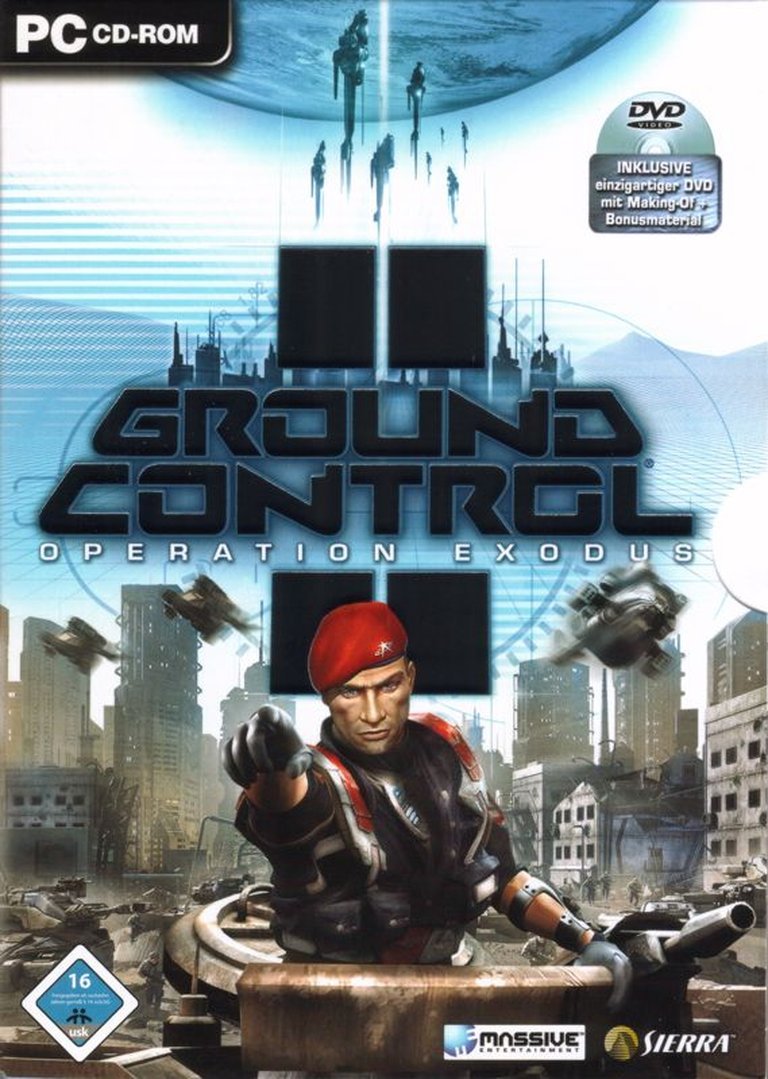
Ground Control II: Operation Exodus (Special Edition) is a real-time tactics video game set in a futuristic universe where humanity has colonized the galaxy, divided into Inner and Outer Spheres with communications limited to Tachuron relay stations. The story, taking place 320 years after the original game, centers on a conflict between the Northern Star Alliance, Viron Nomads, and the Terran Empire, focusing on tactical unit deployment via dropships and resource acquisition through victory point capture. This enhanced edition includes a making-of DVD with developer interviews, artwork, trailers, and other extras that delve into the game’s creation.
Where to Buy Ground Control II: Operation Exodus (Special Edition)
PC
Ground Control II: Operation Exodus (Special Edition) Patches & Updates
Ground Control II: Operation Exodus (Special Edition) Mods
Ground Control II: Operation Exodus (Special Edition) Reviews & Reception
ign.com : Massive Entertainment gives us another reason to love tactical RTS games.
Ground Control II: Operation Exodus (Special Edition) Cheats & Codes
Ground Control II: Operation Exodus (PC)
Press ~ twice in-game to open the console and enter codes.
| Code | Effect |
|---|---|
| godmassive | God Mode |
| gomassive | Unlocks All Missions |
| fps | Shows FPS |
| fps2 | Shows FPS |
| notgod | Disables God Mode |
Ground Control II: Operation Exodus (Special Edition): Review
Introduction: The Last Stand of a Tactical Vision
In the mid-2000s, the real-time strategy (RTS) genre was experiencing a painful identity crisis. The dominant paradigm—epic base-building, resource gathering, and tech trees—was being challenged by a counter-movement seeking to strip away the macro-management and focus purely on the micro-tactical ballet of combat. Ground Control II: Operation Exodus (2004) stands as one of the most polished, cohesive, and narratively ambitious executions of this “Real-Time Tactics” (RTT) philosophy. Developed by Sweden’s Massive Entertainment and published by Sierra/Vivendi, it was a sequel that refined its predecessor’s brilliant core concept while injecting it with a desperate, operatic sci-fi narrative. The later Special Edition, bundling a making-of DVD, serves as the definitive preservation package for a title that remains a high-water mark for focused, cinematic tactical warfare—a game whose legacy is one of influential purity overshadowed by the behemoths of its era.
Development History & Context: A Swedish Refinement
Studio & Vision: Massive Entertainment, founded in 1997 in Malmö, Sweden, carved its niche with the original Ground Control (2000). That game was a revelation: a stunningly beautiful 3D RTT title where camera freedom and line-of-sight mattered, and success hinged on deploying the right units for each mission, not on economic micromanagement. For the sequel, the team—led by Executive Producer Martin Walfisz, Project Manager Carl Fransson, Lead Designer Henrik Sebring, and engineers Niklas Hansson & Johannes Norneby—set out to address the first game’s perceived pacing issues and lack of reinforcement flexibility.
Technological Constraints & Innovations: Built on an updated version of Massive’s proprietary MassTech/Asura engine, GCII leveraged the full 3D environment in ways few RTS games had. The free-rotating camera wasn’t a gimmick; it was essential for utilizing terrain and elevation bonuses. The technological leap was most apparent in the visual fidelity: dynamic lighting, weather effects (from driving rain to snow), and meticulous unit animation where hatches, turrets, and doors moved realistically. The most significant systemic innovation was the Acquisition resource system. Instead of mining, players earned points by capturing “Victory Locations” and destroying enemies. This created a direct, aggressive feedback loop between battlefield control and force projection, accelerating the pace to something akin to a visceral, ground-focused Command & Conquer.
Gaming Landscape of 2004: The RTS world was bifurcated. On one side, Blizzard’s Warcraft 3 and StarCraft dominated the competitive scene with deep economies and hero units. On the other, a niche of tactical purists championed games like Close Combat and the original Ground Control. GCII entered this space against giants like Homeworld 2 and, later, Rome: Total War. Its Special Edition release (bundled with a developer documentary) was part of a late-cycle push to sustain interest, arriving amidst a market increasingly focused on online multiplayer and expanding into the burgeoning digital distribution era (it would later be preserved on GOG.com).
Narrative & Thematic Deep Dive: A Saga of Desperation and Sacrifice
Setting & Lore: The game is set in the year 2741 AD, 320 years after the events of the first Ground Control. The lore establishes a fractured humanity: the Inner Sphere (centered on Earth) was conquered by the Draconis Empire, which became the totalitarian Terran Empire. The Outer Sphere colonies, cut off by destroyed Tachyon relay stations, splintered into the Northern Star Alliance (NSA) and the Intergalactic Trade Guild (ITG). The Empire has now invaded the Outer Sphere, and the game opens on the NSA’s last major stronghold, Morningstar Prime.
Plot & Character Arc: Players assume the role of Captain Jacob Angelus, a brilliant but weary NSA officer. The campaign is a chronicle of inevitable defeat and last-gasp hope. The narrative twist arrives with the crash of a mysterious ship—the CSS Astrid, commandeered 320 years prior by Major Sarah Parker (protagonist of the first game). Its Singularity Drive offers a potential escape route to another galaxy. Angelus’s mission evolves from planetary defense to a desperate retrieval operation, culminating in a race to evacuate Morningstar Prime’s populace.
The story’s power lies in its tragic structure. Angelus is not a conqueror but a rearguard commander. Victory is redefined: success is measured in lives saved, not territories held. The climax is a masterclass in bittersweet resolution. The evacuation succeeds for a fraction of the population, but Angelus himself is stranded and presumed lost on the planet’s surface as the Imperial fleet glasses the region. This subversion of the typical RTS “save the day” ending imbues the entire campaign with a somber, heroic weight. Supporting characters, like the treacherous NSA General and the enigmatic Viron Nomad allies, are sketched efficiently through well-voiced in-mission chatter and brief CGI cutscenes, a practical approach that prioritizes gameplay momentum over melodrama.
Themes: The core theme is Asymmetric Resistance. The NSA, outgunned and outproduced, must rely on tactical ingenuity, superior unit adaptability (via secondary functions), and control of key terrain to offset the Empire’s brute force. The Viron Nomads, with their unique “melding” technology (combining two units into a new, more powerful one), represent another form of strategic alchemy—sacrifice and transformation. The narrative also grapples with Legacy and Myth, the Singularity Drive being a literal relic from the past that becomes the key to the future.
Gameplay Mechanics & Systems: Tactics Over Tempo
Core Loop & Acquisition System: The genius of GCII is its relentless focus on the tactical skirmish. There is no base building, no resource gathering, no tech tree. Each mission provides a finite roster of units via an initial dropship deployment. New units are called in mid-mission by spending Acquisition Points (AP), which flow in continuously but at a rate inversely proportional to the size of your current force. AP is also awarded for capturing Victory Locations (capture points that also act as reinforcement beacons) and destroying enemies. This creates a dynamic where:
1. Aggression is rewarded: Moving out to capture points and engage enemies boosts your income.
2. Conservation is punished: Hoarding a large force starves you of new units.
3. Victory Locations are paramount: They are AP sources, reinforcement landing zones (LZs), and often mission objectives. Losing your LZs cuts off reinforcements, potentially leading to catastrophic loss.
Unit Design & Faction Asymmetry:
* Northern Star Alliance (NSA): Human, versatile, and direct. Units have clear primary/secondary functions (e.g., Rocket Launchers: anti-vehicle rockets / anti-missile shield; Hover Tanks: main guns / speed boost). Their strength is in reliable, combined-arms synergy.
* Viron Nomads: Alien, bizarre, and synergistic. Their signature is Melding, where two units can be merged into a single, more powerful form (e.g., two infantry become a heavy beast, a tank + infantry creates a shielded assault unit). This adds a profound layer of strategic calculation: which units to sacrifice for a greater total? Their secondary functions are often buffs/debuffs, requiring more active management.
* Terran Empire: The non-playable antagonist in the campaign, fielding powerful, straightforward units like heavy tanks and aircraft, representing the overwhelming conventional force the NSA must outthink.
Dropship as a Tactical Asset: The dropship is no longer just a delivery mechanism. It’s a vulnerable but upgradeable flying fortress. Players can spend AP on dropship upgrades (armor, weapons, speed, cargo capacity). An armed dropship can strafe enemy positions, making its survival critical. Losing it means no more reinforcements and a likely mission failure.
Campaign & Mission Design: The single-player campaign is a tightly scripted, linear sequence of 15 missions that tell Angelus’s story. Each mission is a self-contained tactical puzzle with primary and secondary objectives. The design excels at teaching faction mechanics (NSA first, then Viron) and ratcheting up the pressure. The final missions on Morningstar Prime are spectacular, pitting you against overwhelming Imperial waves in a desperate holding action.
AI & Pathfinding: The AI is aggressive and mission-focused, actively contesting Victory Locations and targeting your dropship. However, as noted by reviewers like IGN’s Dan Adams, it can exhibit baffling tactical decisions and struggles with complex terrain. Unit pathfinding, while improved from the first game, still suffers from units getting momentarily stuck or awkwardly reordering in formations during movement—a minor but persistent annoyance in an otherwise smooth system.
Multiplayer: The online component (now defunct due to GameSpy’s 2008 shutdown) featured fast-paced skirmish and the revolutionary full cooperative campaign. Co-op allowed players to trade control of units mid-battle and manage separate dropships, perfectly echoing the decentralized command theme. However, the lack of objective-based modes (like attack/defend scenarios) and the inability for human players to fully replace AI commanders in some single-player missions were noted limitations.
UI & Accessibility: The 3D camera, controlled via keyboard/mouse, is fluid and intuitive once mastered. The UI cleanly presents unit health, secondary function readiness, AP count, and Victory Location status. The lack of a minimap (relying on the main view and a small radar) reinforces the tactical, on-the-ground feel. The learning curve is moderate; veterans of RTT or nuanced RTS will adapt quickly, but the pace and lack of traditional RTS safeguards can punish hesitation.
World-Building, Art & Sound: A Cohesive Futuristic Theater
Visual Direction & Engine: The MassTech engine shines. Environments are dense with detail: alien flora, crumbling urban ruins, frozen tundras, and steaming swamps. The use of atmospheric lighting—harsh suns on open battlefields, eerie twilight in forested areas—creates distinct moods. Weather isn’t just cosmetic; rain and snow affect visibility and unit movement. The art direction for units is superb. NSA vehicles are utilitarian, industrial, and painted in drab camouflage. Viron units are organic, bulbous, and bioluminescent. The Terran Empire’s gear is sleek, polished, and menacing in grey and crimson. Every explosion, energy discharge, and wreck is rendered with a satisfying heft.
Sound Design & Music: Composer Ola Strandh delivers a soundtrack that is both stirring and melancholic, with driving percussion for battles and haunting, ambient tracks for mission briefings and in-game tension. Sound effects are crunchy and impactful: the thud of artillery, the shriek of missile locks, the roar of hover engines. Voice acting (for Angelus, his subordinates, and mission briefings) is competent and clear, selling the military desperation without camp. The overall audio mix ensures critical information (like unit warnings) cuts through the din of battle.
Atmosphere & Cohesion: The sci-fi setting avoids cliché. It’s not shiny Star Trek; it’s a worn, lived-in universe where technology is a tool of survival. The UI design, mission briefings, and in-mission dialogue all reinforce the narrative’s tone of a rearguard action. The world feels consequential; each battle matters in the grand, tragic story.
Reception & Legacy: A Critical Darling, A Commercial Footnote
Launch Reception (2004): GCII was met with generally favorable reviews, holding a Metacritic score of 80/100. Critics widely praised its:
* Polished visuals and performance.
* Brilliantly refined tactical gameplay that removed the “busywork” of RTS.
* Strong, if straightforward, narrative with a satisfyingly tragic arc.
* Innovative systems (Acquisition, dropship upgrades, Viron melding).
Common criticisms included:
* A sometimes-simplistic AI that lacked strategic depth.
* Occasional pathfinding issues.
* A perceived lack of longevity compared to base-building RTS (though the co-op campaign added significant value).
* The exclusion of the Terran Empire as a playable faction in multiplayer.
* A short single-player campaign (though densely packed).
GameSpot named it the best PC game of June 2004. IGN awarded it 8.8, calling it “fast and fun” and “one of the most entertaining games” they’d played in weeks.
The Special Edition Context: Released alongside the standard edition, the Special Edition primarily included a making-of DVD with developer interviews and artwork. In the modern market (via GOG, Steam), this bundle represents the most complete, drm-free version. Its value is archival, offering insight into Massive’s design philosophy, rather than adding new gameplay content.
Evolution of Reputation: Over time, GCII’s reputation has solidified into that of a cult classic and genre pinnacle. It is frequently cited in discussions about the best RTT games ever made, alongside Homeworld and Company of Heroes. Its influence is seen in later tactical games that emphasize terrain, unit preservation, and limited reinforcement pools (e.g., Men of War, Wargame series). However, its legacy is also one of a cul-de-sac. The pure RTT model it championed became increasingly niche as the RTS genre itself declined in mainstream prominence, and Massive Entertainment shifted focus to the massive online shooter The Division series. The 2008 shutdown of the GameSpy servers crippled its online community, further isolating it.
Comparative Legacy: While its predecessor Ground Control is remembered as the groundbreaking pioneer, Operation Exodus is remembered as the refined masterpiece. It took a brilliant but occasionally punishing concept and made it faster, more accessible, and narratively more cohesive without sacrificing tactical depth. It did not achieve the iconic status of StarCraft or the mass appeal of Warcraft 3, but among connoisseurs of tactical gameplay, it is revered.
Conclusion: An Enduring Benchmark of Tactical Purity
Ground Control II: Operation Exodus (Special Edition) is the definitive version of a seminal real-time tactics game. It represents the apex of Massive Entertainment’s pre-Division design ethos: a stunning 3D world married to a ruthlessly elegant system where tactical acumen is the sole currency of success. Its Acquisition system, dropship mechanics, and faction asymmetry created a battlefield of constant, aggressive decision-making. Its tragic, sacrifice-driven narrative provided stakes rarely felt in the genre. Flaws are present—the AI’s limitations, pathfinding quirks, and a campaign that leaves you wanting more—but they are overshadowed by the sheer intensity and clarity of its vision.
In video game history, GCII is a monument to focused design. It proved that a strategy game could be a cinematic, story-driven experience without sacrificing depth, and that removing economic micromanagement could intensify, not diminish, strategic tension. The Special Edition, with its behind-the-scenes content, is a fitting coda, preserving a game that deserves to be studied by any student of game design. It may not have sparked a revolution, but it perfected a philosophy: that war is hell, and the best strategy games make you feel the weight of every command. For that reason, Ground Control II: Operation Exodus remains not just a great game of its time, but an enduring benchmark for tactical purity and narrative integration. It is an essential, if melancholic, chapter in the story of the real-time strategy genre.
Final Verdict: 9/10 – A Flawed Gem of Tactical Brilliance.