
- Release Year: 2012
- Platforms: Windows
- Publisher: CleanWaterWorks
- Developer: CleanWaterWorks
- Genre: Action
- Perspective: Diagonal-down
- Game Mode: Single-player
- Gameplay: Arcade, Shooter
- Setting: Fantasy, Medieval
- Average Score: 60/100
Description
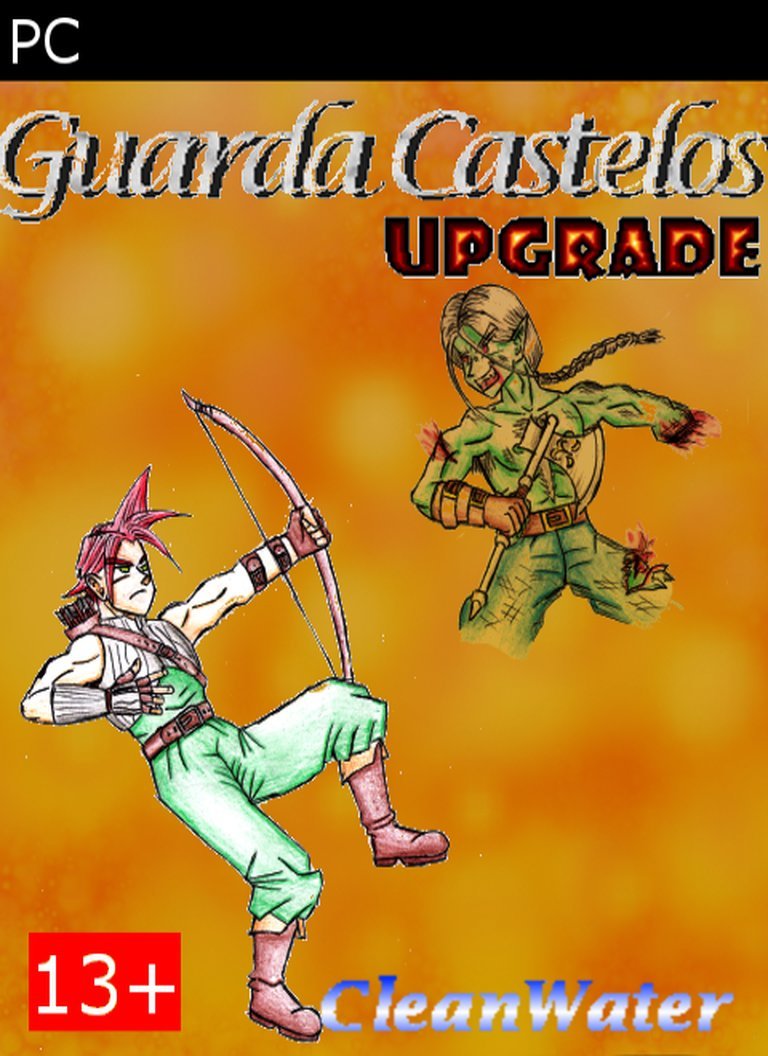
Guarda Castelos Upgrade is a fantasy shoot ’em up remake set in a medieval world, where players must defend a castle wall from invading orcs and increasingly tougher enemies like armored orcs, mages, and bomb-carriers. With limited ammo replenished by pickups and magic orbs that grant piercing attacks, the game features a clearable ‘Normal’ mode and an endless ‘Nightmare’ mode for high-score challenges, all as freeware on Windows.
Guarda Castelos Upgrade Reviews & Reception
moddb.com (60/100): Simple but fun Space Invaders-style shooter with nice-looking pixel art.
Guarda Castelos Upgrade: The Castle’s Last Stand – A Historical Appraisal of an Obscure Indie Shooter
Introduction: A Whisper in the Archive
In the vast, ever-expanding library of video game history, certain titles exist as mere footnotes—games known to a handful of players, documented by scant metadata, and existing on the periphery of cultural memory. Guarda Castelos Upgrade (2012) is one such title. A freeware, top-down fantasy shooter developed by the Brazilian indie outfit CleanWaterWorks (also styled CleanWaterSoft), this game represents a specific and fascinating stratum of early 2010s independent game development: the solo or micro-team project built with accessible tools, distributed via humble means, and dedicated to a pure, unadorned gameplay loop. Its legacy is not one of blockbuster success or critical acclaim, but of工匠精神 (gōngjiàng jīngshén—craftsman spirit) within extreme constraints. This review argues that Guarda Castelos Upgrade is a compelling case study in minimalist design, a digital artifact that encapsulates the do-it-yourself ethos of the GameMaker Studio era, and a testament to the enduring appeal of the arcade shoot-’em-up formula when stripped to its absolute essentials. To understand it is to understand a quiet, persistent thread in the tapestry of indie gaming.
Development History & Context: The Solo Developer’s Forge
The story of Guarda Castelos Upgrade is intrinsically the story of its creator, Alysson L. Neto. MobyGames credits reveal an extraordinary concentration of roles: Neto served as Director, Programmer, Game Designer, Enemy A.I. Architect, Character Designer, Sound Effects Creator, and English Translator. The only external contributions are Werther Azevedo’s composition of two core music tracks and a special thanks to Mark Overmars, the creator of GameMaker. This attribution pattern is a smoking gun for the game’s development context: it was almost certainly a passion project built by a single individual (or a core duo, given the “CleanWaterWorks” group name) using GameMaker Studio, the immensely popular 2D game engine that democratized development in the late 2000s and early 2010s.
The “Upgrade” suffix in the title is not mere branding but a literal descriptor. This is a remake of an earlier, presumably even more primitive, game titled Guarda Castelos (Portuguese for “Guard the Castles”). This practice of creating an “Upgrade” version was a common trope among small indie developers and hobbyists of the period—a way to denote a polished, feature-complete, or graphically enhanced revision of an earlier freeware experiment, often sharing a core conceptual DNA but with refined mechanics. CleanWaterWorks would later employ this pattern again with Porradaria Upgrade (2014) and Porradaria 2: Pagode of the Night, situating Guarda Castelos Upgrade within a small, self-contained universe of projects.
Technologically, the game sits firmly in the GameMaker Studio 1.x era. Its specifications from MobyGames—Windows-only, 256 MB RAM requirement, ~9MB download size—speak to a focus on maximum accessibility and minimum barrier to entry. The “Diagonal-down” perspective and “Fixed / flip-screen” visual style are hallmarks of classic arcade shooters (like Space Invaders or Galaga) translated to a vertical fantasy arena. The choice of a freeware/public domain business model was standard for such projects, prioritizing reach and community sharing over profit. In the gaming landscape of 2012, this placed it in the same ecosystem as thousands of other GameMaker titles on platforms like IndieDB and Newgrounds, competing for attention in a burgeoning but crowded indie space.
Narrative & Thematic Deep Dive: The Last Archer’s Oath
If narrative is the why and thematic depth is the so what, Guarda Castelos Upgrade presents a fascinating minimalist study. The IndieDB description provides the sole canonical narrative framing: “In this game, you play the role of the last human soldier left alive, an archer who needs to protect the castle from the orcs invasion.” This is not a story told through cutscenes, dialogue, or lore entries. It is a pure ludonarrative premise: the narrative exists solely to justify the gameplay loop. You are the last defender. The castle wall is your line. The orcs are the relentless horde. Failure means the end of humanity.
This stark narrative efficiency is its strength. The player projects their own desperation and determination onto the silent archer sprite. The themes are elemental and archetypal:
* Lone Heroism vs. Overwhelming Odds: The player is one against a rising tide. The “Normal” mode’s finite wave count provides a narrative arc of a winnable, desperate stand, while the “Nightmare” mode reframes the premise into a literal, endless last stand—a high-score grind that embodies a Sisyphean struggle.
* Resource Scarcity and Strategic Positioning: The limited ammo and the spatially-distinct refill points force a constant negotiation between aggressive firing and defensive movement. The “magic orb” power-up, which grants piercing, instant-kill shots, becomes a narrative event—a moment of divine intervention or surge of latent power in the fight for survival.
* The Erosion of Defense: The core mechanic—orcs breaking down the wall—is a brilliant thematic mechanic. The castle is not a static backdrop; it is a depleting resource. Each hit on the wall is a literal and metaphorical chink in humanity’s armor. The player is not just killing enemies; they are performing repairs on a failing barrier. The anxiety of seeing gaps appear in the wall, especially when fast-moving bombers or spread-shot mages appear, is a direct translation of narrative tension into gameplay.
The dialogue and character are nonexistent, which is a deliberate design choice. The orcs are not individuals; they are a faceless, swarming antagonist force. The protagonist has no personality beyond their function. This aligns the game with the tradition of mythic and folkloric storytelling, where archetypes (The Last Defender, The Invading Horde) are more potent than individual characters.
Gameplay Mechanics & Systems: The Calculus of Survival
Guarda Castelos Upgrade is a masterclass in tight, systemic design. Its entire architecture serves the core loop: shoot, move, collect, survive.
-
Core Loop & Perspective: The diagonal-down perspective on a fixed screen creates a classic, readable arena. Enemies spawn at the top and move in straight lines downwards, their paths occasionally intersecting with the wall segments. The player’s archer is confined to the bottom “safe zone” behind the wall. This creates a constant triage situation: which enemy is closest to a weak wall section? Which enemy type poses the greatest immediate threat?
-
Enemy Tiers as a Difficulty Curve: The enemy progression is the game’s primary difficulty engine and is ruthlessly logical:
- Standard Orcs: Cannon fodder. One hit kills. Their primary threat is in numbers and sheer pressure on the wall.
- Armored Orcs: Introduce the concept of durability. Requiring two hits, they force the player to either focus fire (wasting time on one target) or use magic to remove them instantly, creating a resource management sub-puzzle.
- Quick Mages: Introduce ranged, indirect threat. They attack from a distance (likely with projectiles that can also damage the wall, though the description focuses on their “attack from range” behavior). They force the player to look up, breaking the simple “aim at things coming down” rhythm.
- Bomb-Carrying Orcs: Introduce area-of-effect and delayed threats. They must be killed before they reach the wall, or their bomb damages a large section. This creates high-priority target calls.
- Red Mages: The “bullet hell” catalyst. Their spread shot can instantly carve multiple gaps in the wall, turning a manageable defense into a crisis in seconds. They represent the pinnacle of the game’s threat, demanding perfect positioning and shot timing.
-
Ammo & Resource Economy: The limited ammo forces pacing. The periodic ammo crates spawning at the screen edges are a brilliant tension mechanic. To refill, you must abandon your defensive post and risk running into exposed areas, potentially leaving wall segments undefended. This transforms a static shooter into a game of positional risk-reward.
-
The Magic Orb: This is the game’s exclamation point. Its scarcity and transformative power—piercing, instant kills—make its spawn a critical strategic event. Saving it for a wave of armored orcs or a red mage is a key tactical decision. It temporarily elevates the player from a weary defender to an unstoppable force, providing a powerful but fleeting sense of empowerment.
-
Game Modes as Philosophical Statements: “Normal” is a finite challenge, a story with an ending. Its clearability provides closure and a “good ending” (implied by IndieDB’s phrasing). “Nightmare” is the pure arcade endurance test, stripping away narrative hope and exposing the core gameplay loop as an abstract puzzle of efficiency and reflexes. The high-score chase in both modes acknowledges the game’s true heart: it is a score attack game disguised as a defense game.
-
UI & Interface: By all accounts (and inferred from the genre), the UI is likely brutally minimal: a wall integrity meter (or visual wall segments), an ammo counter, score, and perhaps a lives counter. There is no inventory, no complex stats, no skill trees. This purity is intentional and effective.
World-Building, Art & Sound: Pixel-Perfect Atmosphere
Given the technical constraints and solo development, Guarda Castelos Upgrade‘s presentation is a study in atmospheric efficiency.
-
Visual Direction & Setting: The “Fantasy Medieval” setting is rendered through a fixed-screen, pixel-art aesthetic. The castle wall is the central, most detailed sprite, serving as both game board and narrative icon. The orc and mage sprites are likely simple but distinguishable animations—the armored orc perhaps with a slight color shift or a bucket helmet, the mage with a distinct hat and casting pose. The “diagonal-down” perspective creates a sense of depth and scale, making the wall feel like a vast, looming rampart against a darkening sky (implied by the “Nightmare” mode). The world is not fleshed out; it is dramatically implied. The lack of background detail focuses the player’s entire attention on the impending threat at the wall’s edge, creating a claustrophobic, urgent atmosphere.
-
Sound Design & Music: Werther Azevedo’s contributions—the “Main Theme” and “Battle Theme”—and Alysson Neto’s own tracks (“Winning is so Good; Die isn’t Fun”) suggest a chiptune or tracker-music inspired soundtrack, common in GameMaker projects of the era. The music likely drives the emotional tempo: a tense, repetitive exploration during lulls and a more driving, urgent melody as waves intensify. Neto’s sound effects work is crucial; the thwack of arrows, the crunch of orcs dying, the splintering sound of wall damage, and the ominous beep or whoosh of the red mage’s spread shot are all critical audio feedback that replaces complex visuals. The soundscape is functional, immediate, and iconic.
Together, the art and sound create a cohesive, retro-fantasy arcade cabinet experience. It doesn’t aim for realism or deep immersion; it aims for readability and tension, successfully evoking the feel of 1980s arcade shooters like Wizard of Wor or Berzerk, but with a fantasy skin.
Reception & Legacy: The Curious Case of the Missing Score
By any mainstream metric, Guarda Castelos Upgrade is a commercial and critical non-entity. It holds a Moby Score of “n/a” due to insufficient critic reviews. On Metacritic, it has zero critic reviews. Its player reception, per MobyGames, rests on a single rating averaging 2.8 out of 5—a figure that tells us almost nothing. The more active community on ModDB shows a slightly clearer picture: two user reviews, both rating it a 6/10.
The ModDB reviews are telling. User “csmv” calls it a “Simple but fun Space Invaders-style shooter with nice-looking pixel art.” User “AriesShadow” discovered it through the developer’s later Porradaria series, noting it is “very simple and straightforward, but still fun to play for a simple top down shooter,” and specifically highlights the escalating challenge of the red mages. This is the consensus: a simple, competent, and fun distraction with a niggling difficulty spike.
Its legacy is therefore niche and associative:
1. Within CleanWaterWorks’ Oeuvre: It is the foundational “Upgrade” title, a prototype for the mechanics and style that would be refined in Porradaria Upgrade (a platformer) and its sequel. It shows the developer’s early interest in tight action gameplay and the “Upgrade” branding convention.
2. In the GameMaker Ecosystem: It is one of millions of GameMaker projects, but a well-executed example of using the engine for a focused arcade experience. Its existence is a data point in the history of accessible game development tools enabling solo creators to build and distribute complete games.
3. In the “Retro-Shooter” Subgenre: It is a contemporary peer to other minimalist indie shooters of the early 2010s like Upgrade Complete! (2009) or Porradaria Upgrade itself. It represents a trend of downloading “freeware gems” from IndieDB or forums—games that existed outside Steam’s greenlight ecosystem, cherished by a few, forgotten by many.
Its influence is indirect and cultural, not mechanical. It did not redefine a genre. Instead, it embodies a philosophy: that a compelling game can emerge from a single core mechanic (defend the wall), a clear escalating enemy roster, and a respect for the player’s time and intelligence. It is a game that asks little and gives exactly what it promises.
Conclusion: The Value of the Obscure
Guarda Castelos Upgrade is not a lost masterpiece. It will never appear on “Greatest Games of All Time” lists. Its historical significance is not monumental but archival. It is a perfectly preserved snapshot of a specific moment: a Brazilian developer, using a Dutch-made engine, creating a European-folklore-inspired arcade shooter in English and Portuguese, and releasing it for free to a global audience via IndieDB.
Its genius lies in its uncompromising focus. Every system—limited ammo, refill pickups, magic orbs, the degrading wall, the clear enemy tier list—serves the single goal of creating a tense, skill-based, repeatable challenge. There is no fat, no bloat, no pretension. It is a game that understands its lineage (Space Invaders, Wizard of Wor) and executes its vision with clean, efficient programming.
In the grand canon, Guarda Castelos Upgrade is a vital footnote. It reminds us that game history is not only written by studios with marketing budgets, but also by individuals like Alysson L. Neto working in isolation, powered by passion and accessible tools. It is a testament to the fact that even the most obscure titles can contain within them the pure, distilled essence of play. For the historian, it is a valuable artifact. For the player with ten minutes to spare, it is a surprisingly effective and satisfying little war. Its castle wall may be pixelated and its audience small, but in its own small arena, it stands firm.
Final Verdict: 7/10 — A flawlessly designed, if simple, arcade shooter that achieves everything it sets out to do. Its historical value as an indie development artifact far outweighs its modest gameplay depth. Seek it out to experience a clean piece of GameMaker-era craftsmanship.