
- Release Year: 1988
- Platforms: DOS, Windows
- Publisher: Paragon Software Corporation, Ziggurat Interactive, Inc.
- Developer: Paragon Software Corporation
- Genre: Adventure
- Perspective: First-person
- Game Mode: Single-player
- Gameplay: Interactive fiction, Text adventure, Time-limited
- Setting: Alternate history, Futuristic, Sci-fi
- Average Score: 72/100
Description
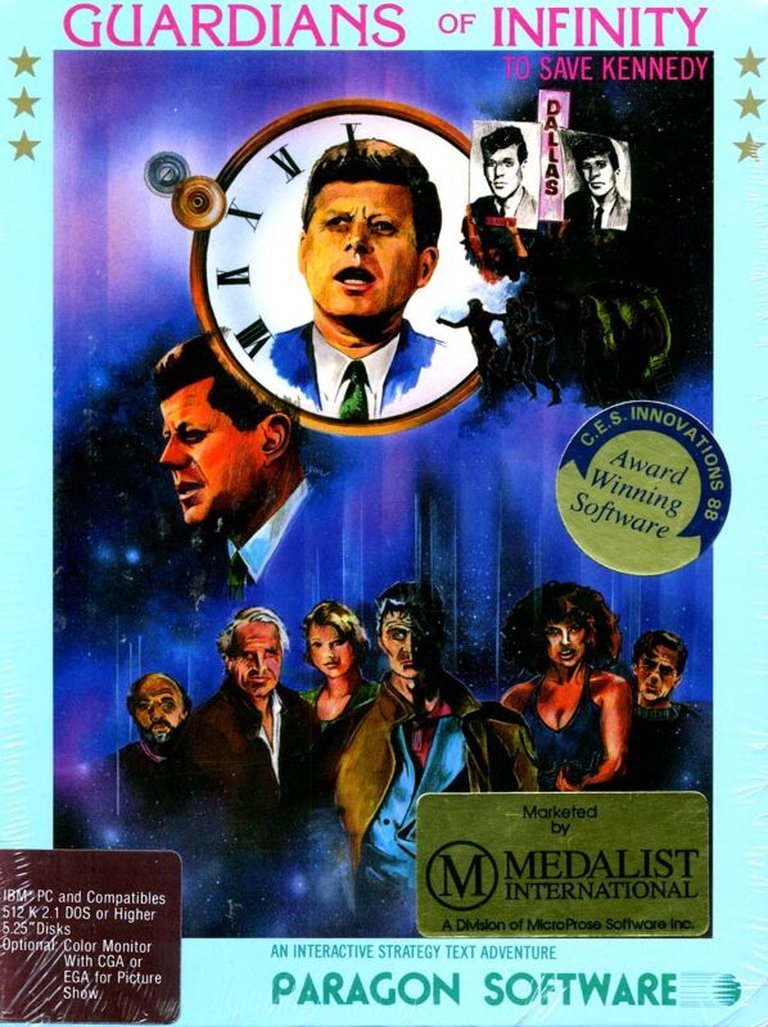
In the year 2087, a brilliant physicist invents a time machine and assembles a team of Guardians to travel back in time and prevent the assassination of President John F. Kennedy. Players navigate an alternate history through a text adventure, issuing commands to agents to protect Kennedy and convince key figures of the impending danger. The game relies heavily on a detailed manual for crucial information and has a time limit, adding to the challenge and immersion.
Gameplay Videos
Where to Buy Guardians of Infinity: To Save Kennedy
Guardians of Infinity: To Save Kennedy Mods
Guardians of Infinity: To Save Kennedy Reviews & Reception
mobygames.com (72/100): Guardians of Infinity: To Save Kennedy is a bizarre but flawed graphic adventure with one of the most convoluted plots in gaming history, which manages to be engaging and original.
squakenet.com : Guardians of Infinity is a graphic adventure which has possibly one of the most convoluted plots in gaming history, which manages to be engaging and original, and perhaps should be played for this reason alone.
Guardians of Infinity: To Save Kennedy: Review
A text-based odyssey through time, ambition, and the weight of history.
Introduction
In 1988, as the gaming industry leaned into pixelated platformers and burgeoning RPGs, Guardians of Infinity: To Save Kennedy dared to ask a provocative question: What if you could rewrite history? Developed by Paragon Software, this DOS-era text adventure challenged players to prevent the assassination of John F. Kennedy, blending alternate history, time travel, and tactical espionage into a package as ambitious as it was flawed. Decades later, its re-release on modern platforms invites a reevaluation: Does this relic of interactive fiction hold up as a bold experiment, or is it doomed to the annals of obscurity?
This review dissects Guardians of Infinity as both a product of its time and a narrative artifact, examining its unique mechanics, its polarizing design, and its enduring legacy in the shadow of gaming’s evolution.
Development History & Context
The Studio and Vision
Paragon Software, best known for licensed titles like The Amazing Spider-Man and Captain America in Dr. Doom’s Revenge!, took a sharp detour with Guardians of Infinity. Spearheaded by writers John Vincent Antinori and F.J. Lennon, the game aimed to marry historical rigor with interactive fiction, a concept rare in the late ’80s. The team conducted extensive research into the Kennedy assassination, weaving real-world figures like Lee Harvey Oswald and Robert Kennedy into a speculative thriller.
Technological Constraints
In an era dominated by parser-driven adventures like Zork, Guardians of Infinity leveraged the limited hardware of DOS systems. Its text-based interface was paired with sparse graphical stills—a compromise between narrative depth and storage limitations (the game shipped on a single 5.25″ floppy disk). Crucially, the manual doubled as a copy-protection tool, locking vital gameplay information behind physical documentation—an early example of anti-piracy measures intersecting with design.
The 1988 Gaming Landscape
Released alongside genre-defining titles like Pool of Radiance and Maniac Mansion, Guardians of Infinity stood out for its audacious premise. While most games embraced fantasy or sci-fi escapism, Paragon dared to engage with real-world tragedy, a risky move in a medium still defining its cultural voice.
Narrative & Thematic Deep Dive
Plot and Structure
Set in 2087, players assume the role of Adam Cooper, a temporal physicist who discovers that the Kennedy assassination is a fracture point destabilizing reality. Assembling a team of “Guardians,” Cooper sends agents back to November 1963 to infiltrate key locations—Dallas, Hyannis Port, Washington D.C.—and avert the tragedy.
The narrative unfolds through branching dialogue and agent management. Players must convince historical figures (e.g., Lyndon B. Johnson, JFK’s security detail) of the impending threat, balancing persuasion with subterfuge. The game’s climax—a direct meeting with Kennedy—requires meticulously coordinated actions, reflecting the high stakes of altering history.
Characters and Dialogue
The Guardians themselves are thinly sketched, functioning more as chess pieces than personalities. However, the historical figures they interact with are rendered with surprising depth, drawing from FBI records and biographies. Robert Kennedy, for instance, reacts skeptically to warnings, demanding evidence before committing to action—a nod to his real-world pragmatism.
Themes
Beneath its pulpy premise, Guardians of Infinity grapples with ethical quandaries: the morality of rewriting history, the fragility of causality, and the hubris of playing god. Its bleak ending (should players fail) underscores the inevitability of certain events, a sobering counterpoint to its time-travel fantasy.
Gameplay Mechanics & Systems
Core Loop and Parser
The game employs a verb-noun parser, typical of ’80s text adventures. Commands like “INSTRUCT AGENT TO FOLLOW OSWALD” or “EXAMINE MOTORCADE ROUTE” direct agents across locations. However, the parser’s limited vocabulary often clashes with the game’s complexity, leading to frustration. As The Games Machine noted in 1989, “The parser is not as smart as it could be.”
Time Management and Difficulty
A strict in-game clock ticks toward November 22, 1963, forcing players to prioritize tasks. Miss a critical interaction, and the assassination proceeds unchecked. This tension is both the game’s greatest strength and weakness: while it amplifies immersion, the lack of multiple save slots (a technical limitation of the era) renders trial-and-error gameplay punishing.
The Manual as a Mechanic
The included manual isn’t optional—it’s essential. It contains schedules, maps, and dossiers on 125 historical figures, embedding players in the role of a tactician. Without it, progress is impossible, a design choice that Joystick criticized as cumbersome but Squakenet praised for its novelty.
World-Building, Art & Sound
Visual Design
Static, monochrome illustrations punctuate key moments—Kennedy’s motorcade, the Texas School Book Depository—evoking a documentary aesthetic. While primitive by modern standards, these images ground the player in the era, compensating for the text’s abstraction.
Sound Design
Minimalist to a fault, the game features sparse ambient noise (crowd murmurs, typewriter clacks) and no music. This silence heightens the focus on narrative, though it risks monotony during extended play sessions.
Atmosphere
The game’s true atmosphere emerges from its writing. Descriptions of 1963 America—the tension of Cold War politics, the glamour of Camelot—are rich with period detail, immersing players in a world teetering on the edge of catastrophe.
Reception & Legacy
1988 Reviews
Critics were divided. The Games Machine lauded its “innovative character interaction” (85/100), while Joystick deemed it “a flawed execution of a brilliant idea” (60/100). Players found it divisive: Steam user reviews range from admiration for its ambition to frustration with its opacity.
Modern Re-Evaluation
The 2023 re-release sparked interest among retro enthusiasts, though its dated mechanics limit mainstream appeal. Its legacy lies in pioneering alternate history narratives and manual-integrated gameplay—a precursor to titles like Her Story and Return of the Obra Dinn.
Cultural Impact
Though niche, Guardians of Infinity influenced later games exploring historical fiction, such as JFK Reloaded and Jagged Alliance. Its bold premise remains a talking point in debates about gaming’s capacity for serious storytelling.
Conclusion
Guardians of Infinity: To Save Kennedy is a fascinating time capsule—a game of grand ambitions hamstrung by the technology and design conventions of its era. Its parser frustrations and reliance on external materials will deter casual players, but for historians and genre devotees, it offers a singular experience: a chance to grapple with history’s weight, one typed command at a time.
While not a masterpiece, it deserves recognition as a daring experiment—one that dared to ask, What if? long before gaming had the tools to fully answer.
Final Verdict: A flawed but visionary text adventure, best appreciated as a historical curiosity and a testament to gaming’s untapped narrative potential in the late ’80s.
Score: 7/10
(Historic significance: 9/10 | Modern playability: 5/10)