
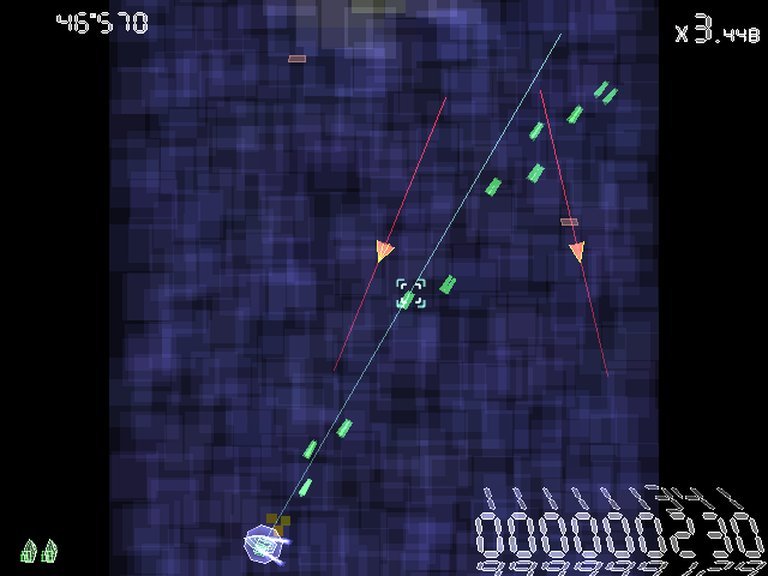
Description
Gunroar is a freeware, 360-degree gunboat shooter with wire-frame vector graphics, created by Kenta Cho. Players control a gunboat, moving in all directions to shoot enemies and avoid projectiles. The game features multiple control modes (including twin-stick and mouse), periodic boss battles, increasing difficulty, and a retro visual style.
Gunroar Free Download
Gunroar Guides & Walkthroughs
Gunroar Reviews & Reception
homeoftheunderdogs.net (84.7/100): Highly recommended!
Gunroar Cheats & Codes
PSP
| Code | Effect |
|---|---|
| quivira | Accelerated firing |
| hunter | All chapters in quick play mode |
| Soapy | All Poker missions complete |
| nedwhite | All weapons in Story Mode expect Final Weapon |
| campbell | Increased ammunition capacity |
| barton | Infinite ammunition in Story Mode |
| allies | Unlocks Jenny as a Playable Character |
| BADLANDS | Unlocks bonus deathmatch level |
Gunroar: Review
Introduction
In the pantheon of freeware shooters, few titles embody the philosophy of “deceptive simplicity” as masterfully as Gunroar. Conceived by the enigmatic Japanese developer Kenta Cho under his ABA Games moniker, this 2005 release is a masterclass in minimalist design, where abstract vector graphics and stripped-down mechanics coalesce into a gameplay experience of startling depth. At first glance, it appears to be a straightforward top-down naval combat game, yet beneath its unassuming surface lies a labyrinth of strategic systems, punishing risk-reward mechanics, and emergent complexity that has cemented its status as a cult classic among shoot ’em up aficionados. This review will dissect Gunroar‘s legacy, exploring how its elegant design, innovative scoring, and philosophical underpinnings not only defined a creative niche but continue to resonate in the broader landscape of indie game development.
Development History & Context
Kenta Cho, a pseudonymous developer known as “Saba,” emerged in the early 2000s as a pivotal figure in the freeware shooter movement. Operating under ABA Games from his base in Japan, Cho cultivated a reputation for crafting games of exceptional polish and conceptual purity, often built around single, potent mechanics. Gunroar was developed in 2005 during a transitional era for PC gaming, where independent developers leveraged open-source tools to bypass traditional publishing pipelines. Technologically, the game was a product of its constraints and ambitions: it was written in the experimental D Programming Language (v0.149), utilizing OpenGL for hardware-accelerated 3D rendering and the Simple DirectMedia Layer (SDL) for cross-platform compatibility. This stack allowed Cho to achieve fluid 60 FPS gameplay with minimal resource overhead—a remarkable feat for the era.
The gaming landscape of 2005 saw a burgeoning appreciation for freeware titles, fueled by broadband proliferation and communities like Home of the Underdogs. Gunroar arrived alongside Cho’s other celebrated works (rRootage, TUMIKI Fighters), contributing to a wave of “abstract shooters” that prioritized mechanical purity over narrative. Its release as freeware and open-source (under a BSD-style license) aligned with Cho’s ethos of democratizing game design, while its multi-platform support (Windows, Linux, Mac OS X) reflected the decentralized spirit of early indie game culture.
Narrative & Thematic Deep Dive
Gunroar deliberately eschews conventional storytelling, instead weaving its narrative through pure gameplay abstraction. The premise is elegantly stated by Cho himself: “Steer a boat and sink enemy fleet.” This minimalist directive frames the game as a perpetual conflict between the player’s gunboat and an endless onslaught of naval adversaries. Thematically, the game explores several profound ideas through its systems:
- Endless Conflict: The procedurally generated ocean and infinite waves of enemies create a Sisyphean struggle, symbolizing futility and resilience. The player’s journey is not about victory but survival against an uncaring, mechanized enemy force.
- Deceptive Simplicity: The absence of explicit narrative forces players to derive meaning from mechanics—each destroyed turret, each dodge, and each risky advance forward becomes a chapter in a silent drama of skill and risk.
- Isolation vs. Connection: While single-player, the game’s Double Play mode (controlling two linked boats) introduces a theme of interdependence. The connector between boats, which strengthens with distance, metaphorically represents sacrifice and synergy—greater reward requires greater separation, yet one’s downfall dooms both.
The game’s world-building is purely atmospheric, with no dialogue or explicit characters. Instead, the laser sights of enemies serve as antagonists, their geometric patterns (lines or pie-slices) communicating hostility without words. This creates a tense, wordless ballet where every enemy is a silent, programmed threat, heightening the game’s existential themes.
Gameplay Mechanics & Systems
At its core, Gunroar is a multidirectional shooter with four distinct modes that recontextualize its mechanics:
Core Loop
The player pilots a teal gunboat in an infinite ocean, battling four enemy types:
– Patrol Boats: Fragile, fast-moving vessels destroyed in one hit.
– Gunboats: Larger ships with 1–5 turrets, each independently targetable.
– Land Batteries: Immovable coastal defenses.
– Battleships: Colossal bosses with dozens of turrets and a central red core.
The player begins with two lives and a temporary shield that shatters on impact. Survival hinges on two defensive strategies: bullet cancellation (destroying enemies to eliminate their projectiles) and dodging, aided by laser sights that preview enemy aim.
Weapon Systems
- Main Turret: Automatic fire when a button is held, with direction locked to the boat’s movement.
- Lance: A powerful single-shot weapon requiring a tap to reload. Only one Lance can exist on-screen at once.
- Mouse Mode: Separates boat movement from aiming, using the mouse for turret control and left/right clicks for narrow/wide fire.
Innovative Mechanics
-
Dual Multiplier System:
- Enemy Multiplier: Destroying turrets before a ship’s hull multiplies points (e.g., 1 turret = 2x, 2 turrets = 3x). Bosses can yield 10x–20x multipliers.
- Global Multiplier (Rank): Decreases over time but increases by advancing vertically (scrolling the screen). Moving to the top accelerates spawning and difficulty but boosts scores exponentially, peaking at 200x+.
-
Screen Scrolling:
Movement near the top speeds up scroll, creating a risk-reward dynamic: rapid progression maximizes score but floods the screen with threats. -
Tactical Targeting:
Bosses require strategic turret destruction—some guns block access to the core, demanding prioritization. -
Double Play Mode:
Two boats connected by an invincible spread-firing connector. Weapons strengthen with distance but cease if boats are too close, forcing spatial mastery.
UI and Controls
The UI is ruthlessly minimalist: a countdown timer for bosses, score, multiplier, and lives. Control schemes include keyboard, mouse, and twin-stick options, with Mouse Mode lauded for its precision and decoupling of aim from movement. The lack of a traditional HUD reinforces the game’s focus on pure gameplay.
World-Building, Art & Sound
Gunroar‘s aesthetic is a triumph of abstraction. The game uses wireframe 3D vector graphics rendered via OpenGL, with ships and bullets rendered as minimalist geometric forms. This choice strips away visual noise, making bullets and enemy turrets instantly recognizable. The environment—an infinite ocean of shifting blues and greens with randomly generated landmasses—serves as both backdrop and obstacle. Land can block movement, shallow areas allow navigation, and impassable ridges add spatial strategy.
The art direction prioritizes functional clarity:
– Enemy Design: Patrol boats are simple triangles; gunboats are polygonal clusters with protruding turrets. Battleships are sprawling, biomechanical monstrosities.
– Effects: Water ripples trail boats; destruction scatters parts that drift downward like digital flotsam; defeated ships sink with lazy grace.
– Lighting: Additive blending creates radiant explosions and highlights, while laser sights use contrasting red/cyan for visibility.
Sound design is similarly sparse. Ogg Vorbis-encoded chiptune music and beeps provide rhythm without distraction, emphasizing the game’s visual tension. The audio reinforces mechanics—bullet impacts trigger staccato bursts, while the low hum of the engine grounds the player in the oceanic void.
Reception & Legacy
Upon release, Gunroar was lauded for its accessibility and depth. Softonic awarded it 80%, praising its “quick, fun action” and intuitive controls. Home of the Underdogs rated it 8.47/10, calling it a “must-play” for its addictive gameplay and abstract beauty. It featured in Eurogamer‘s “Summer of PC Plenty” and G4’s Attack of the Show!, marking a rare mainstream spotlight for a freeware title.
Over time, its reputation evolved beyond praise to academic reverence. GameDev.net dissected its design as a paragon of “deceptive simplicity,” where “no choice is obvious, no choice is perfect.” Players debated strategies—e.g., the counterintuitive “rush-forward” method for scoring—highlighting the game’s emergent depth. Culturally, it became a benchmark for indie developers, cited by designers like Trent Polack (LightBox Interactive) as a font of “endless design ideas.” Its influence is evident in twin-stick shooters and bullet-hell games that prioritize mechanical elegance over narrative.
Kenta Cho’s legacy is defined by Gunroar‘s ethos: prove that complexity can arise from simplicity. The game remains a staple of freeware archives, with ports and mods ensuring its survival.
Conclusion
Gunroar is not merely a shooter—it is a philosophical statement in interactive form. Kenta Cho’s genius lies in distilling the essence of combat to its purest form: movement, targeting, and risk. Its abstract visuals and minimalist systems create a canvas where skill becomes poetry, and every decision echoes across an infinite ocean. While its freeware status and niche aesthetic may limit mainstream appeal, its impact on game design is undeniable. It is a testament to the power of constraint and a reminder that the most enduring games are those that challenge players to find meaning in motion. As a historical artifact, Gunroar stands as a pillar of the freeware movement; as an experience, it remains as electrifying and profound today as in 2005. Verdict: A timeless masterpiece that redefined what a simple game could achieve.