
- Release Year: 2015
- Platforms: Macintosh, Nintendo Switch, PlayStation 4, Windows, Xbox One
- Publisher: Crazy Monkey Studios BVBA, Flyhigh Works Co., Ltd., Strictly Limited Games
- Developer: Claeys Brothers Studios, Crazy Monkey Studios BVBA
- Genre: Action
- Perspective: Side view
- Game Mode: Co-op, Hotseat, Single-player
- Gameplay: Platformer, Shooter
- Setting: 1920s, Prohibition, United States
- Average Score: 83/100
Description
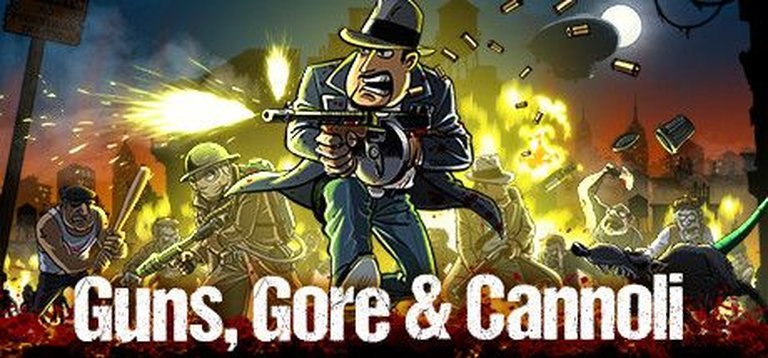
Guns, Gore & Cannoli is a 2D side-scrolling shooter set in 1920s Prohibition-era America, where mob enforcer Vinnie Cannoli navigates a zombie-infested town while battling rival gangsters. Featuring hand-drawn Belgian comic book-style visuals, the game combines run-and-gun mechanics with platforming elements, an arsenal of weapons, and health replenished by cannoli, offering both local multiplayer and cooperative story modes.
Gameplay Videos
Where to Buy Guns, Gore & Cannoli
Guns, Gore & Cannoli Free Download
Guns, Gore & Cannoli Guides & Walkthroughs
Guns, Gore & Cannoli Reviews & Reception
metacritic.com (90/100): Guns, Gore and Cannoli might only last a couple of hours, bit it can be picked up for a low price of $9.99, and I’d highly recommend any fan of the genre to check this game out immediately.
opencritic.com (76/100): Considering Guns, Gore & Cannoli costs £6.99, it packs quite a punch for the price. There’s a lot of fun to be had in the time the game lasts, and it looks great to boot. The exaggerated voice acting fits perfectly with the tone of the title and the story is surprisingly entertaining too. There’s never a dull moment in Guns, Gore & Cannoli, and it ends just at the right time too.
gamesradar.com : A game so middle-of-the-road it ends up as roadkill. The ideas in here are solid, but simply refuse to go anywhere over its three-hour duration.
Guns, Gore & Cannoli: Review
Introduction
In a gaming landscape saturated with zombie shooters and gritty crime sagas, Guns, Gore & Cannoli (2015) emerges as a vibrant, unapologetic love letter to the golden age of 2D run-and-gun shooters and Belgian comic art. Developed by Crazy Monkey Studios and Claeys Brothers Studios, this indie title masterfully blends the explosive chaos of Metal Slug with the darkly humorous underworld of prohibition-era gangsters, all filtered through the lens of a cartoonish zombie apocalypse. Yet, beneath its blood-soaked exterior lies a game of contrasts: a visually stunning, mechanically sound experience hampered by repetitive design and fleeting ambition. As we dissect its legacy, Guns, Gore & Cannoli stands as a testament to the power of style and local multiplayer, even as it stumbles in its quest for long-term depth. This review argues that while it falls short of transcending its influences, its unique aesthetic and chaotic co-op cement it as a cult classic—a flawed but essential stop for fans of arcade action.
Development History & Context
Crazy Monkey Studios and Claeys Brothers Studios, a Belgian collaborative effort, crafted Guns, Gore & Cannoli from a shared vision: to adapt their acclaimed animated short film, Hell Bent for Whiskey, into a video game. The developers, leveraging Unity’s flexibility, targeted a late-2010s indie renaissance where 2D platformers and retro-inspired shooters (Hotline Miami, Guacamelee!) were thriving. Their goal was clear: merge the frenetic, arcade-perfect feel of Metal Slug with a hand-drawn aesthetic reminiscent of Belgian comics like Tintin or Smokey and the Bandit.
Technological constraints were minimal but deliberate. Unity allowed for cross-platform support (PC, Mac, Xbox One, PS4, later Switch), but the team prioritized fluid 60 FPS gameplay and intricate animation over graphical fidelity. The art style—a meticulous blend of watercolor textures and cel-shaded characters—demanded painstaking frame-by-frame work, with the Claeys Brothers handling all animation. Meanwhile, Crazy Monkey Studios focused on programming, AI, and UI, ensuring tight controls and responsive gunplay. The result was a polished, if resource-intensive, product that respected its 2D roots without reinventing the wheel.
The 2015 gaming landscape was primed for such a release. Digital storefronts like Steam Greenlight provided a launchpad for quirky indies, while co-op-focused games (Helldivers, BattleBlock Theater) highlighted the resurgence of local multiplayer. Guns, Gore & Cannoli capitalized on this zeitgeist, offering accessible, couch-based carnage at a budget-friendly $9.99. Its Steam debut, bolstered by a successful Greenlight campaign, positioned it as a niche darling—a “Godfather + Metal Slug + Zombies” hybrid, as one critic aptly summarized.
Narrative & Thematic Deep Dive
Set in 1925 Thugtown, Guns, Gore & Cannoli spins a yarn of betrayal, biohazard, and mobster machismo. Vinnie Cannoli, a stone-faced enforcer for the Belluccio crime family, is dispatched to retrieve Frankie “The Fly,” a low-level gangster gone missing. Upon arrival, Thugtown is overrun by zombies—ravenous, undead victims of a tainted whiskey supply. The narrative unfolds through animated cutscenes and Vinnie’s deadpan voiceovers, revealing a conspiracy: Frankie, a WWI veteran with a penchant for betrayal, orchestrated the outbreak using a zombie serum developed by a rogue German scientist. His goal? To cripple rival mafia families and abscond with Belluccio’s fortune.
The plot is a pastiche of gangster tropes—double-crosses, Tommy guns, and cigar-chomping dialogue—but its charm lies in self-aware absurdity. Vinnie, a nominal hero, is more anti-hero than protagonist: a remorseless killer whose loyalty extends only to his cannoli. His one-liners (“Keep the change, you filthy animal!”) and quips (“I’m making America great again!”) inject levity into the carnage. Frankie, meanwhile, embodies treachery as a tragicomic villain—initially meek, revealed as a calculating sociopath. The theme of moral ambiguity permeates the game: Vinnie survives by embracing violence, while the “good guys” (the U.S. Army) quarantine Thugtown with lethal gas, blurring the line between heroism and atrocity.
Thematic depth is found in its critique of excess. Prohibition fuels both the zombies (via bootleg booze) and the carnage (via gangster warfare), mirroring real-life historical tensions. The serum, originally a government project to poison alcohol, symbolizes the collateral damage of authoritarian overreach. Yet, the game never wallows in grimness; instead, it revels in cartoonish mayhem, turning pulp fiction into a playground of dark comedy.
Gameplay Mechanics & Systems
At its core, Guns, Gore & Cannoli is a side-scrolling shooter that prioritizes relentless action over innovation. The loop is deceptively simple: move right, duck, jump, and slaughter everything in your path. Vinnie’s arsenal is a highlight, ranging from the infinite-ammo pistol to heavy-hitting options like the Lupara (sawed-off shotgun), flamethrower, and Tesla coil. Reload mechanics add tension—switching weapons or kicking enemies during downtime becomes a lifesaver against hordes. Headshots are rewarded with instant kills, encouraging precision, but the game’s “Denial of Diagonal Attack” (enemies only shoot from front/side) limits tactical depth.
Combat thrives on chaos. Zombies—shamblers, gas-belching housewives, leprechaun-like balloon-riders—swarm in predictable patterns, while human foes (gangsters, soldiers) provide variety with bats and rifles. The level design is hit-or-miss: segments explode with explosive barrels and set pieces, but abrupt platforming challenges or frustrating boss fights (e.g., a blimp battle with recycled mechanics) break the momentum. Health is replenished via cannoli, a callback to the Godfather, but resource scarcity (e.g., ammo droughts) can feel punitive.
Co-op is the game’s trump card. Up to four players can locally tackle the campaign or a versus mode, transforming solo tedium into communal chaos. AI bots fill in gaps, but human camaraderie elevates the experience—kicking a friend into a horde or sharing a flamethrower becomes the highlight. However, replay value is sparse. No New Game+, minimal unlockables, and repetitive enemy rosters diminish longevity. The Nintendo Switch port (2017) admirably maintains 60 FPS but fails to innovate, leaving it as a competent but dated relic.
World-Building, Art & Sound
Thugtown is a triumph of atmospheric design. Every frame drips with 1920s authenticity: speakeasy neon signs, Model T Fords, and cobblestone alleys evoke a Prohibition underworld. The art style, hand-drawn with ink-and-waterbrush textures, elevates mundane environments into living comics. Bullet casings litter the ground, glass shatters with satisfying detail, and gore—splattering blood, decapitated heads—is rendered with cartoonish flair. Characters like Vinnie (chiseled jaw, pinstripe suit) and zombie footballers (armor pads torn, eyes vacant) ooze personality through animation.
Sound design complements the visuals. A jazzy, saxophone-driven soundtrack punctuates shootouts, while Vinnie’s grunts and one-liners (“Stop trying to bite me, you freaking lunatics!”) deliver dark humor. Gunshots are meaty, explosions resonate, and the gibbing sound effects—a squelch here, a crunch there—add visceral punch. Yet, the audio lacks dynamic range; tracks loop repetitively, and environmental ambience (distant sirens, zombie moans) is underutilized. Still, the cohesive fusion of art and sound creates a world that feels lived-in and anarchic—a playground where violence is both absurd and artfully rendered.
Reception & Legacy
Upon release, Guns, Gore & Cannoli garnered a “Mixed or Average” reception (74% Metacritic). Critics praised its “excellent graphics and animations” (Gameplay Benelux) and “surprisingly intense multiplayer” (Nintendo Life), with ZTGameDomain awarding it 90%, calling it a “blast” for genre fans. Yet, complaints about repetition and brevity were universal. Games.cz lamented its “monotonous” design, while GamesRadar+ dismissed it as “roadkill” due to its three-hour runtime. Player reviews were kinder, highlighting local co-op as a saving grace, but noted the “tedious” late-game grind.
Its legacy is one of cult adoration, not industry influence. The sequel (2018) refined mechanics and expanded the story, but the original remains a blueprint for indie run-and-gun ambition. Ports to Switch and physical releases (via Strictly Limited Games) introduced it to new audiences, while Steam’s “Very Positive” user rating (89%) underscores its enduring appeal as a budget-friendly party game. Thematically, it inspired no direct imitators, but its Belgian art style and co-op focus paved the way for titles like Void Gore (2021). Ultimately, Guns, Gore & Cannoli is remembered for its personality—a footnote in gaming history, but a joyful one.
Conclusion
Guns, Gore & Cannoli is a game of delightful contradictions: a technical marvel saddled with repetitive gameplay, a visual feast wrapped in a paper-thin narrative. It excels as a co-op spectacle, where local multiplayer transforms its flaws into shared laughter. As a single-player experience, however, it falters, its short length and lack of replay value leaving players craving more. Yet, its Belgian comic art, chaotic charm, and Vinnie’s immortal line—”That’s some good cannoli!”—ensure it occupies a niche in the pantheon of arcade-inspired indies.
Verdict: A solid 7.5/10. Guns, Gore & Cannoli is not a revolution, but it is a raucous, well-crafted romp for those who value style over substance. For fans of Metal Slug or couch-based carnage, it’s a must-play—especially on sale. For everyone else, it’s a charming, fleeting encounter with the undead and the underworld. In the end, it leaves you hungering for more cannoli—and maybe a sequel.