
- Release Year: 2021
- Platforms: Windows
- Genre: Action, Adventure
- Perspective: Side view
- Game Mode: Single-player
- Gameplay: RPG elements
- Setting: Europe, Sweden
- Average Score: 100/100
Description
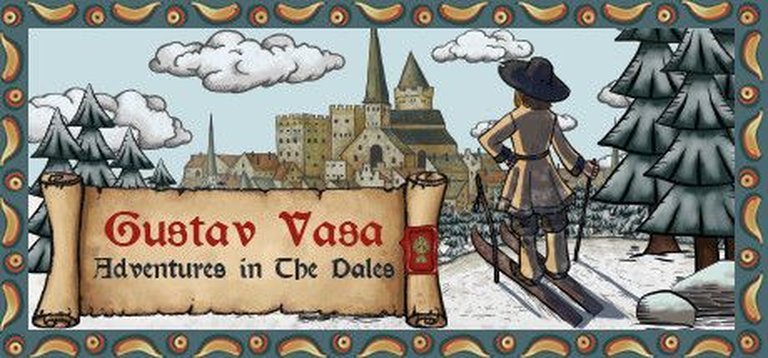
Gustav Vasa: Adventures in the Dales is a historical action-adventure game set in 1522 Sweden, where players control the young nobleman Gustav Eriksson Vasa as he flees Danish soldiers on skis through stunning 3D wintery landscapes of the Swedish Dales following his father’s murder in the Stockholm Bloodbath. Between high-speed chase sequences, explore picturesque 2D side-scrolling villages to recruit locals and build support for Gustav’s quest to overthrow the tyrant King Kristian and claim the Swedish throne, incorporating RPG elements in a blend of racing and adventure gameplay.
Gameplay Videos
Where to Buy Gustav Vasa: Adventures in the Dales
PC
Gustav Vasa: Adventures in the Dales: Review
Introduction
Imagine hurtling through snow-swept Swedish valleys on skis, arrows whistling past as Danish pursuers close in, all while channeling the spirit of a real-life rebel who would forge a nation. Gustav Vasa: Adventures in the Dales (2021) isn’t just a game—it’s a stylized retelling of one of Sweden’s most pivotal historical legends, blending pulse-pounding chase mechanics with intimate narrative vignettes. Released amid the indie explosion on Steam, this debut from Crystalyrian Games captures the raw desperation of 16th-century Scandinavia in a compact, evocative package. My thesis: While its on-rails structure and niche scope limit replayability, Gustav Vasa stands as a masterful indie artifact, marrying authentic Dalecarlian artistry, tense physics-driven action, and educational historical drama into a forgotten gem worthy of rediscovery.
Development History & Context
Crystalyrian Games, a minuscule Swedish indie collective, birthed Gustav Vasa as their inaugural project, launching it on June 1, 2021, exclusively for Windows via Steam at a humble $5.99. The team—Ingeborg Asplund (programming, game design, level design, 2D animation, UI), Stanislav Hallberg (programming, AI, game design, UI, bug fixing, gameplay physics, web design), Natali Hallberg (skyboxes, UI graphics, trailer editing), Joakim Bengtsson (character modeling, animations, lighting, music), and Gertrud Bondesson (2D graphics, 3D environment graphics, texturing)—embodied the DIY ethos of modern indie development. Their personal website chronicles the journey from a “Hello World” post in February 2021 to launch, highlighting a passion project rooted in national pride.
The 2021 gaming landscape was dominated by AAA blockbusters like Resident Evil Village and the ongoing indie surge via Steam’s accessibility, but historical adventures remained underserved. Technological constraints were minimal—built on Unity (inferred from security patches for old versions), it targets modest specs (Windows 10, 4GB RAM, NVIDIA 460)—allowing focus on stylized visuals over photorealism. The creators’ vision was clear: educate on Gustav Vasa’s legend while innovating with ski chases, a nod to folklore where the future king evaded capture on skis through the Dales (Dalarna region). In an era of endless runners and open-world epics, this hybrid approach felt refreshingly constrained yet purposeful, echoing early 2010s indies like Limbo but infused with Scandinavian folklore.
Narrative & Thematic Deep Dive
Plot Summary and Historical Fidelity
Set in 1522 amid the Stockholm Bloodbath—where Danish King Christian II (“Kristian the Tyrant”) executed Swedish nobles, including Gustav’s father—the story thrusts players into Gustav Eriksson Vasa’s flight north to the isolated Dales. Historically, Gustav escaped execution, rallied peasants against Danish occupation, delivered a rousing speech in Falun, and marched on Stockholm to become King Gustav I, founding Sweden’s Vasa dynasty and breaking the Kalmar Union. The game mythologizes this: Gustav skis frantically between villages, pleading for aid from skeptical Dalesfolk (Dalecarlians), culminating in his Falun oration and coronation.
Characters and Dialogue
Gustav emerges as a compelling protagonist—youthful, resolute, burdened by loss—voiced with narration that underscores his transformation from hunted noble to kingly visionary. Dalesfolk are archetypal: wary farmers, pious villagers, and opportunistic leaders, their dialogues rooted in period-appropriate Swedish rusticism. Interactions feel intimate, with branching pleas for support that tie into light RPG recruitment (e.g., convincing miners or herders). Themes of tyranny vs. liberty, isolation vs. unity, and myth-making permeate: the game weaves folklore (Gustav’s ski legend) with facts, positioning players as witnesses to nation-building. Yet, as indie critic InfinityWaltz noted, it’s “somewhat limited in player agency,” feeling on-rails—choices influence recruitment tallies but not major outcomes, prioritizing historical reverence over divergence.
Thematic Resonance
Beneath the adventure lies a meditation on leadership amid crisis. Gustav’s Falun speech, a playable highlight, echoes real rhetoric imploring Dalesmen to “rise against the tyrant,” blending pathos with urgency. Themes of cultural preservation shine through Dalecarlian motifs, critiquing foreign oppression while celebrating Swedish resilience. Narration adds gravitas, making it family-friendly education disguised as gameplay, though purists might crave deeper moral ambiguity.
Gameplay Mechanics & Systems
Core Loops: Chase and Story Alternation
The game alternates tense 3D behind-view ski chases with 2D side-scrolling village segments, creating a rhythmic pulse. Chases—pure runner action—are the star: Gustav auto-speeds downhill, players dodging trees, rocks, and crossbow arrows via lean-left/right, jump, and terrain exploitation (e.g., banking off hills). Stanislav Hallberg’s physics tuning delivers adrenaline, with momentum-based slides and near-misses heightening stakes; failure restarts checkpoints, demanding pattern mastery.
Village 2D sections shift to direct-control adventure: side-scroll through hand-painted hamlets, initiating dialogues to recruit. Light RPG elements track supporter counts, unlocking story beats or minor buffs (e.g., faster skis from morale boosts). UI is clean—minimalist HUD for health/arrows, inventory for quest items like proclamations—though sparse menus reflect indie brevity.
Innovative and Flawed Elements
Innovations abound: physics-driven evasion feels organic, presaging games like SkiFree remakes but historical. Arrow-dodging adds verticality, rewarding landscape reads. Flaws? On-rails linearity caps progression—no deep trees or gear upgrades—and short runtime (likely 1-2 hours) limits depth. Controls are responsive yet unforgiving on harder chases, with no accessibility sliders. Still, the loop’s purity—escape, recruit, repeat—mirrors Gustav’s odyssey flawlessly.
World-Building, Art & Sound
The Dales come alive as a winter idyll turned gauntlet: 3D chases traverse stylized snowy vistas—pine forests, frozen rivers, aurora skies—crafted by Gertrud Bondesson’s texturing and Natali Hallberg’s skyboxes. Villages burst in 2D splendor: hand-painted thatched roofs, carved wooden portals, and vibrant folk patterns inspired by genuine Dalecarlian art (e.g., floral rosemåling), evoking 16th-century Sweden without anachronisms.
Atmosphere builds immersion: chases evoke peril via wind howls and arrow thwacks; villages ooze coziness with crackling fires and choral undertones. Joakim Bengtsson’s music—folksy strings, tense percussion—swells dramatically, enhancing narration’s gravitas. These elements synergize: art’s stylization (cartoonish yet evocative) sells myth, sound amplifies solitude-to-triumph arc, forging an unforgettable sensory tapestry.
Reception & Legacy
Launch reception was whisper-quiet: Steam shows 1-2 user reviews (100% positive from scant data), MobyGames and GameFAQs list none, reflecting obscurity. InfinityWaltz’s 2021 column hailed it a “hidden Steam gem,” praising art and ski tension despite “on-rails” gripes. No major awards, commercial flops (low visibility), but a 2023 security patch shows ongoing care.
Legacy? Minimal direct influence—too niche amid Assassin’s Creed Valhalla‘s Viking boom—but it pioneers historical runners, blending education with action (tags: Educational, Historical). For Swedish gamers, it’s cultural touchstone; globally, it enriches indie’s micro-histories, akin to The Republia Times. In an oversaturated market, its purity inspires: proof small teams can craft heartfelt legacy.
Conclusion
Gustav Vasa: Adventures in the Dales is a triumph of focused ambition—a brisk, beautiful ode to Swedish heroism that punches above its indie weight through innovative chases, exquisite Dalecarlian art, and faithful narrative. Flaws like linearity and brevity temper its scope, but they suit its mythic essence. As a historian, I laud its preservation of Vasa lore; as a journalist, its unheralded charm demands attention. Verdict: Essential for history buffs and indie enthusiasts—a 8.5/10 niche masterpiece cementing Crystalyrian’s promise in video game history’s fringes. Seek it on Steam; the Dales await.