
- Release Year: 2010
- Platforms: Windows
- Publisher: RTL Interactive GmbH
- Developer: Intenium GmbH
- Genre: Simulation
- Perspective: 3rd-person (Other)
- Game Mode: Single-player
- Gameplay: Dating simulation, Life simulation, Social simulation
- Setting: Contemporary setting, Modern setting
- Average Score: 25/100
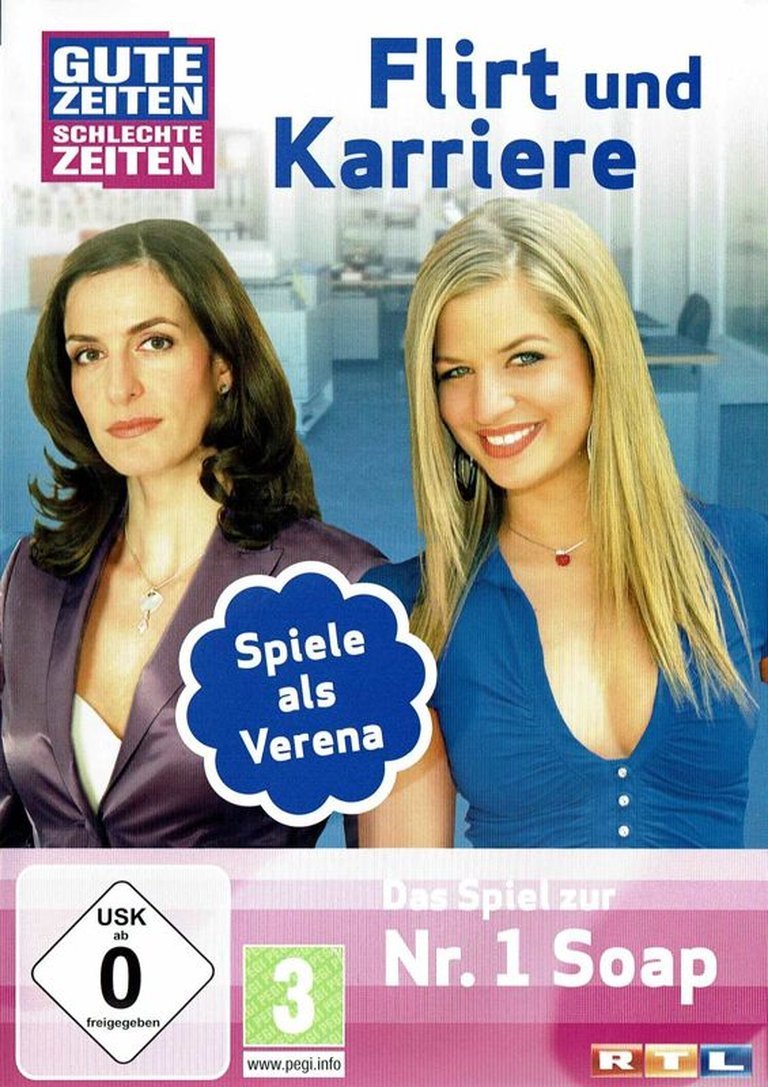
Description
Based on the German soap opera of the same name, Gute Zeiten, Schlechte Zeiten: Flirt und Karriere is a simulation game where players assume the role of Verena, competing for the position of editor-in-chief for the official fan magazine. The game blends dating simulation and life simulation mechanics, allowing players to advance their career by either flirting with rival Alexander or resorting to intrigue and schemes, all within the original soap opera universe populated by its iconic characters.
Gute Zeiten, Schlechte Zeiten: Flirt und Karriere Reviews & Reception
myabandonware.com : This game seems to be a modified version of Supple. Interesting, I had no idea it existed.
Gute Zeiten, Schlechte Zeiten: Flirt und Karriere: A Flawed Soap Opera Simulation
Introduction
In the crowded landscape of licensed games, few genres risk more critical derision than the soap opera simulator. Fewer still dare to bridge the gap between daytime television melodrama and interactive gameplay. Gute Zeiten, Schlechte Zeiten: Flirt und Karriere (2010), a German-exclusive PC title from Intenium GmbH, represents one such audacious attempt. Based on RTL’s decades-long soap opera, it thrusts players into the high-stakes world of magazine journalism and romantic rivalry. This review dissects this peculiar artifact of licensed gaming history, examining its place within the Gute Zeiten franchise, its mechanical ambitions, and its surprising legacy as a reskinned foreign title. While ultimately a niche curiosity, the game reveals fascinating intersections between television licensing, localization, and mid-budget simulation design.
Development History & Context
Gute Zeiten, Schlechte Zeiten: Flirt und Karriere emerged in 2010 from Intenium GmbH, a German developer known for casual and simulation titles. Its publisher, RTL Interactive GmbH, leveraged the immense cultural cachet of its flagship soap opera – then celebrating over 15 years on air. The game was released on June 18, 2010, exclusively for Windows via CD-ROM, targeting fans of the show with a PEGI 3 rating, suggesting broad accessibility.
Crucially, development occurred during a period where German publishers aggressively pursued licensed games targeting niche demographics. The game inherited its core mechanics from Supple (2008), a dating/life sim developed by Spanish studio GamesLab. Intenium’s adaptation exemplified the prevalent “localization-as-engineering” practice of the era: asset-swapping and dialogue translation to adapt a pre-existing game engine for a specific market. This explains the comment on MyAbandonware identifying it as a “modified version of Supple.” The technological constraints were evident: utilizing a third-person cinematic camera perspective typical of mid-budget sims, with limited graphical fidelity compared to AAA titles of 2010.
The gaming landscape in 2010 saw social simulations flourishing on platforms like Facebook and casual portals, but licensed TV-to-game adaptations often struggled with depth and polish. Flirt und Karriere positioned itself as a blend of life simulation and dating mechanics, attempting to capture the serialized drama of its source material within a constrained interactive framework.
Narrative & Thematic Deep Dive
The game’s narrative is a direct translation of soap opera tropes into interactive choices. Players assume the role of Verena, a candidate for the coveted position of Editor-in-Chief for the official Gute Zeiten fan magazine. The central conflict hinges on her rivalry with another candidate, Alexander. Success requires navigating two distinct, often overlapping, pathways: Flirt (romantic advancement) or Intrigue (sabotage).
The narrative structure resembles a branching visual novel. Dialogue choices drive progress, influencing Alexander’s perception and the outcome of job applications. Characters are drawn directly from the soap opera roster, including the voice-credited Alina (voiced by Anika Lehmann), reinforcing the licensed authenticity for fans. Themes of ambition, workplace politics, and romantic competition are foregrounded. The dialogue, while functional, leans heavily on soap opera clichés – misunderstandings, veiled compliments, and dramatic declarations – mirroring the source material’s serialized storytelling.
However, the narrative depth is severely limited by its simulation framework. Character interactions lack nuance beyond binary choices (“Flirt” vs. “Intrigue”), reducing complex relationships to simple stat management. The overarching goal – securing the editorship – feels disconnected from the repetitive daily tasks and social encounters, resulting in a narrative experience that feels more like a checklist than an evolving story. The potential for genuine drama is stifled by the mechanical constraints.
Gameplay Mechanics & Systems
Flirt und Karriere operates on a core loop of daily decision-making and stat progression. As Verena, players manage time through a day/night cycle, allocating actions between three primary areas:
- Career Progression: Completing tasks (writing articles, conducting interviews) to build credentials for the editor role. This involves navigating a simple task interface and making dialogue choices that impact success rates.
- Social Interaction (Flirt): Engaging with Alexander through dialogue options specifically tagged for flirtation. Success increases a “Flirt” stat, potentially unlocking romantic story branches and weakening his competitive stance.
- Social Interaction (Intrigue): Selecting dialogue options designed to subtly undermine Alexander, spreading rumors or highlighting his flaws. Success increases an “Intrigue” stat, directly impacting his job performance metrics.
The core flaw lies in the shallow implementation of these systems. Dialogue choices lack contextual weight, often boiling down to selecting a tagged keyword (“Flirt,” “Intrigue,” “Work”). There’s minimal consequence or variation; the outcome is largely predetermined by the selected path. The stat progression feels arbitrary, offering little strategic depth beyond consistently choosing the appropriate option. The “cinematic camera” perspective is a static series of character portraits and pre-rendered backgrounds, further reducing interactivity. User interface elements are basic, prioritizing functionality over polish, reflecting the game’s mid-budget origins. The experience becomes a repetitive grind of selecting the right dialogue tag to advance a linear path towards one of two endings.
World-Building, Art & Sound
The game’s world-building is entirely dependent on its license. The setting – the offices and social circles of the Gute Zeiten universe – is presented through static backgrounds and character sprites. The use of “all original characters” is its primary world-building tool, appealing directly to fans familiar with the show’s dynamics and visual identity.
Artistically, the game is a product of its budget and source material. Character sprites are simplistic, with limited animation beyond lip-syncing during dialogue. Backgrounds are pre-rendered, depicting generic office and café environments that lack detail or personality. The visual direction prioritizes recognizability over artistic flair, relying on the association with the TV show to fill in atmospheric gaps. The “cinematic camera” designation is misleading; there’s no dynamic cinematography, just static shots framing character interactions.
Sound design is equally functional. The German voice acting, including Anika Lehmann’s contribution as Alina, provides authenticity but lacks the energy of the live-action show. Background music is minimal and generic, serving as little more than atmospheric filler. Sound effects are sparse and unremarkable. The overall audio-visual presentation is competent but uninspired, failing to immerse the player beyond the initial novelty of seeing soap opera characters rendered in a crude game engine.
Reception & Legacy
Contemporary reception for Gute Zeiten, Schlechte Zeiten: Flirt und Karriere was muted and largely confined to German gaming outlets. The most documented critical review comes from Computer Bild (via chartspiele.de), which awarded a scathing 25%. While the review text isn’t provided, the score suggests significant criticism likely aimed at its shallow mechanics, repetitive gameplay, and reliance on the license over substance. Metacritic lists no critic reviews, reflecting its niche status and lack of international impact.
Commercial figures are unavailable, but its status as a licensed title for a specific demographic (German soap opera fans) suggests limited mainstream appeal. Its legacy, however, is more interesting than its reception. The game is primarily remembered today for two things:
- Localization Artifact: It stands as a prime example of the “reskinning” trend common in mid-budget European development. The identification of it as a modified Supple on MyAbandonware highlights how publishers like Intenium leveraged existing engines and assets for licensed titles, prioritizing speed-to-market over original design.
- Franchise Milestone: It represents the final major game iteration of the Gute Zeiten franchise on PC. Released a decade after the initial wave of titles (1999-2000), it marked a shift towards more casual, simulation-focused licensed games before the franchise seemingly exited the interactive space. Its inclusion in GameFAQs’ franchise list alongside trivia and quiz games solidifies its place as a footnote in the series’ history.
Conclusion
Gute Zeiten, Schlechte Zeiten: Flirt und Karriere is a curiously specific artifact of licensed gaming history. As a soap opera simulator, it fails to capture the addictive drama or emotional resonance of its source material, reduced to a shallow dialogue-tagging exercise within a rigid simulation framework. Its reliance on a pre-existing engine (Supple) is evident in its limited mechanics, dated visuals, and generic presentation. The licensed appeal for Gute Zeiten fans provides a unique hook but cannot sustain the experience beyond the initial novelty.
Yet, to dismiss it entirely would overlook its significance. It represents a distinct moment in the lifecycle of a long-running TV property: the shift from early adventure/quiz games towards more complex (though still mid-budget) life simulations. Its existence as a reskinned title offers a fascinating window into the development practices of European casual gaming studios in the late 2000s. While critically derided and commercially niche, it endures as a peculiar, if flawed, example of how television licenses were translated into interactive experiences. For historians and genre enthusiasts, Flirt und Karriere serves as a cautionary tale about the pitfalls of licensed adaptation, but also as a testament to the creative (if sometimes cynical) efforts to bring beloved serial dramas onto the PC screen. It is, ultimately, a relic of a specific time and place in gaming – a “schlechte” (bad) time in the series’ interactive history, but an undeniably gute (good) one for studying the business of licensed games.