
- Release Year: 2011
- Platforms: Windows
- Publisher: UIG Entertainment GmbH
- Genre: Simulation
- Perspective: 1st-person
- Game Mode: LAN, Online Co-op
- Gameplay: Business simulation, Managerial
- Setting: Europe
Description
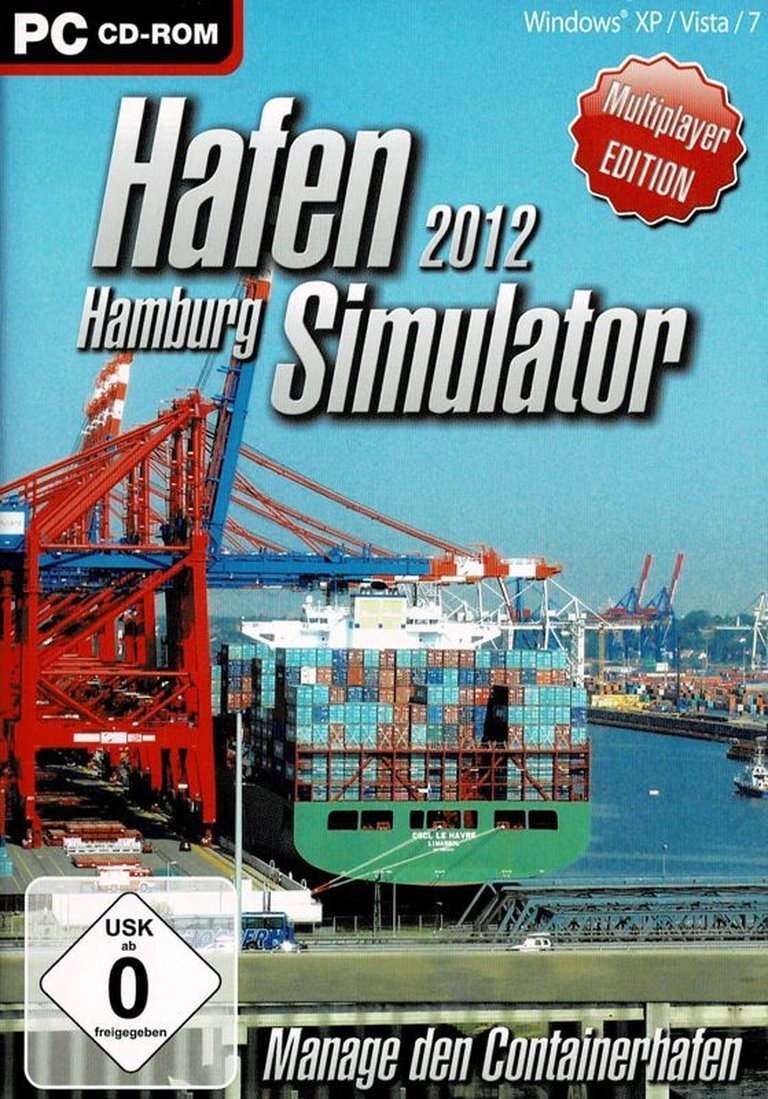
Hafen Simulator 2012: Hamburg is a simulation game where players take on the role of a port manager in Hamburg, overseeing the handling of ships, coordinating personnel, and managing the movement of various goods using cranes, forklifts, and other machinery. The game features both single-player and multiplayer modes, allowing players to collaborate in loading and unloading ships via LAN or the internet.
Gameplay Videos
Hafen Simulator 2012: Hamburg Patches & Updates
Hafen Simulator 2012: Hamburg Reviews & Reception
4p.de : Das liegt nicht an der Komplexität, sondern an der wenig durchdachten Handhabung, die zudem schlecht umgesetzt wurde.
Hafen Simulator 2012: Hamburg Cheats & Codes
PC
Use the trainer functions by pressing the corresponding keys while playing the game.
| Code | Effect |
|---|---|
| F1 | Easy Complete Mission |
| F2 | Edit Ammo |
| F3 | Disable Damage System |
| F4 | Set Attack and Defense Percentages |
| F5 | Team God Mode |
| F6 | Change Social Points |
| HOME | Disable All |
Hafen Simulator 2012: Hamburg: Review
1. Introduction
In the pantheon of niche simulators, few titles evoke such polarized reactions as Hafen Simulator 2012: Hamburg. Released in October 2011 by German studio UIG Entertainment, this game promised players the mantle of a modern port manager, tasked with orchestrating the symphony of logistics in one of Europe’s busiest harbors. More than a decade later, it endures as a case study in ambition-meets-execution—a title revered by a small cult for its authenticity yet derided by mainstream critics as a monument to tedium and technical incompetence. This review dissects Hafen Simulator 2012: Hamburg not merely as a product, but as a cultural artifact of the early 2010s simulator boom. Its thesis lies in this duality: beneath the surface of clunky controls and sparse gameplay lies a surprisingly detailed, if flawed, simulation of industrial labor that captures the quiet grandeur of maritime commerce—a relic worth revisiting for its unvarnished portrayal of a world often overlooked in gaming.
2. Development History & Context
UIG Entertainment, a prolific developer of budget “Simulator” titles (e.g., Woodcutter Simulator 2012, Agricultural Simulator 2012), crafted Hafen Simulator 2012: Hamburg amid a saturated market for hyper-specialized simulations. The studio’s vision, as outlined in press materials, was to replicate the “complexity of logistics processes” in a modern seaport, using Hamburg’s Elbe River terminals as a blueprint. This ambition was constrained by the era’s technological limitations: the game required minimal hardware—a Pentium 4 2GHz CPU, 1GB RAM, and a 128MB GPU (SM 3.0+)—reflecting its budget pricing and CD-ROM distribution.
The game’s release coincided with the peak of the “Simulator” craze, where titles like Farming Simulator dominated the casual market. UIG leaned into this trend, positioning Hafen Simulator as a niche alternative to mainstream management games. Yet, its development was plagued by shortcuts. Patches from The Patches Scrolls reveal post-launch attempts to fix critical bugs (e.g., a 311MB patch to resolve save-function crashes), hinting at rushed production. The studio’s prior work, including Hafen 2011 (a less detailed predecessor), established a template of direct-vehicle control mixed with top-down management—a dual approach Hafen 2012 would inherit and struggle to refine. Ultimately, the game emerged as a product of its time: a low-budget, high-specialization title banking on the “Hamburg” brand to attract port enthusiasts, yet lacking the polish to satisfy a broader audience.
3. Narrative & Thematic Deep Dive
Hafen Simulator 2012: Hamburg eschews traditional narrative for a simulation of procedural labor. There are no named characters, scripted dialogue, or overarching plot. Instead, the game’s “story” emerges from the player’s routine: hiring dockworkers, allocating budgets, and responding to cargo shipments. This absence of narrative is itself thematic, mirroring the dehumanized efficiency of modern logistics. The player’s role as a “manager” is solitary and transactional—hiring faceless workers, balancing budgets, and coordinating machinery with no personal stakes.
The underlying themes revolve around industrial realism and the unseen machinery of global trade. The game’s focus on mundane tasks—valving oil tankers, aligning train tracks, stacking containers—serves as a quiet tribute to the labor that underpins maritime commerce. Yet, this realism is undercut by the game’s lack of narrative depth. Events like weather changes or cargo delays lack consequence, reducing port management to a checklist. Multiplayer mode (LAN/Internet) introduces a collaborative layer where players could share tasks, fostering camaraderie in a simulated workplace. Thematically, this transforms the game into a digital workspace—a “Hanseatic” fantasy without the human drama. As the 4P.de review notes, the “Hanseatic atmosphere” never materializes, leaving the game a sterile exercise in logistics rather than a living world.
4. Gameplay Mechanics & Systems
At its core, Hafen Simulator 2012: Hamburg operates on three interlocking loops: economic management, vehicle operation, and task coordination.
- Economic Management: Players begin with €10 million, hiring staff (dockworkers, port captains) and purchasing equipment (cranes, tugboats, rail cars). Revenue flows from fulfilling contracts, such as unloading container ships or pumping oil from tankers. The economic loop is functional but shallow; money is earned passively via AI workers, with little strategic depth beyond “hire more, earn more.”
- Vehicle Operation: Direct control is limited to cranes and tugboats, with other vehicles managed by AI. The controls are infamously flawed: crane movements are sluggish, and switching vehicles often glitches (e.g., retaining crane controls while piloting a tugboat). As 4P.de critiques, the steering “never does what it should,” turning manual labor into a frustrating chore.
- Task Coordination: Players must schedule trains, align valves for oil transfers, and monitor cargo flow. These tasks feel like disconnected minigames—e.g., timing train arrivals to avoid collisions—with no emergent complexity. The game’s “acceleration” feature lets players fast-forward time, but as 4P.de notes, days still feel “interminable” due to minimal activity.
Innovations include a day/night cycle and weather effects, though these are purely cosmetic. The multiplayer mode, allowing simultaneous ship unloading, is a bold idea but rendered moot by a near-empty online community. Ultimately, the gameplay is a masterclass in promise unfulfilled: the simulation’s breadth (coal/oil/autoterminals) is undermined by its execution, turning port management into a test of patience rather than strategy.
5. World-Building, Art & Sound
UIG Entertainment’s recreation of Hamburg’s port is the game’s most polarizing feature. The studio claims a “1:1” replication of the Altenwerder terminal, and while the layout includes recognizable elements like container stacks and rail spurs, critics dismiss it as a “schematic” facsimile. The 3D environment is viewed primarily from a bird’s-eye perspective, with the ground offering little detail. Character and vehicle models are rudimentary—cranes are angular, and trucks move in stiff, predictable paths.
Atmosphere suffers from this abstraction. The “Hamburg” identity relies on landmarks like the cruise ship terminal, but the world feels eerily empty. As 4P.de observes, “hardly anyone runs around the Elbe,” and the absence of ambient life robs the port of vitality. Weather effects (rain, fog) are visually appealing but have zero gameplay impact, further divorcing aesthetics from mechanics.
The sound design is equally sparse. The roar of engines and clatter of containers are present but repetitive, with no dynamic audio to reflect port activity. Voice acting is nonexistent, and menus use basic text overlays. The only saving grace is the day/night cycle, which bathes the harbor in moody twilight hues—fleeting moments of beauty in an otherwise sterile world. In essence, Hafen Simulator’s art direction prioritizes functional representation over immersion, creating a world that feels authentic on paper but inert in practice.
6. Reception & Legacy
Upon release, Hafen Simulator 2012: Hamburg was met with near-universal derision. German press outlets like 4P.de awarded it a paltry 27%, lambasting its “miserable controls” and “buggy” save system. Computer Bilde’s 3.3/10 “satisfactory” verdict noted its “beautiful optics” but condemned the “not very lively atmosphere.” In contrast, a vocal minority of players defended its authenticity, with one forum user insisting, “It’s a 1:1 Altenwerder replica—calling it fake is a lie.” This schism highlighted the game’s niche appeal: for port enthusiasts, it was a labor of love; for gamers, it was “software garbage” (4P.de forum).
Commercially, the game capitalized on the “Simulator” brand but failed to break into mainstream sales. Its legacy is twofold: as a cautionary tale about rushed simulation development and as a cult classic among industrial hobbyists. The 2011–2012 “Simulator” boom (e.g., Ski Region Simulator) saw countless clones, but Hafen Simulator stood out for its unwavering focus on a single, unglamorous industry. Its influence is indirect; it predates titles like Cities: Skylines (2015) but shares their ethos of granular, if flawed, simulation. Today, it endures in YouTube “so bad it’s good” compilations, remembered for its ambition outpacing its execution.
7. Conclusion
Hafen Simulator 2012: Hamburg is a paradox: a technically inept simulation that captures the soul of industrial labor better than many polished rivals. Its flaws—buggy controls, shallow gameplay, and anemic world-building—are undeniable, yet they coexist with a reverence for the mundane rhythms of port life. For players seeking the thrill of managing global logistics, it offers a raw, unfiltered experience. For critics, it represents the nadir of shovelware-era simulations.
Ultimately, Hafen Simulator 2012: Hamburg earns a place in gaming history not as a masterpiece, but as a testament to the enduring appeal of niche authenticity. It is a time capsule of a genre obsessed with the overlooked, proving that even the most broken simulator can illuminate a corner of the world. Verdict: For historians and genre enthusiasts, it is a flawed artifact worth preserving; for everyone else, it is a relic best admired from afar.