
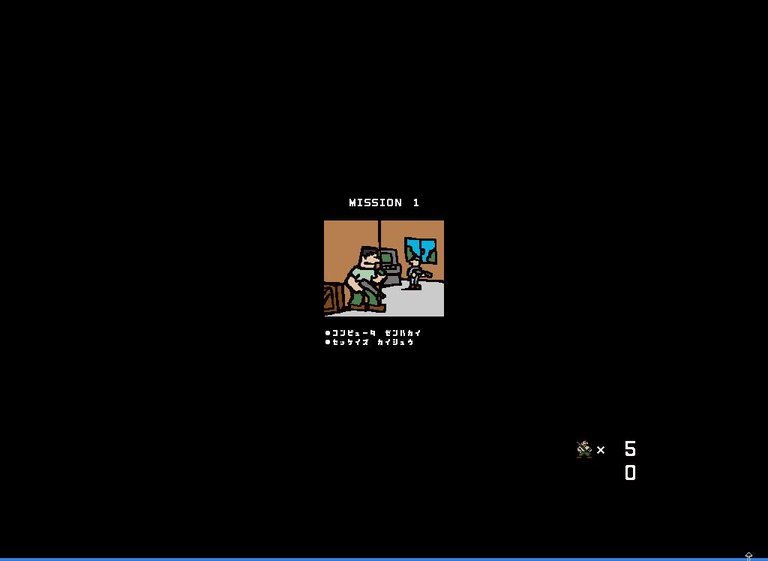
Description
Hakaiman is a top-down shooter game released in 2006, where players take control of a lone commando tasked with executing six special missions, such as stealing plans and infiltrating bases. The game features stealth and shooter gameplay elements, with the commando armed with a rifle and grenades. Players must navigate smart enemies and breakable walls while remaining silent to avoid detection. The game is entirely in Japanese and offers a challenging spy/espionage narrative.
Hakaiman Mods
Hakaiman Reviews & Reception
mobygames.com (54/100): A top-down shooter where the player controls a commando, a lone wolf who must execute special missions.
resetera.com : Hakaiman is a great but relatively obscure Japanese, freeware, stealth/action indie game released more than a decade back that plays really well.
sockscap64.com (80/100): Hakaiman is a top-down shooter where the player controls a commando, a lone wolf who must execute special missions.
glorioustrainwrecks.com : Ikiki was a super talented and absurdly prolific Japanese indie developer from the mid-2000s -> early 2010s.
Hakaiman: Review
Introduction
In the shadowed corridors of gaming history, where cult classics whisper their legends, lies Hakaiman—a 2006 Japanese freeware gem that pioneered a blend of stealth and top-down action years before Hotline Miami electrified the genre. Developed by the enigmatic indie studio Ikiki and lost to time until preservation efforts salvaged it, Hakaiman is a testament to the raw creativity of the mid-2000s freeware scene. This review argues that while commercially obscure and mechanically unpolished, Hakaiman is a foundational text in indie game design, marrying tactical espionage with tense, tactical pacing that would ripple through the industry.
Development History & Context
The Ikiki Enigma and the Freeware Frontier
Ikiki Games—a largely one-man operation helmed by developer “Uta”—was a prolific but unsung force in Japan’s early-2000s indie scene. Working within the constraints of Multimedia Fusion 1.5, a drag-and-drop engine notorious for its limitations, Ikiki released dozens of experimental freeware titles, including Hakaiman. The era was defined by dial-up downloads, rudimentary distribution platforms, and a DIY ethos; games were distributed via personal websites like ikiki.la.coocan.jp, which vanished by the early 2010s, nearly erasing Ikiki’s legacy.
Technological and Cultural Constraints
Released in February 2006, Hakaiman emerged amid a gaming landscape dominated by AAA titans like Resident Evil 4 and Half-Life 2. Yet, Ikiki’s vision was antithetical to mainstream trends. The game’s top-down perspective and minimalist aesthetics were born not just from artistic choice but from necessity: Multimedia Fusion struggled with 3D rendering, forcing Uta to prioritize functional clarity over visual flair. The decision to keep the game exclusively in Japanese further narrowed its audience, cementing its status as a regional curio.
Narrative & Thematic Deep Dive
The Lone Wolf Mythos
Hakaiman’s narrative is Spartan but evocative. Players assume the role of a nameless commando—a “lone wolf”—tasked with six missions ranging from plan thefts to base infiltrations. Dialogue is nonexistent; storytelling unfolds through stark, text-only mission briefings (e.g., “STEAL THE ENEMY BLUEPRINTS”) and the grim consequences of failure (a Game Over screen depicting the protagonist beaten by police). This minimalism channels the stoic ethos of 1980s action cinema, where protagonists were defined by deeds, not dialog.
Themes of Vulnerability and Resourcefulness
Thematically, Hakaiman explores the fragility of the individual against overwhelming systems. With no allies, regenerating health, or checkpoints, the commando’s survival hinges on improvisation: hiding bodies, sabotaging turrets, and scrounging ammo from refrigerators. Every grenade spent to breach a wall is a calculated risk, echoing survival-horror resource management. The game’s Japanese title—roughly translatable as “Boundary Agent”—hints at liminality, casting the player as a ghost slipping between the cracks of enemy infrastructure.
Gameplay Mechanics & Systems
The Stealth-Action Crucible
Hakaiman’s core loop merges methodical stealth with explosive improvisation. Movement and aiming are grid-based, evoking classics like Metal Gear, but with a top-down camera that denies verticality. Players wield a rifle (limited ammo) and grenades (physics-driven destruction), balancing silent takedowns against all-out assaults.
- Stealth Systems: Enemies patrol with cone-of-vision awareness. Noise matters: gunfire or explosions trigger alarms, flooding the map with reinforcements.
- Destruction: Walls crumble under grenades, enabling shortcuts or ambush routes—a feature later popularized by Teardown. Turrets can be disabled by lobbing explosives beneath them.
- Scavenging: Cabinets, boxes, and even refrigerators hide ammo, grenades, and rare extra lives. The scarcity compels tense inventory management.
Brutal Mastery and Flaws
The game’s difficulty borders on punitive, particularly in the infamously grueling final mission (described by players as “FOADIAF” [F* Off And Die In A Fire]). Limited saves and instant-fail states amplify tension but frustrate accessibility. The UI is functional but austere, with no map or objective markers—a “trust the player” design philosophy that demands trial-and-error memorization.
World-Building, Art & Sound
Minimalism as Atmosphere
Visually, Hakaiman embraces a utilitarian aesthetic: walls are gray blocks, enemies red blobs, and the commando a small, black silhouette. This abstraction paradoxically enhances immersion, evoking the sterile dread of a blueprint come to life. The absence of music is masterful; ambient silence is punctuated by footsteps, gunshots, and the metallic clink of grenades, making every noise a heartbeat.
Diegetic Feedback
Sound design serves as the player’s primary intel tool. Distant footsteps hint at patrol routes, while crumbling walls signal exploitable weak points. The Game Over screen’s abrupt cacophony of police batons is a visceral gut-punch, reinforcing the stakes.
Reception & Legacy
Obscurity and Rediscovery
At launch, Hakaiman garnered minimal attention, reflected in its 2.7/5 average user score (based on a solitary MobyGames review). Language barriers and distribution limits confined it to niche Japanese forums. Yet, posthumously, it achieved mythic status. Communities like Glorious Trainwrecks archived Ikiki’s work in the 2010s, revealing its influence on Dennaton Games’ Hotline Miami (2012)—notably the top-down perspective, stealth-violence hybrid, and mission-based structure.
Industry Impact
Hakaiman’s DNA surfaces in modern indie darlings:
– Destruction: The systemic crumbling of environments presaged Teardown and Noita.
– Stealth Pacing: Its “slow-then-sudden” rhythm echoed in Heat Signature and Mark of the Ninja.
– Minimalist Narrative: Text-only briefings inspired Hotline Miami’s cryptic vignettes.
Conclusion
Hakaiman is a fissure in gaming’s bedrock—a modest freeware experiment that quietly shaped a genre. Its lack of polish and accessibility stymied mainstream success, but its innovations in stealth, destruction, and atmospheric minimalism are undeniable. Today, as developers mine indie history for inspiration, Hakaiman stands as a vital artifact: proof that constraint breeds ingenuity. For historians and designers alike, it is not merely a game but a blueprint—a testament to the defiant spirit of indie creation. Play it not for comfort, but for communion with a forgotten pioneer.