
- Release Year: 2006
- Platforms: Windows
- Publisher: Frogster Interactive Pictures AG
- Genre: Compilation
- Average Score: 51/100
Description
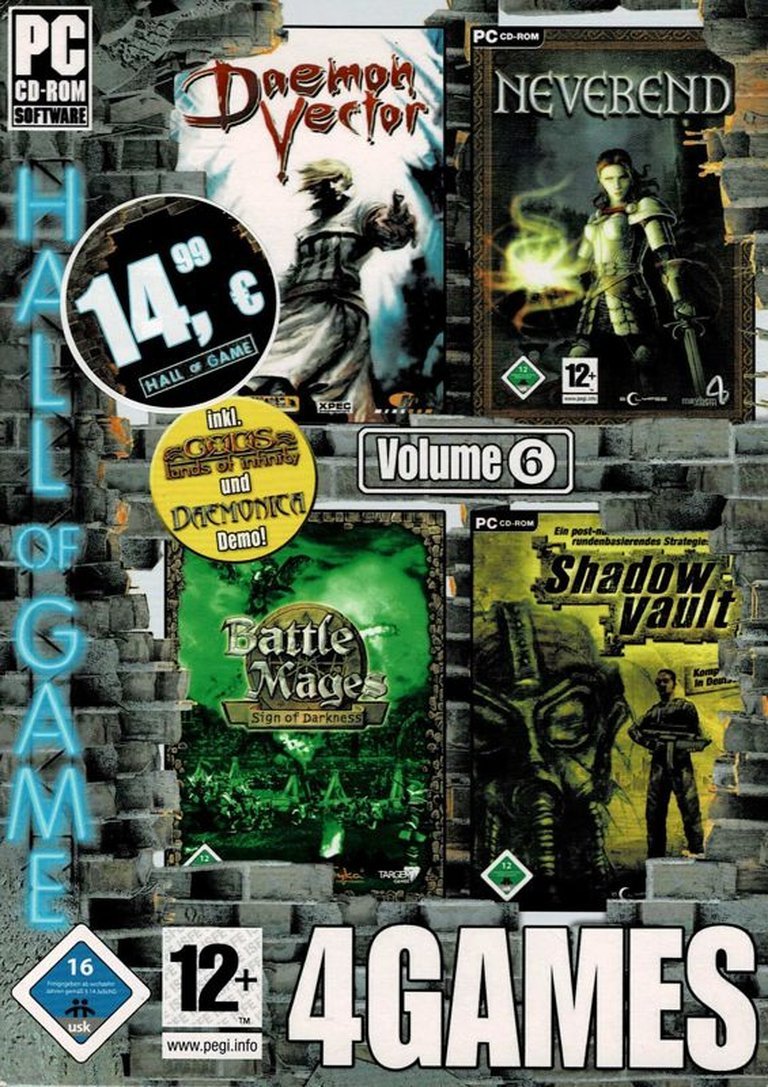
Hall of Game: 4Games – Volume 6 is a Windows compilation released in 2006 that bundles four full games—Daemon Vector, Neverend, Battle Mages: Sign of Darkness, and Shadow Vault—alongside demo versions of GODS: Lands of Infinity and Daemonica. This collection offers diverse gaming experiences across fantasy, strategy, and action genres, packaged as a commercial title with a PEGI 12 rating.
Hall of Game: 4Games – Volume 6: A Forgotten Compilation’s Legacy
Introduction
In the mid-2000s, video game compilations like Hall of Game: 4Games – Volume 6 (2006) were a common sight on store shelves, offering budget-conscious gamers a taste of multiple titles in one package. This particular compilation, published by Frogster Interactive Pictures AG, bundled four lesser-known games—Daemon Vector, Neverend, Battle Mages: Sign of Darkness, and Shadow Vault—along with demo versions of GODS: Lands of Infinity and Daemonica. While it never achieved the cultural impact of its contemporaries like Gears of War or The Elder Scrolls IV: Oblivion, Hall of Game: 4Games – Volume 6 offers a fascinating snapshot of the era’s mid-tier PC gaming landscape. This review will dissect its development, narrative, gameplay, and legacy to determine whether it was a hidden gem or a forgotten relic.
Development History & Context
The early 2000s were a transitional period for PC gaming, marked by the rise of digital distribution and the decline of physical compilations. Hall of Game: 4Games – Volume 6 was part of a series that aimed to capitalize on the demand for affordable, varied gaming experiences. Frogster Interactive, a German publisher, was known for budget-friendly releases, often bundling indie or niche titles to appeal to a broad audience.
The four main games in this compilation spanned different genres:
– Daemon Vector: A first-person shooter with a sci-fi theme.
– Neverend: A fantasy-themed action RPG.
– Battle Mages: Sign of Darkness: A tactical RPG with a dark fantasy setting.
– Shadow Vault: A real-time strategy game with stealth elements.
The inclusion of demos for GODS: Lands of Infinity and Daemonica was a clever marketing tactic, offering players a preview of upcoming titles. However, the compilation’s release in 2006 coincided with the launch of the PlayStation 3 and Xbox 360, which shifted industry focus toward console gaming. This context likely contributed to its lackluster reception.
Narrative & Thematic Deep Dive
Given the compilation’s nature, each game’s narrative is distinct, but they share a common theme of fantasy and sci-fi escapism.
- Daemon Vector: Players assume the role of a space marine battling alien forces. The story is straightforward, focusing on survival and combat.
- Neverend: A fantasy RPG with a more developed narrative, featuring a hero on a quest to save a magical realm. The dialogue and character interactions are basic but serviceable for the genre.
- Battle Mages: Sign of Darkness: This tactical RPG delves into darker themes, with players commanding a group of mages in a war against evil forces. The story is more complex, with moral choices and branching paths.
- Shadow Vault: A real-time strategy game with a stealth-focused narrative, where players control a team of operatives infiltrating enemy bases.
Thematically, the compilation leans into escapism, offering players a variety of worlds to explore. However, the writing is often generic, lacking the depth of AAA titles like The Elder Scrolls IV: Oblivion or Final Fantasy XII, which dominated the year.
Gameplay Mechanics & Systems
The gameplay across the four titles is varied but suffers from technical and design limitations.
- Daemon Vector: A standard FPS with cover mechanics and a variety of weapons. The controls are functional but lack the polish of Half-Life 2 or F.E.A.R., which were released around the same time.
- Neverend: A traditional action RPG with real-time combat and leveling systems. The progression is satisfying, but the combat feels clunky compared to Diablo II or Baldur’s Gate.
- Battle Mages: Sign of Darkness: A turn-based tactical RPG with grid-based movement and spellcasting. The strategy is engaging, but the AI is often predictable.
- Shadow Vault: A real-time strategy game with stealth elements. The gameplay is innovative but suffers from poor pathfinding and unbalanced difficulty.
The UI and controls are dated by modern standards, with clunky menus and unresponsive inputs. The compilation’s technical limitations, such as low-resolution textures and simplistic AI, further detract from the experience.
World-Building, Art & Sound
Visually, the games in Hall of Game: 4Games – Volume 6 are a mixed bag. Daemon Vector and Neverend feature generic fantasy and sci-fi aesthetics, while Battle Mages: Sign of Darkness stands out with its dark, gothic art style. Shadow Vault uses a more abstract, top-down perspective that feels out of place alongside the 3D titles.
The sound design is equally inconsistent. Daemon Vector and Neverend rely on generic orchestral tracks and sound effects, while Battle Mages: Sign of Darkness features a more atmospheric score. Voice acting is minimal, with most dialogue delivered through text.
Reception & Legacy
Hall of Game: 4Games – Volume 6 received a lukewarm reception, with critics panning it as a collection of forgettable titles. The sole critic review on MobyGames gave it a 51% score, describing the games as “fun for a short time but quickly become boring.” The compilation’s lack of innovation and technical shortcomings contributed to its poor reception.
Despite its flaws, the compilation holds a niche appeal for retro gaming enthusiasts. The inclusion of Battle Mages: Sign of Darkness and Shadow Vault makes it a curiosity for fans of tactical RPGs and real-time strategy games. However, it lacks the lasting impact of other 2006 releases like The Legend of Zelda: Twilight Princess or Gears of War, which redefined their respective genres.
Conclusion
Hall of Game: 4Games – Volume 6 is a product of its time—a budget-friendly compilation that offered variety but little innovation. While it may have appealed to budget-conscious gamers in 2006, its technical limitations and lack of depth render it obsolete by modern standards. Its legacy is that of a forgotten curiosity, a snapshot of an era when compilations were a staple of PC gaming. For historians and retro gaming enthusiasts, it serves as a reminder of the diversity of mid-2000s PC titles, but for most players, it’s a relic best left to the past.