
- Release Year: 1998
- Platforms: Windows
- Publisher: Wilco Publishing
- Developer: Quality Simulations
- Genre: Simulation
- Perspective: 1st-person
- Game Mode: Single-player
- Gameplay: Flight Simulation, Gliding, Thermal riding
- Setting: Aerial, Outdoor
- Average Score: 59/100
Description
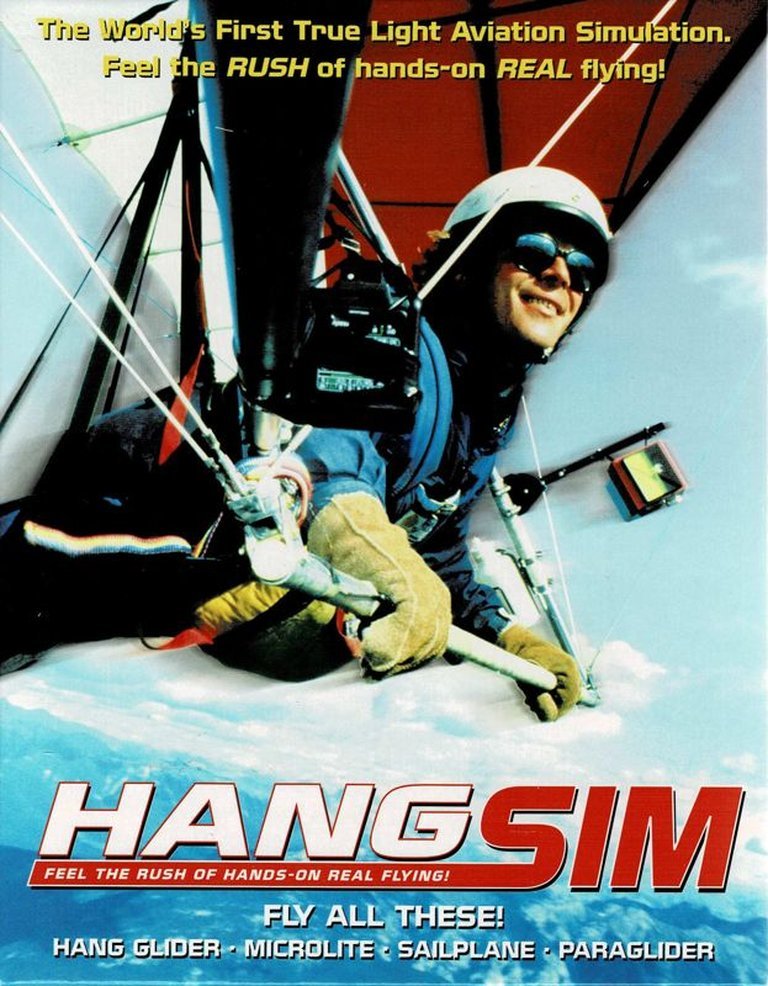
Hangsim is a flight simulator focused on the sport of hang gliding and paragliding, released in 1998 for Windows. The game challenges players to stay aloft by navigating thermals, avoiding turbulence, and mastering flight mechanics in a realistic, physics-based environment. It features a series of structured scenarios to teach basic gameplay elements, as well as a free-flight mode for unrestricted exploration. The game boasts Direct3D-accelerated graphics with dynamic weather and lighting effects, though its visuals and performance may show their age by modern standards. With a minimalist interface, players rely on intuition and skill to prolong their flight, making it a niche but immersive experience for aviation enthusiasts.
Hangsim Free Download
PC
Hangsim Guides & Walkthroughs
Hangsim Reviews & Reception
mobygames.com (65/100): Flew like a brick, sounded divine.
en.wikipedia.org (58/100): The game received mixed reviews according to the review aggregation website GameRankings.
a.espncdn.com (55/100): In the end it only proves that some real-life experiences just don’t make for very good simulations.
Hangsim: A Niche Flight Simulator That Soared Above Expectations
Introduction
In the late 1990s, flight simulators were dominated by heavyweight titles like Microsoft Flight Simulator and Jane’s Combat Simulations, which focused on military aircraft and commercial aviation. Amidst this landscape, Hangsim emerged as a unique and ambitious project—a flight simulator dedicated to the often-overlooked world of hang gliding and paragliding. Developed by Quality Simulations and published by Wilco Publishing, Hangsim offered players an unconventional but deeply immersive experience, blending realistic aerodynamics with serene, almost meditative gameplay. While it didn’t achieve mainstream success, its niche appeal and technical achievements make it a fascinating artifact in the history of flight simulation games.
Development History & Context
The Studio and Vision
Quality Simulations, the Belgian developer behind Hangsim, was a small but passionate team with prior experience in flight simulation add-ons, notably the Airport 2000 series for Microsoft Flight Simulator. Their collaboration with Wilco Publishing, a publisher known for aviation-themed titles, allowed them to bring Hangsim to life. The game was conceived as a “light aviation simulator,” focusing on unpowered flight—a stark contrast to the engine-driven aircraft that dominated the genre.
The core vision of Hangsim was to simulate the nuances of hang gliding and paragliding, where pilots rely on natural forces like thermals, wind currents, and ridge lifts to stay aloft. This required a sophisticated flight model that could accurately depict the delicate balance of low-speed, unpowered flight. The team, led by aerodynamics expert Ilan Papini, invested heavily in creating a physics engine that could replicate the real-world behavior of these aircraft.
Technological Constraints and Innovations
Released in 1998 (with a wider release in 1999), Hangsim was developed during a transitional period in PC gaming. The late ’90s saw the rise of 3D acceleration, and Hangsim leveraged Direct3D to render its environments. However, the hardware limitations of the era posed significant challenges. The game’s terrain, while ambitious, often suffered from blurry textures and low-resolution aerial photography, a common issue in early 3D flight simulators.
Despite these constraints, Hangsim introduced several innovations:
– Dynamic Weather and Thermals: The game simulated real-time weather effects, including thermals (rising columns of warm air) that players could exploit to gain altitude.
– Accurate Flight Models: Each of the seven aircraft (hang gliders, paragliders, microlites, and sailplanes) had distinct handling characteristics, reflecting their real-world counterparts.
– GPS and Navigation Tools: A functional GPS system and moving map display were included, adding a layer of realism for navigation.
The Gaming Landscape of 1998-1999
At the time of Hangsim’s release, the flight simulation genre was highly competitive. Microsoft Flight Simulator 2000 had just launched, offering unparalleled realism for commercial and general aviation. Meanwhile, combat flight simulators like Jane’s F-15 and Falcon 4.0 catered to military enthusiasts. Hangsim carved out its own niche by focusing on the serene, almost philosophical experience of unpowered flight—a stark departure from the high-speed, high-stakes action of its contemporaries.
Narrative & Thematic Deep Dive
The Absence of a Traditional Narrative
Unlike many games of its era, Hangsim did not feature a structured narrative or campaign. Instead, it embraced a sandbox approach, offering players the freedom to explore its environments at their own pace. The game’s “story” was implicitly tied to the act of flying itself—the struggle to stay aloft, the thrill of catching a thermal, and the tranquility of gliding over landscapes.
Themes of Freedom and Mastery
Hangsim’s themes revolved around freedom, patience, and mastery. The game rewarded players who took the time to learn its mechanics, such as reading the terrain for thermals or adjusting their flight path to avoid turbulence. This emphasis on skill and observation mirrored the real-world challenges faced by hang glider pilots, where success depends on understanding the environment rather than brute force.
The Role of Music and Atmosphere
One of Hangsim’s most praised elements was its ambient soundtrack, composed by Didier Biot. The music was light, airy, and meditative, perfectly complementing the game’s serene atmosphere. As noted in player reviews, the soundtrack enhanced the experience, making the act of flying feel almost therapeutic. The absence of engine noise (save for the wind) further immersed players in the quietude of unpowered flight.
Gameplay Mechanics & Systems
Core Gameplay Loop
The primary objective of Hangsim was simple: stay aloft for as long as possible. Players began each flight by launching from a cliff or hill, then had to navigate the environment to find thermals and other updrafts. The game’s challenge lay in its realism—players couldn’t simply “fly forever” without understanding the mechanics of lift and drag.
Aircraft and Handling
Hangsim featured seven aircraft, each with distinct flight characteristics:
– Hang Gliders: Fast and maneuverable but required skill to control.
– Paragliders: Slower and more stable, ideal for beginners.
– Microlites (Ultralights): Motorized but still lightweight, offering a middle ground between gliders and powered aircraft.
– Sailplanes: High-performance gliders capable of long-distance flights.
The flight model, overseen by Ilan Papini, was praised for its accuracy. However, some critics noted that the AI-controlled gliders in competitions could outperform human players, suggesting that the game’s difficulty curve might have been uneven.
Missions and Modes
Hangsim offered several gameplay modes:
– Free Flight: A sandbox mode where players could explore without objectives.
– Challenges: Structured scenarios that tested specific skills, such as navigating through a series of checkpoints.
– Competitions: Multi-glider races where players competed against AI opponents.
– Fun Flight: A more arcade-like mode that included optional weapons (e.g., missiles), a nod to the game’s lighter side.
The inclusion of weapons in “Fun Flight” was a peculiar but amusing addition, allowing players to “shoot down” other gliders—a feature that stood out in an otherwise realistic simulator.
UI and Controls
The game’s interface was functional but sparse, reflecting its focus on realism. Players could switch between first-person cockpit views and external chase cameras. The GPS and map systems were intuitive, though some critics found the lack of detailed instrumentation limiting compared to other flight simulators.
World-Building, Art & Sound
Visual Design and Terrain
Hangsim’s environments were based on real-world aerial photography, offering five distinct regions with varying topography. The terrain resolution was impressive for its time (up to 3 meters per pixel), but the textures often appeared blurry, especially at lower altitudes. The game’s lighting and shadow effects were notable, with dynamic clouds and sun positioning adding to the immersion.
Sound Design
The sound design was minimalist but effective. The primary audio elements were the wind rushing past the glider and the ambient soundtrack. The absence of engine noise reinforced the game’s focus on unpowered flight, creating a uniquely tranquil experience.
Reception & Legacy
Critical Reception
Hangsim received mixed reviews upon release, with critics praising its realism and ambition but noting its technical limitations. Aggregated scores ranged from 50% to 80%, reflecting its polarizing nature:
– Positive Aspects:
– Realistic flight mechanics and thermal simulation.
– Unique focus on hang gliding and paragliding.
– Relaxing atmosphere and soundtrack.
– Negative Aspects:
– Blurry textures and underwhelming visuals.
– Steep learning curve for casual players.
– Limited appeal outside of aviation enthusiasts.
Commercial Performance and Legacy
Hangsim did not achieve widespread commercial success, but it developed a cult following among flight simulation enthusiasts. Its legacy lies in its pioneering approach to unpowered flight simulation—a niche that few games have explored since. The game’s developer, Ilan Papini, went on to create other simulators, including Micro Flight and Virtual Sailor, before his untimely passing in 2024.
Conclusion
Hangsim remains a fascinating footnote in the history of flight simulators. It dared to focus on a niche within a niche, offering an experience that was as much about patience and observation as it was about flying. While its technical limitations and narrow appeal prevented it from reaching mainstream success, its dedication to realism and its serene atmosphere make it a memorable title. For those willing to embrace its slow pace and steep learning curve, Hangsim provided a uniquely meditative take on flight simulation—one that still resonates with aviation enthusiasts today.
Final Verdict: A flawed but ambitious simulator that soared in its niche, Hangsim is a testament to the creativity of its developers and a reminder that sometimes, the most rewarding games are those that dare to be different. 7/10