
- Release Year: 2002
- Platforms: Windows
- Publisher: Levande Böcker i Norden AB
- Developer: Elva Femtiofem Media AB
- Genre: Educational
- Perspective: 3rd-person
- Game Mode: Single-player
- Gameplay: Mini-games
Description
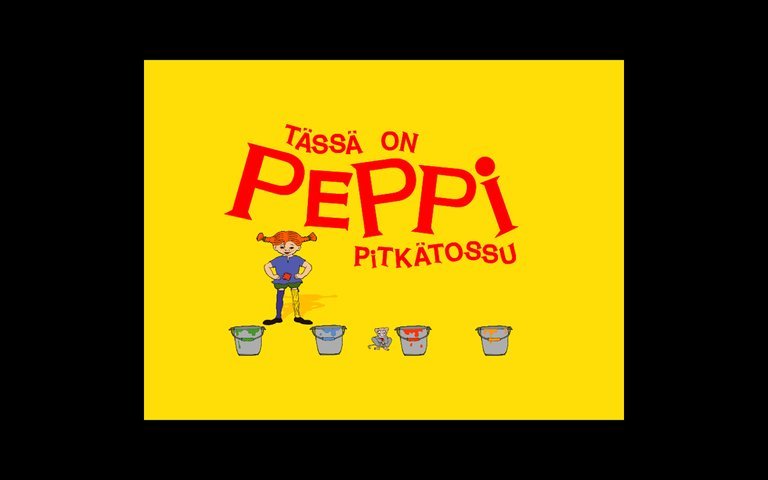
Här kommer Pippi Långstrump is an educational point-and-click adventure game based on Astrid Lindgren’s beloved character. Set in the iconic Villa Villekulla, players control Pippi as they explore her home and engage in ten diverse mini-games alongside Tommy and Annika, designed for fun and learning.
Här kommer Pippi Långstrump Free Download
Här kommer Pippi Långstrump: A Definitive Review of a Scandinavian Educational Gaming Curiosity
Introduction
In the vast, often-overlooked archives of region-specific licensed video games, few titles capture a particular time, place, and cultural ethos as succinctly as Här kommer Pippi Långstrump (2001/2002). While the global gaming community largely fixates on blockbuster franchises and avant-garde indie darlings, this Swedish point-and-click educational game exists in a quiet corner of history—a loving, technically modest, yet fiercely authentic digital translation of Astrid Lindgren’s iconic creation. This review argues that Här kommer Pippi Långstrump is not merely a forgotten relic but a significant case study in the challenges and triumphs of adapting cherished children’s literature for the interactive medium during the formative years of the edutainment genre. Its legacy is twofold: as a technically competent, warmly received piece of Swedish cultural software and as a benchmark for how localized, non-English gaming experiences can faithfully preserve the spirit of their source material against all technological and commercial odds.
Development History & Context
The game emerges from a specific historical and technological confluence. Developed by Elva Femtiofem Media AB (a studio whose name, “Elva Femtiofem,” translates to “Eleven Fifty-Five,” hinting at a small, possibly quirky team) and published by Levande Böcker i Norden AB (“Living Books in the Nordic Region”), the project was steeped in a Nordic educational and literary ethos. The publisher’s name itself evokes the American “Living Books” series, suggesting an aspiration toward interactive storytelling with pedagogical value, but firmly rooted in Scandinavian content.
The release window—circa 2001/2002—places it at the tail end of the “edutainment boom” of the 1990s and the dawn of the new millennium’s more robust gaming landscape. Technologically, it was built for the Windows 98/ME/XP era, as indicated by system requirements from PCGamingWiki (Pentium III 500 MHz, 128MB RAM). This was a period of transition: 3D acceleration was becoming standard, but 2D, CD-ROM-based point-and-click adventures were still a viable, cost-effective format for niche and children’s markets. The game’s existence as a retail-only, non-DRM title (per PCGamingWiki) was typical for its target audience—schools, libraries, and families purchasing physical media from regional software sections.
Crucially, it was the second game in the nascent Pippi Långstrump digital series, following a 1995 title (Pippi). This sequel arrived six years later, allowing the developer to refine its approach based on any perceived shortcomings of its predecessor. The source material, of course, is Astrid Lindgren’s 1945 novel, a cornerstone of Nordic childhoods. The game’s alternative titles—Her kommer Pippi Langstrømpe (Norwegian/Danish), Pippi Calzaslargas (Spanish), Tässä on Peppi Pitkätossu (Finnish)—attest to a targeted, multi-Nordic release strategy, prioritizing cultural and linguistic localization over global reach. The voice cast, as listed in the Swedish Media Database (SMDB), includes Chanette Rindahl as Pippi, Mia Norgren as Annika, and Erik Lundqvist as Tommy, ensuring the characters’ iconic personalities were conveyed through native Scandinavian performance.
Narrative & Thematic Deep Dive
As an educational mini-game compilation, Här kommer Pippi Långstrump eschews a traditional, linear narrative in favor of a hub-based structure. Players explore Villa Villekulla, Pippi’s fantastical, upside-down house, which serves as a central menu from which ten distinct activities are launched. This design choice is profoundly thematic: Villa Villekulla is Pippi’s world—a place of chaotic, rule-free wonder. By making it the explorable lobby, the game immediately immerses the player in the book’s core setting, transforming it from a backdrop into an interactive playspace.
The narrative“narrative” elements are therefore embedded within each mini-game’s framing. While the source material details specific plots from the books (Pippi’s珍宝 hunting, her interactions with the police, her sailing adventures), the game abstracts these into playful challenges. The themes are pure Lindgren:
* Childhood Autonomy & Strength: Pippi’s defining trait—her unmatched physical strength and self-reliance—is translated into gameplay through activities that require uncovering hidden objects, solving simple environmental puzzles, or “cleaning” the house in unconventional ways. You don’t just read about Pippi lifting a horse; you might click to help her accomplish a feats of strength in a mini-game context.
* Anti-Authoritarian Joy: The mischievous, good-natured defiance of adult rules (likeMrs. Prysselius’s attempts to impose order) is channeled into games where “cleaning up” or “following rules” is presented as a fun, quirky task rather than a chore, aligning with Pippi’s perspective.
* Friendship & Imagination: The inclusion of Tommy and Annika as playable characters is critical. Their presence validates the book’s central trio. Gameplay segments likely involve cooperative or parallel play, reinforcing the theme that adventure is best shared. The dialogue, while sparse in a point-and-click context, is written by Gun Jacobson (SMDB) and delivered by the voice cast, capturing the innocent, often hilarious logic of childhood.
The game’s literature is not adapted as a story but as a vibe. It captures the “bagatellartad underhållning” (“trifling amusement”) lauded by critic Thomas Arnroth (TT Spektra). The stakes are never high; the joy is in the doing, not the outcome. This is a thematic masterstroke for an educational title—it makes learning feel like playing in Villa Villekulla.
Gameplay Mechanics & Systems
Mechanically, Här kommer Pippi Långstrump is a point-and-click adventure (P&C) framework housing ten discrete mini-games. This hybrid approach was common in children’s software of the era (e.g., the Freddi Fish or Pajama Sam series), but here the P&C element is primarily navigational.
- Core Loop: From Villa Villekulla’s isometric or pre-rendered 3D view (the exact perspective is “3rd-person (Other)” on MobyGames), the player clicks on icons representing rooms or characters to access mini-games. This establishes a safe, exploratory rhythm.
- Mini-Game Design: The ten activities are the heart of the experience. Based on critical descriptions of “enkel, underhållande” (simple, entertaining) and “lagom svårt” (just the right difficulty), we can infer a spectrum of cognitive tasks:
- Observation & Pattern Recognition: Spotting hidden objects in cluttered rooms (Pippi’s treasure trove?).
- Simple Logic & Sequencing: Arranging events or items in order (perhaps dressing Pippi or planning a picnic).
- Motor Skills & Reaction: Very basic arcade-style tasks, like clicking moving targets (catching butterflies?) or guiding Pippi across a room.
- Exploration-Based Puzzles: Using Tommy or Annika to reach places Pippi can’t, or vice-versa, encouraging perspective-taking.
The genius is in the lack of punitive failure. Critic Bengt Arvidson (Sydsvenskan) called it “tryggt” (secure/safe). This aligns with an educational philosophy where the goal is engagement and positive reinforcement, not high scores or “game over” screens. A “failed” attempt likely just resets the mini-game gently.
- Progression & UI: There is no character progression in an RPG sense. “Progression” is the completion of mini-games, possibly unlocking new areas of Villa Villekulla or simple rewards like animated stickers. The interface is pure point-and-click: icon-driven, with minimal text, relying on intuitive visuals and the charming voice-over for instruction. This makes it language-agnostic within its supported tongues (Swedish, Norwegian, Danish, Finnish)—a child can play even with limited reading skills.
- Innovation & Flaws: Its innovation is in its faithful, non-didactic adaptation. It doesn’t force-feed morals; it lets the Pippi-verse facilitate fun. The primary flaw, noted by Göteborgs-Posten’s Torgny Karin, is the sound quality being “kunnat vara bättre” (could have been better) compared to the 1995 game. Given the voice acting is a key strength, this is a notable dip in polish. The mini-games themselves might vary in depth—Lennart Nilsson (Expressen) called them “varierande” (varied)—suggesting some are more engaging than others, a common issue in compilation titles.
World-Building, Art & Sound
This is where the game achieves its greatest artistic success and cement its cultural value.
* Visual Direction & Art: The game’s visuals are its crown jewel. It directly utilizes the iconic, delicate line-drawing illustrations of Ingrid Vang Nyman, the original illustrator of Lindgren’s books. As noted by multiple critics (“fina illustrationer”), seeing Pippi, Villa Villekulla, and the town rendered in this unmistakable style is a powerful evocation of the literary world. The art is not an imitation but a direct digital extension of the source material, preserving its whimsical, slightly surreal aesthetic. Animations by Peter Jando and Sari Felt Norgren (SMDB) likely bring these static images to life with modest, effective motion—Pippi’s signature pigtails bouncing, her stockings stripy and bold.
* Sound Design & Music: The soundscape is split. The voice acting, as highlighted, is a major asset. Chanette Rindahl’s Pippi captures the character’s unique cadence—loud, confident, and funny. The music, composed by Jan Johansson (SMDB), likely consists of gentle, melodic tunes or arrangements of the famous “Här kommer Pippi Långstrump” song theme, creating a warm, familiar audio cocoon. The one critical weakness is the technical quality of the audio samples, which Karin found subpar. This was likely a budget or technical limitation of the era—compressed voice clips common in CD-ROM games.
* Atmosphere: The combination creates an atmosphere of secure nostalgia. For Swedish children of the early 2000s, this was likely their first opportunity to inhabit Villa Villekulla. The point-and-click navigation, the lack of pressure, the familiar sights and sounds—it all builds a world that feels less like a “game” and more like a digital dollhouse or playset based on the books. It’s a interpretation that understands Pippi’s world is one of imaginative, consequence-free play.
Reception & Legacy
Här kommer Pippi Långstrump enjoyed a strong critical reception within Sweden upon its 2001 release, a rarity for licensed software which often faces skepticism.
* Critical Consensus: Reviews from major Swedish dailies were consistently positive, averaging around 4 out of 5 stars. Critics uniformly praised its:
1. Appropriate Difficulty: “Lagom utmanande för de små” (“Just challenging enough for the little ones”) – Göteborgs-Posten.
2. Artistic Fidelity: “Fina illustrationer” (Fine illustrations) – Multiple reviews.
3. Spirit of the Source: “Helt i Pippis anda” (“Completely in Pippi’s spirit”), “Tryggt, snyggt och klassiskt” (“Secure, neat and classic”) – Sydsvenskan.
4. Entertainment Value: “Simpelt men smart” (“Simple but smart”), “Bagatellartad underhållning” (“Trifling amusement”) – TT Spektra.
* Comparison to Predecessor: Critics favorably compared it to the 1995 Pippi game, specifically noting that its sound was an improvement (though still not perfect). This indicates the developer, Elva Femtiofem Media, successfully addressed prior criticisms.
* Commercial & Cultural Impact: While exact sales figures are unavailable, its inclusion in the collections of Swedish libraries and schools (a common distribution channel for such titles) suggests it achieved its intended commercial and educational goals. Its preservation in institutions like the Internet Archive (which hosts a disk image and manual) and documentation in the Svensk mediedatabas (SMDB) signifies its recognition as a piece of Sweden’s digital cultural heritage.
* Legacy & Influence: Its direct influence on the broader games industry is minimal. It did not spawn a new wave of Pippi games; the next major title, a 3D action game for DS/3DS (Pippi Långstrump, 2012), was a completely different, more conventional take. Its legacy is culturally specific and preservational. It stands as a high-water mark for Nordic children’s edutainment: a title that respected its young audience’s intelligence, its source material’s integrity, and the potential of interactive media to build worlds, not just quizzes. It demonstrated that a licensed game could be both critically respectable and true to its heart.
Conclusion
Här kommer Pippi Långstrump (2001) is not a game that will reshape industry paradigms or sell millions globally. Judged by the metrics of modern gaming—graphical fidelity, complex systems, online integration—it is a primitive, narrow, and technically dated product. To dismiss it on these grounds, however, is to miss its profound achievement within its own constrained universe.
As a piece of cultural translation, it is masterful. It understands that Pippi’s world is one of anarchic, loving play and structures its entire design around facilitating that feeling for a child. The use of Ingrid Vang Nyman’s art is not a cheap license but a central design pillar, creating a visual authenticity few adaptations achieve. The mini-game structure, while simple, provides varied, low-stress engagement that aligns perfectly with a child’s natural rhythms of play and attention.
Its historical value is threefold: as a competent example of the late-era point-and-click edutainment genre, as a touchstone of Swedish digital childhoods, and as a case study in successful regional localization and preservation. It is a game that knew its audience—Swedish children familiar with Lindgren’s work—and spoke to them directly, confidently, and with palpable affection.
In the pantheon of video game history, Här kommer Pippi Långstrump occupies a quiet, respected room. It is not a classic because it was revolutionary, but because it was authentic. It is a digital heirloom, a loving and cleverly constructed keyhole through which a generation could peer directly into the upside-down, horse-owning, cookie-loving joy of Villa Villekulla. For that, it earns its place not in the hall of fame, but in the warmer, more personal archive of games that got it exactly right for the people they were made for. Its final verdict is a resounding, unpretentious “Lagom bra”—Just right.