
- Release Year: 1992
- Platforms: DOS, Windows
- Publisher: Atari Interactive, Inc., MicroProse Software, Inc.
- Developer: MicroProse Ltd.
- Genre: Aviation, Flight, Simulation, Vehicular combat, Vehicular
- Perspective: 1st-person
- Game Mode: Single-player
- Gameplay: Campaign options, Flight Simulation, Real-time AI
- Setting: Falklands 1997, Hong Kong 1996, Nord Kapp 1998
- Average Score: 82/100
Description
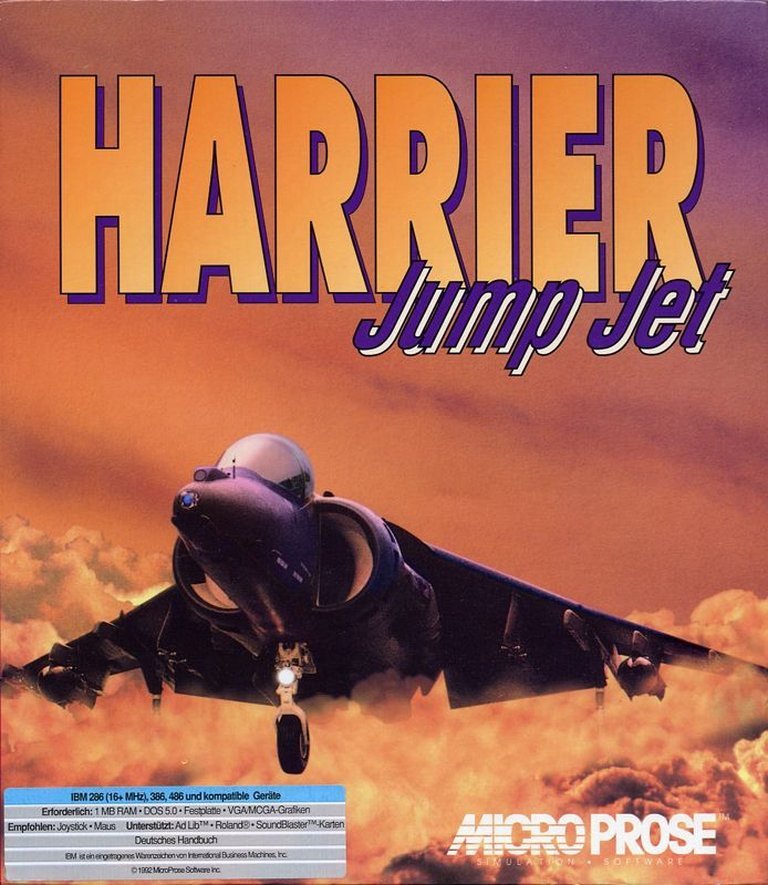
Harrier Jump Jet is a flight simulation game developed by MicroProse, allowing players to pilot the RAF’s Harrier GR7 or the US Marine Corps’ AV-8B in three fictional conflict zones: Hong Kong 1996, the Falklands 1997, and Nord Kapp 1998. The game features realistic flight dynamics, real-time AI-driven missions, and innovative graphics for its time, offering a detailed and immersive experience for aviation enthusiasts.
Gameplay Videos
Where to Buy Harrier Jump Jet
Harrier Jump Jet Free Download
Harrier Jump Jet Patches & Updates
Harrier Jump Jet Guides & Walkthroughs
Harrier Jump Jet Reviews & Reception
mobygames.com (76/100): One of MicroProse’s most overlooked flight sim. Developed by the UK division of MicroProse, Harrier Jump Jet is a great addition to the company’s long list of classic flight-sims.
en.wikipedia.org : Computer Gaming World liked the flight model and “beautiful seamless graphics”, but criticized the campaign mode as “old-fashioned … no wingmen, no interaction with one’s forces, no dynamic battlefield, no feeling of being involved … a dressed up version of F-19”.
myabandonware.com (89.8/100): With excellent graphics, flight dynamics, and campaign options, Harrier Jump Jet is highly recommended to all armchair pilots, and especially to fans of Digital Integration’s Tornado.
Harrier Jump Jet Cheats & Codes
PC
Use a hex editor to modify the specified memory addresses.
| Code | Effect |
|---|---|
| 1692C | CHAFF |
| 1693C | FLARE |
| 1E574 | GUN |
| 1E580 | WEAPON #1 |
| 1E58C | WEAPON #2 |
| 1E598 | WEAPON #3 |
| 1E5A4 | WEAPON #4 |
| 1E5B0 | WEAPON #5 |
| 1E5BC | WEAPON #6 |
| 1E5C8 | WEAPON #7 |
| 1E5D4 | WEAPON #8 |
| 1E5DE | FUEL |
Harrier Jump Jet: A Deep Dive into MicroProse’s Overlooked Flight Simulator Masterpiece
Introduction
In the pantheon of classic flight simulators, few titles evoke the same blend of nostalgia and respect as Harrier Jump Jet. Released in 1992 by MicroProse, this game offered players the chance to pilot one of the most unique and versatile aircraft ever designed: the Harrier Jump Jet. With its vertical take-off and landing (VTOL) capabilities, the Harrier was a marvel of engineering, and MicroProse’s simulation sought to capture its essence in a digital format. Despite its critical acclaim and innovative features, Harrier Jump Jet remains one of the most overlooked titles in MicroProse’s extensive catalog. This review aims to rectify that oversight by providing an exhaustive analysis of the game’s development, gameplay, narrative, and legacy.
Development History & Context
The Studio and Creators’ Vision
MicroProse, founded by Sid Meier and Bill Stealey in 1982, was already a powerhouse in the flight simulation genre by the early 1990s. Known for titles like F-15 Strike Eagle and F-19 Stealth Fighter, the studio had a reputation for creating detailed and immersive flight simulators. Harrier Jump Jet was developed by MicroProse’s UK division, which brought a unique perspective to the project.
The game was spearheaded by a talented team, including lead programmers Adrian Scotney and Tim Walter, graphics artists Jacqueline Govier and Angus Fieldhouse, and game designers Mike Brunton, Kristian Ramsay-Jones, and Tim Walkers. The team’s vision was to create a flight simulator that not only captured the technical intricacies of the Harrier but also provided a compelling and dynamic campaign experience.
Technological Constraints and Innovations
The early 1990s were a period of rapid technological advancement in the gaming industry. Harrier Jump Jet was developed for the DOS platform, with system requirements that included an 80286 processor (though a 386DX-33 or 486SX-25 was recommended), 2 MB of RAM, and MS-DOS 5.0 or higher. The game supported VGA graphics and various sound cards, including Ad Lib, Sound Blaster, and Roland MT-32 / LAPC-I.
One of the most significant technological innovations in Harrier Jump Jet was the use of Gouraud shading, a technique that allowed for more realistic lighting and shading of 3D objects. This was a groundbreaking feature at the time and contributed to the game’s immersive visual experience. The game also featured a detailed flight model that accurately simulated the Harrier’s unique VTOL capabilities.
The Gaming Landscape
In 1992, the flight simulation genre was highly competitive, with titles like Falcon 3.0 and Comanche: Maximum Overkill setting high standards for realism and gameplay. Harrier Jump Jet entered this landscape with a unique selling point: the ability to pilot a VTOL aircraft, which offered a different kind of challenge and excitement compared to traditional fixed-wing simulators.
The game’s release coincided with a growing interest in military aviation and technology, fueled by events like the Gulf War. This context provided a fertile ground for Harrier Jump Jet to thrive, as players were eager to experience the thrill of piloting a cutting-edge aircraft in realistic combat scenarios.
Narrative & Thematic Deep Dive
Plot and Setting
Harrier Jump Jet is set in three imagined flash-point areas of future conflict, which, from the perspective of the 2020s, are now in the past: Hong Kong 1996, the Falklands 1997, and Nord Kapp 1998. Each of these theaters of war presents unique challenges and enemies, from the People’s Republic of China in Hong Kong to Argentine forces in the Falklands and the Russian Republic in Nord Kapp.
The game’s narrative is driven by pre-flight briefings and scene-setting that immerse the player in the action. Mission objectives and enemies change dynamically as the flights unfold, thanks to a real-time AI system that adapts to the player’s actions. This dynamic approach to mission design was innovative for its time and added a layer of unpredictability and replayability to the game.
Characters and Dialogue
While Harrier Jump Jet does not feature deeply developed characters in the traditional sense, the game’s briefings and debriefings are filled with military jargon and procedural dialogue that enhance the sense of realism. The player takes on the role of a Harrier pilot, and the game’s narrative is primarily conveyed through mission briefings, radio communications, and post-mission debriefings.
The dialogue is functional and serves to provide necessary information about mission objectives, enemy positions, and tactical considerations. While it may not be as rich or nuanced as the dialogue in narrative-driven games, it effectively conveys the urgency and tension of combat situations.
Underlying Themes
At its core, Harrier Jump Jet explores themes of military strategy, technological innovation, and the human experience of combat. The game’s focus on the Harrier’s unique capabilities highlights the importance of adaptability and versatility in modern warfare. The dynamic mission structure underscores the unpredictability of combat and the need for quick thinking and strategic planning.
The game also touches on the geopolitical tensions of the early 1990s, with its scenarios reflecting the real-world concerns of the time. The Hong Kong campaign, for example, reflects the anxieties surrounding the handover of Hong Kong from British to Chinese control, while the Falklands campaign revisits the tensions between the UK and Argentina over the sovereignty of the islands.
Gameplay Mechanics & Systems
Core Gameplay Loops
Harrier Jump Jet is built around a core gameplay loop that involves mission briefing, flight planning, combat execution, and debriefing. Players begin each mission by reviewing their flight plan, targets, and orders. They then select their armaments and take off in their Harrier, engaging in intense, realistic combat from either an aircraft carrier or a forward air base.
The game offers a variety of mission types, including air-to-air combat, ground attack, reconnaissance, and search-and-rescue operations. Each mission type presents unique challenges and requires different tactical approaches. The dynamic mission structure ensures that no two playthroughs are the same, adding to the game’s replayability.
Combat and Flight Dynamics
The combat system in Harrier Jump Jet is designed to be realistic and challenging. Players must manage their aircraft’s speed, altitude, and weapons systems while engaging enemy forces. The game’s flight model accurately simulates the Harrier’s VTOL capabilities, allowing players to take off and land vertically, hover, and even reverse direction in mid-air.
The game features a wide range of period-correct ordnance, including air-to-air missiles, air-to-surface missiles, bombs, rockets, guns/cannons, and other items like a reconnaissance pod or ECM. Players can customize their loadout to suit their mission objectives and playstyle, adding a layer of strategic depth to the gameplay.
Character Progression and UI
While Harrier Jump Jet does not feature a traditional character progression system, players can earn promotions and medals based on their performance in missions. The game’s UI is designed to be functional and intuitive, with a heads-up display (HUD) that provides essential information about the aircraft’s status, weapons systems, and mission objectives.
The game also features a detailed cockpit view, which includes various instruments and controls that players can interact with. This level of detail enhances the sense of realism and immersion, making players feel like they are truly piloting a Harrier Jump Jet.
Innovative and Flawed Systems
One of the most innovative aspects of Harrier Jump Jet is its use of Gouraud shading, which allows for more realistic lighting and shading of 3D objects. This was a groundbreaking feature at the time and contributed to the game’s immersive visual experience. The game also features a dynamic mission structure that adapts to the player’s actions, adding a layer of unpredictability and replayability.
However, the game is not without its flaws. Some critics have noted that the game’s flight model, while impressive for its time, is not as realistic as more modern simulators. Additionally, the game’s mission structure can sometimes feel repetitive, with little variation between missions.
World-Building, Art & Sound
Setting and Atmosphere
Harrier Jump Jet is set in three distinct theaters of war, each with its own unique environment and challenges. The Hong Kong campaign features a mix of urban and rural landscapes, with dense cityscapes and open countryside. The Falklands campaign is set in a more rugged and remote environment, with rocky terrain and open seas. The Nord Kapp campaign takes place in a cold and desolate Arctic landscape, with snow-covered terrain and icy waters.
The game’s environments are rendered in detail, with Gouraud shading adding depth and realism to the landscapes. The game’s atmosphere is enhanced by its sound design, which includes realistic engine noises, weapon sounds, and radio communications.
Visual Direction
The visual direction in Harrier Jump Jet is focused on realism and immersion. The game’s use of Gouraud shading allows for more realistic lighting and shading of 3D objects, creating a sense of depth and dimension. The game’s environments are rendered in detail, with textures and colors that reflect the real-world settings of the game’s theaters of war.
The game’s cockpit view is particularly impressive, with a detailed and functional instrument panel that players can interact with. This level of detail enhances the sense of realism and immersion, making players feel like they are truly piloting a Harrier Jump Jet.
Sound Design
The sound design in Harrier Jump Jet is focused on creating a realistic and immersive audio experience. The game features realistic engine noises, weapon sounds, and radio communications, all of which contribute to the game’s atmosphere. The game’s soundtrack, composed by John Broomhall, is a mix of military-themed music and ambient tracks that enhance the game’s sense of tension and urgency.
Reception & Legacy
Critical and Commercial Reception
Harrier Jump Jet received generally positive reviews from critics upon its release. The game was praised for its innovative use of Gouraud shading, detailed flight model, and dynamic mission structure. Critics also noted the game’s impressive visuals and sound design, which contributed to its immersive experience.
However, the game was not without its detractors. Some critics felt that the game’s flight model, while impressive for its time, was not as realistic as more modern simulators. Additionally, the game’s mission structure was criticized for being repetitive, with little variation between missions.
Commercially, Harrier Jump Jet was a moderate success, selling well enough to justify its development costs but not achieving the same level of commercial success as some of MicroProse’s other titles. Despite this, the game has developed a cult following over the years, with many players praising its innovative features and immersive gameplay.
Influence on Subsequent Games and the Industry
Harrier Jump Jet has had a lasting influence on the flight simulation genre. The game’s use of Gouraud shading and dynamic mission structure set new standards for realism and immersion in flight simulators. The game’s focus on the Harrier’s unique VTOL capabilities also inspired other developers to explore the possibilities of simulating different types of aircraft.
The game’s legacy can be seen in subsequent flight simulators, which have continued to push the boundaries of realism and immersion. The game’s influence can also be seen in the broader gaming industry, where the use of advanced graphics techniques and dynamic mission structures has become increasingly common.
Conclusion
Harrier Jump Jet is a classic flight simulator that deserves to be remembered as one of MicroProse’s most innovative and immersive titles. The game’s use of Gouraud shading, detailed flight model, and dynamic mission structure set new standards for realism and immersion in the genre. While the game is not without its flaws, its innovative features and immersive gameplay have earned it a place in the pantheon of classic flight simulators.
For fans of flight simulators and military aviation, Harrier Jump Jet is a must-play title. Its unique blend of realism, innovation, and immersion makes it a standout title in the genre. Whether you’re a seasoned veteran of flight simulators or a newcomer to the genre, Harrier Jump Jet offers a challenging and rewarding experience that is well worth your time.
In the final analysis, Harrier Jump Jet is a testament to the creativity and innovation of MicroProse’s development team. The game’s legacy continues to inspire and influence the flight simulation genre, and its place in video game history is secure. For those who have yet to experience the thrill of piloting a Harrier Jump Jet, now is the time to take to the skies and discover what makes this game a true classic.