
- Release Year: 2001
- Platforms: Windows
- Publisher: Just Flight Ltd
- Developer: Alpha Simulations
- Genre: Aviation, Flight, Simulation, Vehicular
- Perspective: First-person
- Game Mode: Single-player
- Gameplay: Flight Simulation, Mission-based, Vertical Take-off
- Setting: Falklands War, Military, Modern
- Average Score: 62/100
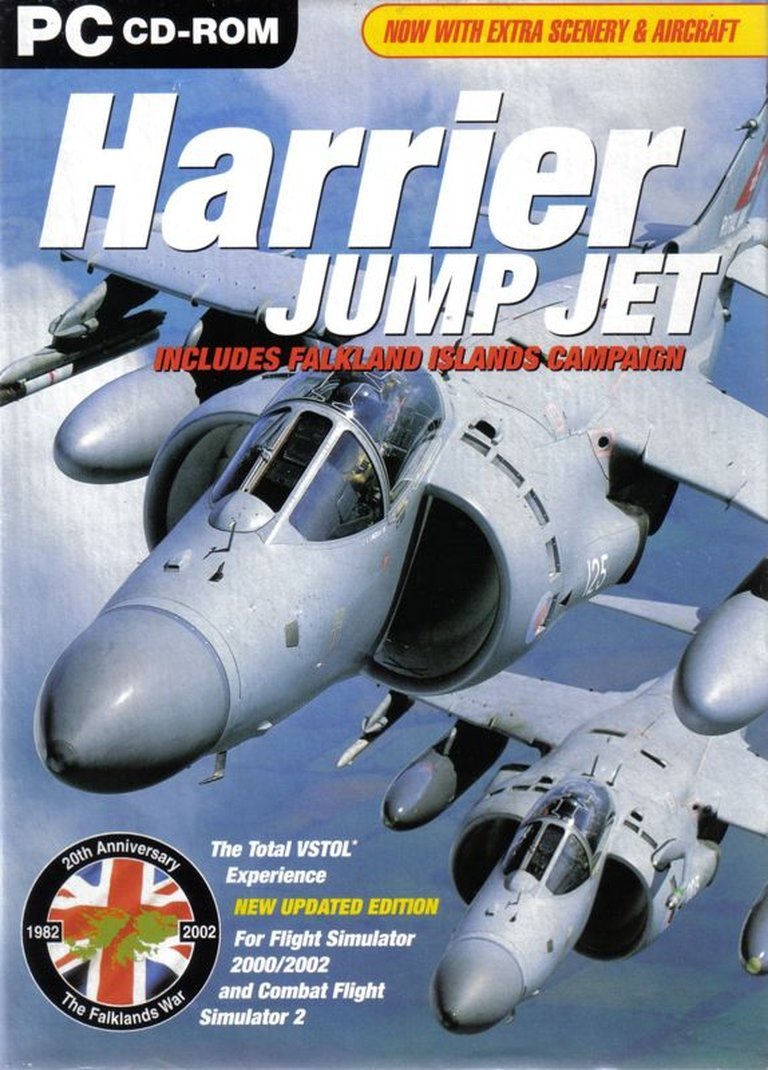
Description
Harrier Jump Jet: Falklands 20th Anniversary Release is a re-released add-on for Microsoft Combat Flight Simulator 1 and 2, as well as Microsoft Flight Simulator 2000 and 2002, featuring additional scenery and aircraft. The game includes twenty missions across two campaigns (British and Argentinian) set during the Falklands conflict, playable individually or as part of a campaign. It offers a variety of Harrier variants and other aircraft, with unique vertical take-off mechanics adapted to the limitations of the flight simulators. The package enhances the original simulators with new locations like Port Stanley and HMS Fearless, providing an immersive combat flight experience.
Harrier Jump Jet: Falklands 20th Anniversary Release Reviews & Reception
mobygames.com (62/100): Critics 62% (1)
en.wikipedia.org : Computer Gaming World liked the flight model and “beautiful seamless graphics”, but criticized the campaign mode as “old-fashioned … no wingmen, no interaction with one’s forces, no dynamic battlefield, no feeling of being involved … a dressed up version of F-19”.
Harrier Jump Jet: Falklands 20th Anniversary Release Cheats & Codes
PC
Use a hex editor to modify the specified memory addresses.
| Code | Effect |
|---|---|
| 1692C | CHAFF |
| 1693C | FLARE |
| 1E574 | GUN |
| 1E580 | WEAPON #1 |
| 1E58C | WEAPON #2 |
| 1E598 | WEAPON #3 |
| 1E5A4 | WEAPON #4 |
| 1E5B0 | WEAPON #5 |
| 1E5BC | WEAPON #6 |
| 1E5C8 | WEAPON #7 |
| 1E5D4 | WEAPON #8 |
| 1E5DE | FUEL |
Harrier Jump Jet: Falklands 20th Anniversary Release – A Niche Masterpiece or Forgotten Relic?
Introduction: The Harrier’s Legacy in Digital Skies
The Harrier Jump Jet, with its iconic vertical takeoff and landing (VTOL) capabilities, is one of aviation’s most revolutionary aircraft. Its digital counterpart, Harrier Jump Jet: Falklands 20th Anniversary Release, is a fascinating artifact of early 2000s flight simulation—a niche add-on that sought to immortalize the Harrier’s role in the Falklands War while expanding its virtual legacy. Released in 2001 by Just Flight and developed by Alpha Simulations, this expansion for Microsoft Combat Flight Simulator 2 (CFS2) and Microsoft Flight Simulator 2000/2002 (FS2000/FS2002) is a curious blend of historical reverence, technical ambition, and the limitations of its era.
This review dissects the game’s development, gameplay, historical context, and legacy, arguing that while it remains a cult favorite among flight sim enthusiasts, its constrained design and reliance on aging simulators prevent it from achieving the grandeur of its real-world inspiration. Yet, for those willing to navigate its quirks, it offers a uniquely immersive glimpse into the Harrier’s operational versatility.
Development History & Context: A Labor of Love in a Crowded Sky
The Studio and the Vision
Alpha Simulations, a British developer specializing in flight simulation add-ons, partnered with Just Flight—a publisher with a strong reputation in the flight sim community—to create Harrier Jump Jet. The project was conceived as a tribute to the 20th anniversary of the Falklands War (1982), a conflict where the British Harrier and Argentine forces clashed in one of the most intense aerial campaigns of the late 20th century.
The team’s vision was twofold:
1. Historical Authenticity: Recreate the Harrier’s role in the Falklands with meticulous attention to aircraft variants, mission types, and geographical accuracy.
2. Expansive Accessibility: Ensure compatibility across multiple Microsoft flight simulators, broadening its appeal beyond hardcore combat sim fans.
Technological Constraints of the Era
The early 2000s were a transitional period for flight simulators. Microsoft Combat Flight Simulator 2 (2000) was a significant leap forward in combat flight simulation, but it was still bound by the limitations of its engine:
– Flight Model Fidelity: While CFS2 improved upon its predecessor, it lacked the granular physics modeling of later simulators like Falcon 4.0 or Lock On: Modern Air Combat.
– VTOL Limitations: The Harrier’s signature vertical takeoff was approximated rather than fully simulated. Players could perform short takeoffs (STO) and near-vertical lifts, but true VTOL was impossible due to engine constraints.
– Mission Design: The game’s campaign system was linear, lacking the dynamic, emergent gameplay of modern titles.
The Gaming Landscape in 2001
By 2001, the flight sim genre was fragmenting:
– Combat Sims: Titles like Jane’s F/A-18 and European Air War dominated the military flight sim space.
– Civilian Sims: Microsoft Flight Simulator 2002 catered to aviation purists, with a focus on realism over combat.
– Arcade Hybrids: Games like Ace Combat 4 blurred the line between simulation and arcade action.
Harrier Jump Jet occupied an awkward middle ground—too niche for casual players, yet not deep enough for hardcore simmers. Its reliance on CFS2 as a base game further limited its audience, as players needed to own the original simulator to access its full features.
Narrative & Thematic Deep Dive: Reliving the Falklands in Pixels
The Dual Campaigns: British and Argentine Perspectives
The game’s standout feature is its dual-campaign structure, offering players the chance to experience the Falklands conflict from both sides:
– British Campaign: Focuses on the Sea Harrier’s dominance in air superiority and ground attack roles, with missions ranging from CAP (Combat Air Patrol) to strikes on Argentine positions.
– Argentine Campaign: Puts players in the cockpit of A-4 Skyhawks, Super Étendards, and Pucarás, emphasizing low-altitude attacks and evasion tactics against British defenses.
Mission Design and Historical Accuracy
The twenty missions (ten per campaign) are meticulously researched, drawing from real-world engagements:
– Operation Black Buck: Recreated as a high-stakes bombing run.
– San Carlos Landings: Players escort landing craft under heavy fire.
– Exocet Strikes: Argentine players must navigate the treacherous waters of the South Atlantic to launch anti-ship missiles.
However, the missions suffer from the linear design of CFS2. There are no dynamic battlefields, no AI wingmen to coordinate with, and no real-time strategic shifts. The experience feels more like a scripted reenactment than a living war.
Themes of Asymmetry and Innovation
The game subtly explores the asymmetrical nature of the Falklands War:
– British Technological Superiority: The Sea Harrier’s beyond-visual-range (BVR) capabilities and VTOL flexibility are highlighted.
– Argentine Ingenuity: The Argentine campaign emphasizes hit-and-run tactics, using terrain and weather to offset technological disadvantages.
Yet, the lack of narrative depth—no cutscenes, no character arcs, no post-mission debriefs—means these themes are implied rather than explicitly developed.
Gameplay Mechanics & Systems: The Harrier’s Digital Dance
Flight Model and VTOL Simulation
The Harrier’s flight model is the game’s centerpiece, but it’s a double-edged sword:
– Three Takeoff Modes:
1. Conventional Takeoff: Uses the full runway.
2. Short Takeoff (STO): Fans partially rotated for a quick lift.
3. Near-Vertical Takeoff: Fans fully rotated, but the plane still rolls briefly before liftoff—a compromise due to CFS2’s limitations.
– Hovering and Vectored Thrust: The game simulates the Harrier’s ability to hover and adjust thrust vectors, but the controls are clunky, relying on the F and V keys (normally used for flaps) to rotate the nozzles.
Combat and Weapon Systems
The game includes a wide array of ordnance, from Sidewinder missiles to cluster bombs, but combat feels dated:
– Lock-On Mechanics: Simplified compared to modern simulators.
– Damage Modeling: Basic, with little feedback on hit registration.
– AI Behavior: Enemy pilots follow predictable patterns, lacking the aggression or tactical depth of later sims.
User Interface and Accessibility
The UI is a relic of early 2000s design:
– Cluttered Cockpits: The Harrier’s instrument panels are densely packed, with poor labeling.
– Key Binding Chaos: Controls vary between CFS2 and FS2000/FS2002, leading to confusion.
– No GPS in Combat Mode: A glaring omission, given the Harrier’s reliance on precise navigation.
Innovations and Flaws
- Innovation: The inclusion of 17 Harrier variants, from prototypes to international models, is impressive.
- Flaw: The lack of true VTOL and dynamic campaigns holds the game back from greatness.
World-Building, Art & Sound: The Falklands in Pixels and Polyphony
Geographical Fidelity
The game’s Falklands scenery is a mixed bag:
– Key Locations: Port Stanley, HMS Fearless, and other landmarks are included, but they’re scattered haphazardly within CFS2’s existing maps.
– Terrain Textures: Low-resolution by modern standards, but serviceable for 2001.
Visual Design
- Aircraft Models: The Harrier variants are detailed, with accurate liveries and weapon loads.
- Effects: Smoke, explosions, and weather effects are rudimentary but functional.
Sound Design
- Engine Noise: The Harrier’s distinctive roar is well-replicated.
- Radio Chatter: Minimal, with no dynamic communications.
- Music: Nonexistent—just the hum of engines and the occasional explosion.
Atmosphere
The game captures the isolation and tension of the South Atlantic, but the lack of ambient details (e.g., ship movements, dynamic weather) prevents full immersion.
Reception & Legacy: A Cult Classic or Forgotten Footnote?
Critical Reception
The game received a lukewarm 62% from PC Action (Germany), which praised its aircraft variety but criticized its reliance on CFS2’s outdated framework. Most reviews noted that while it was a worthy addition for Harrier enthusiasts, it offered little innovation beyond its aircraft roster.
Commercial Performance
Sales figures are unclear, but the game’s niche appeal likely limited its reach. It remains a collector’s item, with physical copies fetching high prices among flight sim historians.
Influence on Later Games
- Harrier Simulators: Later titles like Harrier Assault (2017) and DCS: AV-8B Harrier built on its foundation, offering more realistic VTOL mechanics.
- Add-On Culture: Harrier Jump Jet exemplified the early 2000s trend of expansion packs for flight simulators, paving the way for modern DLC models.
Legacy
Today, the game is remembered fondly by a small but dedicated community. Its historical significance—capturing the Harrier’s Falklands legacy—ensures its place in flight sim history, even if its gameplay hasn’t aged gracefully.
Conclusion: A Flawed but Fascinating Tribute
Harrier Jump Jet: Falklands 20th Anniversary Release is a game of contradictions. It’s a lovingly crafted homage to one of aviation’s most iconic aircraft, yet it’s shackled by the limitations of its host simulator. It offers a unique perspective on the Falklands War, but its linear missions and lack of dynamic gameplay prevent it from being a definitive experience.
For historians and Harrier enthusiasts, it’s a must-play—a digital time capsule of early 2000s flight simulation. For modern gamers, it’s a curiosity, a reminder of how far the genre has come. Its legacy lies not in its gameplay, but in its ambition: to preserve the Harrier’s story in an interactive format.
Final Verdict: 7/10 – A Niche Masterpiece for the Patient and the Passionate.
Post-Script: The Harrier’s Digital Future
With modern simulators like Digital Combat Simulator (DCS) offering near-perfect Harrier simulations, Harrier Jump Jet feels like a relic. Yet, its historical campaigns and painstaking attention to detail ensure it remains a valuable artifact—a bridge between the analog past and the digital future of flight simulation.