
- Release Year: 2012
- Platforms: Windows
- Publisher: Big Fish Games, Inc
- Developer: ERS G-Studio
- Genre: Adventure, Puzzle
- Perspective: 1st-person
- Game Mode: Single-player
- Gameplay: Hidden object, Mini-games
- Setting: Horror
- Average Score: 90/100
Description
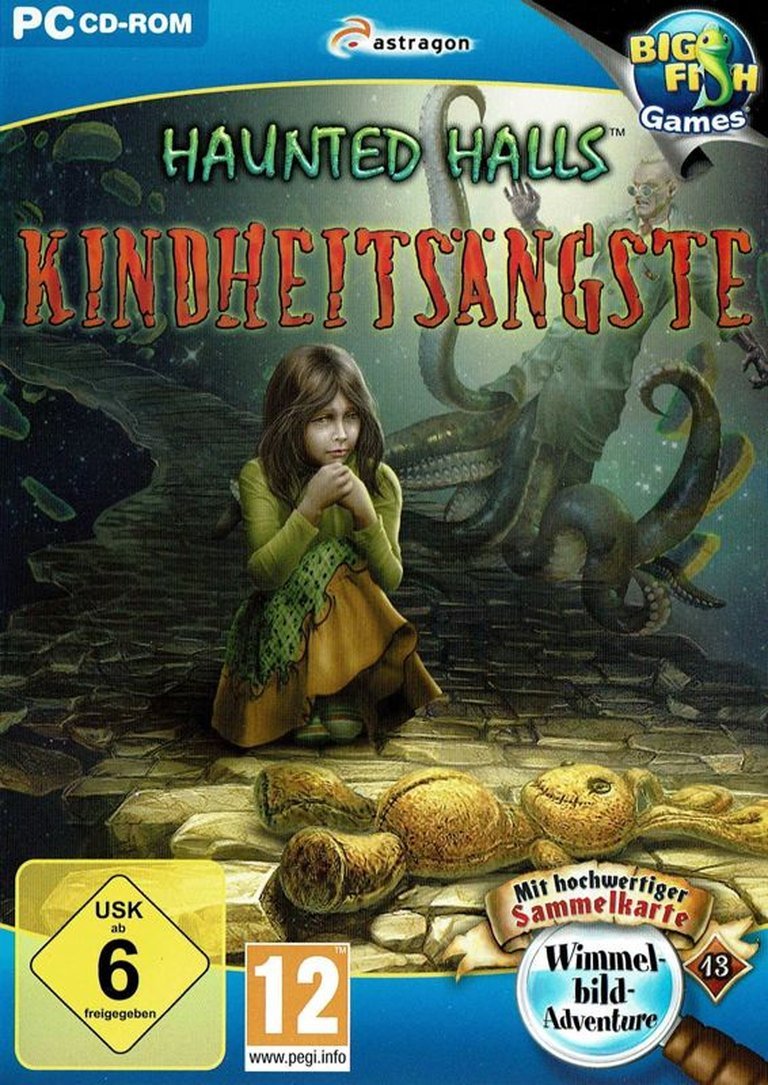
In ‘Haunted Halls: Fears from Childhood,’ players embark on a chilling adventure to stop the sinister Dr. Blackmore, who manipulates nightmares to achieve his dark goals. After stepping through a portal into zero gravity, you encounter a mysterious house with five locked doors, each requiring a fairy tale book to unlock. Beyond each door lies a child’s dreamworld, where you must restore order by solving hidden object scenes and puzzles. Navigate through eerie environments, collect useful items, and confront childhood fears to thwart Dr. Blackmore’s plans.
Gameplay Videos
Where to Buy Haunted Halls: Fears from Childhood
PC
Haunted Halls: Fears from Childhood Free Download
Haunted Halls: Fears from Childhood Guides & Walkthroughs
Haunted Halls: Fears from Childhood Reviews & Reception
steambase.io (90/100): Haunted Halls: Fears from Childhood Collector’s Edition has earned a Player Score of 90 / 100.
Haunted Halls: Fears from Childhood: A Masterclass in Psychological Horror and Hidden Object Puzzle Design
Introduction: A Portal into Childhood Nightmares
Haunted Halls: Fears from Childhood (2012) is not merely a hidden object puzzle adventure (HOPA) game—it is a psychological descent into the darkest corners of the human psyche, wrapped in the trappings of a fairy tale gone horribly wrong. Developed by ERS G-Studio and published by Big Fish Games, this title stands as a pivotal entry in the Haunted Halls series, bridging the eerie corridors of Green Hills Sanitarium (2010) and the vengeful climax of Revenge of Doctor Blackmore (2013). At its core, the game is a haunting exploration of how childhood fears—those irrational, primal terrors—can be weaponized, manipulated, and twisted into a labyrinth of nightmares.
The premise is deceptively simple: Dr. Blackmore, the series’ recurring antagonist, has dragged the protagonist’s boyfriend, Tim, through a mysterious portal into a surreal, gravity-defying void. There, players encounter a house with five locked doors, each guarded by a fairy tale book that serves as a key to a child’s dreamworld. These are not the whimsical dreams of innocence, but nightmares distilled from the deepest anxieties of youth—abandonment, monsters under the bed, the unknown lurking in the dark. The game’s genius lies in its ability to transform these universal fears into interactive, puzzle-laden environments, forcing players to confront and dismantle them one by one.
Haunted Halls: Fears from Childhood is a game that understands the power of atmosphere. It is not content to be a mere collection of hidden object scenes and mini-games; it aspires to be an experience, a journey through the fractured minds of children whose fears have been given form. In doing so, it elevates the HOPA genre beyond its casual roots, infusing it with a narrative depth and psychological weight rarely seen in its peers. This review will dissect the game’s development, narrative, gameplay, and legacy, arguing that it is not only a standout title in the Haunted Halls series but a landmark in the evolution of hidden object games as a medium for storytelling.
Development History & Context: The Rise of ERS G-Studio and the HOPA Boom
To fully appreciate Haunted Halls: Fears from Childhood, one must first understand the landscape in which it was created. The early 2010s marked the golden age of the hidden object puzzle adventure genre, a period where developers like ERS G-Studio, Alawar, and Artogon were pushing the boundaries of what these games could achieve. The genre, which had its roots in the point-and-click adventures of the 1990s, had evolved into a hybrid form that combined exploration, inventory management, and puzzle-solving with the addictive, completionist thrill of hidden object scenes. Big Fish Games, the publisher behind Haunted Halls, was at the forefront of this movement, distributing titles through its digital platform and catering to a growing audience of casual gamers seeking more immersive experiences.
ERS G-Studio, the Ukrainian developer behind the game, was no stranger to the HOPA genre. By 2012, the studio had already established itself with titles like Puzzle Chronicles and The Treasures of Mystery Island, but it was the Haunted Halls series that would become its most enduring legacy. The first entry, Haunted Halls: Green Hills Sanitarium (2010), introduced players to Dr. Blackmore and his sinister experiments, setting the stage for a narrative that would span multiple games. Fears from Childhood was conceived as a direct continuation of this story, deepening the lore while expanding the scope of its gameplay and thematic ambitions.
Technologically, Fears from Childhood was constrained by the limitations of its time. Built for Windows and later adapted for Mac and mobile platforms, the game relied on a fixed, first-person perspective with flip-screen navigation—a design choice that harkened back to classic adventure games like Myst but was increasingly rare in an era dominated by 3D environments. This deliberate stylistic decision, however, worked in the game’s favor. The static, pre-rendered backgrounds allowed ERS G-Studio’s artists to craft meticulously detailed scenes, each dripping with atmosphere and symbolic imagery. The game’s visuals are a masterclass in environmental storytelling, using color, lighting, and composition to evoke the unsettling tone of a child’s nightmare.
The gaming landscape of 2012 was also in the midst of a shift. While AAA titles dominated the mainstream, indie and casual games were carving out their own niches, proving that there was an audience for experiences that prioritized narrative and puzzle-solving over action and spectacle. Fears from Childhood arrived at a time when players were increasingly open to games that challenged them intellectually and emotionally, rather than just testing their reflexes. This cultural moment allowed the game to thrive, appealing to both longtime HOPA fans and newcomers drawn in by its dark, fairy-tale aesthetic.
Narrative & Thematic Deep Dive: The Anatomy of Fear
At its heart, Haunted Halls: Fears from Childhood is a story about the weaponization of fear. Dr. Blackmore, a mad scientist whose motivations remain deliciously ambiguous, has created a realm where the nightmares of children are not just real but tangible. Each of the five doors in the central hub leads to a different child’s dreamworld, and each world is a manifestation of a specific, archetypal fear:
- The Boy in the Tree: A forest teeming with danger, where the fear of the wild and the unknown reigns supreme. The boy is trapped in a tree, surrounded by wolves and other predators, embodying the primal terror of being prey.
- The Girl in the Toy Store: A once-whimsical playroom twisted into a surreal, almost Lovecraftian nightmare. Here, toys come to life in grotesque ways, reflecting the fear of the familiar turning hostile—a common childhood anxiety.
- The Boy in the Bedroom: A bedroom that shifts between different nightmarish landscapes (a desert, a winter wonderland, a tropical island), representing the fear of the unpredictable and the loss of control over one’s own space.
- The Girl in the Graveyard: A gothic cemetery where the fear of death and the supernatural is given form. The graveyard is not just a setting but a character, its statues and mausoleums hiding secrets and puzzles.
- The Boy in the Museum: A museum where historical artifacts and exhibits come to life, symbolizing the fear of the past and the unknown forces that shape our world.
Each of these worlds is more than just a backdrop for puzzles; they are carefully constructed metaphors for the psychological struggles of their inhabitants. The game’s narrative is minimalist, relying on environmental storytelling and symbolic imagery to convey its themes. There is no lengthy exposition or dialogue-heavy cutscenes. Instead, the story unfolds through the player’s interactions with the world, the items they collect, and the puzzles they solve.
The protagonist, whose name and backstory are never fully revealed, serves as a silent avatar for the player. Their mission is clear: rescue the children trapped in these nightmares and stop Dr. Blackmore. Yet, the game’s true power lies in its ambiguity. Who is Dr. Blackmore, really? Is he a literal mad scientist, or a manifestation of the children’s collective fears? The game never provides a definitive answer, leaving players to interpret his role for themselves. This ambiguity extends to the children as well. Are they real, or are they projections of the protagonist’s own unresolved childhood traumas? The game’s narrative is a Rorschach test, inviting players to project their own fears and anxieties onto its surreal canvas.
Thematically, Fears from Childhood is a meditation on the nature of fear itself. It suggests that fear is not something to be conquered but understood—that by confronting and dismantling the nightmares that haunt us, we can reclaim control over our own minds. This is reflected in the gameplay itself, where players must solve puzzles that are often literal representations of the children’s fears. For example, in the toy store, players must restore order to a chaotic scene by placing toys in their proper places, symbolizing the reassertion of control over a world gone mad. In the graveyard, players must reassemble a skeleton, a metaphor for confronting and accepting the inevitability of death.
The game’s use of fairy tales as a framing device is particularly noteworthy. Fairy tales have long been a way for societies to process and convey complex emotions, particularly those related to fear and danger. By structuring its narrative around fairy tale books, Fears from Childhood taps into this rich tradition, using the familiar language of folklore to explore universal human experiences. The fairy tales referenced in the game are not the sanitized, Disneyfied versions but the darker, original tales—stories where wolves eat grandmothers and children are abandoned in forests. This choice reinforces the game’s themes, reminding players that fear is an inherent part of the human experience, something to be acknowledged rather than suppressed.
Gameplay Mechanics & Systems: The Art of Puzzle Design
Haunted Halls: Fears from Childhood is, at its core, a hidden object puzzle adventure game, and its gameplay mechanics reflect the genre’s strengths and conventions. The game is divided into two primary modes: exploration and puzzle-solving. Players navigate through a series of fixed screens, clicking on objects of interest to interact with them, collect items, or trigger puzzles. The inventory system is straightforward, with items stored at the bottom of the screen and used by clicking on them and then on the appropriate object in the environment.
Hidden Object Scenes: The Backbone of the Genre
The hidden object scenes (HOS) in Fears from Childhood are where the game’s casual roots are most evident. These scenes task players with finding a list of items hidden within a cluttered environment, a mechanic that has been a staple of the genre since its inception. What sets Fears from Childhood apart, however, is the way it integrates these scenes into the broader narrative and thematic framework. Unlike many HOPA games, where HOS can feel like arbitrary interruptions, here they are seamlessly woven into the fabric of the game world.
For example, in the toy store chapter, the HOS are not just random collections of objects but reflections of the chaotic, nightmarish environment. Players must find items like a “pirate hat” or a “bomb,” which are then used to progress the story. The items themselves are often symbolic, reinforcing the game’s themes. In the graveyard, players might be asked to find a “peeled banana” or a “lit lamp,” items that seem mundane but take on a sinister edge in the context of the setting.
The game also employs a clever variation on the traditional HOS formula. Some items are listed in orange, indicating that an additional action is required to reveal them. For example, players might need to move a object or use an inventory item to uncover a hidden object. This mechanic adds a layer of interactivity to the HOS, preventing them from feeling like mere busywork.
Inventory Puzzles: The Logic of Nightmares
The inventory puzzles in Fears from Childhood are where the game truly shines. These puzzles require players to combine items from their inventory in logical (or sometimes illogical) ways to progress. The brilliance of these puzzles lies in their ability to reflect the surreal, dreamlike logic of the game’s world. In a child’s nightmare, a “wet suction cup” might be the key to opening a door, or a “fiery lizard” might be used to melt a snowman. The game embraces this absurdity, challenging players to think outside the box while still adhering to an internal consistency.
One of the most memorable inventory puzzles occurs in the first chapter, where players must create a “wet suction cup” by using a regular suction cup on a leaking pipe. This item is then used to open a door, a solution that is both intuitive and delightfully bizarre. Another standout puzzle involves using a “bottle tornado” to break apart a block of ice, a moment that perfectly captures the game’s blend of whimsy and horror.
The game’s puzzles are also notable for their variety. While some rely on traditional logic (e.g., using a wrench to unscrew nuts), others are more abstract, requiring players to interpret symbolic clues or manipulate objects in unexpected ways. This variety keeps the gameplay fresh and engaging, ensuring that players are constantly challenged in new ways.
Mini-Games: The Test of Wits
In addition to HOS and inventory puzzles, Fears from Childhood features a wide array of mini-games, ranging from jigsaw puzzles to logic-based challenges. These mini-games serve as palate cleansers, breaking up the rhythm of exploration and hidden object scenes while providing a different kind of mental challenge.
One of the most interesting aspects of the mini-games is how they reflect the themes of the chapters in which they appear. For example, in the toy store, players must solve a puzzle involving a dollhouse, where they must place dolls in their correct rooms based on visual clues. This puzzle is not just a test of observation but a metaphor for restoring order to a chaotic world. Similarly, in the graveyard, players must reassemble a skeleton, a task that is both a literal puzzle and a symbolic confrontation with mortality.
The mini-games are also notable for their difficulty curve. While some are relatively straightforward, others are fiendishly complex, requiring careful planning and multiple attempts to solve. The game’s hint system helps mitigate frustration, allowing players to skip puzzles after a certain amount of time or providing clues to nudge them in the right direction.
Navigation and UI: The Invisible Hand
The user interface (UI) in Fears from Childhood is minimalist and unobtrusive, designed to immerse players in the game world without distracting them with unnecessary clutter. The inventory is displayed at the bottom of the screen, with items clearly labeled and easy to access. The hint button, located in the bottom-right corner, is a lifeline for players stuck on a particularly tricky puzzle, though it requires a cooldown period between uses to prevent over-reliance.
Navigation is handled through a point-and-click system, with players moving between fixed screens by clicking on arrows or interactive objects. This system, while somewhat dated by modern standards, is well-suited to the game’s atmospheric tone. The fixed perspective allows for meticulously crafted environments, each one a work of art in its own right.
One of the few criticisms that can be leveled at the game’s UI is the lack of a map or fast-travel system. In later chapters, players may find themselves backtracking through multiple screens to retrieve an item or solve a puzzle, a process that can become tedious. However, this is a minor quibble in an otherwise polished experience.
World-Building, Art & Sound: Crafting a Nightmare
The world of Haunted Halls: Fears from Childhood is a masterclass in atmospheric design. From the moment players step through the portal into the zero-gravity void, they are immersed in a world that is both beautiful and unsettling. The game’s art direction is a blend of gothic horror and surrealist fantasy, with each chapter offering a distinct visual identity that reflects its central fear.
The Forest: The Fear of the Wild
The first chapter, set in a dense forest, is a study in organic horror. The trees are gnarled and twisted, their branches reaching out like skeletal fingers. The color palette is dominated by deep greens and browns, with occasional splashes of red—blood on the leaves, perhaps, or the glow of a distant fire. The forest is not just a setting but a living, breathing entity, one that seems to watch the player with malevolent intent.
The artistry in this chapter lies in its attention to detail. Every leaf, every rock, every patch of moss is rendered with painstaking care, creating a sense of realism that makes the supernatural elements all the more jarring. The forest is not just a place of danger but a place of mystery, its secrets hidden in plain sight.
The Toy Store: The Fear of the Uncanny
The toy store chapter is a stark contrast to the forest, trading organic horror for the uncanny valley. Here, the once-whimsical toys of childhood have been twisted into grotesque parodies of themselves. Dolls with missing eyes, robots with exposed gears, stuffed animals with jagged stitches—every object in this chapter is designed to unsettle.
The color palette shifts to bright, almost garish hues, a deliberate choice that heightens the surrealism of the environment. The toys are not just creepy; they are wrong, their cheerful exteriors belying the darkness within. This chapter is a visual representation of the fear that the familiar can turn hostile, that the objects we trust can become instruments of terror.
The Bedroom: The Fear of the Unpredictable
The bedroom chapter is perhaps the most visually diverse, shifting between three distinct environments: a desert, a winter wonderland, and a tropical island. Each of these landscapes is rendered with a dreamlike quality, their vibrant colors and surreal geography reinforcing the theme of unpredictability.
The desert is a sea of golden sand, its dunes stretching into the distance like waves. The winter wonderland is a frozen paradise, its ice sculptures glinting in the pale light. The tropical island is a lush jungle, its foliage dense and impenetrable. What ties these environments together is their shared sense of isolation—each is a self-contained world, cut off from the rest of reality.
The Graveyard: The Fear of Death
The graveyard chapter is a gothic masterpiece, its crumbling mausoleums and weathered statues evoking the weight of history and the inevitability of death. The color palette is dominated by grays and blacks, with occasional flashes of white—the glow of a ghostly apparition, perhaps, or the light of a distant star.
The artistry in this chapter lies in its use of symbolism. Every tombstone, every statue, every cracked slab of marble tells a story, hinting at the lives and deaths of those interred within. The graveyard is not just a place of fear but a place of reflection, a reminder that death is a natural part of the cycle of life.
The Museum: The Fear of the Past
The museum chapter is a celebration of history and mythology, its exhibits ranging from ancient artifacts to medieval weaponry. The color palette is rich and varied, with each exhibit offering a distinct visual identity. The Egyptian artifacts are bathed in gold and blue, the Viking displays in red and black, the Renaissance paintings in warm, earthy tones.
What makes this chapter so effective is its attention to detail. Each exhibit is meticulously researched and rendered, creating a sense of authenticity that makes the supernatural elements all the more unsettling. The museum is not just a repository of the past but a living, breathing entity, one that seems to whisper secrets to those who dare to listen.
Sound Design: The Symphony of Fear
The sound design in Fears from Childhood is every bit as important as the visuals in creating the game’s atmosphere. The soundtrack, composed by an unnamed artist (as is often the case in casual games), is a haunting blend of orchestral and electronic elements, shifting between melancholic melodies and dissonant cacophonies.
The forest chapter is accompanied by the sound of rustling leaves and distant howls, creating a sense of isolation and danger. The toy store chapter features a twisted, music-box version of a children’s lullaby, its cheerful tune warped into something sinister. The graveyard chapter is dominated by the sound of wind and the occasional toll of a distant bell, reinforcing the theme of mortality.
The game’s sound effects are equally impressive. Every click, every creak, every whisper is designed to unsettle, to make the player feel as though they are not alone. The sound of a door creaking open, the distant laughter of a child, the whisper of a voice just beyond hearing—these are the sounds that linger in the player’s mind long after the game is over.
Reception & Legacy: A Cult Classic in the Making
Haunted Halls: Fears from Childhood was released to a mixed but generally positive reception. Critics praised its atmospheric design, inventive puzzles, and thematic depth, though some criticized its reliance on genre conventions and occasional tedium. The game’s lack of a map or fast-travel system was a common point of contention, as was its somewhat abrupt ending.
Despite these criticisms, the game quickly developed a cult following. Players were drawn to its dark, fairy-tale aesthetic and its willingness to tackle complex themes. The game’s narrative ambiguity, in particular, sparked numerous discussions and theories, with players debating the true nature of Dr. Blackmore and the children’s nightmares.
The game’s legacy is perhaps best measured by its influence on subsequent titles in the Haunted Halls series and the HOPA genre as a whole. Haunted Halls: Revenge of Doctor Blackmore (2013) built on the foundations laid by Fears from Childhood, expanding the lore and introducing new gameplay mechanics. The series as a whole has become a benchmark for atmospheric HOPA games, inspiring developers to push the boundaries of what the genre can achieve.
Beyond the Haunted Halls series, Fears from Childhood has had a broader impact on the HOPA genre. Its success demonstrated that there was an audience for games that prioritized narrative and atmosphere over mere puzzle-solving, paving the way for titles like Dark Parables and Mystery Case Files. The game’s use of psychological horror and surrealist imagery has also influenced indie developers, who have drawn inspiration from its blend of whimsy and dread.
In the years since its release, Fears from Childhood has been re-released as part of the Haunted Halls Collection (2018), introducing it to a new generation of players. The Collector’s Edition, which includes bonus gameplay, concept art, and wallpapers, has further cemented the game’s status as a cult classic.
Conclusion: A Nightmare Worth Remembering
Haunted Halls: Fears from Childhood is more than just a hidden object puzzle adventure game—it is a journey into the heart of darkness, a meditation on the nature of fear, and a testament to the power of atmospheric design. Its narrative ambiguity, surrealist imagery, and inventive puzzles set it apart from its peers, elevating it to the status of a genre classic.
The game’s greatest strength lies in its ability to transform childhood fears into interactive experiences. By forcing players to confront and dismantle these nightmares, Fears from Childhood does more than entertain—it challenges, it unsettles, and it lingers in the mind long after the final puzzle is solved.
In the pantheon of HOPA games, Haunted Halls: Fears from Childhood stands as a landmark title, a game that dared to push the boundaries of what the genre could achieve. It is a nightmare worth remembering, a fairy tale gone wrong, and a testament to the enduring power of fear.
Final Verdict: 9/10 – A Masterpiece of Psychological Horror and Puzzle Design