
- Release Year: 2009
- Platforms: Windows
- Publisher: Educational Initiatives Group, Inc.
- Genre: Compilation
- Game Mode: Single-player
Description
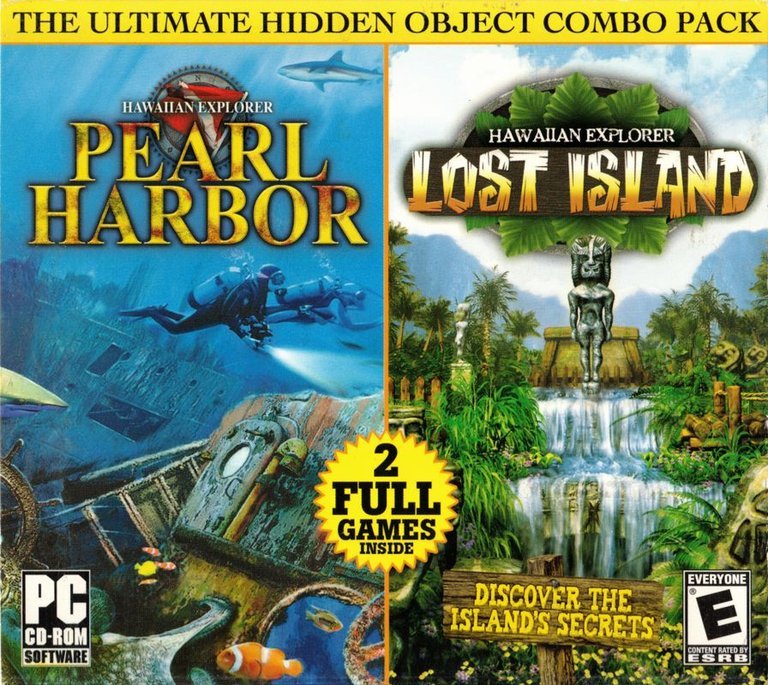
Hawaiian Explorer: Pearl Harbor / Lost Island is a 2009 Windows compilation featuring two educational adventure games. The bundle includes Hawaiian Explorer: Pearl Harbor (2007), which explores historical shipwrecks and artifacts related to the iconic WWII site, and Hawaiian Explorer: Lost Island (2008), focusing on tropical island mysteries and hidden treasures. Published by Educational Initiatives Group, this single-player CD-ROM collection combines historical discovery with puzzle-solving across Hawaiian settings.
Hawaiian Explorer: Pearl Harbor / Lost Island: Review
Introduction
In the crowded landscape of late-2000s casual gaming, Hawaiian Explorer: Pearl Harbor / Lost Island stands as a time capsule of the hidden object genre’s zenith. This 2009 compilation bundles two titles—Hawaiian Explorer: Pearl Harbor (2007) and Hawaiian Explorer: Lost Island (2008)—into a single package aimed at players seeking leisurely yet methodical treasure-hunting escapades. While neither game redefined the genre, their fusion of Hawaiian mystique, World War II intrigue, and relentlessly casual-friendly design captured a niche audience. This review dissects the compilation’s legacy, contextualizing its successes and flaws within an era when hidden object games transitioned from CD-ROM novelties to digital marketplace staples.
Development History & Context
Developed by Polish studio centrum.pl (credited for Lost Island) and published by GameMill Entertainment and Educational Initiatives Group, Inc., the Hawaiian Explorer games emerged during a boom in budget-friendly, episodic hidden object titles. The late 2000s saw studios like iWin and Big Fish Games dominate the market, leveraging simple mechanics and exotic locales to cater to an underserved demographic: predominantly older, PC-oriented players seeking low-stakes engagement.
Technologically, both games were constrained by the standards of their time. Built for Windows XP/Vista systems, they relied on static pre-rendered backgrounds and minimal animation—a cost-effective approach that prioritized accessibility over innovation. The compilation’s 2009 release, however, arrived just as digital distribution began eclipsing physical media, cementing its status as a late-entry CD-ROM relic. Compatibility issues plagued modern systems, particularly Lost Island’s dependence on deprecated Adobe software, highlighting the industry’s pivot toward browser-free, DRM-heavy platforms.
Narrative & Thematic Deep Dive
The compilation’s dual narratives are rooted in pulpy adventure tropes, with both games weaving treasure hunts through Hawaii’s cultural and historical tapestry:
-
Pearl Harbor: Players assume the role of a mercenary “extreme search and find” operative hired by an eccentric millionaire to recover the 800-year-old Japanese Diamond Medal. The quest spans shipwrecks, caves, and beaches, framed by Pearl Harbor’s wartime legacy—a thematic choice that risks trivializing history but ultimately sanitizes it into a backdrop for object hunts.
-
Lost Island: A rescue mission to locate Charlie Johnson, a vanished millionaire explorer, unfolds across jungles, temples, and airplane hangars. While dialogue is minimal and characters archetypal (e.g., the “eccentric patron”), the narrative elevates tension through environmental storytelling—a crumbling temple suggests danger, while a cave’s isolation heightens urgency.
Notably, both games sidestep fantasy or supernatural elements, instead grounding their stakes in tangible artifacts and human drama—a rarity in a genre often reliant on ghosts and curses. However, the writing lacks nuance, reducing Hawaiian culture to aesthetic wallpaper rather than engaging with its depth.
Gameplay Mechanics & Systems
The compilation epitomizes the hidden object genre’s core loop: scrutinize cluttered scenes to find listed items, solve rudimentary puzzles, and progress through chapters. Yet subtle distinctions between the two titles reveal evolving design philosophies:
-
Core Loop:
- Scenes contain 50+ randomized items per playthrough, requiring sharp observation and quick clicks.
- Time limits (10 minutes per scene in Lost Island) and penalties (-15 seconds per wrong click) add pressure.
- Hints deduct 45 seconds, forcing players to weigh desperation against efficiency.
-
Innovations & Flaws:
- Pearl Harbor introduces map-assembly mini-games, where fragmented clues must be pieced together to unlock new areas.
- Lost Island’s Mahjongg-style interludes—matching tiles with “free” edges—offer respite but feel mechanically disconnected.
- Randomization ensures no two playthroughs are identical, though asset reuse (e.g., tropical foliage, underwater coral) dulls novelty.
-
UI/UX:
- Functional but dated interfaces prioritize clarity over flair. Text-heavy lists and a timer HUD dominate the screen, leaving visuals uncluttered but aesthetically sterile.
The lack of difficulty options or adaptive scaling may frustrate newcomers, while genre veterans will find comfort in the formulaic rigor.
World-Building, Art & Sound
Visually, both games leverage Hawaii’s natural beauty through pre-rendered 2D backdrops—lush jungles, sun-bleached beaches, and coral-rich seabeds—that evoke postcard idealism rather than authentic immersion. Pearl Harbor’s underwater scenes stand out with animated fish swimming across static ruins, subtly enhancing atmosphere without disrupting gameplay.
Sound design is minimalistic: ambient waves, rustling foliage, and sporadic musical stings (e.g., triumphant fanfares upon completing a level) reinforce tranquility. While hardly groundbreaking, the audio complements the games’ relaxed pace, though repetition dulls impact over time.
Artistically, the games’ “realistic” approach—eschewing cartoonish exaggeration—aligns with their non-fantasy narratives. However, this realism clashes with object-placement absurdity (e.g., a wrench nestled in a coral reef), reminding players they’re engaging with artificial puzzles, not living worlds.
Reception & Legacy
Upon release, the compilation garnered little critical attention, reflecting the hidden object genre’s marginalized status in mainstream gaming press. User reviews from Amazon, GameFools, and eBay paint a fragmented picture:
- Positive: Players praised the “challenging” object hunts and “stunning Hawaiian scenery,” with one reviewer noting, “I love that your games don’t rely on zombies or magic” (GameFools).
- Negative: Complaints centered on technical obsolescence (Lost Island’s Adobe dependency) and “repetitive” mini-games (eBay).
Commercially, the games found modest success as bargain-bin staples, retailing for $6–$10 in used markets. Their legacy lies in embodying the genre’s transitional phase—bridging CD-ROM-era casual games and the mobile/Object Hunt hybrids of the 2010s. While not influential, they endure as comfort food for nostalgia-seeking enthusiasts.
Conclusion
Hawaiian Explorer: Pearl Harbor / Lost Island is a competent but unremarkable compilation that encapsulates the hidden object genre’s middle age—too late to innovate, too early to leverage modern distribution. Its strengths lie in methodical design, serene Hawaiian aesthetics, and accessible gameplay, while its flaws—dated tech, narrative thinness—reflect the constraints of its era.
For historians, it’s a footnote in the casual gaming boom; for players, it remains a harmless diversion. As one eBay reviewer succinctly concluded: “Very fun game, need to be super quick”—a fitting epitaph for a duo that asks little but offers just enough.
Final Verdict: A nostalgic curio for genre diehards, but overshadowed by more ambitious contemporaries.