
- Release Year: 2018
- Platforms: Linux, Macintosh, Nintendo Switch, PlayStation 4, Windows Apps, Windows, Xbox One
- Publisher: Chorus Worldwide Games, Ltd., Unbound Creations LLC
- Developer: Unbound Creations LLC
- Genre: Journalism, Simulation
- Perspective: 1st-person
- Game Mode: Single-player
- Gameplay: 2D exploration, Choice and consequence, Moral decisions, News management
- Setting: Near-future, Political
- Average Score: 79/100
Description
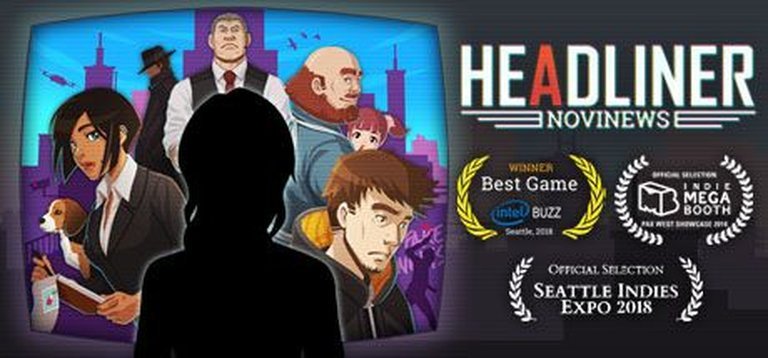
Headliner: NoviNews is a simulation game set in the fictional state of Novistan, where players assume the role of a news editor tasked with selecting and framing daily headlines. Each decision impacts public opinion, character fates, and the nation’s future, exploring themes of media influence, political polarization, and the consequences of journalistic choices through a branching narrative with multiple endings.
Gameplay Videos
Where to Buy Headliner: NoviNews
Headliner: NoviNews Guides & Walkthroughs
Headliner: NoviNews Reviews & Reception
opencritic.com (74/100): Headliner: NoviNews’ poignant narrative and weighty decisions offers an entertaining take on a topical conversation: the responsibility of media. Sitting in such a position of power challenges your morals in smart ways while being fun to boot. This is fake news worth investing in.
metacritic.com (75/100): Headliner: NoviNews is a solid political adventure title with gut-wrenching decisions and scathing morality. If you can withstand the crushing weight of your decisions, you’re sure to love your time in Novistan.
Headliner: NoviNews: Review
Introduction
In an era where media manipulation and political polarization dominate global discourse, Headliner: NoviNews emerges as a chillingly prescient interactive experience. Released on October 23, 2018, by Seattle-based indie studio Unbound Creations, this “media bias adventure” plunges players into the role of a newspaper editor in the dystopian nation of Novistan. Armed only with a green approval stamp and a red rejection stamp, players wield the power to shape public opinion—and potentially destroy lives—with every editorial decision. As the game’s tagline declares, “Control the news. Control the truth.” This review argues that Headliner: NoviNews transcends its niche premise to deliver a profound meditation on journalistic ethics, systemic power, and the butterfly effect of information, even as its repetitive structure prevents it from achieving true greatness.
Development History & Context
Unbound Creations, founded by Jakub “Koobazaur” Kasztalski, crafted Headliner: NoviNews with a vision to explore how media influences societal narratives—a passion fueled by Kasztalski’s background in humanities and ethnic conflict studies. The small, five-person team (including writer/lead dev Kasztalski and lead artist Emmy Toyonaga) built the game in Unity3D, leveraging the engine’s versatility for cross-platform deployment to Windows, macOS, Linux, and later consoles (Switch, PS4, Xbox One in 2019). Technologically, Unity3D allowed for the game’s minimalist 2D art style but also introduced limitations, such as persistent crashes on macOS and Linux, which the community eventually patched.
Released into a 2018 gaming landscape defined by narrative-driven indie darlings like Celeste and Return of the Obra Dinn, Headliner: NoviNews carved a niche as a spiritual successor to the studio’s 2017 title HEADLINER. While the original focused on a neighboring dystopia, NoviNews expanded its scope, integrating deeper character arcs and randomized events to enhance replayability. The game’s development coincided with rising global tensions around “fake news,” making its exploration of media manipulation eerily timely—a sentiment echoed in player reviews noting its “prescient” themes during the COVID-19 pandemic.
Narrative & Thematic Deep Dive
Headliner: NoviNews’s narrative unfolds over 14 intense days in Novistan, a nation grappling with xenophobic Prime Minister Wolff, genetic modification plagues, and synthetic alcohol controversies. As the Headliner of NoviNews, players navigate a daily cycle: reviewing articles (e.g., “National Healthcare Debate” or “Learian Immigrant Crime Surge”) and deciding their fate. Each choice ripples across society, influencing public opinion and triggering events like riots, drone surveillance, or economic collapse.
The narrative’s emotional core lies in its three primary characters:
– Evelyn “Evie” Rivera: An immigrant coworker grappling with healthcare access and xenophobia, whose fate hinges on coverage of Learian issues.
– Justin: The player’s brother, a comedian battling depression, whose story arc mirrors society’s mental health crisis.
– Rudy: A small-business owner crushed by corporate megamarts and synthetic alcohol “BetterBuzz,” symbolizing economic inequality.
These characters embody the game’s central themes: the weight of responsibility, the illusion of neutrality in media, and the dehumanizing impact of “big picture” decisions. One particularly harrowing event—a coordinated public suicide—underscores the consequences of sensationalist reporting, leading to the Steam achievement “My god, what have you done…?” Notably, the game avoids moralizing, allowing players to pursue any political stance (from pro-Wolff authoritarianism to anarchist chaos) without judgment. Only on subsequent playthroughs does the narrative break the fourth wall, with characters like Rudy’s daughter Ada accusing the player of “bias” and “ruining timelines,” meta-commentary on the cyclical nature of media-driven conflicts.
Gameplay Mechanics & Systems
The gameplay loop deceptively simple:
1. Newsroom Phase: Stamp articles (green to publish, red to suppress) based on ethical, financial, or personal trade-offs.
2. Commute Phase: Navigate a 2D side-scrolling city, interacting with NPCs and observing societal changes (e.g., protests or drones).
3. Evening Phase: Spend earnings on luxuries (drone adoption, dog treats) or necessities, reflecting the Headliner’s moral compromises.
Character progression is narrative-driven, with no traditional leveling. Instead, outcomes depend on dialogue choices (e.g., helping Justin overcome depression or advising Rudy against investing in BetterBuzz). The murder-mystery side quest featuring police officer Helene unlocks after the first playthrough, adding noir-inspired depth.
The UI is functional but repetitive: article stamps and dialogue menus dominate, with little variation in daily tasks. Critics noted that after 2-3 playthroughs, the formula wears thin, as noted by Nintendo-Online.de: “After the first two, three Spieldurchgängen, the game’s principle… relatively quickly ab[s]e… due to monotony.” However, randomized articles and events (e.g., a plague outbreak or a comedian’s viral moment) mitigate this, supported by 59 Steam achievements incentivizing exploration.
World-Building, Art & Sound
Novistan, a “20 Minutes into the Future” dystopia, merges recognizable anxieties with speculative elements: ubiquitous drones, genetic modification technology, and synthetic alcohol. The city dynamically reflects the player’s influence—a pro-government stance fills streets with surveillance cameras, while anti-establishment choices graffiti walls and spark riots. Environmental artist A.G. Noël’s minimalist 2D visuals juxtapose detailed character portraits (Evie’s weary expression, Rudy’s hopeful smile) against stark, isometric cityscapes, creating a sense of scale and isolation.
Sound design amplifies the atmosphere: the newsroom’s corporate muzak clashes with the commute’s ambient noise (protest chants, drone whirs), while radio host Frank’s satirical monologues (“What if we are all made by some sad manchild…”) wink at the player. Emmy Toyonaga’s art style—inspired by graphic novels—uses color sparingly: blood-red stamps, neon highlights, and monochrome palettes reinforce the game’s tension. This cohesion makes the world feel lived-in, even as its limited scope belies Novistan’s potential.
Reception & Legacy
Headliner: NoviNews launched with a mixed-to-positive critical reception. Metacritic’s 75 “Generally Favorable” score praised its “gut-wrenching decisions” (Gaming Age) but criticized its lack of depth (Digitally Downloaded: “lacks subtlety and nuance”). Steam’s user base was warmer, with 88% positive reviews lauding its replayability (“I spent a day playing and replaying,” noted Gaming Age).
Commercially, the game found success on Steam ($13.99 at launch) and later console ports, fueled by bundles like the Racial Justice and Equality bundle. Its legacy lies in its thematic relevance: players in 2020 marveled at its prescient plague storyline, and critics like Rock Paper Shotgun noted its “overlap of issues defies easy answers.” The game influenced titles focused on systemic impact, such as Not Tonight, but its greatest contribution is its unflinching portrayal of media as both a tool for good and a weapon of control. Unbound Creations’ follow-up, Rain on Your Parade, retained its satirical edge but shifted focus.
Conclusion
Headliner: NoviNews is a flawed gem—a game that resonates more in reflection than in play. Its strength lies in the moral gravity of its choices and the hauntingly relatable characters, while its weakness is the monotonous daily grind that undermines its own message about media fatigue. Yet, in a world where headlines shape reality, NoviNews’s exploration of power, responsibility, and unintended consequences is indispensable. It is not the Papers Please of media ethics, but it is a vital, thought-provoking experience that asks players to consider the ink they wield. For those willing to embrace its cyclical nature, Headliner: NoviNews offers a chilling, unforgettable lens into the fragile architecture of truth.