
- Release Year: 2011
- Platforms: Macintosh, Windows
- Publisher: Telltale, Inc.
- Developer: Straandlooper Animation
- Genre: Adventure, Compilation
- Perspective: 3rd-person
- Game Mode: Single-player
- Gameplay: Graphic adventure, Puzzle elements
- Average Score: 75/100
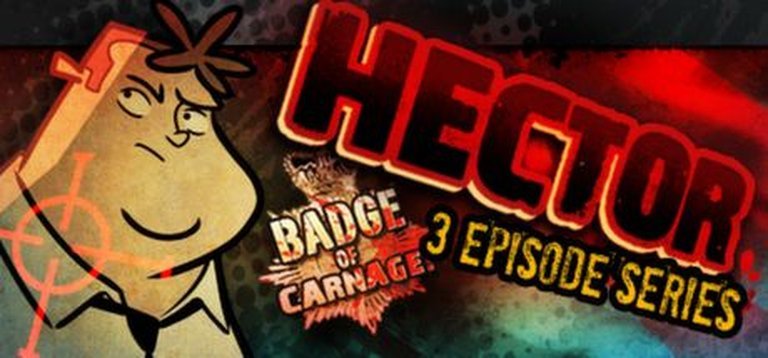
Description
Hector: Badge of Carnage is a darkly comedic point-and-click adventure game series released in three episodes between April and September 2011 for Windows and Macintosh. The game follows the misadventures of Hector, a crude and politically incorrect detective in the fictional British town of Clappers Wreake, as he stumbles through absurd and often grotesque investigations. With a unique art style, sharp wit, and a blend of puzzle-solving and narrative-driven gameplay, the series is known for its irreverent humor and satirical take on crime-solving, appealing to fans of edgy, adult-oriented storytelling.
Gameplay Videos
Where to Buy Hector: Badge of Carnage
Hector: Badge of Carnage Guides & Walkthroughs
Hector: Badge of Carnage Reviews & Reception
metacritic.com (66/100): A triumphant return to form for the series.
gamepressure.com (90/100): A humorous adventure game with attractive cartoon graphics and an excellent plot.
gamesreviews2010.com (70/100): A point-and-click adventure filled with humor, puzzles, and a cast of unforgettable characters.
Hector: Badge of Carnage: A Masterclass in Crass, Clever, and Compelling Adventure Gaming
Introduction: The Unlikely Hero of a Wretched Hive
In the annals of adventure gaming, few protagonists are as memorably repugnant—or as oddly endearing—as Detective Inspector Hector, the “fat arse of the law” from Hector: Badge of Carnage. Released episodically between 2010 and 2011 by Straandlooper Animation and published by Telltale Games, this three-part graphic adventure is a masterful blend of grotesque humor, sharp writing, and classic point-and-click mechanics. Set in the fictional British town of Clappers Wreake—a place so irredeemably vile it makes Sin City look like a postcard from the Cotswolds—Hector is a game that revels in its own filth while delivering a surprisingly tight narrative and some of the most inventive puzzles of its era.
At its core, Hector: Badge of Carnage is a love letter to the golden age of adventure games, wrapped in the grime of a town that has long since given up on decency. It’s Monkey Island meets Trainspotting, with a dash of Hot Fuzz’s small-town absurdity. The game’s legacy is one of cult adoration, a title that flew under the radar for many but left an indelible mark on those who dared to dive into its murky depths. This review will dissect why Hector remains a standout in the adventure genre, exploring its development, narrative brilliance, gameplay intricacies, and the ways it both honors and subverts the traditions of its predecessors.
Development History & Context: The Birth of a British Beast
The Studio and the Vision
Hector: Badge of Carnage was the brainchild of Dean Burke and Kevin Beimers at Straandlooper Animation, a Northern Irish studio with a knack for dark, offbeat humor. The game began life as an iOS title in 2010, a bold move given the platform’s nascent status as a home for narrative-driven adventures. Straandlooper’s vision was clear: create a game that embraced the grotesque, the absurd, and the unapologetically British, all while paying homage to the point-and-click classics of the 1990s.
The collaboration with Telltale Games in 2011 was a pivotal moment. Telltale, already a powerhouse in the adventure genre thanks to Sam & Max and Tales of Monkey Island, provided the resources to port Hector to PC and Mac using their proprietary Telltale Tool engine. This partnership allowed Straandlooper to refine their vision, expanding the game’s scope while retaining its distinctive hand-drawn aesthetic and biting wit.
Technological Constraints and Innovations
The game’s origins on mobile platforms imposed certain limitations, particularly in terms of interface design and asset complexity. However, these constraints also forced the developers to prioritize clarity and efficiency in their puzzle design—a lesson that would serve the PC version well. The transition to desktop platforms allowed for higher-resolution assets and more intricate animations, but the core gameplay remained rooted in the simplicity of its mobile roots.
One of the most notable technical achievements was the game’s voice acting, performed entirely by producer Richard Morss. Morss’s ability to inhabit a cast of characters—from Hector’s gravelly, chain-smoking growl to Lambert’s dopey innocence—added a layer of authenticity that elevated the game’s humor and immersion. The decision to use a single voice actor for multiple roles was a cost-effective necessity, but it also lent the game a unique, almost theatrical quality.
The Gaming Landscape of 2010-2011
Hector emerged during a fascinating period in adventure gaming. The genre, long considered moribund after the decline of LucasArts and Sierra in the late 1990s, was experiencing a renaissance thanks to digital distribution and the rise of indie development. Telltale Games was at the forefront of this revival, proving that episodic storytelling could thrive in the modern market. Meanwhile, platforms like Steam and the App Store provided new avenues for niche titles to find audiences.
Yet, Hector stood apart from its contemporaries. While Telltale’s other offerings—Back to the Future, Jurassic Park—leaned into family-friendly humor and licensed nostalgia, Hector was unapologetically adult. Its humor was crude, its setting squalid, and its protagonist a far cry from the charming rogues of Monkey Island or the bumbling heroes of Sam & Max. In many ways, Hector was a throwback to the edgier adventure games of the 1990s, like Leisure Suit Larry or The Dark Eye, but with a distinctly British sensibility.
Narrative & Thematic Deep Dive: A Tale of Filth and Redemption
Plot Overview: The Crime Capital of Britain
Hector: Badge of Carnage unfolds across three episodes, each escalating the absurdity and depravity of Clappers Wreake. The story begins with a hostage crisis: a terrorist has taken civilians captive in a building, systematically executing negotiators with a sniper rifle. Enter Hector, a detective so disillusioned and debauched that he’s initially found passed out in a jail cell, surrounded by empty liquor bottles and a used condom. His mission? Negotiate with the terrorist, who demands that Hector “clean up” the town by completing a series of increasingly bizarre tasks.
The terrorist’s demands—fixing the town clock, donating to a preservation society, and shutting down a porn shop—are ostensibly altruistic, but they quickly reveal a sinister undercurrent. As Hector stumbles through these tasks, he uncovers a conspiracy involving biochemical warfare, a deranged environmentalist named Barnsley Noble, and a plot to purge Clappers Wreake of its sins through mass hysteria. The narrative culminates in a climactic showdown involving a giant inflatable castle, a chemically enhanced badger, and a vibrator repurposed as a sonic weapon.
Characters: The Grotesque and the Guileless
Hector himself is a masterclass in character design. He is, by any measure, a terrible person: a corrupt, alcoholic, misanthropic cop who views the world through a haze of cynicism and curry fumes. Yet, his unfiltered honesty and sheer incompetence make him oddly sympathetic. His philosophy—”Everyone is guilty”—is less a moral stance than a survival mechanism in a town where corruption is the only currency.
His foil is Lambert, his perpetually cheerful and hopelessly naive assistant. Lambert is the game’s moral compass, though his optimism is so misplaced it borders on delusion. Their dynamic is the heart of the game, a classic odd-couple pairing that drives much of the humor. Lambert’s unwavering loyalty to Hector, despite the latter’s constant abuse, adds a layer of pathos to their relationship.
The supporting cast is equally memorable, from the morally flexible Chief Superintendent Meeks to the enigmatic Barnsley Noble, whose descent into villainy is as tragic as it is absurd. Even minor characters, like the street urchin with a hook for a hand or the French waiter at Chez LeBouffet, are imbued with personality and purpose.
Themes: Corruption, Hypocrisy, and the Illusion of Redemption
At its core, Hector: Badge of Carnage is a satire of institutional failure and moral hypocrisy. Clappers Wreake is a microcosm of societal decay, where every institution—from the police to the church—is rotten to its core. The terrorist’s plan to “clean up” the town is revealed to be just as corrupt as the system he seeks to overthrow, a dark commentary on the futility of extremism.
The game also explores the idea of redemption, though it does so with a wink and a nudge. Hector is not a hero in any traditional sense; his motivations are selfish, and his methods are often as reprehensible as the crimes he’s investigating. Yet, by the end of the trilogy, there’s a sense that he has, in his own way, grown. His final act—saving Lambert from a fate worse than death—is perhaps the closest thing to heroism the game allows.
Dialogue and Writing: A Masterclass in British Wit
The writing in Hector is razor-sharp, blending rapid-fire insults, absurdist humor, and moments of genuine pathos. The dialogue is packed with British slang, cultural references, and a level of vulgarity that would make a sailor blush. Yet, it never feels gratuitous; every profanity and crude joke serves a purpose, whether to underscore the game’s themes or to elicit a laugh.
One of the game’s greatest strengths is its ability to balance humor and horror. A scene where Hector slips roofies into an entire restaurant’s food is played for laughs, but it’s also a stark reminder of the game’s moral ambiguity. Similarly, the game’s puzzles often involve tasks that are as disgusting as they are clever, from retrieving a paperclip from a toilet bowl (using a condom) to passing off a comatose heroin addict as a defective sex doll.
Gameplay Mechanics & Systems: The Art of the Puzzle
Core Gameplay Loop: Point, Click, and Cringe
Hector: Badge of Carnage is, at its heart, a traditional point-and-click adventure. Players explore environments, collect items, and combine them in often absurd ways to progress. The game’s interface is streamlined and intuitive, with a simple mouse-driven system that avoids the pixel-hunting frustrations of older adventures.
The inventory system is particularly well-designed, allowing players to easily combine items and experiment with solutions. The game also features a hint system, though it’s often delivered through Lambert’s naive observations, which adds to the humor rather than detracting from the challenge.
Puzzle Design: Clever, Crude, and Occasionally Cruel
The puzzles in Hector are a highlight, blending classic adventure game logic with the game’s unique brand of humor. Some puzzles are straightforward, like fixing a broken clock or retrieving a key from a locked drawer. Others are delightfully twisted, such as using a giant vibrator to amplify a musical jingle or turning a combine harvester into an escape vehicle.
One of the game’s most infamous puzzles involves Hector’s attempt to shut down Exotica, the local porn shop. The solution—passing off a comatose addict as a defective sex doll—is both hilarious and grotesque, embodying the game’s willingness to push boundaries. Similarly, a puzzle involving an electrified bathtub and a toaster is a darkly comedic take on the classic “death trap” trope.
The game’s difficulty curve is well-balanced, though some puzzles may stump players due to their sheer absurdity. However, the writing is so sharp and the characters so engaging that even the most frustrating moments are tempered by the game’s charm.
Character Progression and Agency
While Hector lacks the branching narratives of later Telltale games, it does offer a sense of progression through its episodic structure. Each episode builds on the last, with Hector’s actions in earlier chapters having consequences in later ones. The game also features multiple playable characters, with Lambert taking the reins in certain sections, adding variety to the gameplay.
UI and Accessibility
The game’s UI is clean and functional, with a minimalist design that keeps the focus on the gameplay. The inventory is easily accessible, and the game’s hint system is integrated seamlessly into the dialogue. The only notable flaw is the occasional ambiguity in puzzle solutions, which can lead to frustration. However, the game’s save system is generous, allowing players to experiment without fear of irreversible mistakes.
World-Building, Art & Sound: A Feast for the Senses (If You Have the Stomach)
Setting: Clappers Wreake, the Town That Time Forgot
Clappers Wreake is more than just a backdrop; it’s a character in its own right. The town is a grotesque parody of British urban decay, a place where every street corner hides a new horror. From the filthy alleys to the dilapidated church-turned-strip-club, every location is rendered in loving, disgusting detail.
The game’s art style is a mix of hand-drawn 2D backgrounds and animated characters, giving it a distinct, almost comic-book-like aesthetic. The environments are richly detailed, with a level of grime and texture that immerses players in the game’s world. The character designs are equally impressive, with Hector’s bloated, unshaven visage and Lambert’s perpetually bewildered expression standing out as particularly memorable.
Atmosphere and Tone
The tone of Hector is a delicate balance of comedy and horror. The game’s humor is often derived from its willingness to embrace the grotesque, whether it’s Hector’s casual racism, the town’s rampant corruption, or the sheer absurdity of the puzzles. Yet, there’s an underlying sense of melancholy, a recognition that Clappers Wreake is beyond saving.
The game’s sound design complements this tone perfectly. The voice acting, as mentioned earlier, is superb, with Richard Morss delivering a tour-de-force performance. The soundtrack is equally effective, blending jaunty British tunes with eerie, atmospheric pieces that underscore the game’s darker moments.
Visual Direction: A Love Letter to the Grotesque
The visual direction of Hector is a masterclass in using art to enhance narrative. The game’s hand-drawn aesthetic gives it a timeless quality, evoking the golden age of adventure games while feeling fresh and modern. The character animations are fluid and expressive, with Hector’s slovenly gait and Lambert’s awkward shuffling adding to their personalities.
The game’s use of color is particularly striking. Clappers Wreake is rendered in muted, grimy tones, with occasional bursts of color—like the neon sign of Exotica or the gaudy decorations of the town fair—serving as stark contrasts. This visual language reinforces the game’s themes of decay and corruption, making the town feel like a living, breathing entity.
Reception & Legacy: A Cult Classic in the Making
Critical Reception: Praise and Polarization
Hector: Badge of Carnage received generally positive reviews upon release, with critics praising its humor, writing, and puzzle design. Gameplay (Benelux) awarded it an 80%, comparing its comedic impact to Day of the Tentacle, while Hooked Gamers and Defunct Games gave it scores of 77% and 75%, respectively. Critics highlighted the game’s sharp dialogue, memorable characters, and inventive puzzles, though some noted that its humor might not appeal to all players.
The game’s reception on the App Store was particularly strong, with an average rating of 4.5 stars from over 500 reviews. Players praised its unique blend of humor and adventure, though some criticized its occasional reliance on toilet humor.
Commercial Performance and Longevity
While Hector never achieved the commercial success of Telltale’s bigger franchises like The Walking Dead or Tales from the Borderlands, it developed a dedicated cult following. Its episodic release model and niche appeal meant it flew under the radar for many, but those who discovered it often became fervent advocates.
The game’s legacy has grown in the years since its release, with many fans citing it as one of the best adventure games of the 2010s. Its influence can be seen in later titles that embrace dark humor and morally ambiguous protagonists, such as Disco Elysium and The Red Strings Club.
Influence on the Adventure Genre
Hector: Badge of Carnage is a testament to the enduring appeal of the point-and-click adventure. It proved that the genre could thrive in the modern era, provided it was willing to take risks and embrace its own idiosyncrasies. The game’s success also demonstrated the viability of episodic storytelling in adventure games, a model that Telltale would later perfect with The Walking Dead.
Perhaps most importantly, Hector showed that adventure games didn’t need to be family-friendly to succeed. Its unapologetic embrace of adult themes and humor paved the way for other mature adventure games, proving that there was an audience for stories that were as crude as they were clever.
Conclusion: A Flawed Masterpiece
Hector: Badge of Carnage is not a game for everyone. Its humor is crude, its protagonist is reprehensible, and its setting is a nightmare. Yet, for those willing to dive into its filthy depths, it offers one of the most rewarding adventure experiences of the past decade. The game’s writing is razor-sharp, its puzzles are inventive, and its world is so vividly realized that it lingers in the mind long after the credits roll.
In the pantheon of adventure games, Hector occupies a unique place. It’s neither a nostalgic throwback nor a radical reinvention, but a perfect synthesis of the old and the new. It honors the traditions of the genre while pushing it into darker, funnier, and more audacious territory. For that alone, it deserves to be remembered as a classic.
Final Verdict: 9/10 – A Must-Play for Adventure Fans
Hector: Badge of Carnage is a masterpiece of crass, clever, and compelling storytelling. It’s a game that embraces its own filth, revels in its own absurdity, and never apologizes for its excesses. For fans of adventure games, it’s an essential experience—a reminder that the genre can still surprise, delight, and disgust in equal measure. If you have the stomach for it, Hector is a journey well worth taking.