
- Release Year: 2002
- Platforms: Windows
- Publisher: 1C Company, Anuman Interactive SA, Capcom Co., Ltd., DreamCatcher Interactive Inc., Frogster Interactive Pictures AG, MC2-Microïds, Sold Out Sales & Marketing Ltd., Wanadoo Edition
- Developer: Digital Reality Software Kft
- Genre: Strategy, Tactics
- Perspective: 3rd-person (Other)
- Game Mode: LAN, Online Co-op, Online PVP, Single-player
- Gameplay: 4X, Colonization, Colony management, Combat, Diplomacy, espionage, Fleet Building, Real-time strategy, Space, Technology research
- Setting: Futuristic, Sci-fi
- Average Score: 76/100
Description
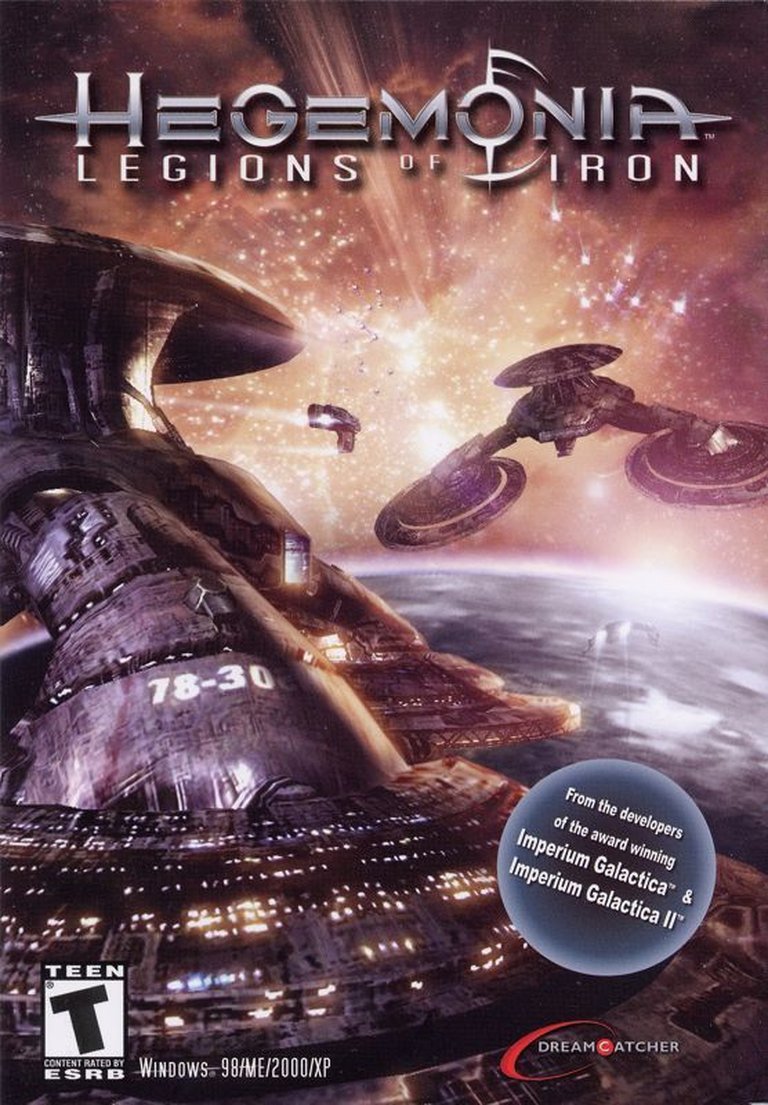
Set in the year 2104, ‘Hegemonia: Legions of Iron’ depicts a future where Mars, home to over 700 million people and Earth’s space project hub, declares independence, sparking a war between the two factions. This conflict intensifies when mysterious alien forces emerge, forcing Earth and Mars to unite as the Legions of Iron to survive. Players engage in a space-based 3D RTS experience, focusing on colonizing planets, researching technologies, building fleets, utilizing espionage, and managing colonies with an emphasis on strategic space combat over micromanagement.
Gameplay Videos
Where to Buy Hegemonia: Legions of Iron
PC
Hegemonia: Legions of Iron Free Download
Hegemonia: Legions of Iron Cracks & Fixes
Hegemonia: Legions of Iron Patches & Updates
Hegemonia: Legions of Iron Guides & Walkthroughs
Hegemonia: Legions of Iron Reviews & Reception
metacritic.com (75/100): Goes where no space RTS has gone before with its incredible visuals and moderately realistic gameplay.
ign.com : it can be more than a little difficult to actually find the information that you need.
gamesreviews2010.com : Haegemonia: Legions of Iron was a critical and commercial success, receiving widespread acclaim for its innovative gameplay, engaging story, and stunning presentation.
Hegemonia: Legions of Iron: Review
Introduction
In the vast, uncharted expanse of video game history, few titles embody the ambition and grandeur of early 2000s space strategy like Hegemonia: Legions of Iron. Developed by Hungarian studio Digital Reality, this 2002 release stands as a towering monument to the “space opera” real-time strategy (RTS) genre—a bold fusion of empire-building, tactical fleet combat, and narrative spectacle. While it arrived in the shadow of giants like Homeworld and Imperium Galactica II, Hegemonia carved its own legacy through its breathtaking visuals, intricate mechanics, and audacious scale. Yet, it is also a product of its time, hampered by interface quirks and narrative inconsistencies. This review delves into the game’s origins, design, reception, and enduring impact, arguing that Hegemonia remains a flawed masterpiece—a cult classic whose ambition still resonates two decades later.
Development History & Context
Hegemonia emerged from the crucible of Digital Reality, a Hungarian developer renowned for the complex Imperium Galactica series. The studio sought to distill the genre’s most compelling elements—empire management from Master of Orion, tactical combat from Homeworld—into a streamlined, accessible package. Led by Project Manager László Peller and programmers István Árpád Kiss and Norbert Szabó, the team leveraged their proprietary “Walker 1” engine to render 3D space battles with unprecedented detail for the era. Technological constraints were significant: hardware limitations forced compromises in unit counts and physics, but the engine’s particle effects and dynamic lighting were cutting-edge, rivaling contemporary titles like Star Wars: Galactic Battlegrounds.
The game’s release was fraught with turbulence. Originally slated for publisher Cryo Interactive, the studio’s bankruptcy forced a last-minute switch to DreamCatcher Interactive (North America) and Wanadoo Edition (Europe), resulting in regional delays. This instability may have hindered its marketing, but Hegemonia arrived in a gaming landscape hungry for innovation. 2002 saw RTS giants like Warcraft III and Age of Mythology dominate shelves, but space RTS remained a niche. Hegemonia positioned itself as a spiritual successor to Imperium Galactica II, emphasizing “space battle over micromanagement” while retaining the franchise’s strategic depth. Its Hungarian roots also fostered unique cultural touches, such as a Hungarian collector’s edition with a soundtrack CD—rare for a Western-developed title.
Narrative & Thematic Deep Dive
Set in 2104, Hegemonia unfolds across acts of escalating conflict. Its core premise—a cold war between Earth and Mars erupting into civil war after a shuttle bombing (a false flag operation)—establishes immediate tension. Players choose sides: Earth’s pragmatic Captain Jack Garner or Mars’ fiery Captain Nilea Cortilliari. While the campaigns diverge superficially, they converge into a shared narrative of human unity against existential threats. The “Legions of Iron” emerge from the ashes of war, tasked with expanding Terran dominance via wormholes.
The narrative’s strength lies in its thematic ambition. It explores colonialism (Mars’ “The War of Earthly Aggression”), first-contact misunderstandings (the Kariak’s “Poor Communication Kills” attack), and the corruption of power (the Darzok’s manipulation of both species). Dialogue is serviceable but uneven—voice acting is functional yet lacks nuance, with heroes like spymaster Gertrude feeling archetypal. The story’s pacing falters; early missions feel like a “basic training” tutorial, while late-game twists (e.g., the Abusive Precursors) feel abrupt. Yet, the galaxy’s reactive universe—where alien alliances shift based on player actions—creates emergent drama.
Thematic depth emerges in its critique of hegemony. The title’s namesake—the “Legions of Iron”—ironically becomes the instrument of tyranny, bombing planets into submission (a process requiring the slaughter of billions). This moral ambiguity is rare for 2002, though underdeveloped. The Solon Heritage expansion deepens this with “ecological disaster” spy missions, but the base game’s narrative remains a space opera of high concepts and variable execution.
Gameplay Mechanics & Systems
Hegemonia’s gameplay is a tripartite fusion: empire management, research, and combat. Its core loop revolves around colonizing planets, researching technologies, and deploying fleets via wormholes. Resources are generated through taxation, asteroid mining, and espionage—a dynamic system that rewards diversification. Each mission allocates Research Points (RPs), forcing strategic choices: proton weapons for shield-penetration, ion beams for disabling Kariak ships, or quantum artillery for area damage.
Combat is Hegemonia’s showcase. Squadrons of fighters, corvettes, cruisers, and battleships engage in 3D battles with subsystem targeting—hull, engines, or weapons. This adds tactical nuance, as crippling engines can cripple fleeing foes. However, execution is flawed. Unit counts are capped (e.g., 7 fighters/squadron), leading to late-game reliance on capital ships. Combat devolves into “blob vs. blob” brawls, with smaller ships becoming obsolete. The Homeworld-esque movement controls are praised for immersion but criticized for finicky depth adjustments and poor pathfinding.
Espionage is a standout innovation. Spy ships, invisible to sensors, conduct missions—stealing tech, sowing unrest, or assassinating heroes. Heroes level up, specializing in combat or management, and can be transferred between missions. This RPG layer adds persistence, though micromanaging spies becomes tedious. The UI, while intuitive for planet/fleet switching, lacks shortcuts, and the absence of a tutorial alienates newcomers. Planet bombardment, requiring sustained fire to force surrender, is particularly tedious—a “death from above” mechanic that feels punitive rather than strategic.
World-Building, Art & Sound
Hegemonia’s universe is a tapestry of wonder and peril. Solar System locales like Mars and Jupiter’s moons feel lived-in, complete with orbital defense grids and terraforming projects. Beyond Sol, wormholes unlock diverse star systems, from volcanic Kariak worlds to barren Darzok wastelands. Planets are not mere backdrops; terraforming mechanics—turning “Gaia” worlds into idyllic havens—add strategic depth. Environmental hazards like asteroid fields and pulsars force tactical adaptation, enriching exploration.
The art direction is Hegemonia’s crowning achievement. Ship designs are iconic: humans’ angular warships, Kariak’s organic curves, and Darzok’s carapace-armored behemoths. Textures and lighting are sumptuous for 2002, with nebulae casting ethereal glows and capital ships exploding in intricate fireballs. Planets showcase rotating continents and city lights, immersing players in scale. TVTropes aptly notes the “Units Not to Scale” quirk—military stations loom like continents—but this amplifies their imposing presence.
Sound design complements the visuals. Ervin Nagy and Támas Kreiner’s orchestral score swells during battles (“Marching of the Legions of Iron”) and drifts during exploration (“Painted Skies”). Combat effects are visceral—proton weapons crackle, missiles detonate with thunderous booms. Voice acting, while not stellar, fits the genre’s pulpy tone. The Hungarian collector’s edition soundtrack remains a cult artifact, elevating the game’s operatic grandeur.
Reception & Legacy
Upon release, Hegemonia received generally favorable reviews (Metacritic 75%). Critics lauded its ambition: Game Chronicles awarded it 100%, calling it “one of the year’s best games,” while IGN praised its “drop-dead gorgeous” visuals. However, criticisms were consistent. GameSpot lamented its “lack of accessibility,” and Computer Gaming World derided the “heavy scripting” that sidelined player agency. Combat was deemed “simplistic,” and UI frustrations were universal.
Commercially, Hegemonia underperformed, likely due to publisher instability and niche appeal. Yet, its legacy endured. The expansion The Solon Heritage (2003) added skirmish modes and modding tools but no campaign—a missed opportunity that alienated fans. Cult status grew through modding communities and ports (iOS/Android in 2014), preserving its accessibility.
Influence is profound. Hegemonia bridged 4X and RTS genres, foreshadowing Sins of a Solar Empire’s blend of empire-building and tactical combat. Its subsystem targeting and espionage mechanics appear in later titles like StarCraft II. TVTropes’ analysis—that it “avoids 2-D Space” and features “Arbitrary Headcount Limits”—highlights its lasting impact on space RTS design. Today, it is remembered as a flawed pioneer: a game where ambition outpaced polish but whose vision still inspires.
Conclusion
Hegemonia: Legions of Iron is a paradox—an ambitious failure and a flawed triumph. Its blend of empire management, tactical combat, and narrative scope was ahead of its time, a testament to Digital Reality’s audacity. Yet, its clunky UI, simplistic late-game combat, and narrative unevenness prevent it from reaching true greatness. Its legacy, however, is secure. As a space opera RTS, it remains unmatched in scale and visual splendor, a cult classic that pushed genre boundaries and left an indelible mark on strategy gaming.
For players willing to overlook its imperfections, Hegemonia offers a glimpse into the boundless potential of the medium—a sprawling, star-spanning saga where the thrill of discovery outweighs the frustrations of execution. In the pantheon of space strategy, it is not a masterpiece, but it is a necessary one—a flawed, fascinating relic of an era when developers dared to dream of galaxies.