
- Release Year: 2006
- Platforms: Windows
- Publisher: TGC – The Games Company GmbH
- Developer: greencode Software GmbH
- Genre: Simulation, Sports
- Perspective: 3rd-person
- Game Mode: Hotseat, LAN, Single-player
- Gameplay: Business simulation, Managerial
- Setting: Football (European), Soccer
- Average Score: 58/100
Description
Heimspiel 2006: Der Fußballmanager is a soccer management simulation game where players take on the role of a football team manager, overseeing both financial and athletic aspects of their club. The game features real-time match calculations, allowing players to watch multiple games simultaneously, and offers simplified controls with streamlined player stats (strength, stamina, and morale) and special abilities. Unlike traditional manager games, it eliminates calendar-based delays, making changes like stadium expansions take effect immediately. The game also includes optional AI assistants to automate tasks and a text mode for match summaries.
Heimspiel 2006: Der Fußballmanager Reviews & Reception
mobygames.com (58/100): A middling 08/15-manager that pales in comparison to ‘Fussballmanager 06’ or the legendary ‘Anstoss 3’.
gameswelt.at : A middling 08/15-manager that pales in comparison to ‘Fussballmanager 06’ or the legendary ‘Anstoss 3’.
retro-replay.com : A comprehensive range of managerial duties with a streamlined interface, making it accessible even for newcomers.
spielemagazin.de : A football manager of a different kind, offering simple navigation and a clear management system.
4p.de : A descent candidate, essentially a cold rehash of a game from 2002, with minimal updates and an unjustified price tag.
Heimspiel 2006: Der Fußballmanager – A Retrospective Analysis
Introduction
Heimspiel 2006: Der Fußballmanager is a curious artifact in the annals of sports management simulations—a game that arrived at the height of football fever during the 2006 FIFA World Cup in Germany, yet struggled to carve out a distinct identity in a genre already dominated by titans like Championship Manager and FIFA Manager. Developed by greencode Software GmbH and published by TGC – The Games Company GmbH, Heimspiel 2006 was marketed as an accessible, streamlined alternative to the complexity of its contemporaries. However, its legacy is marred by accusations of being a rehashed iteration of earlier titles, particularly Fußball Manager Fun (2002), with minimal innovations. This review dissects the game’s development, mechanics, reception, and enduring (or lack thereof) impact on the football management genre.
Development History & Context
The Studio and Vision
Greencode Software GmbH, a German developer with a modest portfolio, was no stranger to sports management simulations. The studio’s earlier work, Soccer Manager Pro (2003), laid the groundwork for Heimspiel 2006, which was essentially a repackaged version of Fußball Manager Fun (2002). The game’s lead designers, Werner Krahe and Jens Onnen, envisioned a title that prioritized accessibility over depth, targeting casual players intimidated by the sprawling complexity of competitors like Anstoss 3 or FIFA Manager 06.
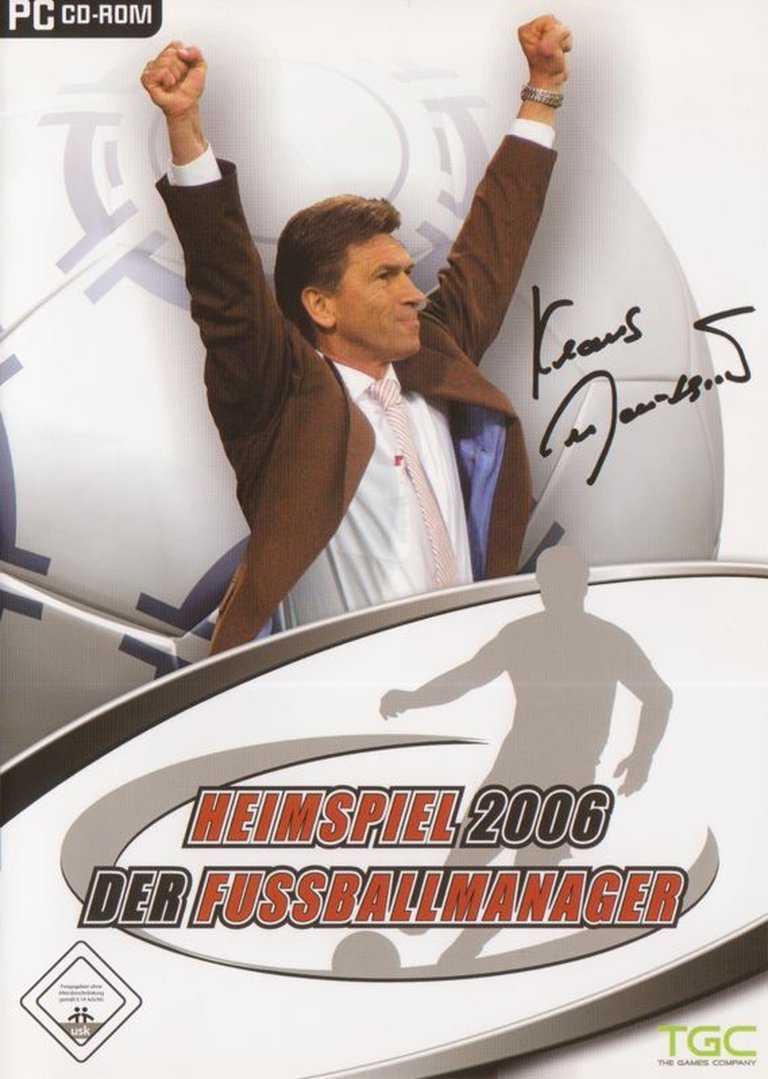
The 2006 World Cup in Germany provided the perfect marketing backdrop. The game’s cover featured Klaus Augenthaler, then-manager of VfL Wolfsburg, lending it a veneer of authenticity. Yet, beneath the surface, Heimspiel 2006 was a game caught between two eras: it retained the simplicity of late ’90s/early 2000s managers while attempting to modernize with a new 3D engine and real-time match calculations.
Technological Constraints
Released on May 26, 2006, Heimspiel 2006 was built for Windows PCs with modest system requirements (1 GHz CPU, 256 MB RAM). The game’s 3D engine, though touted as “new,” was a far cry from the polished visuals of FIFA Manager 06. The match presentations, while functional, lacked the fluidity and detail of contemporary titles. The UI, though streamlined, suffered from low-resolution textures and a dated aesthetic that felt out of step with 2006 standards.
The absence of official licenses (teams and players used fictional names) further hampered its appeal. While an in-game editor allowed players to manually input real-world data, this was a half-hearted solution compared to the fully licensed rosters of EA Sports’ offerings.
The Gaming Landscape
In 2006, the football management genre was in a state of flux. Championship Manager (later Football Manager) had already established itself as the gold standard for hardcore fans, while FIFA Manager catered to those seeking a more arcade-like experience. Heimspiel 2006 attempted to occupy a niche for beginners, but its lack of innovation and dated presentation made it a tough sell. Critics and players alike noted its similarities to Fußball Manager Fun, leading to accusations of laziness or outright cash-grabbing.
Narrative & Thematic Deep Dive
The Illusion of a Story
Heimspiel 2006 is not a narrative-driven game in the traditional sense. There are no scripted campaigns, dramatic cutscenes, or protagonist arcs. Instead, the “story” emerges organically from the player’s decisions—whether it’s guiding an underdog team to glory or navigating the pitfalls of financial mismanagement. This emergent storytelling is a hallmark of the genre, but Heimspiel 2006’s execution feels particularly barebones.
Themes: Accessibility vs. Depth
The game’s central theme is accessibility. Every design choice—from the simplified player stats (reduced to strength, stamina, and morale) to the absence of a calendar system—serves to lower the barrier to entry. Stadium expansions, for instance, take effect immediately upon payment, eliminating the wait times seen in other managers. This immediacy is both a strength and a weakness: it keeps the game moving at a brisk pace but sacrifices the long-term strategic planning that defines deeper simulations.
The game’s AI assistants, which can automate tasks like lineups and tactics, further emphasize this theme. For newcomers, this is a godsend; for veterans, it’s a reminder of the game’s limitations.
Characters and Dialogue
The “characters” in Heimspiel 2006 are the players and staff, but their personalities are reduced to a handful of attributes and special abilities (e.g., “loyalty,” “mobility”). There’s no dialogue to speak of—no press conferences, no player interactions beyond dry statistical feedback. The lack of humanization makes the game feel sterile, a far cry from the rich, dynamic worlds of Football Manager, where players have personalities, egos, and backstories.
Gameplay Mechanics & Systems
Core Gameplay Loop
Heimspiel 2006 distills the football management experience into its most basic components:
1. Financial Management: Secure sponsorships, set ticket prices, and expand the stadium.
2. Team Management: Buy/sell players, set lineups, and adjust tactics.
3. Training: Improve player attributes via a skill tree system.
4. Matchdays: Watch matches in real-time 3D or text mode, with tactical interventions allowed mid-game.
The loop is straightforward, but the lack of depth in each area is glaring. The transfer market, for instance, is simplistic, with no nuanced negotiation mechanics. Tactics are reduced to basic sliders (offensive/defensive, wing play, etc.), offering little room for creative experimentation.
Real-Time Match Engine
The game’s standout feature is its real-time match engine, which calculates all league matches simultaneously. Players can watch up to four games at once—a novel idea that adds a layer of strategic oversight. However, the 3D visuals are rudimentary, with stiff animations and a camera that struggles to capture the flow of play. The text mode, while functional, lacks the charm of Anstoss 3’s legendary commentary.
Player Progression and Skill Trees
Player development is handled via a skill tree system, where attributes like “mobility” or “loyalty” can be upgraded. This is a rare attempt at innovation, but the execution is shallow. The three core stats (strength, stamina, morale) are overly simplistic, and the skill tree feels tacked on rather than integral to the experience.
Multiplayer and Replayability
The game supports hot-seat and LAN multiplayer for up to four players, a feature that adds replay value. However, the lack of online play (a staple in modern managers) limits its longevity. The absence of a career mode—where players could progress from club to national team management—is another missed opportunity.
World-Building, Art & Sound
Setting and Atmosphere
Heimspiel 2006’s world is a skeletal representation of professional football. The 1,000 teams and 20,000 players are mere data points, devoid of the cultural and historical context that makes real-world football compelling. The stadiums, while expandable, lack personality, and the crowds are lifeless.
Visual Design
The game’s visuals are its Achilles’ heel. The 3D engine, though “new,” looks like a minor upgrade from Fußball Manager Fun. Player models are blocky, animations are stiff, and the UI is a low-resolution mess. The split-screen feature for watching multiple matches is ambitious but ultimately underwhelming due to the engine’s limitations.
Sound Design
The audio is equally uninspired. The commentary is nonexistent in 3D mode, and the text mode relies on dry, unengaging descriptions. The ambient stadium sounds are generic, and the soundtrack is forgettable “supermarket gedudel,” as one critic put it.
Reception & Legacy
Critical Reception
Heimspiel 2006 received lukewarm reviews, with an average critic score of 58% (MobyGames). Praise was reserved for its accessibility and bug-free performance, but critics lambasted its lack of innovation, dated presentation, and shallow gameplay. PC Games (76%) called it “exzellent for beginners” but noted its graphical inferiority to FIFA Manager 06. 4Players (39%) was harsher, labeling it the “Biggest Insolence of the Year” for its blatant recycling of Fußball Manager Fun.
Commercial Performance
The game’s commercial performance is difficult to gauge, but its reception suggests it was a niche product at best. The 2006 World Cup likely boosted sales, but the lack of official licenses and the game’s dated feel likely limited its appeal.
Influence and Legacy
Heimspiel 2006’s legacy is one of cautionary tale. It stands as a reminder of the risks of recycling old code without meaningful innovation. The game’s focus on accessibility foreshadowed later titles like Football Manager Touch, but its execution was too flawed to leave a lasting impact. The Heimspiel series continued with Eishockeymanager 2007 and Handballmanager 2008, but none achieved significant acclaim.
Conclusion
Heimspiel 2006: Der Fußballmanager is a game of contradictions. It succeeds in its mission to be beginner-friendly but fails to offer anything beyond a superficial experience. Its real-time match engine and multiplayer options are innovative touches, but they’re undermined by dated visuals, shallow mechanics, and a lack of ambition. In the pantheon of football management games, Heimspiel 2006 is a footnote—a relic of an era when accessibility was prioritized over depth, and when recycling old ideas was mistaken for innovation.
Final Verdict: 6.3/10 – A flawed but functional entry for newcomers, overshadowed by its own limitations and the giants of the genre.