
- Release Year: 2002
- Platforms: Linux, Windows
- Publisher: 1C Company, Snowball.ru, ZUXXEZ Entertainment AG
- Developer: Reality Pump Sp. z o.o.
- Genre: Action, Scrolling shoot ’em up
- Perspective: Diagonal-down
- Game Mode: Online PVP, Single-player
- Gameplay: Shooter, Vehicular
- Setting: Arcade
- Average Score: 74/100
Description
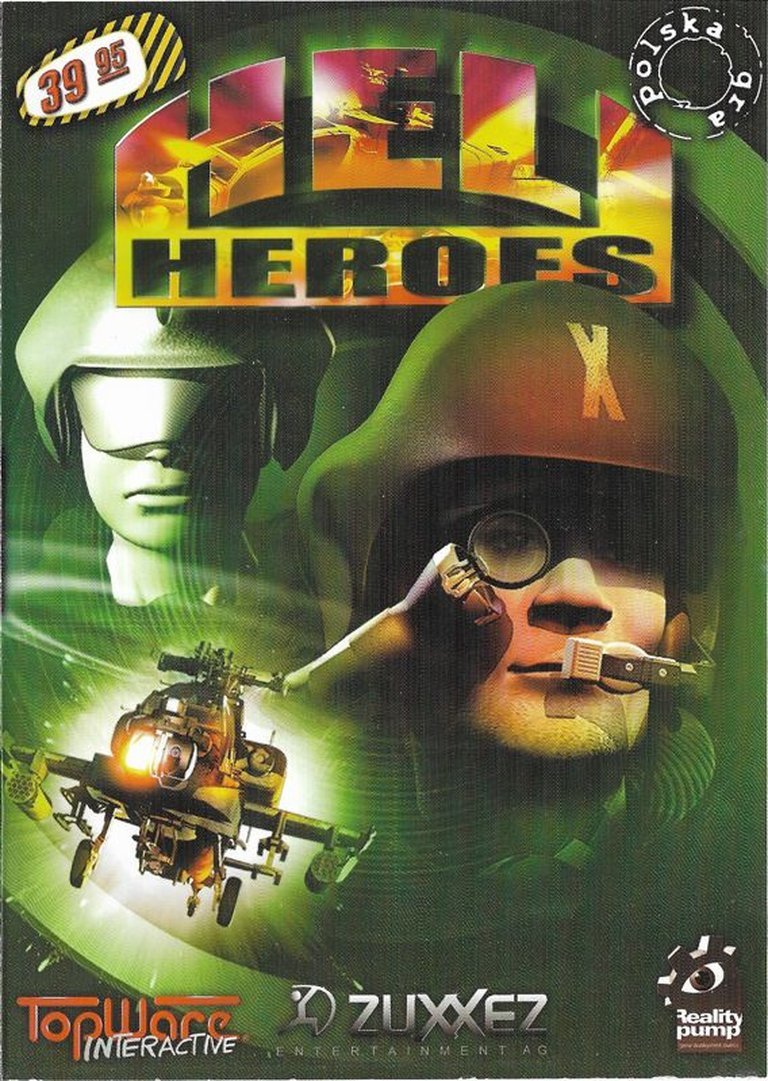
Heli Heroes is an arcade-style action game where players control a helicopter, blasting through enemies across 30 levels. The game features a straightforward design with occasional branching paths, offering power-ups like rockets and lasers as rewards for defeating foes. Built on the graphic engine from World War III: Black Gold, it delivers fast-paced, top-down shooter gameplay with three difficulty levels, making it accessible for both beginners and experienced players.
Gameplay Videos
Where to Buy Heli Heroes
PC
Heli Heroes Guides & Walkthroughs
Heli Heroes Reviews & Reception
mobygames.com (72/100): Average score: 72% (based on 16 ratings)
steambase.io (62/100): Heli Heroes has earned a Player Score of 62 / 100.
myabandonware.com (90/100): Awesome air blaster by Polish devteam! Highly similar to AirStrike series of chopper shooters by DivoGames.
Heli Heroes Cheats & Codes
PC
While playing, press ‘~’ (pressing the ‘Pause’ key is useful), enter one of the following codes and press [Enter] to activate.
| Code | Effect |
|---|---|
| GiveMeAll | All Cheats |
| GiveMeFuel | Add Fuel |
| MoreLives | Add Lives |
| HealthMe | Full Health |
| GiveMeInvulnerable | 30 sec. God Mode |
| GiveMeInvisibility | 30 sec. Invisibility |
| GiveMeAllAmmo | All Weapons & Ammo |
Heli Heroes: A Nostalgic Blast from the Early 2000s
Introduction
In the pantheon of early 2000s arcade shooters, Heli Heroes stands as a vibrant, if somewhat overlooked, relic of a bygone era. Released in February 2002 by Polish developer Reality Pump Studios and published by ZUXXEZ Entertainment AG, this diagonal-down shooter offered a frenetic, helicopter-centric twist on the classic shoot ’em up formula. At a time when gaming was rapidly transitioning into the 3D era, Heli Heroes clung to the simplicity and immediacy of arcade action, delivering a game that was as much about reflexes as it was about nostalgia. This review will dissect Heli Heroes in exhaustive detail, exploring its development, gameplay, reception, and lasting legacy.
Development History & Context
The Studio and Vision
Reality Pump Studios, based in Poland, was no stranger to the gaming industry by 2002. Known for titles like Earth 2150 and World War III: Black Gold, the studio had a reputation for blending strategy and action. Heli Heroes emerged as a departure from their usual fare—a pure, unadulterated arcade shooter designed to evoke the golden age of coin-operated cabinets. The game was built using the graphic engine from World War III: Black Gold, a real-time strategy game, repurposed to render a 3D landscape that players could traverse in their helicopters.
The vision was clear: create a game that was easy to pick up but hard to master, with a focus on fast-paced action and spectacular explosions. The developers aimed to capture the essence of classic titles like Tiger-Heli and Raptor, while leveraging modern technology to enhance the visual and auditory experience. The result was a game that felt both familiar and fresh, a bridge between the arcade past and the PC gaming present.
Technological Constraints and Innovations
The early 2000s were a period of rapid technological advancement, but they also presented challenges. Heli Heroes was constrained by the hardware of its time, requiring a balance between visual fidelity and performance. The game supported resolutions up to 2048×1800 in 32-bit color depth, a feat that was impressive for the era but demanded robust hardware. The use of Direct3D 8 ensured compatibility with a wide range of systems, though it also meant that the game was tied to the capabilities of early 2000s graphics cards.
One of the standout innovations was the inclusion of Dolby Digital 5.1 sound, a feature that was still relatively rare in PC games at the time. This, combined with the game’s explosive visuals, created an immersive experience that belied its simple premise. The developers also incorporated support for nearly all pads and joysticks, making the game accessible to a broad audience.
The Gaming Landscape of 2002
The early 2000s were a transitional period for PC gaming. The arcade shooter genre, once a staple of gaming culture, was beginning to wane in popularity as more complex, narrative-driven games took center stage. Titles like Half-Life and Deus Ex were redefining what players expected from a PC game, emphasizing storytelling and immersion over pure action.
Heli Heroes arrived in this landscape as a throwback, a deliberate nod to the arcade games of the 1980s and 1990s. It was not alone in this endeavor—games like Ikaruga and Radiant Silvergun were also keeping the shoot ’em up genre alive—but it distinguished itself with its helicopter-centric gameplay and modern visuals. The game’s release on CD-ROM and as a downloadable title made it accessible to a wide audience, though its shareware business model meant that it had to compete with both retail and free-to-play titles.
Narrative & Thematic Deep Dive
Plot and Setting
Heli Heroes is not a game that prioritizes narrative depth. Its story is minimal, serving primarily as a backdrop for the action. The game opens with a premise that feels ripped from a Cold War thriller: Revolution Now, a formidable terrorist group, is on the verge of creating a new world order. The player, commanding either an AH-64 Apache Longbow or a Russian Hokum helicopter, must thwart their plans across 30 missions.
The missions are set in a variety of locations, from Iraqi oilfields to Alaskan tundras, blending real-world settings with sci-fi elements. The game’s narrative is delivered through brief mission briefings, which are more functional than immersive. The dialogue, such as it is, is campy and over-the-top, with lines like “Harr! Nimm das!” and “Oh, hab’ ich dir etwa weh getan?” adding a layer of unintentional humor.
Characters and Dialogue
The game features two playable helicopters, each with distinct characteristics. The AH-64 Apache Longbow is equipped with superior machine guns, while the Russian Hokum boasts better armor. Beyond these mechanical differences, the helicopters are not imbued with personality or backstory. The game’s “characters” are essentially the player’s avatar and the faceless enemies they encounter.
The dialogue, delivered in a mix of English and other languages depending on the localization, is often criticized for its repetitive and stereotypical nature. The voice acting is hammy, with lines delivered in a manner that feels more suited to a B-movie than a video game. While this detracts from the game’s immersion, it also contributes to its charm, reinforcing its arcade roots.
Themes and Tone
At its core, Heli Heroes is a game about chaos and destruction. The themes are straightforward: good versus evil, order versus chaos, and the triumph of skill over overwhelming odds. The game does not delve into moral ambiguity or complex character arcs; instead, it revels in the sheer joy of blowing things up.
The tone is unapologetically campy, with a self-aware embrace of its own absurdity. The game’s missions are framed as a global struggle against terrorism, but the execution is so over-the-top that it never feels serious. This tone is reinforced by the game’s visual and auditory design, which prioritizes spectacle over realism.
Gameplay Mechanics & Systems
Core Gameplay Loop
Heli Heroes is, at its heart, a shoot ’em up game. The core gameplay loop involves piloting a helicopter through a series of levels, destroying enemies, and completing objectives. The game’s 30 missions are divided into training, regular, and “intercept” missions, with the latter serving as boss battles against large, heavily armored targets.
The gameplay is fast-paced and relentless, with enemies swarming the screen in waves. Players must navigate through these onslaughts, collecting power-ups and avoiding obstacles. The game’s difficulty is balanced by a variety of defensive and offensive systems, including decoys, additional armor, and stealth capabilities.
Combat and Weaponry
Combat in Heli Heroes is straightforward but satisfying. The player’s primary weapon is a chain gun, which can be upgraded to include additional barrels for increased firepower. Secondary weapons include unguided Hydra rockets, heat-seeking Hellfire missiles, and even atomic weaponry. These weapons are collected as power-ups during missions, adding a layer of strategy to the otherwise frenetic gameplay.
The game’s combat is designed to be accessible, with a simple control scheme that allows players to focus on the action. The helicopter’s movement is tied to its position on the screen—flying higher increases speed, while flying lower slows the player down. This mechanic adds a layer of depth to the gameplay, requiring players to manage their speed and position carefully.
Character Progression and Upgrades
Heli Heroes does not feature a traditional progression system. Instead, upgrades are tied to power-ups collected during missions. These power-ups include extra fuel, repairs, shields, lives, and temporary invulnerability. The game’s lack of a persistent upgrade system means that each mission is a self-contained challenge, with no carry-over of abilities or equipment.
This design choice reinforces the game’s arcade roots, emphasizing high scores and replayability over long-term progression. Players are encouraged to replay missions to improve their scores and unlock achievements, a feature that was still relatively novel in 2002.
UI and HUD
The game’s user interface is minimalist, with a heads-up display (HUD) that provides essential information without overwhelming the player. The HUD includes a fuel gauge, ammunition counter, health bar, and score display. The game’s mission objectives are displayed prominently, ensuring that players always know what they need to accomplish.
The UI is functional but unremarkable, with a design that prioritizes clarity over aesthetics. The game’s menus are similarly straightforward, with a focus on ease of use. This simplicity is in keeping with the game’s arcade sensibilities, ensuring that players can jump into the action with minimal fuss.
Innovative and Flawed Systems
Heli Heroes introduces several innovative mechanics that set it apart from other shooters of the era. The game’s use of a 3D landscape, rendered in a diagonal-down perspective, creates a sense of depth and immersion that was rare in shoot ’em up games at the time. The inclusion of day and night missions, as well as varying weather conditions, adds variety to the gameplay.
However, the game is not without its flaws. The lack of a persistent upgrade system means that players must start each mission from scratch, a design choice that can feel punishing. The game’s difficulty curve is also uneven, with some missions feeling overly challenging due to the sheer number of enemies on screen.
World-Building, Art & Sound
Setting and Atmosphere
Heli Heroes takes place in a world that blends real-world locations with sci-fi elements. The game’s missions are set in a variety of environments, from deserts to forests to urban landscapes. Each environment is rendered in 3D, with a level of detail that was impressive for the time.
The game’s atmosphere is one of constant chaos, with explosions, gunfire, and enemy chatter filling the air. The game’s visual design is colorful and vibrant, with a focus on readability and spectacle. The environments are designed to be visually distinct, ensuring that players can easily navigate through the chaos.
Visual Direction
The game’s visual direction is a mix of realism and arcade sensibilities. The helicopters and enemies are rendered in 3D, with a level of detail that was advanced for the time. The game’s explosions are particularly impressive, with dynamic lighting and particle effects that create a sense of scale and impact.
The game’s use of color is bold and vibrant, with a palette that emphasizes contrast and readability. The environments are designed to be visually distinct, with each mission featuring unique landmarks and obstacles. The game’s visual design is functional but also aesthetically pleasing, with a style that is both modern and nostalgic.
Sound Design
The sound design in Heli Heroes is a standout feature, with a mix of crisp sound effects and a pulsing soundtrack. The game’s explosions are particularly impressive, with a depth and richness that was rare in PC games at the time. The game’s soundtrack is a mix of synthetic melodies and percussion, with a tempo that matches the game’s fast-paced action.
The game’s voice acting, while often criticized for its campy delivery, adds a layer of personality to the experience. The lines are delivered with a mix of humor and intensity, reinforcing the game’s over-the-top tone. The sound design is immersive and effective, contributing to the game’s overall atmosphere.
Reception & Legacy
Critical Reception
Heli Heroes received a mixed but generally positive reception from critics. The game’s average score of 72% on MobyGames reflects its status as a competent but not groundbreaking title. Critics praised the game’s fast-paced action, impressive visuals, and accessible controls, but also noted its lack of depth and repetitive gameplay.
Reviewers at Game Captain and CyberJoy highlighted the game’s arcade sensibilities, calling it a “gelungenes Arcade Game” and a “perfect shot of adrenaline.” ActionTrip and GameGenie praised the game’s graphics and gameplay, though they noted its lack of innovation. PC Games and GameStar were more critical, pointing out the game’s repetitive missions and lack of variety.
Commercial Performance
Heli Heroes was not a commercial blockbuster, but it found a niche audience among fans of arcade shooters. The game’s shareware model allowed it to reach a wide audience, though its lack of persistent upgrades and uneven difficulty curve limited its appeal. The game’s legacy is one of a cult classic, a title that is remembered fondly by those who played it but never achieved mainstream success.
Influence and Legacy
Heli Heroes is not a game that redefined the shoot ’em up genre, but it did contribute to the ongoing evolution of arcade-style shooters. The game’s use of 3D landscapes and modern visuals influenced later titles, though its lack of innovation meant that it was quickly overshadowed by more ambitious projects.
The game’s legacy is one of nostalgia, a reminder of a time when arcade shooters were a staple of gaming culture. While it may not be remembered as a classic, Heli Heroes remains a fascinating artifact of the early 2000s gaming landscape.
Conclusion
Heli Heroes is a game that embodies the spirit of early 2000s arcade shooters. It is a title that prioritizes action and spectacle over narrative depth, delivering a fast-paced, chaotic experience that is both exhilarating and repetitive. The game’s visuals and sound design are impressive for the time, though its lack of innovation and uneven difficulty curve limit its appeal.
In the grand tapestry of video game history, Heli Heroes is a minor but noteworthy entry. It is a game that captures the essence of arcade shooters, offering a glimpse into a genre that was rapidly fading from the mainstream. For fans of shoot ’em up games, Heli Heroes is a title worth revisiting, a reminder of a time when gaming was simpler, faster, and more chaotic.