
- Release Year: 1996
- Platforms: DOS, Windows Apps, Windows
- Publisher: Bethesda Softworks LLC, id Software, Inc.
- Developer: Raven Software Corporation
- Genre: Action
- Perspective: 1st-person
- Game Mode: Co-op, Single-player
- Gameplay: ARTIFACTS, Flying, Inventory system, Powered-up weapons, Secret levels, Shooter
- Setting: Fantasy, Gothic, Medieval
- Average Score: 85/100
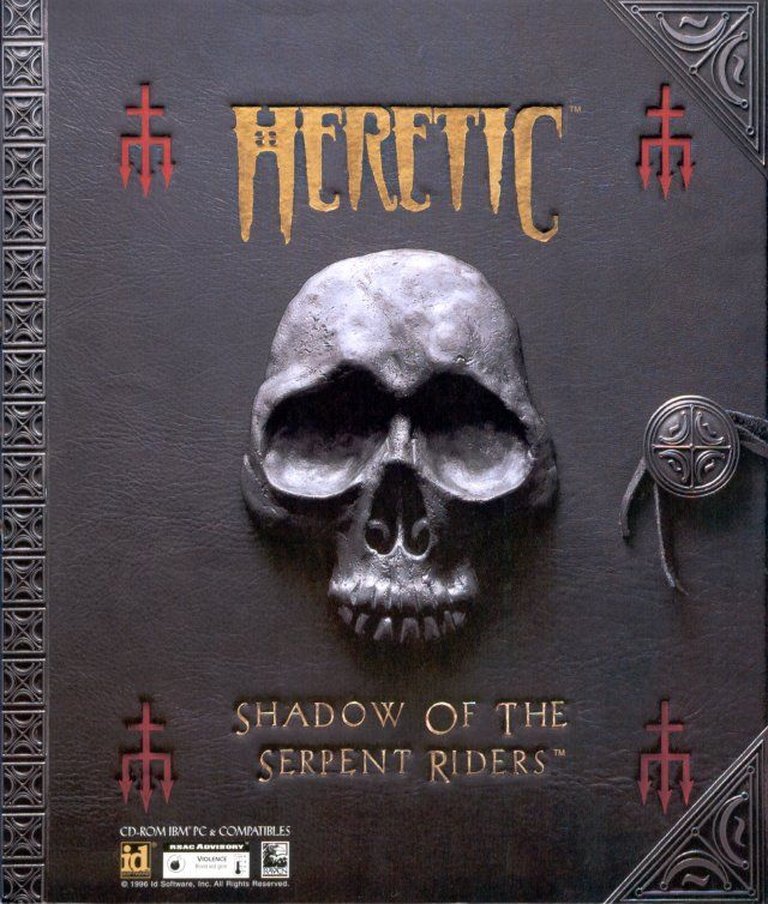
Description
Heretic: Shadow of the Serpent Riders is an expanded version of the original Heretic, featuring two additional episodes for a total of five. Set in a dark fantasy world, the game follows the Heretic, a lone warrior battling the oppressive Serpent Riders, particularly D’Sparil, who remains to enforce their tyranny. Built on an enhanced Doom engine, the game introduces features like an inventory system, vertical aiming, and the ability to fly, while retaining the fast-paced shooter gameplay. Players traverse diverse environments, from medieval cities to ruined dimensions, using a variety of weapons and magical artifacts to combat demons and undead. The expanded episodes offer increased difficulty and richer lore, making it a standout title in the Heretic/Hexen franchise.
Gameplay Videos
Where to Buy Heretic: Shadow of the Serpent Riders
PC
Heretic: Shadow of the Serpent Riders Free Download
Heretic: Shadow of the Serpent Riders Patches & Updates
Heretic: Shadow of the Serpent Riders Mods
Heretic: Shadow of the Serpent Riders Guides & Walkthroughs
Heretic: Shadow of the Serpent Riders Reviews & Reception
godmindedgaming.com : Despite the name, there aren’t many references to evil magic. Instead, the main issue is the large amount of blood and gore depicted during the violent gameplay.
metacritic.com (81/100): This takes the Doom engine to new heights! A lot of variety in gameplay, but great consistency in the levels.
honestgamers.com : Heretic wasn’t satisfied with giving you basic weaponry and thus included some useful consumable items to collect and hold in your bag.
gamesreviews2010.com (90/100): Heretic: Shadow of the Serpent Riders is a dark fantasy FPS classic that offers an immersive and challenging experience.
Heretic: Shadow of the Serpent Riders Cheats & Codes
PC
Type one of the following codes during gameplay.
| Code | Effect |
|---|---|
| quicken | God mode |
| rambo | All weapons |
| skel | All skeleton keys |
| cockadooledoo | Chicken mode |
| gimme<0-9> | Spawn item |
| gimme |
Spawn item |
| iddqd | Instant Death |
| idkfa | All Weapons Taken from Player |
| ravmap | Change Map Mode |
| gimmej | Chaos device |
| ponce | Full Health |
| gimmez0 | Gives you five of everything |
| massacre | Kill All Monsters in Level |
| engage(episode number level number) | Level Select |
| gimmeh | Morph Ovum |
| gimmed | Mystic Urn |
| ravskel | Obtain all skeleton keys |
| gimmec | Quartz Flask |
| gimmea | Ring of Invulnerability |
| gimmeb | Shadowsphere |
| noise | Sound Debug |
| gimmeg | Time Bomb of the Ancients |
| shazam | Toggle Power-Up Mode |
| gimmee | Tome of Power |
| gimmef | Torch |
| ticker | View Ticks Per Frame |
| kitty | Walk Through Walls |
| gimmei | Wings of Wrath |
MAC
Type one of the following codes during gameplay.
| Code | Effect |
|---|---|
| gimmej# | (1-9) of Chaos Device |
| gimmeh# | (1-9) of Morph Ovum |
| gimmed# | (1-9) of Mystic Urn |
| gimmec# | (1-9) of Quartz Flask |
| gimmea# | (1-9) of Ring of Invulnerability |
| gimmeb# | (1-9) of Shadowsphere |
| gimmeg# | (1-9) of Time Bomb of the Ancients |
| gimmee# | (1-9) of Tome of Power |
| gimmef# | (1-9) of Torch |
| gimmei# | (1-9) of Wings of Wrath |
| ravskel | All Keys |
| rambo | All Weapons & Ammo |
| idkfa | All Weapons are taken away |
| cockadoodledoo | Chicken Mode |
| engage## | Episode # Level # |
| ponce | Full Health |
| gimmez0 | Gives you five of everything |
| quicken | God Mode |
| iddqd | Instant Death |
| massacre | Kill All Monsters in Level |
| kitty | No Clipping mode |
| shazam | Tome of Power Power-Up |
| ticker | View Ticks Per Frame |
Heretic: Shadow of the Serpent Riders – A Dark Fantasy Masterpiece
Introduction
In the mid-1990s, the first-person shooter genre was dominated by Doom, a game that redefined action and intensity in video games. Amidst this landscape, Heretic: Shadow of the Serpent Riders emerged as a bold and innovative title, blending the fast-paced gameplay of Doom with a dark fantasy setting. Developed by Raven Software and published by id Software, Heretic was not just a reskin of Doom but a significant evolution of the genre. This review delves into the game’s development, narrative, gameplay mechanics, world-building, reception, and legacy, offering a comprehensive analysis of why Heretic: Shadow of the Serpent Riders remains a beloved classic.
Development History & Context
The Birth of a Fantasy Shooter
Raven Software, a studio known for its ambition and creativity, sought to carve a niche in the burgeoning FPS genre. Their earlier title, ShadowCaster, had laid the groundwork for a 3D role-playing experience, but it was Heretic that truly showcased their potential. The game was conceived as a medieval-themed Doom-like, but Raven’s vision extended far beyond a simple reskin.
John Romero, co-founder of id Software, proposed the idea of a fantasy-themed Doom to Raven Software in late 1993. Raven, composed of avid Dungeons & Dragons fans, initially drafted the game with role-playing elements. However, id Software, fresh off the success of Doom, wanted Raven to adhere closely to the Doom formula while infusing it with a fantasy aesthetic. This directive led to a game that retained the core mechanics of Doom but introduced several groundbreaking features.
Technological Innovations
Heretic was built on a modified version of the Doom engine, but Raven Software enhanced it with several key improvements:
- Inventory System: Unlike Doom, where power-ups were immediately consumed, Heretic introduced an inventory system that allowed players to collect and strategically use items such as health potions, time bombs, and the infamous Morph Ovum, which turned enemies into chickens.
- Vertical Movement: The game introduced the ability to look up and down, as well as fly, adding a new dimension to exploration and combat. While the “looking” mechanic was more of a vertical shift in perspective rather than true 3D movement, it was a significant step forward.
- Environmental Interactivity: Raven incorporated environmental elements such as wind currents and water physics, which could push the player character around, adding a layer of realism and challenge.
- Enhanced Audio: The game featured randomized ambient sounds, including evil laughter, chains rattling, and water dripping, which significantly enhanced the atmospheric immersion.
The Team Behind the Game
The development team at Raven Software was a mix of talented programmers, artists, and designers. Key figures included:
- Brian Raffel: Project Director and co-founder of Raven Software, who played a crucial role in shaping the game’s vision.
- John Romero: Executive Producer from id Software, who provided guidance and resources, including the Doom engine.
- Kevin Schilder: Composer and sound designer, whose haunting soundtrack and eerie sound effects became a hallmark of the game.
- Shane Gurno and Brian Pelletier: Artists who crafted the game’s dark fantasy aesthetic, creating a visually distinct world filled with gothic architecture and grotesque creatures.
Release and Expansions
Heretic was initially released in 1994 as a shareware title, featuring a single episode. The full retail version, Heretic: Shadow of the Serpent Riders, was released in 1996 and included five episodes, with the additional two episodes—The Ossuary and The Stagnant Demesne—offering increased difficulty and new environments. A free patch was also made available for owners of the original Heretic to upgrade to the full five-episode experience.
Narrative & Thematic Deep Dive
A World Ravaged by Evil
Heretic is set in a dark fantasy world where the three Serpent Riders—D’Sparil, Korax, and Eidolon—have corrupted the land of Parthoris. Using their powerful magic, they have possessed the seven kings of the realm, turning them into mindless puppets and corrupting their armies. The Sidhe elves, resistant to the Serpent Riders’ magic, are labeled as heretics and hunted down. The player takes on the role of Corvus, the last surviving Sidhe elf, who embarks on a quest for vengeance against D’Sparil, the weakest of the three Serpent Riders.
Themes of Vengeance and Despair
The narrative of Heretic is steeped in themes of vengeance, despair, and resistance against overwhelming evil. Corvus’s journey is not just a physical one but also an emotional odyssey through a world that has been utterly broken by the Serpent Riders. The game’s environments reflect this despair, with ruined cities, opulent palaces of evil, and dimensions where fire and ice coexist in a chaotic juxtaposition.
The Serpent Riders and Their Minions
The Serpent Riders are the primary antagonists, each embodying a different aspect of evil. D’Sparil, the main antagonist of Heretic, is a necromancer who oversees the oppression of the Sidhe elves. His minions include:
- Gargoyles: Winged creatures that attack from above.
- Golems: Stone constructs that are tough to destroy.
- Disciples of D’Sparil: Floating, robed figures that chant incantations and attack with magic.
- Maulotaurs: Massive, minotaur-like creatures that charge at the player.
- Iron Liches: Skeletal warriors that guard key areas.
The Journey Through the Episodes
The game is divided into five episodes, each with a distinct setting and atmosphere:
- City of the Damned: A ruined medieval city filled with nooks, crannies, and hidden secrets.
- Hell’s Maw: A hostile other dimension where fire and ice coexist, evoking a Norse mythology feel.
- The Dome of D’Sparil: The opulent palace of D’Sparil, filled with traps and challenges.
- The Ossuary: The shattered remains of a world conquered by the Serpent Riders centuries ago.
- The Stagnant Demesne: A combination of elements from all previous episodes, serving as the ultimate nest of evil.
Each episode culminates in a boss battle, with the final confrontation against D’Sparil himself.
Gameplay Mechanics & Systems
Core Gameplay Loop
At its core, Heretic retains the fast-paced, action-oriented gameplay of Doom. Players navigate through levels, collecting keys to unlock doors, battling hordes of enemies, and ultimately facing off against bosses. However, Heretic introduces several mechanics that set it apart:
- Inventory System: Players can collect and use a variety of items, including health potions, time bombs, and the Morph Ovum. This system adds a strategic layer to the gameplay, as players must decide when to use these items for maximum effect.
- Weapon Variety: The game features a diverse arsenal of weapons, each with unique properties:
- Staff: A basic melee weapon.
- Elven Wand: Functions like a pistol.
- Ethereal Crossbow: Similar to a shotgun, firing multiple projectiles.
- Dragon Claw: A rapid-fire weapon akin to a chaingun.
- Hellstaff: A plasma rifle that fires powerful energy bolts.
- Phoenix Rod: A rocket launcher with splash damage.
- Firemace: A powerful melee weapon that can also shoot fireballs.
- Tome of Power: A special artifact that enhances the player’s weapons, making them more powerful and sometimes changing their effects entirely. For example, the Hellstaff’s “red rain of death” is a devastating powered-up attack.
Combat and Strategy
Combat in Heretic is intense and requires quick reflexes and strategic thinking. Enemies often attack in groups, and players must use the environment to their advantage, such as taking cover behind pillars or using doorways to limit the number of enemies they face at once. The inventory system adds depth to the combat, allowing players to use items like the Morph Ovum to turn enemies into chickens or the Time Bomb to set traps.
Level Design and Exploration
The level design in Heretic is more intricate and detailed than in Doom. Each episode features distinct environments, from the gothic architecture of the City of the Damned to the chaotic landscapes of Hell’s Maw. The levels are filled with secrets, hidden passages, and ambient sounds that enhance the atmosphere. Players are encouraged to explore thoroughly, as hidden areas often contain valuable items and power-ups.
Multiplayer and Replayability
Heretic supports multiplayer gameplay, allowing up to four players to compete in deathmatch mode or cooperate in the main campaign. The game’s difficulty levels and hidden secrets provide ample replayability, encouraging players to revisit levels to uncover all their secrets.
World-Building, Art & Sound
A Dark Fantasy Aesthetic
Heretic‘s world is a masterclass in dark fantasy world-building. The game’s environments are richly detailed, with gothic architecture, ruined cities, and opulent palaces that reflect the corruption and despair of the world. The art direction, led by Shane Gurno and Brian Pelletier, creates a visually distinct and immersive experience.
Atmospheric Sound Design
The sound design in Heretic is a standout feature, contributing significantly to the game’s atmosphere. Kevin Schilder’s haunting soundtrack, combined with randomized ambient sounds such as evil laughter, chains rattling, and water dripping, creates an oppressive and unsettling mood. The enemy sound effects, from the snickering of gargoyles to the thundering bellows of Maulotaurs, add to the immersion.
Visual and Audio Enhancements
The game’s visuals, while limited by the technology of the time, are impressive in their use of color and detail. The ability to look up and down, although not true 3D movement, adds a new dimension to the gameplay. The sound effects and music are of exceptionally high quality, enhancing the overall experience and making the world of Heretic feel alive.
Reception & Legacy
Critical and Commercial Reception
Upon its release, Heretic: Shadow of the Serpent Riders received generally positive reviews. Critics praised the game’s innovative features, such as the inventory system and the ability to look up and down, as well as its dark fantasy setting and atmospheric sound design. However, some reviewers noted that the game’s similarity to Doom could be disappointing to players seeking a fresh experience.
Commercially, Heretic was a success, selling over 500,000 copies. The game’s popularity led to the development of sequels, including Hexen: Beyond Heretic and Heretic II, as well as a combined re-release in 2025 titled Heretic + Hexen, which included a new expansion, Faith Renewed.
Influence on the Genre
Heretic had a significant impact on the first-person shooter genre, influencing subsequent games such as Quake, Unreal, and Doom 3. The game’s dark fantasy setting, inventory system, and environmental interactivity set a new standard for FPS games, inspiring developers to experiment with different themes and mechanics.
Legacy and Modern Re-releases
The legacy of Heretic endures through its dedicated fanbase and the availability of source ports that allow the game to be played on modern systems. The 2025 re-release, Heretic + Hexen, introduced the game to a new generation of players, ensuring that its influence continues to be felt in the gaming industry.
Conclusion
Heretic: Shadow of the Serpent Riders is a landmark title in the first-person shooter genre, blending the fast-paced action of Doom with a rich dark fantasy setting. Its innovative features, such as the inventory system and the ability to look up and down, set it apart from its contemporaries and influenced the development of future FPS games. The game’s atmospheric sound design, intricate level design, and compelling narrative make it a timeless classic that continues to be enjoyed by gamers today.
For fans of Doom and dark fantasy settings, Heretic: Shadow of the Serpent Riders is an essential experience. Its legacy as a pioneering title in the FPS genre is well-deserved, and its influence can still be seen in modern games. Whether you’re a veteran of the genre or a newcomer looking to explore its roots, Heretic offers a challenging and immersive journey through a world ravaged by evil.