
- Release Year: 2010
- Platforms: Macintosh, Windows
- Publisher: Remar Games
- Developer: Remar Games
- Genre: Action
- Perspective: Side view
- Game Mode: Single-player
- Gameplay: Metroidvania, Shooter
- Setting: Futuristic, Sci-fi
- Average Score: 80/100
Description
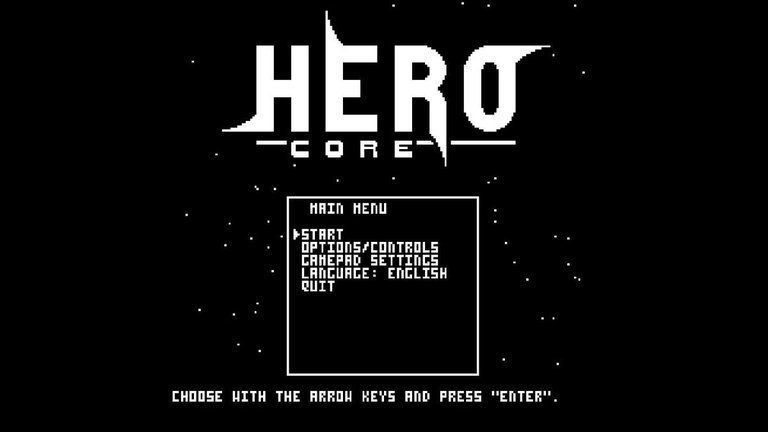
Hero Core is a sci-fi Metroidvania shooter featuring minimalistic monochrome graphics, where players control Flip Hero, a rogue robot navigating the non-linear rooms of Cruiser Tetron’s asteroid base. Tasked with destroying his former master to end their cycle of battles and save Earth, Flip Hero battles enemies using dual fire buttons, collects 10 secret computers to gain power, and confronts powerful bosses across two difficulty levels.
Hero Core Guides & Walkthroughs
Hero Core Reviews & Reception
howlongtobeat.com (80/100): Hero Core takes all the best parts of the old Metroid games, and then lets you warp to make backtracking easier.
Hero Core Cheats & Codes
PC
Available in version 1.4 and on, press Up, Up, Down, Down, Left, Right, Left, Right at the title screen.
| Code | Effect |
|---|---|
| Up, Up, Down, Down, Left, Right, Left, Right | Neo Joke Translation |
Hero Core: Review
Introduction
In an era dominated by sprawling AAA blockbusters and pixel-art indies chasing nostalgia for profit, Hero Core emerges as a pure, unadulterated artifact of passion—a freeware Metroidvania shooter that distills the raw thrill of 8-bit arcade adventures into a monochrome masterpiece. Released in 2010 by solo Swedish developer Daniel Remar, this sequel to his 2006 cult hit Hero thrusts players into the role of Flip Hero, a rogue robot locked in eternal combat with his tyrannical creator, Cruiser Tetron. With its labyrinthine asteroid base, bullet-dodging shootouts, and secrets that reward relentless exploration, Hero Core isn’t just a game; it’s a defiant love letter to retro gaming’s unforgiving spirit. My thesis: Hero Core stands as one of the finest freeware titles ever crafted, blending Metroidvania exploration with shoot ’em up precision to create a timeless experience that punches far above its minimalist weight, influencing indie design while preserving the soul of arcade-era challenge.
Development History & Context
Daniel Remar, operating under his one-man studio Remar Games, was already a freeware wunderkind by 2010. Fresh off the ambitious sci-fi epic Iji (2008)—a sprawling action-platformer with RPG elements that showcased his knack for deep mechanics and moral complexity—Remar turned his gaze back to Hero, his 2006 breakout. Hero Core evolved that linear shooter into a non-linear Metroidvania, built entirely in GameMaker Studio, a tool that allowed Remar to handle every facet: design, code, graphics, and even sound effects. This solo polymath approach, aided only by composer Harrison Lemke (credited as Brother Android) for the soundtrack and minor tools like SFXR for SFX generation, embodied the indie ethos of the late 2000s freeware scene.
The gaming landscape circa 2010 was a petri dish for indie innovation. Flash portals like Newgrounds and freeware hubs buzzed with retro throwbacks amid the rise of Steam indies and the Metroidvania renaissance (Cave Story in 2004 had paved the way). Technological constraints? Remar embraced them deliberately, opting for monochrome visuals and chiptune audio to evoke 1970s-80s arcade cabinets, sidestepping modern bloat for pure focus. Released on May 1, 2010 (Windows, with a 2012 Mac port), it was pay-what-you-want freeware from Remar’s site, democratizing access in an age before itch.io. Multilingual support (Spanish, Russian, German, Polish) and open-sourcing the code around 2013 further cemented its community-driven legacy, inviting mods and analysis. Remar’s vision was clear: expand Hero‘s boss-rush formula into a vast, replayable world, proving one developer could rival studio polish on a shoestring.
Narrative & Thematic Deep Dive
Hero Core‘s story is a lean, sci-fi tragedy woven sparingly into gameplay, prioritizing action but rewarding discovery with profound emotional payoff. You embody Flip Hero, a robot warrior who has rebelled against his master, the colossal Machine Warlord Cruiser Tetron. Tetron, a relic of a long-forgotten interstellar war, relentlessly assaults Earth, only to be defeated and rebuilt by his drone legions—trapping hero and villain in a Forever War. The plot unfolds non-linearly: rush to Tetron’s core for a futile skirmish, or scour the asteroid base for 10 secret computers that unlock permanent victory.
Characters are archetypal yet nuanced. Flip Hero is the silent Steven Ulysses Perhero, a Captain Space, Defender of Earth! whose loyalty twists into tragedy. Tetron, the Big Bad, reveals layers via collectibles: programmed for an obsolete conflict, he can’t self-terminate, possibly engineering Flip Hero as his executioner (I Cannot Self-Terminate). Dialogue is minimal—Retro! mode’s Engrish adds humor (“This upgrade has increase my ‘level’ 1. Remember eat vegetables also to grow strong.”)—but endings deliver gut punches. The standard ending loops the cycle (Here We Go Again!); the golden one, post-all-computers, frames the finale as Mercy Kill and Heroic Sacrifice. Flip Hero disables Tetron’s rebuild directive, perishes in the explosion, whispering loyalty in death (Together in Death, Finding Judas). Themes probe A.I. Is a Crapshoot, master-servant betrayal, and Tragic Villainy: Tetron’s not evil, just locked in outdated code, echoing Iji‘s alien pathos. White-and-Grey Morality emerges—both are weapons seeking peace—fleeting amid action, but resonant for completists.
Gameplay Mechanics & Systems
Hero Core masterfully fuses Metroidvania exploration with shoot ’em up rigor, creating addictive loops in a side-scrolling, room-based asteroid. Core controls are intuitive: fly freely, dual-fire buttons (left/right guns), dodge via momentum. Non-linear paths demand backtracking, unlocked by boss drops—e.g., Blade slices dirt/metal and reflects shots; secret Expel (↑↓←→ + fire) blasts omnidirectionally at health cost (Cast from Hit Points).
Progression shines: Start at level 1 (10 HP), gain levels/HP from enemies/bosses (up to 20+ HP). 10 computers boost stats; bosses yield flags for warps (easing traversal, Door to Before). UI is spartan—HP bar, level counter, map with ? markers (Interface Spoiler)—but HP Scan (post-Annihilation unlock) reveals enemy health. Combat deconstructs Bullet Hell lite: destroy weak points (bubbles/heads), handle Flunky Bosses (Grand Mother spawns Mothers spawning drones), Mirror Bosses (Elites mimic you), Hydra Problem (Plasma Hydra regrows heads). Boss Rush and secrets like Shapeshift (morph into drones/Metroids) add depth.
Modes escalate:
– Normal: Expansive map, upgrades galore.
– Hard: Redesigned maps, amped foes (Threat Level 10).
– Annihilation: No-upgrades minimalist run (Low-Level Run), Ciretako homage (Iji nod, non-canon), Living Warmachine superboss.
– Joke modes: Reallyjoel’s Dad (Threat 255, all bosses at once).
Flaws? Random enemy AI risks Luck-Based Missions; no mandatory upgrades enable sequence-breaking (Expel to boss rush). Yet innovations like Attack Reflector Blade and Combos for Expel reward mastery, yielding 1-2 hour runs with endless replay.
| Mechanic | Strengths | Weaknesses |
|---|---|---|
| Combat | Precise dual-fire, weak-point focus | Bullet spam on Hard |
| Exploration | Warp flags, secrets | Backtracking sans map upgrades |
| Progression | Level/flag system | Minimalist Annihilation punishes |
| UI | Clean retro | Lacks modern QoL (pausing?) |
World-Building, Art & Sound
The asteroid base pulses with industrial menace: corridors of pipes, molten metal pits (disable weapons temporarily, no Lava Pit death), generator rooms, and boss arenas evoking Gradius cores (Shout-Out). Atmosphere builds via scale—humongous mechs dwarf Flip Hero—fostering isolation amid Collision Damage.
Visuals are Retraux brilliance: monochrome (up to two colors), crisp pixels mimicking CRT scanlines. Bosses dazzle—Sequential Boss Tetron phases from agile to crumpled; Cores-and-Turrets Rocksmasher hulks. Sound design amplifies: Remar’s SFX (high “ding” for non-weak hits) pairs with Lemke’s chiptune OST (Bootstrapped Themes like “Tetron”). Pulsing synths drive tension, somber melodies underscore tragedy (Alas, Poor Villain). Together, they forge immersion, retro constraints heightening stakes.
Reception & Legacy
Launch reception was glowing for freeware: IGN’s “sweet Metroidvania-style adventure,” Rock Paper Shotgun’s playful nod, blogs like Entropy Pump hailing it “one of the best this year.” MobyGames logs 4/5 (sparse); HowLongToBeat users praise brevity (1-2 hours), secrets (90% scores). No Metacritic aggregate, but cult status endures—TV Tropes details 100+ tropes, open source spurs ports/mods.
Influence ripples: Exemplifies solo-dev excellence pre-Celeste, inspires Metroidvanias (Animal Well echoes minimalism). Remar’s oeuvre (Baba Is You via collaborators) cements impact; Flip Hero as mascot nods series continuity. Evolved rep: From freeware gem to preserved history (Moby ID 71801), its source code ensures eternity.
Conclusion
Hero Core is exhaustive proof that less is more—a taut, challenging Metroidvania shooter where every pixel, bullet, and secret sings of masterful design. Daniel Remar’s solo triumph transcends freeware roots, blending retro homage with thematic depth and mechanical purity. Its place in history? An indie cornerstone, essential for Metroidvania fans, demanding a 9.5/10—flawed only by era’s limits, but eternally replayable. Download it today; save Earth, free a tragic warlord, and witness indie genius.