
- Release Year: 2016
- Platforms: Windows
- Publisher: Tri Synergy, Inc.
- Genre: Compilation
- Game Mode: Single-player
- Gameplay: Hidden object
Description
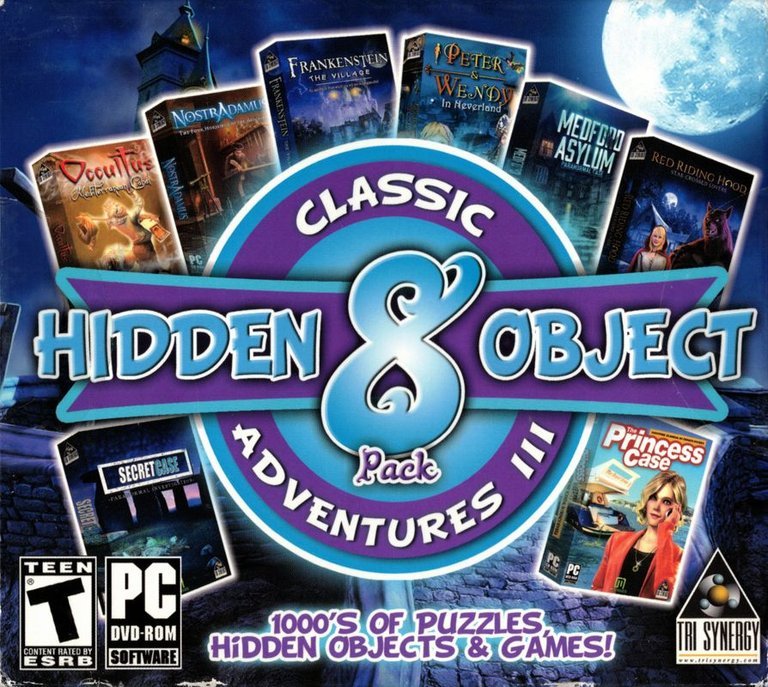
Hidden Object Classic Adventures III is a budget-priced compilation released in 2016 for Windows that bundles eight distinct hidden object titles into a single collection. The games span a variety of themes and narratives, from paranormal investigations and literary adaptations like Frankenstein and Peter Pan to mystical prophecies and supernatural mysteries, offering players a diverse array of scenarios in which to search for cleverly concealed items in static scenes.
Hidden Object Classic Adventures III Guides & Walkthroughs
Hidden Object Classic Adventures III: A Budget Anthology at the Genre’s Crossroads
Introduction
In the sprawling ecosystem of casual PC gaming, few product lines are as quietly ubiquitous as the “Hidden Object Classic” compilations. These budget-priced DVD-ROM bundles, often found in the bargain bins of big-box stores or listed for a few dollars on online marketplaces, represent a specific moment in the genre’s lifecycle: a period of consolidation and mass-market accessibility following its explosive mid-2000s boom. Hidden Object Classic Adventures III, released in 2016 by Tri Synergy, Inc., is not a singular game but a curated anthology—a time capsule of the hidden object genre’s thematic diversity and its industrial realities at the tail end of its physical media dominance. This review will argue that the compilation’s primary historical value lies not in revolutionary design, but in its function as a commercial sampler and preservative vessel, capturing eight distinct narratives and artistic approaches from smaller studios between 2015 and 2018, all while highlighting the genre’s persistent reliance on familiar, reliable mechanics over innovation.
Development History & Context
The Studio and Publisher’s Ecosystem
Tri Synergy, Inc., the publisher credited for this release, operated as a value-oriented distributor specializing in compiling and re-releasing casual games, often sourced from various smaller European and North American developers. Unlike a studio like Big Fish Games, which pioneered and consistently branded its own HOG franchises (Mystery Case Files, Hidden Expedition), Tri Synergy acted as an aggregator. The “Classic Adventures” branding was a marketing label applied to a heterogeneous collection of titles, each with its own independent development history. The compilation itself was likely assembled in-house by Tri Synergy’s product team, selecting finished games from their catalog or licensing agreements that fit the “adventure” and “classic” (meaning traditional, non-fantasy/”fairy tale” themed) criteria.
Technological Constraints and the 2016 Casual Landscape
By 2016, the hidden object genre was technologically mature but facing market stratification. The peak of the physical “collector’s edition” boom on platforms like Big Fish had passed, with digital distribution and free-to-play mobile models (like The Secret Society) ascendant. For Windows PC, the market was bifurcated: premium digital downloads on Steam and storefronts, and ultra-low-cost physical compilations for the less digitally-inclined or gift market. Hidden Object Classic Adventures III squarely occupies the latter niche. Technologically, the included games (notably 2015’s Frankenstein: The Village and Medford Asylum) use the standard 2D static-scene engine prevalent since the mid-2000s: high-detail painted backdrops with layered sprite-based objects. There is no 3D navigation or advanced physics; the constraint was and was chosen for its low development cost, predictable performance on integrated graphics, and clear visual readability for the core “search” mechanic. The inclusion of games dated up to 2018 (Nostradamus: The Four Horsemen of the Apocalypse, Red Riding Hood: Star Crossed Lovers) in a 2016 compilation suggests either a re-release with later additions or a data error in sourcing, a common issue with these budget compilations’ metadata, further evidencing their sometimes-haphazard assembly.
The Gaming Landscape
The mid-2010s saw the “walking simulator” and narrative indie game genres gaining critical prestige, while the hidden object game persisted in its own, highly profitable but critically ignored lane. This compilation represents the genre’s “factory farm” phase: efficient production of themed content (Frankenstein, Neverland, Nostradamus) with minimal mechanical deviation, aimed at a loyal, primarily older female demographic that purchased games based on theme recognition more than developer pedigree.
Narrative & Thematic Deep Dive
As an anthology, Hidden Object Classic Adventures III presents a fragmented narrative experience. There is no overarching plot. Instead, the player engages with eight distinct, self-contained stories, each adhering to a common HOG narrative structure: a protagonist is presented with a mystery, explores a series of static scenes (the “world”), finds objects to progress, and resolves the scenario, often through a final puzzle or confrontation.
Thematic Range and Source Material Adaptation:
The compilation deliberately spans several popular sub-genre niches:
* Literary Horror/Gothic: Frankenstein: The Village and Medford Asylum: Paranormal Case tap into classic horror iconography and settings, focusing on atmosphere of dread and mystery.
* Historical Prophecy & Supernatural Conspiracy: Nostradamus: The Four Horsemen of the Apocalypse and Occultus: Mediterranean Cabal leverage historical figures and global conspiracy theories, framing the object-finding as a quest to prevent cataclysm.
* Fairy Tale Reimagining: Peter & Wendy in Neverland and Red Riding Hood: Star Crossed Lovers subvert or expand familiar stories, often with a romantic or darker twist.
* Espionage/Scandal: The Princess Case: Wedding Scandal in Monaco and FBI: Paranormal Case II – The Guardians inject a detective or spy thriller element, though the “paranormal” tag suggests a supernatural investigation angle even in the FBI title.
Narrative Depth and Execution:
The quality and depth of these narratives are necessarily variable, constrained by the format. Dialogue is functional, serving to provide context for the next hidden object scene or to unveil the next plot beat. Character development is minimal, with most “protagonists” being blank-slate avatars or lightly sketched figures (e.g., “a detective,” “an archaeologist”). The theme of “restoration”—reuniting lovers, curing a curse, uncovering the truth—is universal across the titles. The narrative functions primarily as a scaffolding for the gameplay, a series of justifications for moving from a “London Street” scene to a “Haunted Mansion Library.” The writing leans on genre tropes efficiently but rarely transcends them. The most thematically coherent entries are likely the fairy tale adaptations (Red Riding Hood, Peter & Wendy), where the familiar source material provides instant narrative resonance, allowing the gameplay to serve as an alternative “path” through the known story.
Gameplay Mechanics & Systems
Core Gameplay Loop:
The loop is the genre’s signature and is identical across all eight titles:
1. Load Scene: Enter a highly detailed, static 2D environment (e.g., a laboratory, a Neverland clearing, a Mediterranean alley).
2. Receive List: A verbal or written list of 12-20 items to find (e.g., “cogwheel,” “silver locket,” “candle,” “ragged doll”).
3. Search & Click: The player scans the scene, clicking on objects that match the silhouette/silhouette-text. Correct clicks remove the item from the list and often produce a satisfying sound. Incorrect clicks incur a slight time penalty or point deduction.
4. Scene Completion: Upon finding all items, the scene “resolves”—often with an animation, a line of dialogue, or the acquisition of a key item for the next scene.
5. Progress: Use the acquired item to unlock a new area or trigger a cutscene, repeating the process.
Auxiliary Systems and Mini-Games:
To break the monotony, each title incorporates standard auxiliary systems:
* Hints: A limited-use system that highlights one unfound object or zooms into a cluttered area, essential for well-hidden items.
* Silhouette vs. Word Lists: Alternating between finding items by their textual name (requiring vocabulary recognition) and by their shape (testing pure pattern recognition).
* Mini-Puzzles: Typically deployed between major scene clusters. These are almost exclusively jigsaw puzzles (reassembling a torn document or painting), slider puzzles (moving tiles to form an image), or find-the-differences between two similar images. These serve as “boss gates” to advance the plot.
* Inventory & Object Application: Rarely, a found object must be used on a specific hotspot within a scene (e.g., use a key on a locked chest), blending hidden object with basic point-and-click adventure interaction.
UI and Flaws:
The user interface is standardized and functional: a list pane, hint button, menu button, and timer (if in timed mode). The primary flaw endemic to the genre, and thus present here, is repetition and padding. Scenes are often recycled with minor variations (different time of day, slight object rearrangement), and the mini-games are reskinned but mechanically identical across titles. The “progression” is linear and entirely predictable, offering no systemic depth. There is no character progression (no skill trees, stat upgrades) because the player’s “skill” is purely perceptual and non-upgradable. The innovation is almost entirely thematic and artistic, not mechanical.
World-Building, Art & Sound
Visual Direction and Art Cohesion:
This is the compilation’s strongest and most varied asset. Since the games are independent, their art styles reflect the individual studios’ strengths and budgets, creating a patchwork of visual experiences within the HOG framework.
* Frankenstein: The Village and Medford Asylum employ a dark, painterly, gothic style with heavy use of blues, grays, and desaturated greens. The detail is high, with objects often painted to blend seamlessly into grim environments (a rusted tool in a workshop, a bone in a dissection room).
* Peter & Wendy in Neverland and Red Riding Hood utilize a brighter, more storybook-inspired palette, with whimsical or romantic lighting. The hidden objects here are often fantastical (pixie dust, magic berries).
* Nostradamus and Occultus go for a gritty, pseudo-documentary realism mixed with esoteric symbols, placing objects in ancient manuscripts, maps, and dusty atlases.
* The Princess Case aims for glossy, modern-day glamour, with sleek Monaco locations and shiny objects.
The environments, while static, are meticulously composed. The “search” is a visual puzzle where lighting, scale (objects are sometimes subtly reduced or enlarged), and thematic integration (a “voodoo doll” in a witch’s hut, a “gearshift” in a steampunk lab) are key challenges. The art quality is generally good for the budget tier, though some later titles (2018) may show slight improvements in resolution and shading.
Sound Design and Atmosphere:
Sound design follows the genre convention: a single, looping, mood-setting ambient track per scene or area (e.g., ominous chords for horror, light woodwinds for fairy tales). Sound effects are crucial: a distinct “chime” for correct finds, a “buzz” for errors, and specific sounds for mini-game interactions. Voice acting is present but sparse—typically limited to introductory cutscenes and brief dialogue between scenes. The quality is functional, often with a single narrator voicing multiple characters. The soundscape’s primary role is to reinforce the theme (howling wind for horror, tinkling bells for Neverland) and provide audio feedback for the core loop. It is atmospheric but not dynamically reactive.
Reception & Legacy
Critical and Commercial Reception: A Data Void
MobyGames, Metacritic, and mainstream outlets like IGN and Kotaku show no critic reviews for Hidden Object Classic Adventures III. User reviews on these aggregators are also nonexistent. This is not an anomaly but the norm for budget-published, compilation-formatted casual games. They operated outside the traditional games press ecosystem. Their “reception” was measured purely in units sold at physical retail (Walmart, Target, computer stores) and through digital storefronts like Amazon and eBay. The low listed price point ($7.80-$8.00 used/new as of 2025) is its own review: it signals a commodity product aimed at impulse buys and dedicated genre fans seeking a cheap, quantity-over-quality fix.
Evolution of Reputation and Industry Influence
The reputation of Hidden Object Classic Adventures III is as a representative artifact, not a landmark title. Its legacy is twofold:
1. Genre Preservation: It serves as a time capsule for the “middle period” of HOGs, post-Big Fish golden age but before the mobile free-to-play dominance. The included titles demonstrate the genre’s thematic experimentation (blending HOGs with narrative frameworks from horror, detective, and fairy tales) before these sub-genres solidified into their own sub-franchises.
2. Business Model Artifact: It epitomizes the “budget compilation” business model that sustained many small casual developers. By bundling multiple已完成 games, publishers like Tri Synergy could reach discount retailers and customers wary of digital storefronts. This model has largely vanished with the decline of physical PC software retail and the rise of Steam bundles and Humble Bundle-style offerings, making this compilation a relic of a specific distribution pipeline.
The compilation’s direct influence on subsequent games is negligible, as its mechanics are derivative and its compilation format is a packaging choice, not a design one. However, the individual games within it may have influenced their own niche. For instance, a well-received Frankenstein: The Village might have encouraged other developers to tackle Gothic literature, but the compilation itself does not innovate.
Its true competitor and successor is the digital bundle on Steam and the subscription model (like Big Fish’s own subscription service). The value proposition of “eight games for $8” is now delivered more efficiently and with more user-friendliness via digital storefront sales and all-you-can-play services, rendering the physical DVD-ROM compilation obsolete.
Conclusion: A Snapshot, Not a Landmark
Hidden Object Classic Adventures III is not a game to be judged by traditional standards of narrative depth, mechanical innovation, or artistic cohesion. It is, fundamentally, a commercial product—a low-cost entry point into a sprawling genre. Its thesis, if it had one, is simple: The hidden object formula, applied to varied popular themes, has enduring mass-market appeal.
Strengths lie in its thematic variety and reliable, functional execution of the core seek-and-find mechanic. For a player who enjoys this specific type of puzzle, the compilation offers dozens of hours of varied scenery and scenarios at an absurdly low cost per hour. The art, while uneven across titles, generally meets the genre’s standard for detailed, searchable scenes.
Flaws are inherent to the model: zero mechanical evolution between games, repetitive structure, minimal narrative investment, and production values that, while competent, lack the polish of top-tier digital-exclusive HOGs. The absence of any central creative vision beyond “bundle these games” is palpable.
Final Verdict: Hidden Object Classic Adventures III occupies a crucial but unglamorous position in video game history. It is a historical document of the hidden object genre’s industrial phase, proving the formula’s commercial viability to the point where it could be efficiently packaged and sold as a bulk commodity. It is not a title one analyzes for its artistry or design brilliance, but one examines to understand the economics and distribution of casual PC gaming in the late 2010s. For the historian, it is invaluable as a specimen. For the player, it is a perfectly serviceable, if soul-crushingly repetitive, way to pass the time for the price of a fast-food meal. Its place in history is not on a pedestal, but on a shelf in a museum of gaming commerce—a effective, if uninspired, machine for delivering precisely what a specific segment of the market wanted.