
- Release Year: 2009
- Platforms: Windows
- Publisher: magnussoft Deutschland GmbH
- Genre: Compilation
- Perspective: 2D
- Game Mode: Single-player
- Gameplay: Hidden Objects
Description
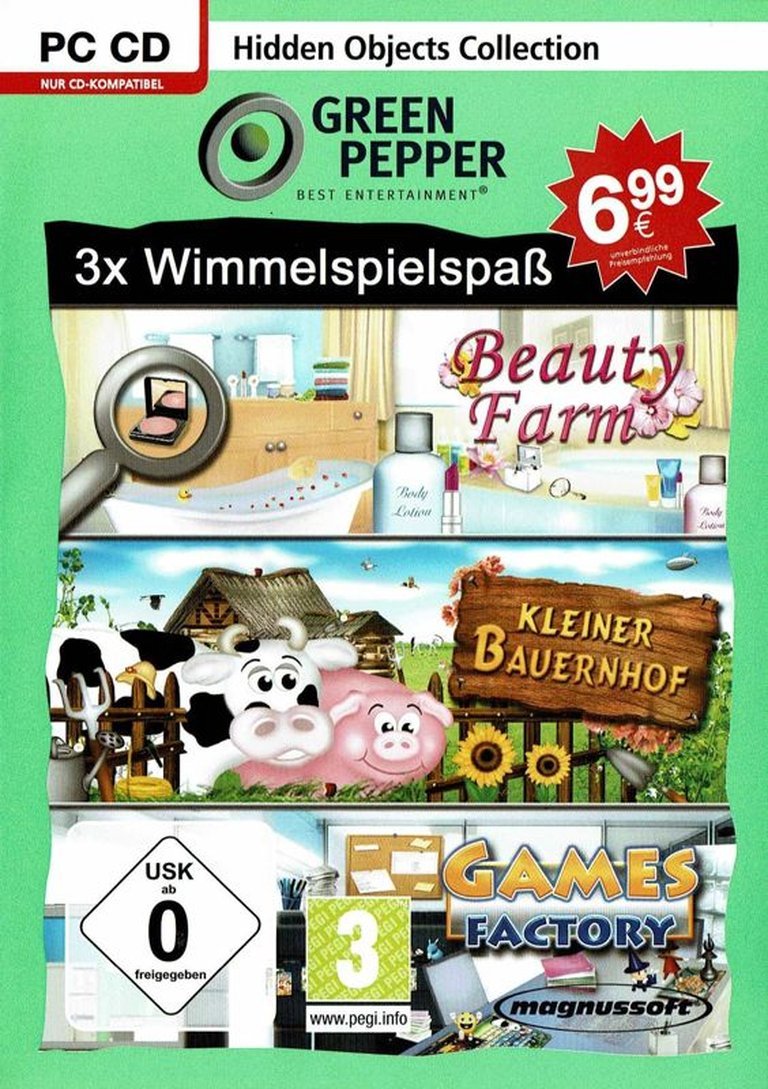
Hidden Objects Collection: 3x Wimmelbildspaß is a compilation of three hidden object games—Beauty Farm, Games Factory, and Kleiner Bauernhof—where players must carefully scour intricately detailed scenes to locate hidden objects. Set in diverse environments like farms, factories, and rural landscapes, the game challenges players’ observation skills across varied settings and puzzles.
Hidden Objects Collection: 3x Wimmelbildspaß: Review
Introduction
In the ever-shifting landscape of digital entertainment, few genres embody the paradox of simplicity and satisfaction quite like hidden object games. These digital scavenger hunts, born from the humble pages of “Where’s Waldo?” books and I-Spy puzzles, carved out a unique niche in the gaming zeitgeist. Hidden Objects Collection: 3x Wimmelbildspaß, released on November 16, 2009 for Windows by magnussoft Deutschland GmbH, stands as a fascinating time capsule from this formative era. This compilation bundles three titles—Beauty Farm, Games Factory, and Kleiner Bauernhof—under the banner of “3x Wimmelbildspaß” (3x Hidden Object Fun). While the games themselves are unassuming, their collective existence offers a window into the German casual gaming market of the late 2000s, a period when the hidden object genre was exploding in popularity yet still experimenting with its identity. This review argues that despite its lack of critical acclaim or innovative gameplay, the compilation’s true significance lies as a cultural artifact, preserving a specific moment in the genre’s evolution before it became dominated by sprawling narratives and mobile monetization.
Development History & Context
magnussoft Deutschland GmbH, the German publisher behind this compilation, operated within a bustling ecosystem of European casual game distributors during the late 2000s. The company specialized in bundling and repackaging titles for retail shelves, capitalizing on the growing demand for accessible, non-violent games. The three included titles—Beauty Farm, Games Factory, and Kleiner Bauernhof (Small Farm)—were developed by studios associated with the “Green Pepper releases” group, a collective focused on lightweight, thematically consistent hidden object games.
Technologically, the games were constrained by the era’s standards. Released on CD-ROM for Windows, they relied on 2D graphics optimized for low-spec systems, a necessity given the genre’s target audience of casual players and older hardware. The gaming landscape of 2009 was pivotal. This was the peak of the PC casual game boom, with Big Fish Games establishing the hidden object template through titles like Mystery Case Files: Huntsville (2005). However, while American studios were weaving complex detective stories, the German market retained a preference for simpler, theme-driven experiences. 3x Wimmelbildspaß reflects this divergence: its titles prioritize cozy, repetitive loops over intricate narratives, aligning more with pastoral life simulations than gothic mysteries. This compilation wasn’t a landmark release but a pragmatic product, designed to offer volume and value on retail shelves where “Wimmelbild” (German for “hidden picture”) books held significant cultural currency.
Narrative & Thematic Deep Dive
As a compilation, 3x Wimmelbildspaß lacks a unified narrative, but its individual games share a thematic core centered on domesticity and resource management, reflecting the genre’s early focus on relatable, low-stakes scenarios.
-
Beauty Farm: This title likely casts players as a farmer tasked with restoring a dilapidated homestead. The narrative is inferred through gameplay: players progress by finding objects hidden in barns, fields, and kitchens, with each scene unlocking upgrades or tools. Themes of stewardship and renewal permeate the game, framing object-finding as a means to nurture life—a stark contrast to the crime-solving or supernatural themes prevalent in later hidden object adventures. Dialogue is minimal, probably limited to on-screen text hints, reinforcing the genre’s emergent “storytelling through mechanics” ethos.
-
Games Factory: Set in an industrial environment, this game pivots to themes of production and order. Players might hunt for machine parts, tools, or paperwork in cluttered workshops or assembly lines. The implied narrative revolves around efficiency and problem-solving, with hidden objects acting as components to repair machinery or optimize workflows. This reflects a subtle shift toward more structured, goal-oriented gameplay, where the “Wimmelbild” scenes serve as literal puzzles within a larger industrial simulation.
-
Kleiner Bauernhof: Reinforcing the pastoral theme, this title likely emphasizes family and community. Hidden objects in village scenes—such as eggs, vegetables, or toys—would support a narrative of daily routines and simple rewards. Like its companions, it avoids complex storytelling, instead using the act of searching as a meditative loop.
Collectively, these themes reveal the genre’s roots in everyday life. Unlike modern hidden object games that often layer gothic horror or espionage, 3x Wimmelbildspaß’ narratives are grounded in tangible, comforting tasks. This simplicity was both a strength and a limitation: it made the games accessible but also narrative-lite, with character development and plot depth sacrificed for mechanical repetition.
Gameplay Mechanics & Systems
At its core, 3x Wimmelbildspaß adheres to the classic hidden object template, but with subtle variations influenced by its compilation nature and thematic focus.
-
Core Loop: Each game presents players with densely illustrated scenes (e.g., farms, factories) and a list of objects to locate. Clicking on an item triggers a satisfying chime and removes it from the list. Completion unlocks the next scene, often accompanied by a simple reward like a tool upgrade or a plot-relevant object.
-
Mechanical Variations:
- Beauty Farm likely integrates object-finding with light resource management—e.g., finding a “watering can” to progress crop growth.
- Games Factory might add timed elements or “spot-the-difference” puzzles, reflecting its industrial theme.
- Kleiner Bauernhof could emphasize narrative progression, where found items (e.g., “grandma’s recipe”) unlock story snippets.
These variations hint at the genre’s early experimentation, though none deviate far from the foundational formula.
-
Character Progression: Absent in the traditional sense. Progress is scene-based, with no persistent stats or skills. The “character” is the player-as-observer, whose advancement is purely spatial. This aligns with the genre’s casual appeal—no skill barriers, just incremental discovery.
-
UI & Innovation: The interface is minimalistic: a list of objects on the screen, a hint button (likely limited in uses), and a cursor that may highlight interactive zones. Innovation is scarce; the compilation doesn’t introduce genre-defining mechanics. Instead, it exemplifies the genre’s “pure” form—prioritizing discovery over complexity. Flaws include potential repetition in scene design and a lack of adaptive difficulty, which could frustrate players seeking challenge.
World-Building, Art & Sound
The trio of games in this compilation crafts distinct yet thematically cohesive worlds, united by their art direction and sound design.
-
World-Building: Each title creates a self-contained microcosm. Beauty Farm evokes rustic charm—wooden barns, overgrown gardens, and warm kitchens—while Games Factory suggests organized chaos, with conveyor belts and blueprints. Kleiner Bauernhof likely expands this into a village idyll, complete with market stalls and pastures. These settings are not explorable in 3D but are meticulously layered 2D dioramas, where every object tells a story. The “Wimmelbild” approach—crowding scenes with life—fosters immersion, encouraging players to linger and appreciate the mundane details.
-
Art Direction: The art is uniformly bright, cartoonish, and functional, prioritizing clarity over realism. Objects are distinct and recognizable, ensuring the search remains fair. Textures are simple—hand-drawn lines with flat colors—yet effective in conveying atmosphere. For example, a sun-drenched farm field uses warm yellows and greens to evoke comfort, while a factory might employ cooler blues and grays. This aesthetic was characteristic of early 2000s hidden object games, where accessibility trumped visual fidelity.
-
Sound Design: Audio is likely sparse but purposeful. Ambient sounds—chirping birds, factory hums, clucking chickens—anchor players in the scenes. Sound effects for finding objects (chimes, pings) provide positive reinforcement, while soft, repetitive background music maintains a meditative rhythm. This design reinforces the genre’s therapeutic appeal, transforming object-hunting into a calming ritual.
Together, these elements create an experience that is visually and aurally cohesive, even if worlds are small. The art and sound work in harmony to make the mundane feel magical, a hallmark of the genre’s early charm.
Reception & Legacy
Upon release, Hidden Objects Collection: 3x Wimmelbildspaß received scant critical attention, a fate common to budget compilations and casual titles outside enthusiast circles. Metacritic lists no critic reviews, and MobyGames records zero user reviews, suggesting it was a niche product overshadowed by genre titans like Mystery Case Files. Commercially, it likely performed moderately well in German-speaking markets, leveraging the “Wimmelbild” cultural phenomenon and the CD-ROM retail model prevalent before digital storefronts like Steam ascended.
Its legacy, however, is more nuanced. As a compilation, it preserves three otherwise obscure titles from the Green Pepper collective, offering historians a snapshot of pre-narrative hidden object games. The genre, which exploded in the 2000s with over 100 million downloads for Mystery Case Files alone, later evolved toward mobile platforms and complex storytelling. Games like June’s Journey (2017) and Hidden Folks (2017) would add depth and innovation, but 3x Wimmelbildspaß represents the genre’s simpler, more innocent phase. It influenced the market by demonstrating the appeal of themed bundles, a tactic still used by publishers today. Yet, its lack of narrative ambition meant it was quickly eclipsed by story-driven HOPA (hidden object puzzle adventure) hybrids, cementing its place as a historical footnote rather than a landmark.
Conclusion
Hidden Objects Collection: 3x Wimmelbildspaß is not a masterpiece of game design, nor does it push the boundaries of its genre. Instead, it is a cultural artifact—a window into the German casual gaming scene of 2009, when hidden object games were evolving from simple digital puzzles into a dominant PC genre. The compilation’s three titles, Beauty Farm, Games Factory, and Kleiner Bauernhof, embody the era’s thematic preferences: domesticity, resource management, and simple satisfaction. Their gameplay, while repetitive, offers a pure form of the “Wimmelbild” experience, prioritizing discovery over complexity.
Visually and aurally, the games excel in creating cozy, immersive worlds that feel lived-in. Yet, their lack of critical reception and narrative depth underscores their status as niche products. In the grand tapestry of video game history, 3x Wimmelbildspaß is a thread—important for its role in documenting the genre’s early iterations, but not transformative. For modern players, it may feel quaint, but for historians, it’s a vital piece of the puzzle, illustrating how hidden object games once flourished in a pre-mobile, pre-narrative golden age. Its legacy is one of preservation, not innovation—a quiet reminder that sometimes, the most telling stories are found not in groundbreaking gameplay, but in the humble bundles that capture a moment in time.