
- Release Year: 2021
- Platforms: Linux, Windows
- Publisher: Hellbent Games Inc.
- Genre: Strategy, Tactics
- Perspective: Side view
- Gameplay: Turn-based strategy
- Setting: Fantasy
- Average Score: 80/100
Description
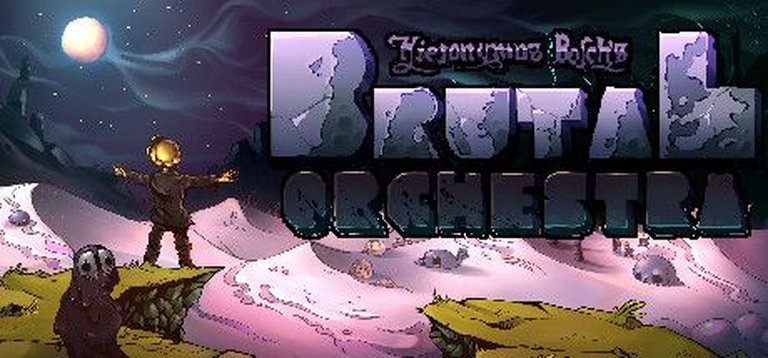
Hieronymus Bosch’s Brutal Orchestra is a turn-based roguelike set in a surreal, fantastical Purgatory. Players control Nowak, a dead man who forms an alliance with the demon Bosch to seek revenge on his killer, navigating the afterlife by recruiting bizarre allies, managing resources, and building a strategic skill deck to overcome horrific and strange foes in brutal, tactical combat.
Gameplay Videos
Where to Buy Hieronymus Bosch’s Brutal Orchestra
PC
Hieronymus Bosch’s Brutal Orchestra Mods
Hieronymus Bosch’s Brutal Orchestra Guides & Walkthroughs
Hieronymus Bosch’s Brutal Orchestra Reviews & Reception
opencritic.com (80/100): Brutal Orchestra is a “meaty” fine roguelite turn-based strategy game which makes great use of a peculiar pixelated art style and an exquisite soundtrack. While the brutal difficulty might turn some people away, the funny writing and good selection of unlockables will make sure the fans will gobble this one up.
Hieronymus Bosch’s Brutal Orchestra: A Turn-Based Descent into Divine Madness
Introduction: A Pact with the Devil of Design
In an era dominated by slick AAA production values and formulaic live-service models, Hieronymus Bosch’s Brutal Orchestra erupts onto the scene like one of its own Jumbleguts—a glistening, unsettling, and utterly unique knot of creative ambition. Released in December 2021 by the tiny, two-person outfit helmed by Talia Bob Mair and Nicolás Delgado, this turn-based roguelike strategy game is not merely an aesthetic homage to the 15th-century Dutch painter Hieronymus Bosch; it is a frantic, philosophical, and brutally difficult ludic translation of The Garden of Earthly Delights’s hellscape. The player’s journey with the deceased protagonist Nowak through a writhing, multiplicitous Purgatory is a masterclass in “bottom-up” game design, where a singular, ingeniously twisted mechanical vision gives birth to a world of profound thematic weight and grotesque beauty. This review argues that Brutal Orchestra stands as a landmark of indie game design, a title whose profound difficulty is inseparable from its core meditation on self-annihilation, regret, and the chaotic, inescapable machinery of consequence, all filtered through a lens of pitch-black humor and artistic reverence.
Development History & Context: The Seed of “Ball Wizards”
The origins of Brutal Orchestra lie not in a narrative concept, but in a mechanical prototype. As creator Talia Bob Mair detailed in a famed creature design interview with Bogleech.com, the project began as a generic pitch called “Ball Wizards” during her time at Vancouver Film School. It was a pure systems-first endeavor, a “bottom-up” design where the rules of engagement were crafted first. The evocative title Hieronymus Bosch’s Brutal Orchestra, which Mair had cherished for years, was finally attached to this framework. The choice of Bosch was deliberate; as a historical figure with no surviving family or celebrity to complicate engagement, his art exists as a pure, open-ended visual lexicon. Mair posits that Bosch’s depictions of hell as a “writhing chaos” are more relevant now than in his own era of organized warfare, presaging the indiscriminate, mechanistic horror of modern conflict.
Technologically, the game was built in Unity with FMOD for sound, a common but flexible stack for a small team. The constraints of a two-person developer (Mair and Nicolás Delgado, with sound by Pato Flores and Chris Dang, music by Publio Delgado) fostered a fiercely idiosyncratic vision. There was no committee to dilute the -concept, no need to appeal to a mass market. The result is a game that feels meticulously hand-carved from a single, darkly creative block of obsidian. Its release in late 2021 placed it in a crowded roguelike space—Slay the Spire, Hades, and Enter the Gungeon were dominant—but Brutal Orchestra distinguished itself by rejecting real-time action for deeply strategic, menu-driven turn-based combat, and by embracing an aesthetic so profoundly alien it defied easy categorization.
Narrative & Thematic Deep Dive: The Anatomy of a Suicide
The story of Brutal Orchestra is deceptively simple in its premise and devastatingly complex in its execution. We begin with Nowak, a man murdered at the end of World War II, who awakens in Purgatory. The entity Bosch—a shifting, oily pillar with a skull for a head, speaking in cryptic, abusive, and often hilarious non-sequiturs—offers him a deal: traverse the afterlife to find the man who killed him (who will die soon and arrive in Purgatory himself) and extract brutal revenge. The quest is linear in goal, but labyrinthine in its psychological and metaphysical implications.
The Characters as Fractured Selves: The supporting cast, the “Fools,” are not mere party members but existential manifestations. Nowak himself is a silent protagonist, a golden skeleton whose only expressive acts are in combat and in the game’s final, poignant moment of creation. Bosch is the central enigma. Player and community discourse, as seen in Steam discussions and Reddit threads, widely interprets him as a facet of Nowak’s own psyche—the Id, the suppressed id, the voice of self-hatred and logical nihilism. His constant verbal abuse (“You thoughtless parasite”) and gleeful promotion of violence are the externalized products of a mind consumed by guilt and the “unfinished business” of a life ended by its own hand (a fact slowly revealed). The final confrontation reveals the ultimate truth: Nowak’s murderer is himself. The “Big Bad” is an internal one.
Themes of Mortality, Legacy, and Artistic Torment: The game’s writing is sparse in gameplay but rich in environmental storytelling and NPC dialogue. Encounters with other damned souls provide gut-punch vignettes on futility. “Stabbed Guy” laments his trivial last words. “Panic Man” sobs about following instructions and taking meds, only to die anyway. These are echoes of Nowak’s own trajectory. A critical, though subtle, piece of lore—revealed via the Brutal Orchestra Wiki and Steam discussions—is that Nowak was an artist, a perfectionist inspired by Bosch himself, who likely committed suicide due to his inability to achieve artistic perfection. His journey through Purgatory, populated by Bosch’s own nightmare visions, is a literal and figurative trip through the hellish consequences of his own despair. The game’s true, “bittersweet ending” sees Nowak finally reconcile with this. He uses his own bleeding wounds to paint on the purgatorial wall, accepting that his art, like his life, is impermanent and unseen but meaningful because “everyone who needs to see it is already here.” He and Bosch, the two halves of his fractured soul, agree to “do this again sometime,” suggesting a cyclical struggle rather than a final escape.
Gameplay Mechanics & Systems: The Pigment of Your Flesh
Brutal Orchestra’s genius lies in its exquisitely cruel and interconnected mechanical systems, all under the umbrella of the Pigment mechanic.
The Core Loop & Resource Management: Each turn, the player’s party generates a set amount of Pigment in four colors: Red, Blue, Yellow, and Purple. Every character ability has a specific pigment cost. Using an ability of the wrong color is impossible, but mismanagement leads to Overflow: if you generate more pigment than you can store (a small, fixed capacity), your party takes escalating damage. This creates a constant, tense calculus. As the Wilson Wire analysis noted, this system embodies “the consequences of man’s actions.” A single misclick or poor planning is not just inefficient; it is physically punishing.
Color Motifs & Party Synergy: The colors are thematically bound, a system Mair described in the Bogleech interview.
* Yellow: Generalist, versatile. Often area-of-effect or utility. The protagonist Nowak’s primary damage moves use Yellow.
* Red: Offensive, high-damage, status-inflicting. The color of aggression and direct harm.
* Blue: Support-oriented—healing, shielding, curing. Generated via a “lucky pigment” mechanic on ability use.
* Purple: Exotic, potent, with drawbacks. Refresh, powerful debuffs, or handling special “exotic” status effects like Parasitism.
Combat & The “Focused” Engine: combat is turn-based on a flip-screen grid. The central Chain Lethality mechanic is the game’s pulsing heart: killing an enemy grants Nowak the “Focused” status, which radically increases his attack power (either +2 flat or +50% based on target health) until he takes damage. This incentivizes aggressive, precise elimination and makes every kill a strategic stepping stone to the next. Bosses are not just damage sponges; they are complex puzzles of pigment management, ability sequencing, and survival against one-hit kill moves like “Headshot” or “Mortal Horizon.”
Progression & The Deck-Building Lite: Between runs, players use “Souls” currency to unlock new characters (Fools), items, and passives for subsequent runs. This meta-progression is crucial, as the base roster is small and rebuilding your party is a core part of the experience. Items, often directly plucked from Bosch’s paintings (like the “Gentleman’s Glove” or “Effigy of the Mettle Mother”), are powerful but come with Necessary Drawbacks—they might cause collateral damage, apply harmful statuses, or have situational uses that require clever setup. This ensures no item is a simple upgrade.
Innovation & Flaws: The most lauded innovation is the per-battle unique soundtrack. Each enemy type, from the pitiful Mung fish to the horrific Music Men, has its own theme that dynamically adapts. The Music Men’s “Feel the Rhythm” ability even adds a new instrument layer to their song, a brilliant audiovisual feedback loop. The Save-Scumming system is also uniquely designed: quitting a battle saves the state, including reduced HP on living characters and a single HP on the dead. This allows for tactical recoiling without trivializing loss. The primary flaw, noted by critics, is the extreme, sometimes brutal randomness. Pigment generation can be wildly swingy, and certain early-game “soft locks” (like facing the optional mini-boss Unfinished Heir with a starter party) can feel prohibitively punishing. This is a feature, not a bug, for the intended audience, but a significant barrier for others.
World-Building, Art & Sound: Purgatory as a Living Painting
The game’s setting is a three-panel triptych in motion, directly mirroring Bosch’s Garden of Earthly Delights.
1. The Far Shore: A bleak, sandy desert of death, where parasitic fish (Mung, Goa) pilot corpses (Mudlungs, Fla Ming Goa) like grisly puppets. The sky is a dull, oppressive gray.
2. The Undergrowth: A rain-lashed, industrial-organic cityscape stalked by the “Ungod.” Here reside the grotesque “Music Men” (humanoids with tumor-instruments) and entities like the skeletal wrestler Roids.
3. The Garden: The final, surreal area, a direct descent into Bosch’s hellscape. It is a monochrome, nightmare-scape of aberrant biology where enemies become pure, chittering body horror like the Sequential Boss pair Osman and Sinnoks.
Visual Design as Philosophy: The pixel art is cartoonishly grotesque. Characters like Agon (a severed head held by his own hands), Clive (blood-red, veiny skin), and Griffin (bandaged, disfigured) are a parade of sympathetic yet monstrous “Fools.” Enemies are born from a unified bestiary logic, as explained by Mair. The Mung (depressed catfish) and its corpse-puppeteering evolution are born from a love of fish as “harbingers of change” and a riff on Half-Life’s Headcrabs. The Jumbleguts are literal piles of living pigment. The Unfinished Heir, a fetal bird-monster with an external heart and dangling placenta, is a direct riff on the Pikmin series’ Smoky Progg, designed to be a “Huge Fuck Off monster” that violates early-game expectations. Every design serves the themes of decay, reuse, and the raw, biological absurdity of an afterlife governed by Boschian logic.
Sound as a Living Score: Composer Publio Delgado’s work is nothing short of essential. The per-enemy music system is revolutionary for the genre. Give a Man a Fish for the Mungs is a quirky, underwater-esque tune. Estupido Pez Sexy for the Fla Ming Goa is a sultry, shamelessly funny Latin-infused piece. War of the Worms for the Kekos is a wiggly, threatening march. Incubus Rising for the Unfinished Heir is a chugging, buzzing metal track that sonically embodies its fetal, mewling horror. The soundtrack is not background noise; it is an active, narrative participant, giving each locale and creature a distinct, unforgettable voice.
Reception & Legacy: The Cult of the Brutal
At launch, Brutal Orchestra existed almost entirely in the realm of enthusiastic word-of-mouth and deep-dive community analysis. Critical reception was sparse but positive. Dutch outlet Gameplay (Benelux) reviewed it, and aggregator OpenCritic shows a single review scoring it 8/10, praising its meaty mechanics and soundtrack while noting its steep difficulty. The commercial and audience reception has been stellar and sustained. On Steam, it holds an “Overwhelmingly Positive” rating (97% of 1,800+ reviews), with players consistently calling it a “criminally underrated” masterpiece, a “roguelike obsession,” and praising its “innovative story with lovable characters.” The Steam community hub is filled with theories, art, and players who have literally tattooed the game’s iconography on their bodies.
Its legacy is nascent but potent. It has carved a permanent niche as a “cult classic of the difficult turn-based roguelike.” Its direct influence is visible in the way it prioritizes extreme mechanical clarity (the pigment system) married to extreme thematic cohesion. It demonstrated that a game could be both punishingly strategic and deeply, personally melancholic. The “ItsTheTalia” franchise, including the later Dead Estate, has developed a devoted following precisely because of this signature blend of body horror, dark comedy, and systemic depth. The game’s commitment to its artistic vision—refusing to soften its visual grotesquerie or its mechanical austerity—has earned it a revered place among players who value audacity and coherence over accessibility. The Wilson Wire article hit the nail on the head: it is Bosch’s art given new life, not just dressed in its clothes.
Conclusion: An Indelible Stain on the Tapestry of Gaming
Hieronymus Bosch’s Brutal Orchestra is a flawed, ferocious, and heartbreakingly intelligent game. It is not for everyone. Its difficulty is a gatekeeper, its aesthetic an acquired taste, its pacing deliberate and often cruel. But for those who engage with it on its own terms, it offers an experience rarely matched in modern gaming. It is a game where a single mechanic (Pigment management) perfectly reflects its core theme (the costly, colored consequences of every action). It is a game where the final boss is a mirror, and the demonic guide is your own despairing, self-annihilating id. Its creature designs are not just enemies to be defeated but pieces of a vast, dying ecosystem that is Purgatory itself, a place where fish out of water commandeer corpses and angels are reduced to slimy, pliable things.
From its bottom-up mechanical genesis to its top-down thematic devastation, Brutal Orchestra is a complete, singular vision. It takes the chaotic, punitive, and strangely musical hellscape of a 500-year-old painting and asks: what if you were trapped here? What if your guide was your own worst impulses? What if every fight was a small, pigment-stained step towards understanding that the only true brutality is the one we inflict upon ourselves? In answering these questions with unparalleled creativity and unflinching darkness, Brutal Orchestra secures its place not just as a great roguelike, but as a vital, haunting work of interactive art—a brutal, necessary, and unforgettable masterpiece.