
- Release Year: 2017
- Platforms: Linux, Macintosh, Nintendo Switch, Windows
- Publisher: Nkidu Games Inc.
- Developer: q-bit Games
- Genre: Action
- Perspective: Side view
- Game Mode: Co-op, Single-player
- Gameplay: Beat ’em up, brawler, Shooter
- Setting: Fantasy, Futuristic, Sci-fi
- Average Score: 60/100
Description
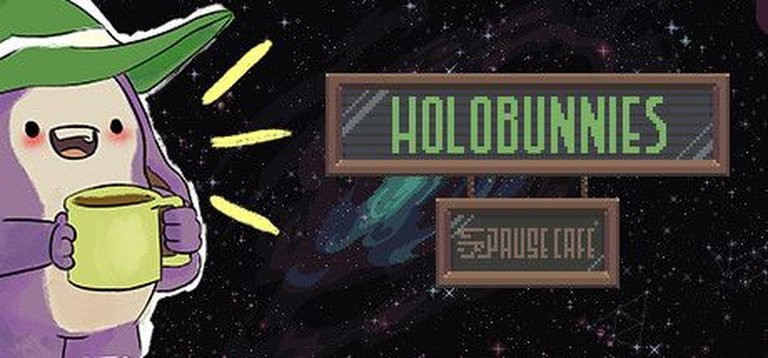
Holobunnies: Pause Café is a whimsical anthology of three mini-games set in a comedic fantasy-sci-fi universe. Players can engage in a frenetic two-player brawler, challenge classic q-bit bosses in Boss Rush, and navigate Kitcat’s solo adventure, all wrapped in a quirky café-themed package with adorable characters and humorous narrative.
Gameplay Videos
Where to Buy Holobunnies: Pause Café
PC
Holobunnies: Pause Café Cracks & Fixes
Holobunnies: Pause Café Reviews & Reception
metacritic.com (60/100): Holobunnies: Pause Cafe is a little minigames collection that delivers a funny, but very short, trial and error platform experience.
sirusgaming.com : it just feels like all 3 modes should have been extras of a much bigger game.
gameskinny.com (60/100): Holobunnies: Pause Cafe exists for the sole purpose to tide over Kickstarter backers — and it does it does in the laziest way possible.
Holobunnies: Pause Café: A Flawed but Fascinating Artifact of Kickstarter-Era Development
Introduction: The Appetizer That Never Quite Fulfilled Its Promise
In the often-tumultuous world of crowdfunded game development, Holobunnies: Pause Café stands as a curious and telling case study. Released in March 2017 for Windows, Mac, and Linux, and later ported to the Nintendo Switch as Super Holobunnies: Pause Café, this title was not the main event but a holding action—a “spin-off” launched before its parent project, Holobunnies: The Bittersweet Adventure, which would not see release for years. Conceived by the small Québecois indie studio q-bit Games, Pause Café was explicitly designed to “tide over Kickstarter backers,” a tactical retreat from the original Metroidvania platformer vision to deliver something tangible. This review will argue that Holobunnies: Pause Café is a game of profound contradictions: a charming, musically rich, and mechanically promising collection of minigames that is ultimately hamstrung by its own origins as a content-light stopgap. It is less a cohesive experience and more a fragmented proof-of-concept, a glass-half-full/half-empty artifact that reveals as much about the pressures of indie development and backer management as it does about game design itself. Its legacy is not one of influence, but of caution—a reminder that an “appetizer” must still satisfy, or it risks spoiling the appetite for the main course.
Development History & Context: A Project Split in Two
To understand Pause Café, one must first understand the chasm between its intent and its execution. The genesis lies in q-bit Games’ original Kickstarter campaign for Holobunnies: The Bittersweet Adventure, which promised a narrative-driven Metroidvania-style platformer starring a family of holographic, space-faring bunnies. As detailed in the studio’s own press kit, development hit a familiar indie snag: the exhausting search for additional team members, specifically an artist. In a moment of pragmatic desperation, lead designer Claude Jr. Labonté Lefebvre had an idea: “What if, to break the monotony of searching for a new artist on our main project, we split up the project into two parts?” This was not a creative evolution but a triage maneuver. Stretch goals and additional features from the Kickstarter were consolidated and moved into this new, smaller project.
The result was Holobunnies: Pause Café, released on March 22, 2017. It was built in Unity with FMOD for audio, a standard but capable toolkit for a small team. The credits (109 names, though many are “thanks”) paint a picture of a lean, multi-hyphenate operation: Roméo Jr. Labonté served as Designer, Programmer, Musician, and even “Husk Of A Human”; Claude Jr. Labonté Lefebvre was Designer, Composer, and “Scholar”; Lu Nascimento and Lucas Pacheco shared Art Direction and pixel art. This tiny core team, with contributions from others like PJ Rivas (“Actual Cowboy from Texas”), wore all hats. The technological constraints were those of a low-budget Unity project: a 300MB install size, modest system requirements (a 1.5 GHz Core2Duo, 2GB RAM), and a reliance on local, split-screen multiplayer.
The gaming landscape of 2017 was saturated with indie titles, many born from Kickstarter. Pause Café entered a market where expectations for “complete” experiences were high, even at a $4.99 price point. Its release before the promised main game was a bold and risky move. It was a live document of the studio’s capabilities at that moment, a snapshot of assets and mechanics that would (or would not) be repurposed for The Bittersweet Adventure. This context is essential: Pause Café was never meant to be judged as a standalone magnum opus, but as a communication tool, a peace offering to backers anxious for any progress. The fact that it required a “Super” re-release on Switch in 2020—adding co-op to Boss Rush and a clearer menu—speaks to its initial incompleteness.
Narrative & Thematic Deep Dive: A Bittersweet Promise Unfulfilled
The narrative framing of Pause Café is elegant in its simplicity but tragically thin in its execution. The Steam store description and press kit establish a compelling premise: after a catastrophe destroyed their home, the Holobunnies—a family of “quirky, space-faring, holographic, bipedal bunnies” including Avril, Mephisto, Romeo, Leenox, and Danielle—are on a “Bittersweet Adventure” to find a new home. Exhausted, they stop at “Qaantar’s Cafe” to rest, drink, and engage in “sportsmanlike competition.”
This setup is potent. The café is a liminal space, a moment of forced respite in a traumatic cosmic journey. Thematically, it touches on found family, the need for recreation amid hardship, and the tension between preparation and the unknown adventure ahead. The very title “Pause Café” suggests a meta-commentary on the player’s role: we are interrupting the Holobunnies’ journey to play with their downtime.
However, the game itself provides almost no narrative within the minigames. As multiple reviews (GameSkinny, Digital Chumps) starkly noted, the café hub contains only a line or two of dialogue per bunny. There is no story quest, no character development, no further explanation of the “catastrophe” or the nature of their quest. The “Bittersweet Adventure” remains an off-screen promise. The only narrative thread with any momentum is Kitcat’s Adventure, where the titular cat (a peripheral character) is on a “quest to share dire news with the Holobunnies.” Yet even this is presented as a faceless runner with no story beats or cutscenes.
The result is a profound narrative dissonance. The lore is rich and evocative, hinting at a deeper sci-fi/fantasy tale. The game is acontextual and arcade-y. The Holobunnies feel less like characters on a journey and more like pawns in disconnected playrooms. This isn’t just a flaw; it’s the fundamental consequence of the game’s origin as a repurposed content dump. The “Bittersweet Adventure” is forever deferred, making Pause Café a narrative ghost town—a place whose history is written elsewhere, leaving the player in a beautifully drawn but story-less café. The theme of “taking a pause” becomes ironic; the player is paused from a story that is never told.
Gameplay Mechanics & Systems: Three Modest Modes, One Fragmented Vision
Pause Café is explicitly structured as a trio of distinct minigames, accessible from the café hub. This design decision, born from splitting a larger project, results in three gameplay “islands” with little mechanical or narrative synergy.
-
Brawler Mode: A 2-player, local, single-screen versus brawler. Players choose from four Holobunnies—each with unique appearances and special abilities (e.g., Mephisto dodges, Danielle heals)—and fight in arenas populated by AI minions and hazards. The core loop is frantic and satisfying in theory, leveraging character differentiation for strategic depth.
- Strengths: The character abilities are creatively differentiated and create fun, dynamic PvP scenarios. The arena design with minions and obstacles adds a layer of chaotic strategy beyond direct combat.
- Flaws: Its single-player viability is nonexistent. There is no AI opponent, no online play, and no way to practice alone. This instantly renders the mode dead on arrival for the vast majority of solo players. As Digital Chumps astutely put it, this makes it a “pointless brawler mode” unless you have a constant local competitor. It feels like a module extracted from a larger versus component, not a finished product.
-
Kitcat’s Adventure: An auto-running platformer where the player controls Kitcat, a non-Holobunny character, with only a jump button. Levels introduce power-ups (speed up, slow down, multi-jump, reverse direction) and require the collection of “souls” to deduct from final time. It’s a precision-based speedrun challenge.
- Strengths: Universally praised by reviewers as the strongest mode (GameSkinny, 3rd-strike, Sirus Gaming). The level design strikes a good balance, introducing concepts gradually and culminating in genuinely challenging stages. The “souls as time deduction” mechanic cleverly incentivizes risk-taking and exploration. The ranked time attack provides clear long-term goals. Its controls are tight and focused.
- Flaws: It is completely disconnected from the Holobunnies’ mechanics and world. Playing as an unrelated cat in a runner feels like a separate mobile game grafted onto the IP. The thematic justification is weak (“Kitcat needs to get to the Holobunnies”), but the gameplay is solid in a vacuum.
-
Boss Rush: A sequential battle against four bosses (from the Bittersweet Adventure roster), each paired with a specific Holobunny whose abilities counter the boss’s pattern (e.g., Danielle vs. the high-damage Shepherd of Fire).
- Strengths: This is where the Holobunnies’ unique abilities shine, creating satisfying “aha!” moments where the right character makes a difficult fight manageable. The pairing is organic and well-designed, teasing the combat system of the main game. The “Super” version added crucial local co-op, addressing a major community request.
- Flaws: It’s extremely short (only four bosses). Once patterns are learned, challenge evaporates. The inability to choose your character is a notable downside, forcing you to use a specific bunny even if you prefer another’s style. Like the other modes, it exists in a vacuum—there’s no progression, no new bosses, just a repeatable time attack on a fixed set.
System-Wide Issues:
* UI & Onboarding: The café hub is confusing. Digital Chumps spent “ten minutes wondering if [they] were pressing the wrong key” to interact with bunnies. The Super re-release explicitly aimed to fix this with a “clearer main menu.”
* Control & Accessibility: Keyboard controls are reported as “all over the place” (Sirus Gaming). The game heavily favors gamepads. A critical failure is the absence of remappable controls on PC, a basic feature that hampered accessibility. Controller compatibility issues, especially with non-Xbox controllers like the DS4, were noted in Steam community discussions.
* Cohesion: The greatest systemic flaw is the lack of connective tissue. The modes don’t share currencies, unlocks, or narrative context. Completing Kitcat’s Adventure does nothing for the Brawler. The three games feel like three separate prototypes thrown together, which, of course, is exactly what they were. This fragmentation is the central gameplay critique.
World-Building, Art & Sound: Aesthetic Cohesion Amidst Mechanical Fracture
Where Pause Café undeniably succeeds is in its audiovisual presentation, which provides a consistent, charming, and retro-infused identity that binds its disparate parts.
- Art Direction & Visuals: The game employs a vibrant, expressive 16-bit pixel art style that reviewers consistently praised as “adorable,” “gorgeous,” and evocative of classic sidescrollers (3rd-strike, Digital Chumps). The Holobunnies themselves are well-animated, with distinct silhouettes and personality in their idle and action poses. The environments, however, tell a different story. Multiple reviews noted a “muted” color palette for backgrounds and maps, which can feel drab compared to the colorful sprites. This suggests a resource allocation where character and enemy art (the focus of gameplay) received priority over expansive, lush backgrounds. The café hub is a particular highlight, successfully conveying a cozy, sci-fi diner atmosphere. The Super version’s engine port likely smoothed animations and resolution, but the core aesthetic identity was established here.
- Sound Design & Music: This is arguably the game’s strongest suit. The soundtrack is described as “heavy-yet-melodic,” “funky,” and “captivating” (Digital Chumps, IndieDB). It dynamically shifts between modes: relaxing lounge tunes in the café hub, punchy, frenzy-inducing metal during Boss Rush, and an energetic beat for Kitcat’s Adventure. The Boss Rush music’s link to on-screen action was specifically noted as enhancing the thrill. The sound effects are crisp and satisfying, particularly for a small indie project. The audio does significant heavy lifting in establishing tone and energy, compensating for the lack of voice acting (bunnies emit “incomprehensible gibbering”).
- The Holobunnies Universe: The art successfully builds the idea of a quirky, holographic universe. The sci-fi/fantasy blend works visually. However, the world-building remains purely aesthetic. We see the bunnies and their potential foes, but we learn nothing about Qaantar’s Cafe, the technology behind their holographic nature, or the specifics of their lost home. The world is a beautiful shell with no interior.
In summary, the art and sound create a cohesive, high-quality aesthetic package that suggests a far more polished and focused project than the gameplay systems deliver. This disconnect is jarring: you are immersed in a cute, musically rich world only to be thrust into a disjointed, shallow set of minigames. The presentation promises a Holobunnies adventure; the gameplay delivers a fragmented tech demo.
Reception & Legacy: A Mixed Response to a Holding Pattern
Holobunnies: Pause Café‘s reception is a microcosm of its identity crisis. Critically, it was met with measured, middling praise. Metacritic scores hovered around 60/100 (SpazioGames, Digital Chumps). The consensus was captured in phrases like “funny, but very short” and “two out of the three games are fun.” Common critiques across all reviews were its extreme brevity, lack of content, and the feeling it was “gutted from the original project” (GameSkinny).
The user reception on Steam has been “Mostly Positive” (70% of 10 reviews at the time of data collection) but with a small sample size and clear polarization. Positive reviews often cite the charm, the fun of Kitcat’s Adventure, and the potential seen. Negative reviews focus on the “lazy” delivery, the pointless brawler, and the unjustifiable price for the content. The Steam Community Hub reveals ongoing issues, like controller recognition problems and crash reports (“null object reference”).
Commercially, it was a modest success in the sense of existing and generating some revenue, but its primary function was Kickstarter backer retention. It was a tangible deliverable that proved the studio was still active. However, this strategic success may have come at a creative cost. The widespread perception—shared by reviewers like Angelina Bonilla of GameSkinny—was that it was “the laziest way possible” to tide people over, a cash-grab that could “put people off” the main game by showcasing its stripped-down potential.
Its legacy is defined by its predecessor’s shadow. For years, Pause Café was the only Holobunnies game players could experience. It served as a prototype, a gameplay sampler for the abilities that would appear in The Bittersweet Adventure. The “Super” re-release on Switch in 2020, adding co-op and UI fixes, was an admission of the original’s shortcomings—an attempt to refine the product for a console audience. Yet, it didn’t fundamentally alter the critique: three mini-games, disconnected, with limited staying power.
In the wider industry context, Pause Café is a cautionary tale about scope management and communication. It demonstrates how a project bifurcation, while pragmatically useful, can produce a product that feels unmoored from its own brand. It has no real influence on game design trends; no mechanics from Kitcat’s Adventure or the Boss Rush were notable enough to be borrowed. Its historical value lies in its documentation of a specific indie development strategy—using a spin-off as a development milestone and backer pacifier—and the risks inherent in that approach when the appetizer is perceived as lacking substance.
Conclusion: A Curio of Promise and Prudence
Holobunnies: Pause Café is a game that exists in a permanent state of “almost.” It has almost a great soundtrack. It has almost charming characters. It has almost interesting mechanics, particularly in the character-boss pairings of Boss Rush and the precision of Kitcat’s Adventure. But it is almost entirely without a narrative, almost completely without cohesion, and almost insultingly short on content.
As a historical artifact, it is fascinating. It is a snapshot of q-bit Games at a crossroads, choosing to ship something rather than nothing, and in doing so, revealing the raw, unassembled parts of their larger vision. The game’s true narrative is not the one set in a cosmic café, but the one written in its credits, its press kit explanations, and its “Super” re-release: a story of creative triage, of managing expectations, and of the hard compromises of indie development.
For the historian, Pause Café is not a lost classic to be rediscovered. It is a “what if” fossil. What if the Brawler had AI bots? What if the modes shared a currency or progression? What if this was a demo for the full game rather than a separate product? Its value is in these questions, not in its answers. It is a testament to the fact that a game can be technically competent, aesthetically pleasing, and musically engaging—and still be a profound disappointment because it fails to deliver a coherent experience or justify its own existence beyond being a placeholder.
Its final verdict in the annals of gaming is that of a well-intentioned misfire. It will be remembered not for the games it contained, but for the gap it left—the gap between the rich lore it promised and the hollow minigame collection it delivered, and the even larger gap it left in the timeline before its parent game’s eventual, uncertain release. Holobunnies: Pause Café is the sound of a pause that stretched on just a little too long, leaving players checking their watches long before the main event ever began.