
- Release Year: 2019
- Platforms: Macintosh, Nintendo Switch, PlayStation 4, Windows, Xbox One
- Publisher: Tree Interactive
- Developer: Tree Interactive
- Genre: Action
- Perspective: Side view
- Game Mode: Co-op, Hotseat
- Gameplay: Fighting, Party game, Platform
- Setting: Fantasy
- Average Score: 75/100
Description
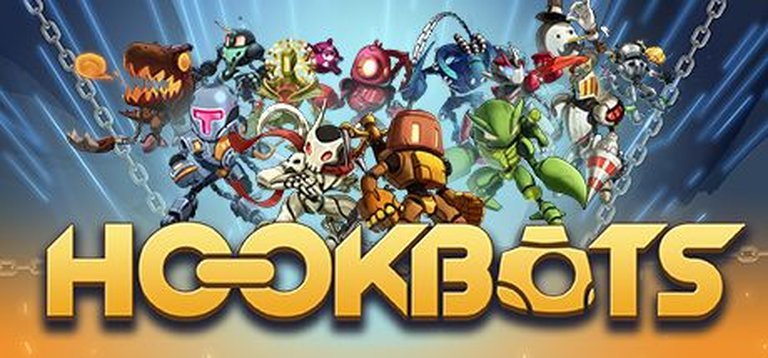
Set in a chaotic fantasy world, Hookbots is a multiplayer party game where players customize and battle robots across 14 diverse game modes, including Hold the Flag, Robo Bomb, and Racing Climbing. Choose from 52 unique bot designs like knights, dinosaurs, bounty hunters, and space warriors, each with extensive customization options, and engage in frenetic local or split-screen battles for up to four players.
Gameplay Videos
Where to Buy Hookbots
PC
Hookbots Guides & Walkthroughs
Hookbots Reviews & Reception
metacritic.com (75/100): Robots, mayhem, and destruction, what more do you want? Hookboots is a good party game, offering more than I expected at first look. Even if you don’t have three friends to play with there is enough content to keep things interesting.
opencritic.com (75/100): Robots, mayhem, and destruction, what more do you want? Hookboots is a good party game, offering more than I expected at first look. Even if you don’t have three friends to play with there is enough content to keep things interesting.
purenintendo.com (75/100): Robots, mayhem, and destruction, what more do you want? Hookboots is a good party game, offering more than I expected at first look. Even if you don’t have three friends to play with there is enough content to keep things interesting.
xboxtavern.com : All in all, Hookbots is an unreal, action packed fun machine and gives players a chance to be vicious in a fight that will bring clubs, feuds, and challenges for all.
Hookbots: A Chaotic Masterpiece of Local Multiplayer Mayhem
Introduction
In the crowded landscape of indie multiplayer games, few titles capture the anarchic spirit of couch co-op quite like Hookbots. Released in August 2019 by developer Tree Interactive, this 2D brawler emerged as a vibrant ode to pixelated destruction and mechanical mayhem. While lacking a traditional narrative, Hookbots carves its own legacy through sheer variety, customization depth, and unrelenting fun. This review argues that despite its modest scale and technical roughness, Hookbots stands as a hidden gem—a testament to the enduring appeal of local multiplayer chaos and creative expression. By dissecting its development, mechanics, and reception, we uncover how a small indie team crafted a surprisingly robust party experience that revitalizes the spirit of classic arena brawlers for a modern audience.
Development History & Context
Tree Interactive, a modest indie studio with no prior major releases, conceived Hookbots as a passion project driven by a clear vision: to create a accessible yet deep multiplayer experience focused on customization and variety. Built in Unity, the game leveraged the engine’s cross-platform capabilities to launch simultaneously on Windows, macOS, PlayStation 4, Xbox One, and Nintendo Switch—a rare feat for a small team. The developers emphasized community-driven development, explicitly inviting player ideas for future updates via social media channels, reflecting a commitment to iterative growth.
Technologically, Hookbots was unambitious but effective: its 2D side-scrolling visuals and fixed/flip-screen design harked back to 16-bit era classics, minimizing resource demands while maximizing clarity in frantic multiplayer action. The 2019 gaming landscape was dominated by service-based online games and battle royales, making Hookbots’ steadfast focus on local-only multiplayer a deliberate counter-cultural statement. In an era where couch co-op had become a niche pursuit, Tree Interactive aimed to reignite the magic of shared-screen rivalry, emphasizing accessibility with keyboard, mouse, and gamepad support. The result was a game unburdened by the pressures of live-service models, allowing it to thrive as a self-contained, endlessly replayable party package.
Narrative & Thematic Deep Dive
Hookbots dispenses with traditional storytelling in favor of pure, distilled conflict. The narrative is minimal yet evocative: players assume the roles of customizable robots—ranging from knights and dinosaurs to bounty hunters and space warriors—clashing in fantastical arenas. There is no overarching plot, no dialogue beyond taunts, and no character arcs; instead, the narrative emerges organically from each match’s escalating chaos. This intentional absence of lore underscores the game’s core themes: competition, creativity, and cathartic destruction.
The bots themselves serve as blank canvases for player expression, their designs blending archetypal fantasy and sci-fi elements with a playful absurdity. Special abilities, such as the Hunter’s X-shaped hook blast or a T-Rex’s stomping rage, inject personality without demanding backstory. The arenas, too, tell micro-stories through environmental hazards—falling hooks, spike traps, and destructible boxes—that frame combat as a high-stakes dance of survival and aggression. Thematically, Hookbots celebrates the joy of unbridled mayhem, transforming mechanical combat into a form of digital theater where every match becomes a unique, improvised saga of triumph and humiliation. The lack of a single-player narrative is not a flaw but a feature, reinforcing the game’s identity as a social experience where the story is written by the players themselves.
Gameplay Mechanics & Systems
At its core, Hookbots revolves around a deceptively simple mechanic: the hook. Players deploy grapple-like hooks to attack opponents, navigate stages, or snatch power-ups, creating a fluid loop of aggressive movement and strategic positioning. This dual-purpose hook elevates combat beyond mere button-mashing, encouraging players to master momentum-based techniques like wall-jumping or aerial repositioning. Combat is weighty yet responsive, with each successful hook strike delivering satisfying visual and auditory feedback that makes destruction feel impactful.
The game’s longevity stems from its staggering variety: 14 game modes range from objective-based challenges like “Hold the Flag” and “Coin Collector” to chaotic brawls like “Robo Bomb” and “Team Deathmatch.” Each mode introduces unique rulesets, such as “Volleyhook” (a volleyball variant) or “Baskethook” (basketball with hooks), ensuring no two sessions feel identical. Character progression is tied to engagement: playing unlocks new bots, skins, and parts for the “Bot Factory,” a robust customization system allowing players to assemble original creations from pre-existing components. Though limited by a lack of original parts, the factory encourages creativity, letting players name their bots and assign special abilities.
The UI prioritizes clarity during fast-paced matches, with crisp icons for health, specials, and objectives. However, the game suffers from a steep learning curve; AI opponents in single-player modes can be unforgiving, and newcomers may struggle with the hook’s physics. Despite this, the adjustable AI difficulty mitigates the issue for solo players, while the sheer volume of content—over 99 customization combinations—ensures sustained engagement. Ultimately, Hookbots’ genius lies in its balance of accessibility and depth: easy to pick up but hard to master, with systems that reward both casual fun and competitive mastery.
World-Building, Art & Sound
Hookbots’ world is a vibrant, cartoonish playground of mechanical mayhem. The arenas are diverse and thematically cohesive, drawing inspiration from the bots’ archetypes: a medieval castle with drawbridges and moats contrasts with a neon-lit space station or a prehistoric jungle. Environmental hazards—falling anvils, laser grids, or tidal waves—stage combat as a dynamic interplay between players and their surroundings, turning each level into a character of its own. The art direction embraces a bold, low-poly aesthetic with cel-shaded textures, creating a timeless look that emphasizes readability over realism. Character designs are exaggerated and expressive, with exaggerated animations for taunts and defeats amplifying the game’s comedic tone.
Sound design complements the visuals perfectly. The soundtrack blends chiptune melodies with heavy metal riffs, evoking a nostalgic yet aggressive energy that mirrors the gameplay’s intensity. Sound effects are crisp and impactful: the thwack of a hook impact, the explosion of a defeated bot, and the clatter of power-ups all contribute to a satisfying auditory feedback loop. While some critics noted the music could be more varied, its energetic quality elevates the chaos, making even mundane matches feel epic. Together, the art and sound craft an atmosphere of unbridled fun, where every match feels like a raucous party fueled by friendship and friendly rivalry.
Reception & Legacy
At launch, Hookbots garnered a mixed-to-positive reception. On Metacritic, it holds a user score of 6.6 (Mixed/Average), with praise directed at its customization and mode variety. Pure Nintendo awarded it 75/100, calling it “a good party game” that exceeded expectations, while Nindie Spotlight noted its “fast and intense competition.” However, recurring critiques centered on its lack of online multiplayer—a significant omission in the 2019 gaming landscape—and occasional repetition in music. Commercial performance was modest, with GameRebellion estimating just 253 units sold, likely due to its niche focus and minimal marketing.
Over time, Hookbots evolved from a modest release to a cult favorite among local multiplayer enthusiasts. Its reputation solidified on platforms like the Nintendo Switch, where its couch-coop focus resonated with families and friends. The game’s influence is most evident in its emulation of the “arena brawler” blueprint—emphasizing customization, varied modes, and accessibility—that inspired subsequent indie titles like Brawlout and Rumbleverse. Tree Interactive’s community-driven approach also set a precedent for player feedback integration, fostering a dedicated fanbase that continues to lobby for online features. Though it never achieved mainstream acclaim, Hookbots endures as a testament to the power of focused design: a small game with a massive heart, proving that chaotic, customizable fun can trump technical polish.
Conclusion
Hookbots is a triumph of concept over execution—a diamond in the rough that shines brightest when played with friends. Its development as a passion project by Tree Interactive resulted in a game that prioritizes variety, creativity, and shared joy over narrative depth or technical spectacle. The hook-based combat, while simple in theory, offers surprising depth, and the 14 game modes provide endless replayability. The customization system, though not revolutionary, allows for personal expression that keeps players engaged. Flaws like the steep learning curve and absence of online multiplayer are real, but they are outweighed by the game’s infectious energy and sheer volume of content.
In the pantheon of party games, Hookbots may not reach the heights of Super Smash Bros. or Mario Kart, but it carves its own niche as a love letter to local multiplayer chaos. Its legacy lies in its authenticity: a game unapologetically built for the joy of friendly rivalry and mechanical mayhem. For anyone seeking a reason to gather friends around a TV, Hookbots remains an essential, affordable addition—a chaotic, customizable, and endlessly fun experience that proves the best parties don’t need a story, just bots, hooks, and mayhem.