
- Release Year: 2001
- Platforms: Windows
- Publisher: Buka Entertainment, Microforum Inc.
- Developer: 7th BitLabs
- Genre: Strategy, Tactics
- Perspective: Top-down
- Game Mode: Hotseat
- Gameplay: characters control, Multiple units, Point and select, Real-time strategy (RTS)
- Setting: Fantasy
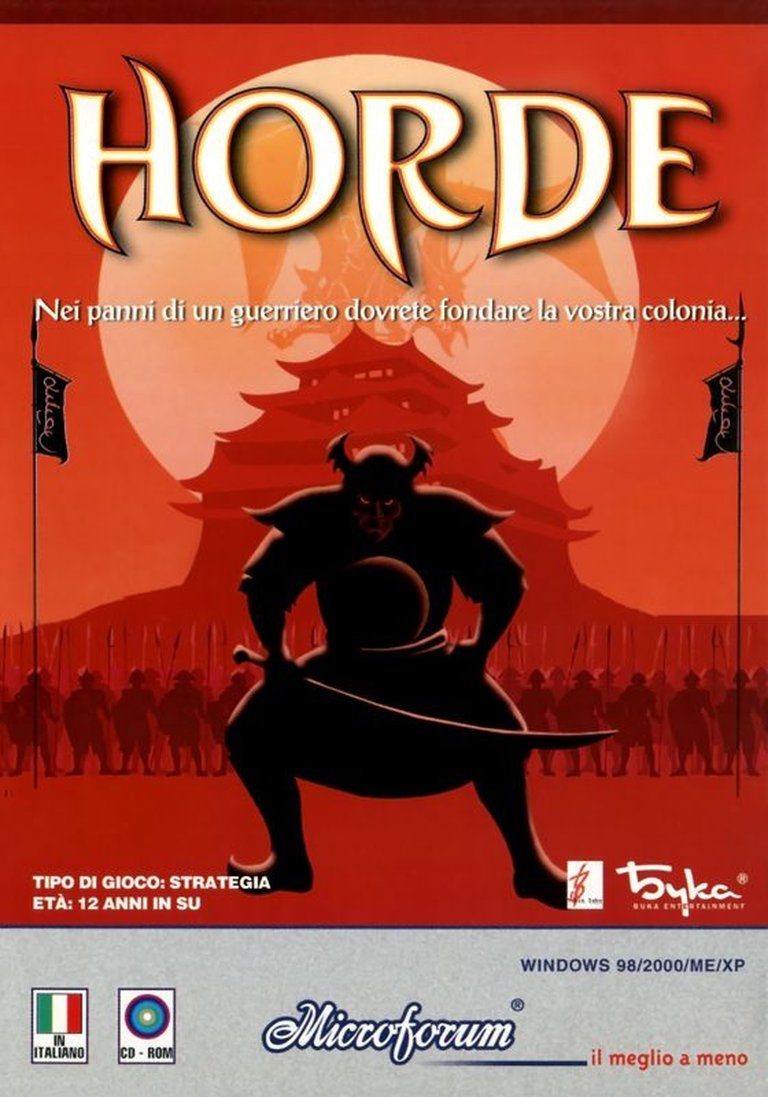
Description
Horde: The Citadel is a fantasy real-time strategy sequel set in Semirechye, continuing the conflict between the Semireks and invading forces led by Khan Teimur. Players must navigate the treacherous Land of Shadows and forge alliances with dragons to besiege Teimur’s fortified citadel. Building on its predecessor’s engine, the game introduces larger maps, dual-attack units, scouting pigeons, new enemies like were-bears and magic riders, and the option to import characters from the first game. Strategic exploration, negotiation, and combat drive the quest across nine challenging maps.
Gameplay Videos
Horde: The Citadel Cheats & Codes
PC Version
| Code | Effect |
|---|---|
| CTRL+SHIFT+ALT+M | Gives You The Ability To See Everything On The Map! |
| CTRL+SHIFT+ALT+R | Sets resources to 100,000 and Population to 500! |
| CTRL+SHIFT+ALT+H | Heals The Troops/Workers That Are Selected (Not Buildings) |
Horde: The Citadel: Review
In the pantheon of real-time strategy games, few titles stand out as uniquely as “Horde: The Citadel.” Released in 2001, this sequel to “Horde: The Northern Wind” expanded on the original’s foundations, offering a rich tapestry of gameplay mechanics, a deep narrative, and a world brimming with lore. This review delves into the intricacies of “Horde: The Citadel,” examining its development history, narrative depth, gameplay mechanics, world-building, and its enduring legacy.
Introduction
“Horde: The Citadel” is a testament to the creativity and ambition of its developers, 7th BitLabs. In an era dominated by Western real-time strategy giants like “StarCraft” and “Warcraft,” this Russian-developed title carved out a niche for itself with its unique blend of fantasy, strategy, and economic management. The game’s legacy lies in its ability to transport players to the mystical land of Semirechye, where they must navigate a complex web of alliances, battles, and economic strategies to secure victory. This review argues that “Horde: The Citadel” is not just a sequel but a masterclass in real-time strategy game design, deserving of a place in the annals of gaming history.
Development History & Context
The Studio
7th BitLabs, the studio behind “Horde: The Citadel,” was a relatively small but ambitious team based in Russia. Led by Vladimir Galimov, the studio was known for its innovative approach to game design, drawing heavily from Russian folklore and mythology. The team’s vision was to create a game that was not only strategically deep but also rich in narrative and atmospheric detail.
The Creators’ Vision
The creators of “Horde: The Citadel” aimed to build on the success of “Horde: The Northern Wind” by expanding the game’s world, adding new units, structures, and terrain types, and enhancing the overall gameplay experience. The vision was to create a game that was both accessible to newcomers and deep enough to satisfy veteran strategy gamers. The game’s higher resolution and larger maps were designed to provide a more immersive experience, while the addition of new units and monsters added strategic depth.
Technological Constraints of the Era
Developed in 2001, “Horde: The Citadel” faced the technological constraints of the time. The game ran on a modified version of the engine used in “Horde: The Northern Wind,” which limited some of its graphical capabilities. However, the developers made the most of the available technology, using higher resolution and larger maps to create a more immersive experience. The game’s sprites were not scaled up, allowing for a larger portion of the battlefield to be visible at any given time.
The Gaming Landscape
The early 2000s were a golden age for real-time strategy games, with titles like “StarCraft,” “Warcraft III,” and “Age of Empires II” dominating the genre. “Horde: The Citadel” entered this competitive landscape with a unique selling proposition: a richly detailed world inspired by Russian folklore, a deep economic management system, and a strategic gameplay loop that rewarded both tactical and diplomatic prowess. The game’s release on December 5, 2001, was met with critical acclaim, praised for its innovation and depth.
Narrative & Thematic Deep Dive
Plot
“Horde: The Citadel” continues the story of the land of Semirechye, where the Semireks are engaged in a conflict with the invading nomads led by their khan, Teimur. In “The Northern Wind,” the Semirek leaders managed to drive Teimur’s forces out of Lower Urgal, but Teimur had allied with hermit wizards and fortified his lands. The only path to Teimur’s main citadel, Vorezh, lies through the Land of Shadows, a treacherous region that no man dares to tread. The Semireks must secure an alliance with the dreaded dragons to pass safely into Teimur’s domain.
Characters
The game features a cast of characters drawn from Russian folklore, each with their own unique abilities and backstories. The player takes on the role of a Semirek hero, leading a group of faithful warriors to build a settlement and defend it against aggressive neighbors. The game’s characters are brought to life through detailed portraits and sprites, adding depth to the narrative.
Dialogue
The dialogue in “Horde: The Citadel” is rich and immersive, drawing heavily from Russian folklore and mythology. The conversations between characters are not just expository but also reveal the game’s themes of loyalty, betrayal, and the struggle for power. The dialogue is written in a way that immerses the player in the game’s world, making the narrative feel more authentic.
Themes
The game explores several themes, including the struggle between good and evil, the importance of alliances, and the consequences of war. The Land of Shadows, a treacherous region that the Semireks must traverse, serves as a metaphor for the challenges and dangers that the characters face. The game’s economic management system also explores themes of resource allocation and the importance of diplomacy in achieving victory.
Gameplay Mechanics & Systems
Core Gameplay Loops
“Horde: The Citadel” features a deep and engaging gameplay loop that combines strategic planning, economic management, and tactical combat. The player must explore each of the nine maps, solve the main quest, find necessary items, defeat or negotiate with opponents, and manage their settlement’s economy. The game’s larger maps and the addition of new units and monsters add strategic depth, requiring players to adapt their strategies to different situations.
Combat
Combat in “Horde: The Citadel” is fast-paced and tactical. The game’s new units, such as dragons, crocodiles, scorpions, were-bears, and magic riders, add variety to the combat experience. The ability to use both melee and ranged attacks, as well as the introduction of air units like pigeons for scouting, adds strategic depth to the combat mechanics. The game’s larger maps and the addition of new terrain types also require players to adapt their tactics to different environments.
Character Progression
Character progression in “Horde: The Citadel” is tied to the player’s ability to manage their settlement’s economy and build alliances. The game features a deep economic management system, where the player’s income is primarily based on taxes collected from the inhabitants of their settlement. This system requires players to balance resource allocation, diplomacy, and military strategy to achieve victory.
User Interface
The game’s user interface is intuitive and easy to navigate. The top-down perspective and free camera allow players to easily manage their units and resources. The point-and-select interface makes it easy to issue commands to multiple units, while the game’s larger maps and higher resolution provide a more immersive experience.
Innovative or Flawed Systems
One of the game’s innovative systems is the ability to import characters from “Horde: The Northern Wind” into “The Citadel.” This feature allows players to carry over their progress and items from the previous game, adding a sense of continuity and progression. However, the game’s technological constraints limited some of its graphical capabilities, and the sprites were not scaled up, which could be seen as a flaw by some players.
World-Building, Art & Sound
Setting
The game’s setting is the mystical land of Semirechye, a world inspired by Russian folklore and mythology. The Land of Shadows, a treacherous region that the Semireks must traverse, serves as a central location in the game’s narrative. The game’s world is richly detailed, with each map featuring unique terrain types, structures, and units.
Atmosphere
The game’s atmosphere is dark and foreboding, reflecting the challenges and dangers that the characters face. The Land of Shadows, in particular, is depicted as a treacherous and dangerous region, adding to the game’s sense of tension and excitement. The game’s higher resolution and larger maps contribute to its immersive atmosphere, allowing players to explore the game’s world in greater detail.
Visual Direction
The game’s visual direction is inspired by Russian folklore and mythology, with detailed portraits and sprites bringing the game’s characters to life. The game’s higher resolution and larger maps provide a more immersive experience, while the addition of new units and monsters adds variety to the gameplay. The game’s art style is unique and distinctive, setting it apart from other real-time strategy games of the era.
Sound Design
The game’s sound design is immersive and atmospheric, with a soundtrack that complements the game’s dark and foreboding setting. The sound effects, from the clash of swords to the roar of dragons, add to the game’s sense of tension and excitement. The game’s voice acting is also noteworthy, with the dialogue written in a way that immerses the player in the game’s world.
Reception & Legacy
Critical and Commercial Reception
“Horde: The Citadel” was met with critical acclaim upon its release, praised for its innovation, depth, and immersive world-building. The game’s unique selling proposition, a richly detailed world inspired by Russian folklore, a deep economic management system, and a strategic gameplay loop that rewarded both tactical and diplomatic prowess, set it apart from other real-time strategy games of the era. The game’s commercial reception was also positive, with players appreciating its depth and replayability.
Evolution of Reputation
Over the years, “Horde: The Citadel” has gained a cult following among strategy gamers, appreciated for its unique blend of fantasy, strategy, and economic management. The game’s enduring legacy lies in its ability to transport players to a richly detailed world, where they must navigate a complex web of alliances, battles, and economic strategies to secure victory.
Influence on Subsequent Games and the Industry
“Horde: The Citadel” has influenced subsequent real-time strategy games, with its unique blend of fantasy, strategy, and economic management. The game’s deep economic management system, where the player’s income is primarily based on taxes collected from the inhabitants of their settlement, has been emulated in other strategy games. The game’s immersive world-building and atmospheric design have also set a standard for future strategy games.
Conclusion
“Horde: The Citadel” is a masterclass in real-time strategy game design, deserving of a place in the annals of gaming history. Its unique blend of fantasy, strategy, and economic management, combined with its richly detailed world and immersive atmosphere, sets it apart from other games of its era. The game’s legacy lies in its ability to transport players to a world where they must navigate a complex web of alliances, battles, and economic strategies to secure victory. For strategy gamers looking for a deep and engaging experience, “Horde: The Citadel” is a must-play title. Its place in video game history is secure, and its influence on the genre is undeniable.