
- Release Year: 2017
- Platforms: PlayStation 4, Windows
- Publisher: PlayStation Mobile Inc., SCE Worldwide Studios, Sony Interactive Entertainment America LLC, Sony Interactive Entertainment Europe Ltd., Sony Interactive Entertainment Inc.
- Developer: Guerrilla B.V.
- Genre: Compilation, Role-playing, RPG
- Perspective: Behind view
- Game Mode: Single-player
- Gameplay: Action RPG, Crafting, Fast travel, Free camera photo mode, Machine hunting, Open World
- Setting: Fantasy, Post-apocalyptic
- Average Score: 85/100
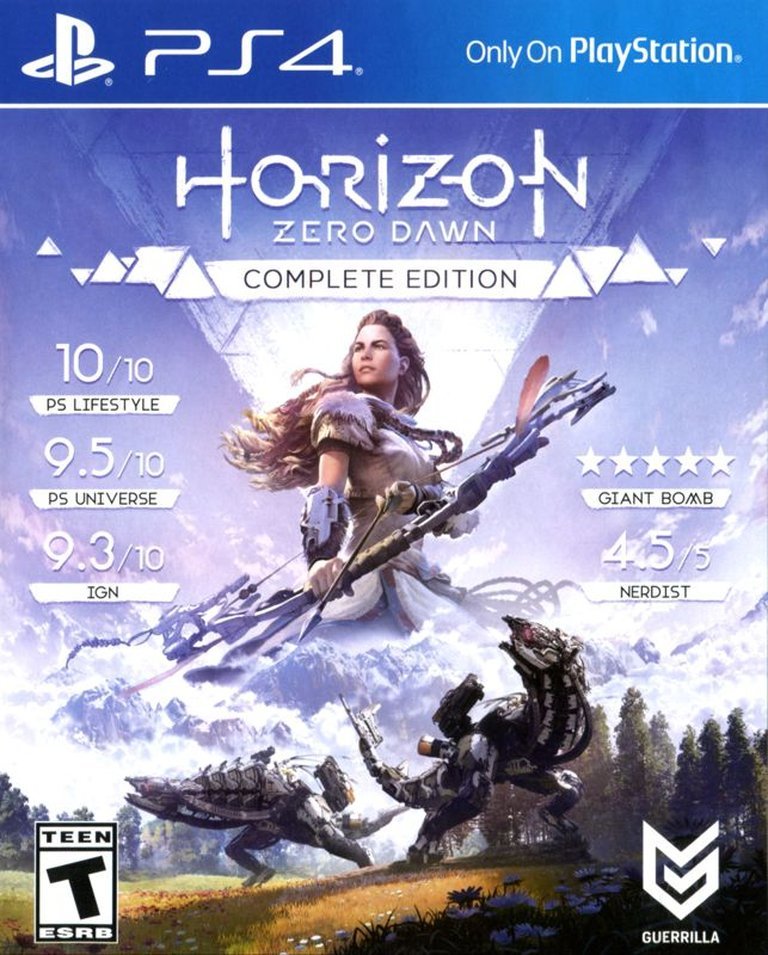
Description
Horizon: Zero Dawn – Complete Edition is an action‑RPG set in a post‑apocalyptic Earth where humanity has reverted to tribal societies and the landscape teems with massive, animal‑like machines. Players follow Aloy, a skilled hunter raised by the Nora tribe, as she uncovers the mystery of the ancient civilization that created the machines and battles hostile factions and robotic beasts.
Gameplay Videos
Horizon: Zero Dawn – Complete Edition Free Download
Horizon: Zero Dawn – Complete Edition Mods
Horizon: Zero Dawn – Complete Edition Guides & Walkthroughs
Horizon: Zero Dawn – Complete Edition Reviews & Reception
metacritic.com (84/100): Horizon Zero Dawn truly expresses how videogames nowadays are an art form, if not only through its visuals and storytelling, then certainly through its expertly incorporated combat.
opencritic.com (83/100): A classy sandbox that stands out from the pack thanks to its brilliant battles against an array of fantastic beasts.
monstercritic.com (84/100): Horizon Zero Dawn: Complete Edition delivers a compelling, emotionally resonant narrative blending post-apocalyptic sci-fi and tribal lore, praised for Aloy’s journey and immersive world-building.
ign.com (93/100): Horizon Zero Dawn presents us with a beautiful world full of unforgettable challenges.
Horizon: Zero Dawn – Complete Edition: Review
Introduction
The moment PlayStation 4’s launch‑year roster welcomed Horizon: Zero Dawn, the gaming world was handed a breathtaking tableau of rusted steel and verdant wilderness, all seen through the eyes of a fierce, red‑haired huntress named Aloy. Ten years on, the Complete Edition—the original game plus the Frozen Wilds expansion, bonus outfits, weapons, and a digital artbook—remains a touchstone for open‑world design, narrative ambition, and the marriage of sci‑fi and tribal mythos. My thesis is simple: Zero Dawn is not merely a beautiful sandbox; it is a landmark that redefined how post‑apocalyptic storytelling can be both intimate and epic, and its Complete Edition preserves that legacy while offering a cohesive, content‑rich experience for both newcomers and veterans alike.
Development History & Context
Studio & Vision
Guerrilla Games, formerly known for the gritty Killzone franchise, pivoted dramatically in 2011. After Killzone 3 wrapped, director Mathijs de Jonge and art director Jan‑Bart van Beek pitched a concept that would become Horizon: a “lush, documentary‑style nature setting, robotic dinosaurs, and a red‑headed lead character.” This was deemed the riskiest idea on the table, but it promised a departure from the studio’s established dystopian aesthetic toward a world that felt post‑post‑apocalyptic—vibrant, hopeful, and brimming with ecological wonder.
Technological Constraints
The project ran on a heavily modified Decima engine, originally built for Killzone: Shadow Fall. Guerrilla had to overhaul streaming pipelines, level editing tools, and asset placement systems to accommodate a seamless open world with a draw distance and lighting fidelity previously reserved for linear shooters. Techniques such as voxel‑based mid‑distance rock geometry and “World Data Maps” for environmental shaders were devised to keep memory usage in check while preserving visual fidelity.
Gaming Landscape (2017)
When Zero Dawn arrived in February 2017, the open‑world market was dominated by titles like The Witcher 3 and Skyrim. Sony’s PlayStation 4 was entering its prime, with the PS4 Pro offering 4K/30 fps support. Guerrilla’s ambition to blend action‑RPG depth with cinematic storytelling positioned the game as a hybrid that could attract both narrative‑driven players and those seeking emergent combat experiences.
Release & Editions
- PS4 launch: 28 Feb 2017 (NA), 1 Mar 2017 (PAL)
- Complete Edition (PS4): 5 Dec 2017 (bundles base game, The Frozen Wilds, outfits, weapons, digital artbook)
- PC port: 7 Aug 2020 (Virtuos, later refined by Nixxes)
- Remaster (PS5/PC): 31 Oct 2024 (Nixxes co‑development)
The Complete Edition’s first‑day price ranged from $14.28 (used) to $25.98 (new) on eBay, while the PC version launched at $49.99 on GOG, underscoring its status as a premium, content‑rich package.
Narrative & Thematic Deep Dive
Core Plot Overview
Set in the 31st century United States, humanity lives in scattered tribal societies—Nora, Carja, Banuk, Oseram—while massive, animal‑like machines dominate the landscape. Aloy, an outcast raised by the former Nora outcast Rost, discovers a Focus (augmented‑reality device) and embarks on a quest to uncover her origins. Her journey reveals the ancient project Zero Dawn, a terraforming AI overseen by GAIA and its subsystems, created by the brilliant scientist Elizabet Sobeck to revive Earth after the catastrophic Faro Plague.
The narrative escalates as Aloy confronts the Eclipse cult, learns of the rogue AI HADES, and ultimately uses a master override to stop HADES from reactivating the destructive Faro machines. The Frozen Wilds DLC expands the story into the Banuk‑controlled Cut, introducing the Spirit AI and the daemon‑like HEPHAESTUS.
Themes & Subtext
| Theme | Manifestation | Critical Insight |
|---|---|---|
| Nature vs. Technology | Machines are integrated into ecosystems; the world is both mechanical and organic. | Critics praised the “living machine” design, noting how the AI’s hierarchical task network makes each creature behave like an animal, reinforcing ecological allegory. |
| Identity & Heritage | Aloy’s status as a clone of Sobeck raises questions about self‑determination versus programmed purpose. | The narrative’s personal stakes (Aloy’s outcast status) juxtapose with the grand scale of humanity’s rebirth, delivering a “personal epic” praised by The Verge and Polygon. |
| Tribal Culture & Post‑Colonialism | Distinct visual identities for Nora, Carja, Banuk, Oseram; each tribe’s relationship to machines reflects differing philosophies. | Some reviewers (e.g., The A.V. Club) critiqued the portrayal as “primitive,” yet the design team consulted anthropologists to avoid monolithic representations. |
| Environmental Responsibility | Project Zero Dawn is a planetary restoration initiative, echoing real‑world climate concerns. | The game’s “post‑post‑apocalyptic” optimism offers a hopeful counterpoint to typical bleak futures, aligning with the studio’s intent to evoke adventure and hope. |
Character & Dialogue
Aloy (voiced by Ashly Burch) evolves from a curious child to a determined leader. Burch’s performance—described as “emotionally well‑rounded” by Ars Technica—shapes the narrative’s emotional core. Sylens (Lance Reddick) serves as a morally ambiguous mentor, while Helis (Crispin Freeman) embodies the Eclipse’s fanaticism. Dialogue wheels allow subtle personality shaping, though some critics noted the limited agency in branching outcomes.
Gameplay Mechanics & Systems
Core Loop
- Exploration – Parkour, zip‑lines, and mounts (overridden Tallnecks, etc.) enable fluid traversal across varied biomes.
- Combat – Ranged bows, spears, traps (Tripcaster, Ropecaster), and elemental ammunition. Machines have distinct weak points, encouraging tactical dismemberment.
- Harvest & Craft – Dismantling machines yields parts for ammo, traps, and upgrades. The skill tree splits into Prowler (stealth), Brave (combat), and Forager (gathering).
Systems Analysis
| System | Strengths | Weaknesses |
|---|---|---|
| Combat | Dynamic AI phases (prepare → engage → escape); emergent moments praised by The Guardian and Polygon. | Human enemy encounters feel under‑developed; some reviewers cite “demanding” difficulty spikes. |
| Skill Tree | Simple, accessible progression; three distinct branches keep focus. | Critics argue it offers “lip service” to RPG depth; lack of deep character stats. |
| Fast Travel | Campfire‑based, integrates with world‑building. | Occasionally feels “overloaded” with side activities (GameStar). |
| UI/UX | Minimalist HUD; Focus overlay provides clear machine data. | PC port initially suffered from occasional clipping and limited graphic options (MobyGames). |
| DLC Integration | Frozen Wilds adds new machines, a “Traveler” skill branch, and a compelling side narrative. | Some felt the DLC’s “daemonic” machines and control towers introduced balance issues. |
Technical Performance
- PS4 Pro: 4K/30 fps, with minor flickering on newer GPUs (MobyGames).
- PC (2020): Unlocked frame rates, ultrawide support, but early builds exhibited clipping and occasional crashes (Game Hoard).
- Remaster (2024): Improved lighting, character models, DualSense haptics, and 30‑60 fps options (TechRadar).
Overall, the Complete Edition’s performance is solid on modern hardware, though the original PC port required patches to iron out stability issues.
World‑Building, Art & Sound
Visual Direction
Guerrilla’s artists, led by Jan‑Bart van Beek, crafted a world where machine design draws from real fauna (e.g., Tallnecks → giraffes, Stalkers → maned wolves). The Decima engine’s irradiance volumes and procedural foliage placement create lush, dynamic lighting that shifts with the day‑night cycle. The world feels “hand‑crafted” despite procedural underpinnings, a balance praised by The Verge for its “remarkable sense of discovery.”
Audio Design
Composers Joris de Man, The Flight, Niels van der Leest, and Jonathan Williams produced a score that blends tribal instrumentation with metallic textures. Sound designers recorded 200‑300 unique machine noises, giving each species a distinct auditory fingerprint. The soundtrack’s “organic feel,” achieved through naïve instrument playing (e.g., resonator guitars, contrabass flute), earned multiple awards (Ivor Novello, Game Audio Network Guild).
Integration
- Focus HUD: Provides holographic overlays of machine anatomy, loot tables, and mission markers.
- Dynamic Weather: Alters ambient sounds (rain, wind) and visual cues (fireflies near bushes).
- Music Stems: Allow the engine to remix themes in real time, preventing repetition during long explorations.
These elements coalesce into an immersive experience where the player feels both a hunter and a participant in a living ecosystem.
Reception & Legacy
Critical Scores
| Platform | Metacritic | OpenCritic | MobyScore |
|---|---|---|---|
| PS4 | 89/100 | 94% (recommended) | 7.3 |
| PC (original) | 84/100 | 94% (recommended) | 7.9 |
| PC (Remaster) | 86/100 | 89% (recommended) | — |
| PS5 (Remaster) | 85/100 | — | — |
Notable critic excerpts:
- Jeuxvideo.com (90%): “Visually stunning on PC; minor glitches but overall excellent.”
- Video Chums (90%): “Exciting enough to look forward to Forbidden West.”
- GameStar (86%): “World design shines, despite occasional overload of activities.”
- Game Hoard (71%): “Story and world‑building are a feast; some side content feels shallow.”
Commercial Performance
- Launch week: Best‑selling title in the UK and Australia; 2.6 M units sold within two weeks.
- Two‑year anniversary: Over 10 M copies sold, making it Guerrilla’s biggest debut.
- PC launch: 700 k digital units in the first month; 3.3 M units on Steam by Dec 2023.
- Total by April 2023: ~24.3 M units worldwide.
Influence
- Open‑World Design: Inspired subsequent titles to treat AI‑driven creatures as ecological entities rather than static enemies.
- Narrative Integration: Demonstrated that a strong, personal protagonist can anchor a sprawling world, influencing games like Elden Ring (character‑driven lore) and Starfield (post‑apocalyptic optimism).
- Technical Benchmark: Decima’s streaming solutions informed later Sony exclusives (e.g., God of War Ragnarök).
Criticisms & Controversies
- RPG Depth: Some felt the skill system lacked depth, labeling it “lip service.”
- Cultural Representation: Critics highlighted potential appropriation of Indigenous motifs and the casting of a white female lead. Guerrilla responded by emphasizing a multi‑cultural research approach.
- Porting Issues: Early PC versions suffered from clipping and limited graphics options, prompting patches from Virtuos and later Nixxes.
Conclusion
Horizon: Zero Dawn – Complete Edition stands as a definitive benchmark for narrative‑driven open‑world action RPGs. Its visual splendor, innovative machine ecology, and compelling protagonist combine to deliver an experience that feels both timeless and urgent. While its RPG mechanics may not satisfy hardcore genre purists, the game’s storytelling, world‑building, and audio‑visual artistry more than compensate, earning it a place among the most influential titles of the last decade.
Verdict: Horizon: Zero Dawn is a landmark achievement that reshaped expectations for post‑apocalyptic storytelling and open‑world design. The Complete Edition, by consolidating the base game, Frozen Wilds DLC, and extra content, offers the most accessible and comprehensive way to experience this seminal work. In the annals of video‑game history, it belongs firmly in the “must‑play” canon, alongside titles such as The Witcher 3 and Breath of the Wild—a testament to Guerrilla Games’ daring vision and Sony’s commitment to expansive, artistically ambitious experiences.