
- Release Year: 2012
- Platforms: Android, iPad, iPhone, Macintosh, Windows Apps, Windows
- Publisher: Alawar Entertainment, Inc., Big Fish Games, Inc, GameFools, Inc., iWin, Inc., S.A.D. Software Vertriebs- und Produktions GmbH, Viva Media, LLC
- Developer: Alawar Five-BN
- Genre: Puzzle
- Perspective: 1st-person
- Game Mode: Single-player
- Gameplay: Hidden object
- Average Score: 78/100
Description
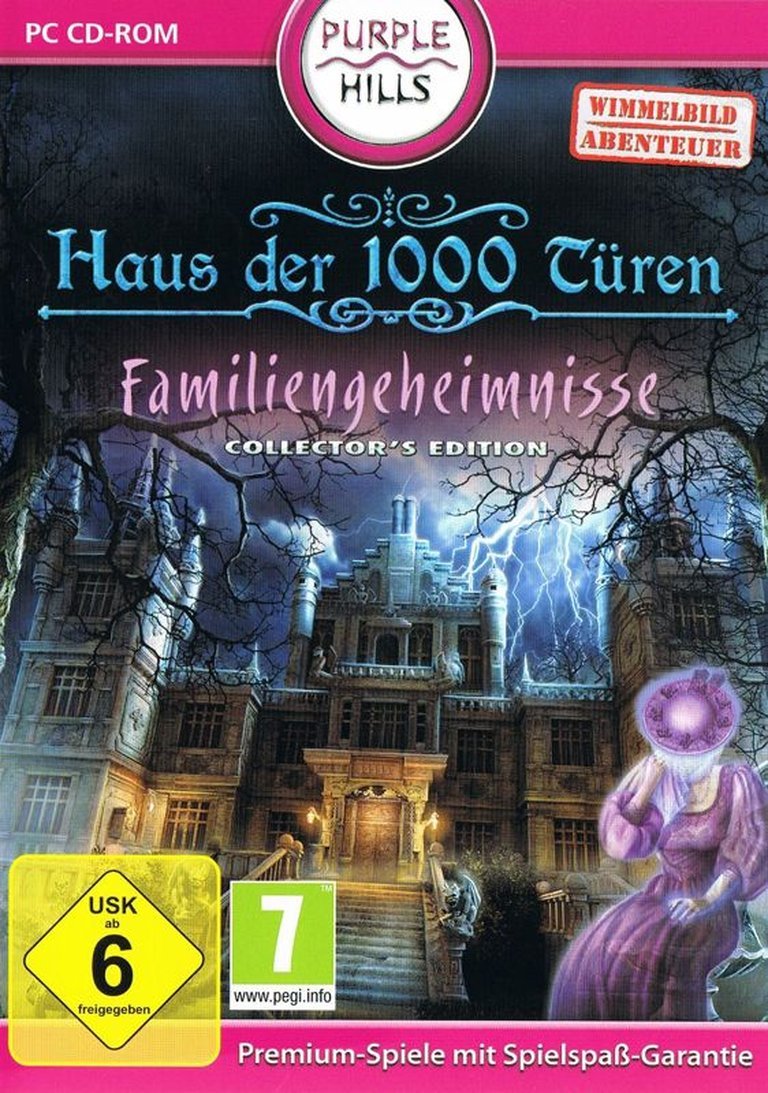
House of 1000 Doors: Family Secrets (Collector’s Edition) is a hidden object adventure game where players step into the shoes of Kate Reed, a writer with a mysterious past, as she explores a haunted mansion that serves as a gateway between worlds. The game features 90 eerie locations, challenging mini-games, and four ghostly cases to solve, blending puzzle-solving with a dark, atmospheric narrative. The Collector’s Edition includes bonus gameplay, an integrated strategy guide, and exclusive wallpapers, enhancing the immersive experience.
House of 1000 Doors: Family Secrets (Collector’s Edition) Guides & Walkthroughs
House of 1000 Doors: Family Secrets (Collector’s Edition) Reviews & Reception
store.steampowered.com (96/100): Very Positive
gametop.com (80/100): House of 1000 Doors: Family Secrets is a captivating hidden object adventure that successfully blends mystery, supernatural themes, and intricate puzzles.
bigantgames.com (60/100): Guide Kate Reed as she solves four mind-bending mysteries that take her to worlds she’s never imagined in House of 1000 Doors: Family Secrets!
House of 1000 Doors: Family Secrets (Collector’s Edition) – A Hauntingly Flawed Masterpiece
Introduction: A Portal to the Supernatural
House of 1000 Doors: Family Secrets (Collector’s Edition) is a hidden object puzzle adventure (HOPA) that invites players into a gothic, otherworldly mansion where the living aid the dead. Released in 2012 by Alawar Entertainment and developed by Five-BN Games, it stands as the inaugural entry in a series that blends mystery, horror, and intricate storytelling. While the game has garnered a mixed reputation—praised for its atmosphere yet criticized for its execution—it remains a fascinating case study in how ambition and inconsistency can coexist in game design.
This review will dissect Family Secrets across its narrative depth, gameplay mechanics, artistic direction, and legacy, ultimately determining whether it is a forgotten gem or a squandered opportunity.
Development History & Context: The Rise of Hidden Object Adventures
The Studio Behind the Doors
Alawar Entertainment, a Russian developer and publisher, has been a prolific force in the casual gaming market since the early 2000s. Known for titles like The Treasures of Montezuma and Mystery Trackers, Alawar carved a niche in puzzle and hidden object games. House of 1000 Doors was developed by Five-BN Games, a subsidiary specializing in narrative-driven adventures.
The game’s creation coincided with the golden age of hidden object games (2008–2014), a period where titles like Mystery Case Files and Dark Parables dominated digital storefronts. The genre’s appeal lay in its accessibility—combining simple mechanics with rich storytelling, making it ideal for casual gamers.
Technological Constraints & Design Philosophy
Released in 2012, Family Secrets was built for Windows XP/Vista with modest system requirements (1.6 GHz CPU, 512 MB RAM). The game’s engine prioritized 2D pre-rendered backgrounds with 3D character models, a common approach in HOPA games of the era. While this allowed for detailed environments, it also led to clunky animations and occasional visual inconsistencies.
The Collector’s Edition (CE) was a strategic move—offering bonus content (extra gameplay, wallpapers, a strategy guide) to justify a premium price. This model, pioneered by Big Fish Games, became an industry standard for HOPA titles.
The Gaming Landscape in 2012
At the time of release, the casual gaming market was flooded with hidden object titles, many following a formulaic structure:
– A mysterious setting (haunted mansions, cursed towns).
– A protagonist with a personal connection to the supernatural.
– A mix of hidden object scenes (HOS), mini-games, and light adventure elements.
Family Secrets attempted to elevate the formula by introducing:
– A portal-based narrative (the House as a nexus between worlds).
– Multiple interconnected mysteries (four major cases).
– A journal system for storytelling immersion.
However, as we’ll explore, its execution was uneven, leaving it in the shadow of more polished contemporaries like Dark Parables or Grim Tales.
Narrative & Thematic Deep Dive: A Story of Ghosts, Regret, and Missed Potential
Plot Summary: Kate Reed’s Descent into the Unknown
The game follows Kate Reed, a once-successful ghost story writer now suffering from writer’s block and personal demons. After receiving an invitation to a séance, she is drawn to the House of 1000 Doors, a mystical mansion that appears across time and space, serving as a limbo for lost souls.
Inside, Kate meets the Lancaster family, the house’s enigmatic caretakers, and discovers that the mansion is a portal to different eras and dimensions. Her mission? To help four tormented spirits find peace by solving their unresolved mysteries.
The Four Cases: A Study in Supernatural Storytelling
Each case represents a self-contained ghost story, tied together by the House’s overarching lore:
- The Cursed Painter – A 19th-century artist trapped by his own obsession.
- The Doomed Lover – A woman waiting eternally for a man who never returned.
- The Betrayed Scientist – A researcher whose experiments led to tragedy.
- The Lost Child – A girl separated from her family in a wartime bombing.
These stories explore themes of grief, obsession, and redemption, but their execution is inconsistent.
Strengths & Weaknesses of the Narrative
✅ Strong Premise – The idea of a house as a gateway to the afterlife is compelling, blending gothic horror with psychological drama.
✅ Atmospheric Delivery – The journal entries (where Kate reflects on her experiences) add depth to her character, making her more than a silent protagonist.
✅ Varied Ghost Stories – Each case has a distinct tone, from tragic romance to eerie mystery.
❌ Underdeveloped Characters – Outside of Kate, most characters (including the Lancasters) feel underutilized. The ghosts are archetypal rather than deeply fleshed out.
❌ Pacing Issues – The story starts strong but loses momentum in the second half, with some cases feeling rushed or illogical.
❌ Cutscene Quality – The CGI cutscenes (a selling point in the CE) are stiff and uncanny, undermining emotional moments.
Themes: Death, Memory, and the Weight of the Past
The game’s central theme is the inability to let go. Each ghost is trapped by regret, and Kate’s own writer’s block mirrors their suffering—she, too, is haunted by her past.
The House of 1000 Doors functions as a metaphor for the subconscious, a place where unresolved emotions manifest physically. This psychological layer elevates the game beyond a simple hidden object hunt, but clunky writing and abrupt endings prevent it from reaching its full potential.
Gameplay Mechanics & Systems: A Mix of Innovation and Frustration
Core Gameplay Loop: Hidden Objects, Puzzles, and Exploration
Family Secrets follows the standard HOPA structure:
1. Hidden Object Scenes (HOS) – Players search cluttered environments for items.
2. Mini-Games & Puzzles – Logic-based challenges (e.g., jigsaw puzzles, lock mechanisms).
3. Adventure Segments – Point-and-click exploration, item combination, and dialogue.
What Works: Clever Design Choices
✔ Non-Linear Exploration – Unlike many HOPAs, Family Secrets allows some freedom in tackling cases, though progression is still gated by key items.
✔ Inventory-Based Puzzles – Many challenges require using collected items in creative ways (e.g., melting ice with a lighter, repairing a broken clock).
✔ Varied Mini-Games – The puzzles are mostly original, avoiding the repetitive sliders and match-3 games found in lesser titles.
What Fails: Glaring Design Flaws
✖ Illogical Item Placement – Some objects are hidden in absurd ways (e.g., a shoe that looks identical to others but is the “correct” one).
✖ Reused Hidden Object Scenes – Players revisit the same locations multiple times, with previously collected items reappearing, breaking immersion.
✖ Unintuitive Puzzle Logic – Certain solutions defy common sense, requiring trial-and-error rather than deduction.
✖ Lack of “Proof-Playing” – The game wasn’t thoroughly tested, leading to frustrating moments where players get stuck due to unclear objectives.
UI & Quality of Life Features
- Integrated Strategy Guide (CE Exclusive) – A lifesaver for stuck players, though its presence highlights poorly communicated objectives.
- Hint System – Works well but recharges slowly, which can be punishing in confusing sections.
- Journal System – A great idea that loses steam as the game progresses, with repetitive entries.
Difficulty & Accessibility
The game is moderately challenging, but not in a rewarding way. Many roadblocks stem from poor design rather than clever puzzle construction. Casual players may enjoy the relaxed pace, while veterans will find some mini-games overly tedious.
World-Building, Art & Sound: A Gothic Dream with Technical Nightmares
Setting & Atmosphere: The House as a Character
The House of 1000 Doors is the game’s greatest achievement. It’s a living, breathing entity—a labyrinth of time and memory where each room could lead to a different era or dimension.
- Visual Design – The pre-rendered backgrounds are richly detailed, with gothic architecture, eerie lighting, and surreal touches (e.g., floating books, ghostly apparitions).
- Thematic Cohesion – Each ghost’s story has a distinct visual style, from Victorian opulence to wartime devastation.
Artistic Strengths & Weaknesses
✅ Environmental Storytelling – The decaying grandeur of the House reinforces its supernatural nature.
✅ Creepy Ambiance – The flickering lights, shifting shadows, and sudden ghostly appearances create genuine tension.
❌ Inconsistent Character Models – The 3D characters (especially in cutscenes) clash with the 2D backgrounds, looking uncanny and out of place.
❌ Repetitive Locations – Some areas are reused too often, making the world feel smaller than it should.
Sound Design & Music: Haunting, But Forgettable
- Ambient Sounds – The creaking floors, distant whispers, and howling wind enhance immersion.
- Music – The orchestral score is moody and atmospheric, but lacks memorable themes. It fades into the background rather than elevating key moments.
- Voice Acting – Decent but not outstanding. Kate’s voice work is serviceable, but some ghostly dialogue feels overly dramatic.
The Collector’s Edition Extras
The CE includes:
– Bonus Gameplay – An additional chapter that expands the lore (though it’s shorter than expected).
– Concept Art & Wallpapers – Beautiful but not essential.
– Integrated Strategy Guide – Useful but reveals how confusing some puzzles are.
Reception & Legacy: A Cult Following with Mixed Reviews
Critical & Commercial Reception
- Player Score (MobyGames): 3.4/5 (based on 3 ratings) – Lack of reviews suggests it was overshadowed.
- Steam Reception: Very Positive (96% from 128 reviews) – Players praise its atmosphere and uniqueness but criticize clunky mechanics.
- Gametop Score: 8.0/10 – Called “a must-play for HOPA fans” despite some puzzle frustrations.
- SomeAwesome Review: 6/10 – “A game that could’ve been great with more polish.”
Why Did It Fade into Obscurity?
- Oversaturated Market – 2012 was peak HOPA, and Family Secrets didn’t stand out enough.
- Technical Limitations – The stiff animations and reused assets made it feel dated quickly.
- Narrative Collapse – The strong start couldn’t sustain its ambitious themes, leading to disappointed players.
Influence & Legacy
Despite its flaws, Family Secrets laid the groundwork for its sequels:
– House of 1000 Doors: The Palm of Zoroaster (2012) – Improved puzzles but similar narrative issues.
– House of 1000 Doors: Serpent Flame (2013) – Better pacing but less atmospheric.
– House of 1000 Doors: Evil Inside (2015) – Darker tone, but still plagued by design quirks.
The series never reached mainstream success, but it cultivated a niche fanbase who appreciated its unique setting and supernatural themes.
Conclusion: A Flawed Gem Worth Exploring
House of 1000 Doors: Family Secrets (Collector’s Edition) is a game of contradictions:
– Brilliant premise, uneven execution.
– Gorgeous world, clunky mechanics.
– Engaging start, disappointing finish.
Final Verdict: 7/10 – “A Hauntingly Imperfect Masterpiece”
✅ Play It If…
– You love gothic horror and supernatural mysteries.
– You enjoy hidden object games with deep lore.
– You can tolerate some janky design for the sake of atmosphere.
❌ Avoid It If…
– You hate illogical puzzles or repetitive gameplay.
– You expect AAA-level polish in storytelling.
– You prefer fast-paced adventures over methodical exploration.
Where Does It Stand in Gaming History?
Family Secrets is not a classic, but it’s not forgettable either. It’s a cult favorite—a game that could have been great but settled for being merely good. For HOPA enthusiasts, it’s a must-play, if only to witness its ambitious flaws.
Final Thought:
If Alawar had refined the puzzles, tightened the narrative, and improved the cutscenes, House of 1000 Doors could have been a landmark in casual gaming. Instead, it remains a fascinating “what if?”—a house of missed opportunities, much like the ghosts it seeks to free.
Would I recommend it? Yes, but with caveats.
Would I call it a masterpiece? No, but it’s haunting in more ways than one.
Now, if you’ll excuse me, I have a séance to attend. 👻