
- Release Year: 2016
- Platforms: Windows
- Publisher: Stress Level Zero
- Developer: Stress Level Zero
- Genre: Action
- Perspective: 1st-person
- Game Mode: Online PVP, Single-player
- Gameplay: RPG elements, Shooter
- Setting: Futuristic, Sci-fi
- Average Score: 80/100
- VR Support: Yes
Description
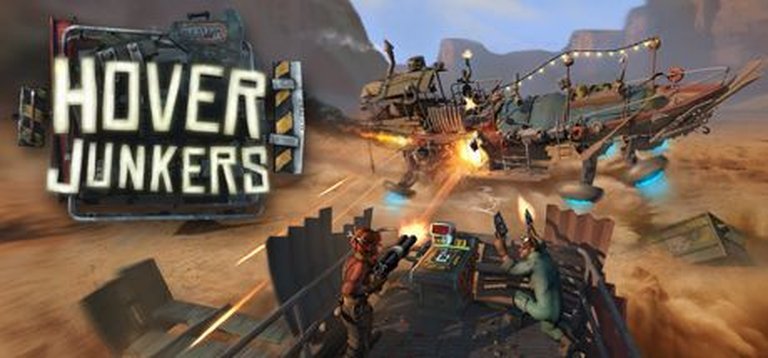
Hover Junkers is a multiplayer virtual reality first-person shooter set in a post-apocalyptic wasteland where Earth has lost much of its water, forcing survivors to scavenge junk in the desert to build and customize controllable hovercraft called Hover Junkers, engaging in intense ship-to-ship combat while fortifying their vessels and defending against rival players.
Gameplay Videos
Where to Buy Hover Junkers
PC
Hover Junkers Reviews & Reception
metacritic.com (80/100): Generally Favorable
pcgamer.com : Even after the free-for-all matches start to feel redundant, the punchy, full-body action in Hover Junkers remains hilarious fun.
metro.co.uk : One of the best VR games so far, with a very clever gimmick for getting first person shooters to work with current technology.
trustedreviews.com : One of the best experiences you can get on the HTC Vive right now, despite its rough edges.
Hover Junkers: Review
Introduction
In the nascent dawn of consumer virtual reality, few titles captured the raw, exhilarating promise of room-scale VR like Hover Junkers. Released in 2016 by the fledgling studio Stress Level Zero, this multiplayer shooter thrust players into a post-apocalyptic wasteland aboard customizable hovercraft, demanding physical dodges, precise reloads, and desperate scrambles for cover—all within the confines of their living room. As a game journalist and historian, I’ve pored over devlogs, crowdfunding pitches, Steam forums, and critical retrospectives, and my thesis is clear: Hover Junkers stands as a bold pioneer of VR-exclusive design, revolutionizing first-person shooters through embodied motion controls, but its multiplayer-only focus and unfulfilled promises ultimately confined it to a cult footnote in VR’s explosive early history.
Development History & Context
Stress Level Zero, founded by programmer Alex Knoll and artist Nate Ebbing, burst onto the scene with Hover Junkers as their debut title, built in Unity for HTC Vive’s SteamVR platform. Development kicked off on March 16, 2015, amid the hype of VR’s consumer launch. The studio’s YouTube devlogs—starting with “Staying Organized” and progressing through early 3D modeling, VR menus, robot bartenders, and ship-building mechanics—offer a transparent window into their iterative process. By December 2015, a beta coincided with Vive pre-orders, culminating in full release on April 5, 2016, at $34.99 (later discounted to $3.99-$19.99 on Steam).
The era’s technological constraints shaped its genius: Vive’s room-scale tracking (up to 5×5 meters) inspired ships scaled to play areas—from tiny seated setups to massive decks—preventing teleportation nausea while bounding action to physical space. An Indiegogo campaign in January 2016 raised funds via tiers like “Basic Junker” ($35) to “Hover Junker Hero” ($8,000), promising Oculus Touch support (Q3/Q4 2016) and a single-player mode akin to The Oregon Trail. The gaming landscape was VR-scarce; competitors like Eve: Valkyrie focused on seated cockpits, while flatscreen shooters dominated. Hover Junkers targeted Vive’s motion-tracked controllers exclusively (“VR with tracked controllers ONLY”), betting on physicality over accessibility. Stress Level Zero’s vision—salvaging junk for defenses in cross-ship dogfights—pushed VR beyond gimmicks, influencing room-scale design amid hardware limits like low resolution (GTX 970 minimum) and motion sickness risks.
Narrative & Thematic Deep Dive
Hover Junkers eschews deep storytelling for emergent multiplayer chaos, but its lore paints a stark post-apocalyptic canvas. Earth, desiccated by an unnamed “evil company,” has driven most survivors off-world, leaving “dustworms” to roam a drought-stricken wasteland. Players embody junk hunters piloting scrap-built Hover Junkers, scavenging debris amid Mad Max-esque hover-skiffs and derelict ruins. Fandom wikis and dev materials flesh this out: maps like Dead Docks, Junk City, Warpgate Ruins, and Cargo Crater evoke forgotten outposts, while avatars—a gritty guy, a tough girl, or a robot—represent customizable archetypes without voiced dialogue beyond radio chatter.
Thematically, it’s a meditation on scarcity and improvisation. Junk isn’t mere loot; it’s survival currency—bolted barricades symbolizing fragile human ingenuity against desolation. Multiplayer raids underscore Darwinian theft: claim scrap, fortify, or perish. No overarching plot binds sessions, but the hub’s Gunther’s Bar (with a Justin Roiland-voiced robot bartender) hints at in-universe lore, later retconned in Stress Level Zero’s Boneworks as a fictional IP within their shared universe (an 8-bit game by “in-universe Stress Level Zero” for “Gammon America”). Dialogue is sparse—push-to-talk VOIP fosters taunts and tactics—emphasizing themes of isolation and brutal pragmatism. Promised single-player (announced August 2017, “six to eight weeks” away) would have added Oregon Trail-style traversal, but its absence leaves narrative as atmospheric backdrop, critiqued in reviews for lacking progression or emotional stakes.
Gameplay Mechanics & Systems
At its core, Hover Junkers is a taut loop of piloting, scavenging, fortifying, and fragging, deconstructed for VR embodiment. Select from 17 ships matching your playspace; pilot via left-controller trigger (point-and-thrust like a Segway), reserving right for shooting or dual-wielding. Combat demands physicality: walk your deck for navigation, duck behind bolted junk for cover, or leap edges at peril (wind alarms warn of falls). Guns shine—revolver (hip-fire sprays, sights precise; trackpad flips cylinder, thumb circles bullets, wrist snaps shut) and break-action shotgun (eject/reload shells via trackpad)—with unlimited ammo but manual tracking, turning reloads into rhythmic duels. Squeeze for fists/radio/flares; trigger+squeeze reloads/channels.
Modes: free-for-all/team deathmatch (up to 8 players), with scrap loot repairing/upgrading ships (walls, turrets). UI is diegetic—floating hands in lobbies, no HUD clutter—innovative yet flawed (low-res hinders distant aims). Progression? Nil beyond cosmetics/achievements (9 Steam ones). Shooting range hones skills; maps (10+) vary verticality (e.g., Elevator’s lifts). Flaws abound: rigid ship movement (no rotation), sparse modes (no CTF despite pleas), bugs (hanging, floor glitches). Multiplayer queues wane post-launch; promised SMG/flare gun/single-player evaporated, dooming replayability. Yet, the loop captivates: a headshot after slick reload feels godlike, physical exertion (crawling, lunging) blurring game/reality.
World-Building, Art & Sound
The wasteland pulses with tactile desolation: sun-baked dunes, rusted hulks, and fog-shrouded canyons craft a Firefly-meets-Mad Max frontier. Maps like Ground-Cloud Canyon or Coliseum exploit room-scale—climb ladders, vault crates—while hubs evoke dusty cantinas. Art is low-poly pragmatic (Unity’s limits), cel-shaded for pop amid grit; ship customization yields asymmetrical fortresses, junk physics satisfyingly throwable. Visuals prioritize clarity over fidelity—grays blend foes at range, but VR immersion compensates, ships feeling perilously small.
Sound design elevates: revolver’s thwap-thwap-clunk reloads, shotgun blasts, and wind howls demand headphones. Catchy soundtrack underscores tension; VOIP crackles camaraderie or trash-talk. Roiland’s quirky robot quips add levity, flares whooshing like signals in void. Elements synergize: creaking decks telegraph falls, dominant wind cues boundaries, forging paranoia aboard your fragile ark. Atmosphere nails VR intimacy—bullets whistle, impacts thud—making every peek pulse-pounding.
Reception & Legacy
Launch buzz peaked: Metacritic 80/100 (critics hailed “killer app” gunplay—PC Gamer 82/100: “hilarious fun”; Pelit 90/100: “new heights of immersion”), Steam “Very Positive” initially (later “Mixed” at 61% from 690 reviews). Praises targeted VR innovation—Metro 70/100: “clever gimmick”; Trusted Reviews: “barrel of laughs.” Gripes: thin content, dead lobbies (Gameplay Benelux: “avoid in current form”), no single-player (promised 2017, silent since). Sales ~56k units; MobyGames notes 5 collectors.
Legacy endures as VR harbinger. Stress Level Zero parlayed success into Boneworks/Bonelab, physics-pioneers owing debts to Hover Junkers‘ embodiment. Influenced room-scale FPS (Superhot VR, Pistol Whip), proving ships-as-boundaries viable. Forums lament abandonment (devs shifted post-2017), but it endures in VR historiography: first “proper FPS” exploiting Vive (Polygon/GameSpot videos), crowdfunding model for indies. Cult status persists—devlogs inspire modders; in-universe nods preserve it.
Conclusion
Hover Junkers is VR’s wild frontier spirit incarnate: exhilarating, innovative, fleeting. Stress Level Zero’s debut nailed physical gunplay and scavenging loops, birthing a genre-defining multiplayer shooter amid 2016’s hardware infancy. Yet, unkept promises—no single-player, sparse updates, dwindling players—curtailed its orbit. As historian, I verdict it a seminal artifact: 8.5/10 for pioneers, essential for Vive owners then, nostalgic gem now. Amid VR’s maturation, it reminds us embodiment trumps spectacle—flawed, forgotten, forever foundational. Play if queues revive; study regardless for gaming’s boldest experiments.