
- Release Year: 1995
- Platforms: Windows
- Publisher: Grokksoft
- Developer: Grokksoft
- Genre: Action
- Perspective: 1st-person
- Game Mode: Online PVP
- Gameplay: Combat, Racing
- Setting: Futuristic, Sci-fi
Description
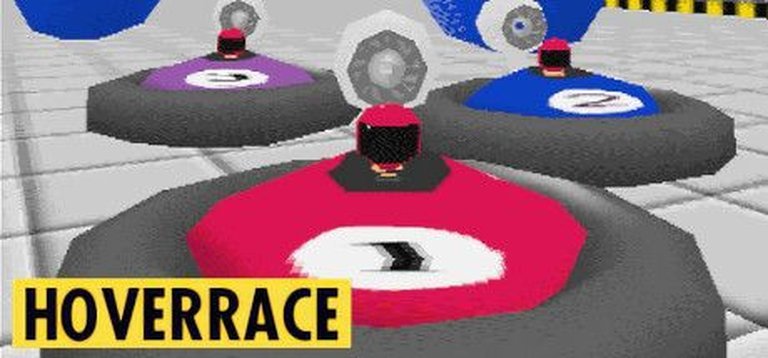
HoverRace is a fast-paced, 3D online racing game set in a sci-fi/futuristic world where players pilot hovercraft on customizable tracks, engaging in standard races or combat modes with up to seven opponents. Originally released as shareware in 1996 by GrokkSoft, it features internet-based multiplayer without a central server and has a dedicated community with its source code publicly available since 2006.
Gameplay Videos
Where to Buy HoverRace
PC
HoverRace Free Download
PC
HoverRace Guides & Walkthroughs
HoverRace Reviews & Reception
steamcommunity.com : very good game overall
HoverRace: The Definitive Review of an Internet Racing Pioneer
Introduction: A Ghost in the Machine
Long before the era of seamless matchmaking and billion-player battle royales, a small team at GrokkSoft dared to envision a world where racers from across the globe could converge on a single track using nothing more than a dial-up modem and a shared IP address. HoverRace, released into the nascent wilds of the internet in the mid-1990s, is not merely a game; it is a digital artifact, a testament to a bygone era of peer-to-peer perseverance, community-driven stewardship, and the raw, unvarnished thrill of connectivity. Its legacy is a paradox: a title often cited in historical footnotes yet deeply obscure in the mainstream consciousness, a game that claimed the title of “first internet-based online multiplayer game” while its own official servers crumbled within years. This review will argue that HoverRace’s true significance lies not in its graphical fidelity or narrative depth—of which it has virtually none—but in its foundational role in shaping the social and technical paradigms of online multiplayer gaming. It is a case study in how a game can outlive its commercial lifecycle through the fierce devotion of its community and the liberating power of open-source software, preserving a unique gameplay loop that remains playable and surprisingly engaging nearly three decades later.
Development History & Context: Wiring the World for Speed
The Studio and the Visionary
GrokkSoft was not a sprawling corporation but a quintessential 1990s shareware operation, a two-person venture helmed by principal programmer Richard Langlois and marketer John Ferber. Operating from the crucible of the early commercial internet, their vision for HoverRace was audaciously simple: a fast-paced, 3D hovercraft racing game where players could directly connect to each other over the internet. In an era where “online play” often meant turn-based play by email or clunky LAN parties, HoverRace’s real-time, peer-to-peer model was revolutionary. The team’s claim of being the “first internet-based online multiplayer game” is a contentious one (titles like MUDs and Doom’s IPX networking predate it), but its specific implementation—a dedicated, downloadable client for direct IP racing—was undeniably pioneering for a mainstream racing title.
Technological Constraints and Ingenious Workarounds
The development context is defined by dial-up limitations. With most users tethered to 28.8k or 56k modems, bandwidth was a precious commodity. This forced a minimalist aesthetic: simple, untextured or crudely textured polygon hovercraft and tracks, a fixed 8-bit color palette to reduce data transmission, and a purely functional user interface. The genius—and eventual Achilles’ heel—of the design was its serverless architecture. Races were direct connections between players’ machines (up to 8, later hex-edited to 10), eliminating the need for a costly, central game server. To facilitate finding opponents, GrokkSoft created the Internet Meeting Room (IMR), a dedicated chat-and-lobby server that acted as a directory. This was a clever, cost-effective solution that placed the onus of connectivity on the players themselves.
The Shareware Lifecycle and Abandonment
HoverRace followed the classic shareware model: a free, crippled version with one basic hovercraft (“The Racer”) and three tracks, with a $16 registration key unlocking all four crafts (including the elusive E-On), all user-created tracks, and the track editor. GrokkSoft employed aggressive grassroots marketing, advertising on Usenet newsgroups and instituting a “HoverRewards” referral program. Brief affiliations with ISPs like MBnet and E-On (which lent its name to a craft) provided temporary user funnels. However, the business was fragile. By 1998, GrokkSoft ceased selling keys. The official IMR server was decommissioned at the end of 1999 after a security breach where a user, Daniel Young, used social engineering to obtain the IMR source code. With no official support, the game slipped into abandonware. This abrupt abandonment is the crucial fork in HoverRace‘s history, separating its commercial past from its communal future.
Narrative & Thematic Deep Dive: The Story is the Race (and the Room)
To describe HoverRace as having a “narrative” in the conventional sense is a misreading. There is no plot, no characters, no lore. The game’s “story” is emergent, written in the high-speed arcs of hovercraft and the trash-talk flowing through the IMR chat. Its themes are therefore derived from its mechanics and social context.
- The Theme of Pure, Unmediated Competition: The setting is a sterile, sci-fi abstraction—grid-based tracks floating in a void or over simple terrain. The vehicles are not personalized; they are statistical differentials (speed, handling, acceleration). This strips racing down to its core: man (or machine) against circuit, against other pilots. The absence of a narrative wrapper focuses all intent on the visceral act of racing and the tactical use of weapons.
- The Theme of Community as Infrastructure: The Internet Meeting Room (IMR) is more than a lobby; it is the game’s social heart and, for years, its only lifeline. Here, players didn’t just queue for races; they socialized, formed rivalries, organized tournaments (like the “War God” series seen in community videos), and shared track creations. The IMR transformed the game from a solitary experience into a persistent, player-run society. Its theft and subsequent replication by the community became a mythic act of preservation.
- The Theme of Player as Creator: The built-in track editor (HoverCad) was not an afterthought but a central pillar. GrokkSoft encouraged user-generated content, and the community responded with thousands of tracks—from realistic raceways to surreal sports arenas. This established a theme of infinite, community-driven extensibility that modern games now achieve with complex modding tools. The “sports tracks,” where a stationary player acts as a ball in a hovercraft hockey or soccer match, showcase a creative repurposing of the core physics engine that the developers likely never fully envisioned.
Gameplay Mechanics & Systems: A Tight, Brutal Loop
Core Racing Loop
The gameplay is immediate and unforgiving. Players select from four hovercraft (Racer, Turbo, Cyclone, and later the community-restored E-On), each with distinct stats. The objective is simple: complete the required number of laps first. The 3D perspective is first-person (with a third-person chase view modded in later), and the physics model is elastic and weightless, emphasizing slides, drifts, and maintaining momentum over realistic handling. Tracks are a complex dance of straightaways for speed boosts, tight corners requiring perfect braking, and hazardous drops. The simplicity belies a high skill ceiling; mastering a track’s “racing line” is paramount.
Combat and Power-Ups: Vehicular Mayhem
What elevates HoverRace from a pure racer to a vehicular combat title is its armory:
* Missiles: Homing projectiles with a lock-on requiring sustained aiming. A direct hit can instantly wreck an opponent, respawning them at a significant disadvantage.
* Landmines: Deployed behind the craft, creating hazardous zones. Skilled players use them to defend passes or trap pursuers.
* Speed Boosters (“Speed Cans”): Scattered on tracks, they provide a crucial burst of velocity but often place the player in a vulnerable, uncontrollable state. Their placement is a key track-design element.
The balance between racing skill and combat prowess is delicate. A pure racer can be undone by a single well-placed missile, while a pure fighter will lose to anyone with track knowledge. This tension creates dynamic, unpredictable race outcomes.
Player Progression & Flawed Systems
There is no character progression or persistent unlocks. All content is available from the start (in the registered version) or via the editor. The only “progression” is the player’s own skill and reputation within the IMR community. This is a significant flaw from a modern monetization perspective but a virtue for its pure, competitive integrity.
The network code, while revolutionary for its time, is the game’s most notorious systemic flaw. The direct-IP connection model is fragile. It requires manual port forwarding (usually UDP port 4242), a technical hurdle that baffled most dial-up users. NAT traversal was non-existent, making play between different home networks a constant chore of router configuration. This technical barrier is what ultimately strangled the official community and necessitated the fan-made HoverNet and the NAT-revamp efforts in the HoverRace.com 1.23 fork.
Innovation: The Sports Tracks
The most brilliant, under-discussed innovation is the sports track mode. By designating one player as a stationary “ball” or “puck” and others as strikers, the game’s physics engine is repurposed for team-basedObjectives. These tracks operate under a different ruleset (weapons often banned, new scoring objectives), demonstrating a flexible game system capable of supporting entirely different genres. It’s a precursor to the user-generated game modes that would flourish in later titles like TrackMania or Rocket League.
World-Building, Art & Sound: The Aesthetic of Connectivity
HoverRace’s world is one of pure abstraction. Tracks are geometric puzzles suspended in monochrome or minimally textured voidscapes. The visual language is that of early 3D modeling: low-poly hovercraft (simple cones and wedges), grid-patterned ground, and flat-shaded walls. There is no story to tell through environment because the environment is the game board. The art direction is purely functional, prioritizing clear track sightlines and readable item placement over atmospheric immersion. The “sci-fi/futuristic” label is applied more by the technological premise than by any cohesive visual style.
The sound design is equally sparse: a basic engine hum, a whoosh for speed boosts, a pew for missiles, and an explosion crash. The iconic sound is the IMR’s door-chime notification, a sound that for veteran players evokes the visceral memory of a friend connecting to the chat room. This auditory simplicity was a necessity for low-bandwidth audio transmission and fits the game’s no-frills ethos. Together, the visuals and sound create a unique, retro-futuristic atmosphere that is less about immersion and more about focus—total concentration on the track ahead and the position of your rivals.
Reception & Legacy: From Shareware Curiosity to Open-Source Heirloom
Contemporary Reception: A Blip on the Radar
HoverRace enjoyed no mainstream critical coverage. The lone review on MobyGames is a bare 1.0/5 from an anonymous user. Its only major press mention appears to be a 1999 GamePro online review after GrokkSoft’s abandonment. Commercially, it was a modest success in shareware circles, buoyed by its unique online play and the HoverRewards program, but it never approached the fame of contemporaries like Quake or Need for Speed. Its claim as the “first internet multiplayer game” was a marketing point, not a widely accepted truth.
The Long Haul: Community as Lifeline
The game’s true story begins post-1999. As documented, the community entered a “sinusoidal” cycle of activity. Key figures like Evan Byl (hosting the IMR) and a collective of “hex editors and resource hackers” kept the executable alive, patching in features like 10-player support and restoring the E-On craft. Fan websites (hoverrace.ds98.com, mydan.com) became hubs for track distribution and tournament organization. This period of orphaned work is a classic tale of 1990s/2000s online community stewardship, where passion substituted for official support.
The Open-Source Renaissance (2006-Present)
The watershed moment was August 2006, when Ryan Curtin (Igglybob) successfully obtained the full source code from Richard Langlois and published it under a non-commercial license. This act transformed HoverRace from abandonware into an open-source project. The subsequent forks chart its evolution:
1. HoverRace.com (1.23+): The official continuation, focusing on modernization: higher resolutions (1600×1200), NAT traversal improvements, configuration options to disable weapons/mines, and platform ports (Linux via OpenGL/OpenAL). Version 1.23.3 remains the stable, accessible release.
2. HoverNet NG / OpenHover: Community forks exploring alternative features and server implementations.
3. HoverX: A from-scratch clone focusing on a low-latency engine, demonstrating the game’s architectural influence.
The 2022 Steam release was a pivotal moment,automating distribution and exposing the game to a new generation of retro and indie enthusiasts, as evidenced by its “Very Positive” (97%) rating from 73 reviews—a stark contrast to its MobyGames score. Reviewers consistently cite its “fun physics,” “great for couch multiplayer,” and “unique charm.”
Influence and Place in History
HoverRace‘s influence is niche but profound:
* Peer-to-Peer Precedent: It demonstrated a viable (if troublesome) model for small-scale online play without dedicated servers, a concept revisited in modern P2P and LAN-centric games.
* User-Generated Content Pipeline: The seamless integration of a user-friendly track editor and the community’s prolific output predated and paralleled the level-sharing ecosystems of TrackMania and Counter-Strike.
* Abandonware to Open-Source Case Study: Its journey from commercial product to community-maintained orphan to officially open-sourced project is a textbook example of digital preservation, informing how we think about the lifecycle of online games.
* Cult of the Niche Multiplayer: It carved a permanent, if small, niche for asymmetric, weaponized racing that feels more akin to R.C. Pro-Am or Super Off Road but in a 3D, online space. Its spirit lives on in indie combat racers and the thriving “oldschool” multiplayer scene.
Conclusion: A Timeless Relic
HoverRace is not a great game by any conventional metric. Its graphics are archaic, its sound sparse, its UI clunky by modern standards, and its online setup a labyrinth of port forwarding. Its narrative is nonexistent. Yet, it is a phenomenally successful and historically vital game. Its success is measured not in sales or metacritic scores, but in longevity and legacy.
It succeeded because it understood a fundamental truth of online play: the desire to race against a real, live human being is a powerful force. It provided a simple, deep, and modifiable framework for that desire, and when its corporate creators stepped away, a community of dedicated fans refused to let it die. They reverse-engineered it, hosted its rooms, and eventually liberated its source code, ensuring that the pure, chaotic thrill of firing a missile down a narrow canyon at 200 km/h remains accessible.
In the pantheon of video game history, HoverRace deserves a prominent place not as a masterpiece, but as a pioneer and a survivor. It represents the DIY, connection-obsessed spirit of the early internet, proving that a game’s life can extend far beyond its publisher’s interest, sustained by the very community it helped to wire together. To play HoverRace today is to engage with a living museum piece, a functional relic that offers a direct, unmediated link to the exhilarating, frustrating, and ultimately communal dawn of online gaming. Its final, definitive verdict is this: HoverRace is not the first online multiplayer game, but it may be the most enduring.