
- Release Year: 2000
- Platforms: Windows
- Publisher: ITE Media ApS (Interactive Television Entertainment), NBG EDV Handels- und Verlags GmbH
- Developer: ITE Media ApS (Interactive Television Entertainment)
- Genre: Action
- Perspective: 3rd-person
- Game Mode: Single-player
- Gameplay: Arcade
- Setting: Jungle
Description
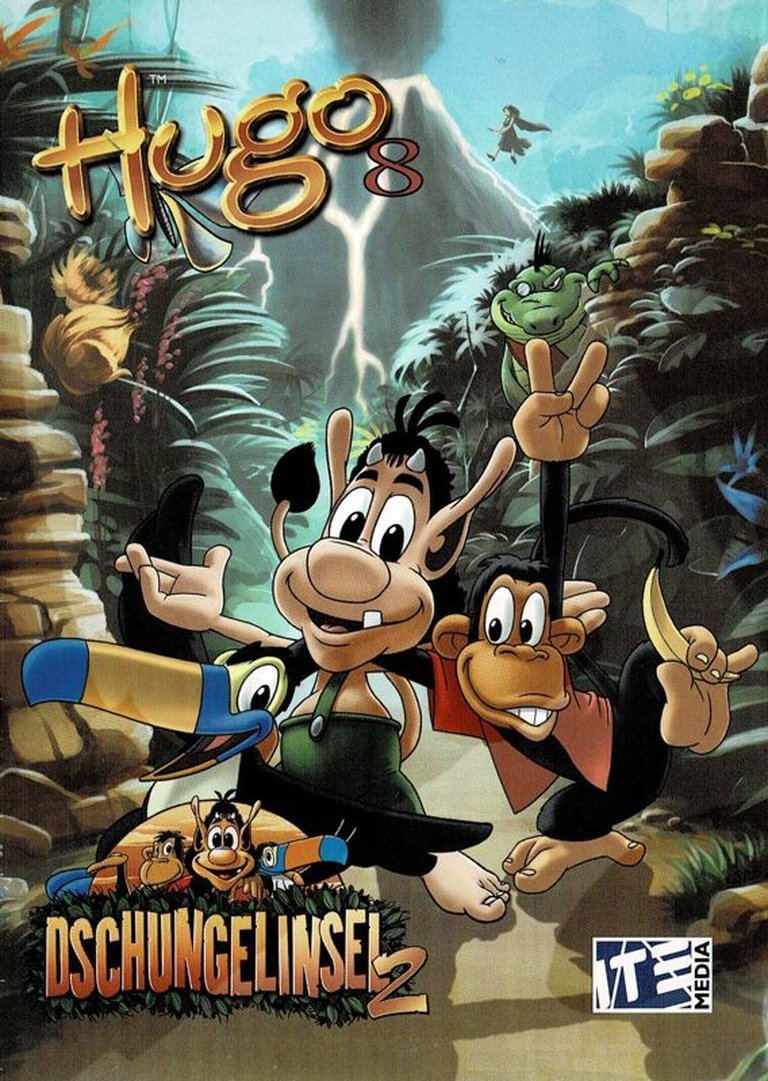
Hugo 8: Dschungelinsel 2 is a 2000 Windows game based on the TV show, where the evil witch Hexana has kidnapped Hugo’s family. Players must help Hugo rescue them by completing six mini-games, including an ape duel, mine cart obstacle course, bug battle, Mah Jongg variant, ostrich race, and volcano climbing, while dodging Hexana’s ape accomplices.
Hugo 8: Dschungelinsel 2 Reviews & Reception
retro-replay.com : Hugo 8: Dschungelinsel 2 plunges you back into the world of the beloved TV show as the evil witch Hexana and her mischievous ape henchmen have kidnapped Hugo’s family.
Hugo 8: Dschungelinsel 2 Cheats & Codes
PlayStation
Enter codes at the map screen.
| Code | Effect |
|---|---|
| Hold L1 + R2 | Advance through map areas |
| Hold L2 + R1 | Move in the opposite direction |
Hugo 8: Dschungelinsel 2: Review
In the twilight years of the CD-ROM era, when gaming was transitioning from pixelated sprites to rudimentary 3D, Hugo 8: Dschungelinsel 2 arrived as a colorful, chaotic, and often bewildering entry in the long-running Hugo franchise. Developed by ITE Media ApS and released in October 2000, this game was a licensed tie-in to the popular Danish TV show, aimed squarely at younger audiences but burdened with the expectations of a series that had already seen multiple iterations. The result is a patchwork of mini-games, each more frantic than the last, held together by a thin narrative thread and a protagonist whose grin never quite reaches his eyes.
Development History & Context
The Hugo series began as an interactive TV show in Denmark, where viewers could call in to guide the titular troll through perilous situations. By the late 1990s, the franchise had expanded into a series of PC games, each attempting to capture the show’s blend of slapstick humor and quick reflexes. Hugo 8: Dschungelinsel 2 was developed during a transitional period for the series, as ITE Media sought to modernize the gameplay with 3D graphics and more varied challenges. However, the technological constraints of the era—limited 3D rendering capabilities, modest system requirements, and the need to appeal to a broad, family-friendly audience—meant that the game often felt like a relic of an earlier age, even as it tried to push forward.
The gaming landscape of 2000 was dominated by titles like Deus Ex, The Sims, and Half-Life, which set new standards for narrative depth and immersive worlds. Hugo 8: Dschungelinsel 2, by contrast, was a throwback to the arcade-style, mini-game compilations that had been popular in the mid-90s. Its release on Windows, with a minimum requirement of a Pentium processor and 16 MB of RAM, positioned it as an accessible title for families, but also limited its appeal to more serious gamers.
Narrative & Thematic Deep Dive
The plot of Hugo 8: Dschungelinsel 2 is as straightforward as it is uninspired: the evil witch Hexana has kidnapped Hugo’s family, and it’s up to our hero to rescue them. The narrative is delivered through brief cutscenes that bookend each mini-game, featuring the kind of over-the-top villainy and slapstick humor that would be at home in a Saturday morning cartoon. Hexana’s taunts are suitably melodramatic, and her ape henchmen serve as comic relief rather than genuine threats.
Thematically, the game is a pastiche of jungle adventure tropes: swinging from vines, dodging lava, and outsmarting mischievous primates. There’s little in the way of character development or emotional depth; Hugo remains the plucky underdog, and his family is little more than a plot device. The writing is functional, if not particularly memorable, and the humor is aimed squarely at children. For adult players, the narrative is likely to feel shallow and repetitive, but for its target audience, it provides just enough motivation to keep playing.
Gameplay Mechanics & Systems
At its core, Hugo 8: Dschungelinsel 2 is a collection of six mini-games, each with its own set of mechanics and challenges. The variety is impressive, ranging from the Ape Duel—a tense, timing-based contest where Hugo boxes an ape atop a swaying log—to the Obstacle Race, a high-speed mine-cart sequence that demands quick reflexes and precise timing. The Bug Battle is a memory game where players must repeat a sequence of bug statues, while the Mah Jongg variant offers a more cerebral challenge. The Ostrich Race and Volcano Climbing levels add further variety, with the latter introducing a race against rising lava and falling rocks.
The controls are simple and intuitive, making the game accessible to younger players. However, the difficulty curve is uneven, with some mini-games feeling too easy and others frustratingly difficult. The final lever-guessing bonus stage, which can only be unlocked after completing certain challenges, adds a layer of risk-reward strategy, but also feels like an arbitrary hurdle.
One of the game’s biggest weaknesses is its lack of replay value. Once all the mini-games have been completed, there’s little incentive to return, especially given the absence of multiplayer modes or additional content. The single-player structure is tightly focused on Hugo’s quest, but it lacks the depth and variety needed to sustain long-term engagement.
World-Building, Art & Sound
Visually, Hugo 8: Dschungelinsel 2 embraces a colorful, cartoon-inspired aesthetic that mirrors the whimsical tone of the TV show. The environments are lush and vibrant, with each mini-game featuring its own distinct visual style. The jungle foliage is detailed and immersive, and the character models are expressive and full of personality. However, the 3D graphics, while a step up from earlier entries in the series, are still rudimentary by 2000 standards, with occasional draw-in and texture pop-in detracting from the overall experience.
The sound design is similarly mixed. The soundtrack is upbeat and catchy, with jungle rhythms and tense percussive beats that heighten the stakes during more intense sequences. Voice clips from Hexana and her apes add personality, but they can become repetitive during extended play sessions. The sound effects are functional, if not particularly memorable, and the overall audio package is adequate rather than exceptional.
Reception & Legacy
Upon its release, Hugo 8: Dschungelinsel 2 received a lukewarm reception from critics. German gaming magazines like PC Player, PC Action, and PC Games gave it scores ranging from 15% to 43%, citing its simplicity, lack of innovation, and uneven difficulty as major drawbacks. The game’s target audience—children and families—may have found more to enjoy, but for serious gamers, it was a forgettable entry in an already crowded market.
In the years since its release, Hugo 8: Dschungelinsel 2 has largely faded into obscurity. It remains a niche artifact of early 2000s family gaming, remembered more for its colorful presentation and variety of mini-games than for any lasting impact on the industry. Its legacy is tied to the broader Hugo franchise, which continued to produce games and TV shows for several more years, but it never achieved the same level of recognition or influence as other titles of its era.
Conclusion
Hugo 8: Dschungelinsel 2 is a game of contradictions. It’s a colorful, chaotic, and often bewildering entry in the Hugo series, offering a variety of mini-games that range from genuinely entertaining to frustratingly difficult. Its narrative is thin and its gameplay uneven, but its charm and accessibility make it a worthwhile pick for younger players or fans of the TV show. For everyone else, it’s a relic of a bygone era—a reminder of a time when gaming was simpler, and the line between entertainment and education was more blurred.
In the grand scheme of video game history, Hugo 8: Dschungelinsel 2 is unlikely to be remembered as a classic. But for those who grew up with Hugo, it remains a nostalgic trip back to a time when gaming was less about pushing technological boundaries and more about having fun. And in that sense, it succeeds admirably.