
- Release Year: 2003
- Platforms: Windows
- Publisher: ITE Media ApS (Interactive Television Entertainment)
- Developer: ITE Media ApS (Interactive Television Entertainment)
- Genre: Action, Sports
- Perspective: Diagonal-down
- Game Mode: Hotseat, Single-player
- Gameplay: Arena-based combat, Character upgrades, Power-ups
- Setting: Fantasy
- Average Score: 70/100
Description
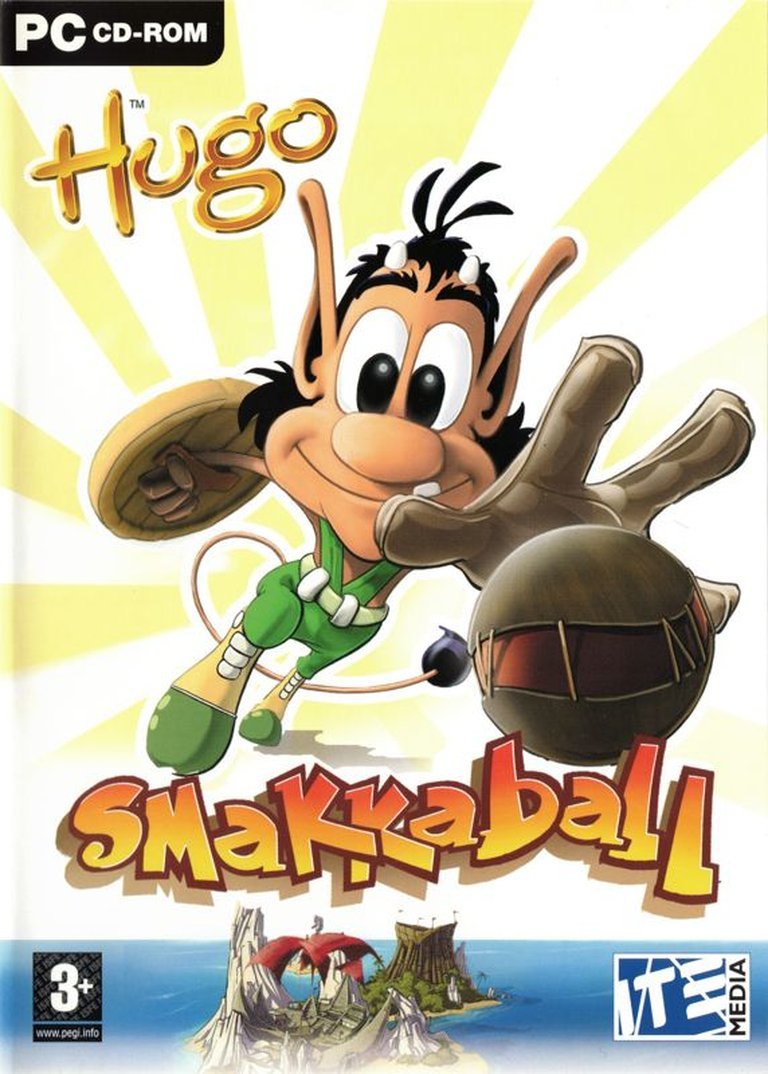
Hugo: Smakkaball is a competitive sports tournament game set in a fantasy arena, where 1-2 players from the Hugo the TV Troll franchise battle to claim the most wall sections by throwing balls at lit-up panels. Matches last three minutes, with players vying to control territory by hitting neutral or opponent-held sections, while power-ups enhance abilities like speed and throwing power. Obstacles include dizzying ball hits and interfering minions, and players can upgrade their character’s stats after each match. The arenas dynamically change based on the ‘home’ character, adding variety to the tournament.
Hugo: Smakkaball Free Download
Hugo: Smakkaball Cracks & Fixes
Hugo: Smakkaball Reviews & Reception
gamepressure.com (70/100): Another family game with children’s favourite, troll Hugo, in the lead role.
Hugo: Smakkaball Cheats & Codes
PC
Use the trainer functions during gameplay.
| Code | Effect |
|---|---|
| F1 | Instant Action |
| F2 | Edit: Current Yen |
| F3 | Edit: Current Upgrade Points |
| F4 | Edit: Franchise Conservation Credits |
| F5 | Instant Stop |
| F6 | Unlimited MP |
| F7 | Mega Logistics |
| HOME | Disable All |
Hugo: Smakkaball – A Forgotten Oddity in the Hugo Franchise
Introduction: The Troll Who Tried to Play Ball
In the vast, often bizarre landscape of licensed children’s games, Hugo: Smakkaball (2003) stands as one of the most peculiar entries. A spin-off of the long-running Hugo the TV Troll franchise, this game attempts to blend competitive sports mechanics with the whimsical charm of its source material. Yet, despite its ambitions, Smakkaball remains an obscure footnote—a game that, by all accounts, failed to capture the imagination of its target audience or critics alike.
This review seeks to dissect Hugo: Smakkaball in its entirety: its development context, its unique (if flawed) gameplay, its reception, and its place in the broader history of the Hugo series. Was it a bold experiment gone wrong, or simply a misguided attempt to capitalize on a fading brand? Let’s find out.
Development History & Context: The Hugo Franchise’s Swansong?
The Hugo Legacy: From TV to Interactive Oddities
The Hugo franchise began in 1991 as a Danish television show centered around Hugo, a friendly troll who lived in a cave with his family and battled the villainous witch Scylla. The series quickly expanded into video games, with early titles like Skærmtrolden Hugo (1991) and Hugo (1996) establishing a formula of simple, child-friendly adventures.
By the early 2000s, the franchise had ballooned into a sprawling multimedia empire, with over 30 games released across multiple platforms. However, many of these titles were rushed, repetitive, or lacked polish—traits that would come to define Smakkaball.
ITE Media’s Vision: A Sports Game for Kids
Developed and published by ITE Media ApS (Interactive Television Entertainment), Hugo: Smakkaball was part of a late-era push to diversify the Hugo brand beyond traditional adventure games. The studio, which had been responsible for nearly all Hugo titles, saw potential in a competitive multiplayer experience tailored for young audiences.
The game was released in September 2003 for Windows, a time when the PC gaming market was dominated by more sophisticated titles. Its minimum system requirements (Pentium 166MHz, 32MB RAM) suggest it was designed for older or lower-end machines, likely to maximize accessibility for its intended demographic (ages 6–10).
The Gaming Landscape of 2003: A Tough Market for Niche Titles
2003 was a transitional year for gaming. Major releases like Half-Life 2, Star Wars: Knights of the Old Republic, and The Legend of Zelda: The Wind Waker set high standards for production values. Meanwhile, the children’s gaming market was flooded with licensed titles tied to popular cartoons and movies (SpongeBob SquarePants, Disney franchises, etc.).
Smakkaball entered this crowded space without the backing of a major IP or innovative mechanics. Its diagonal-down, fixed-screen perspective and direct control interface were reminiscent of early 90s arcade sports games, making it feel outdated even at launch.
Narrative & Thematic Deep Dive: A Tournament of Trolls
Plot: The Smakkaball Tournament
The game’s premise is straightforward: Hugo and his friends (and enemies) compete in the Smakkaball Tournament, a high-stakes competition where players battle for control of an arena’s walls. There is no overarching story—just a series of matches with minimal context.
Characters: Familiar Faces in a Strange Sport
Players can choose from four characters, each with unique stats:
– Hugo – The protagonist, balanced in speed and strength.
– TrolleRat – A faster, weaker opponent.
– TrolleRut – A slower, stronger bruiser.
– Jean Paul – A mysterious figure with varied attributes.
The lack of deeper characterization is striking. Unlike other Hugo games, which often featured lighthearted storytelling, Smakkaball reduces its cast to mere avatars in a mechanical contest.
Themes: Competition Without Consequence
The game’s themes revolve around friendly rivalry and strategic dominance, but these ideas are never explored meaningfully. The “prestige” of owning an arena is mentioned in promotional materials, but the game itself offers no narrative payoff for victory.
Dialogue & Presentation: Minimalist to a Fault
There is no voice acting, and text is limited to basic menus. The absence of any real storytelling makes Smakkaball feel more like a tech demo than a fully realized game.
Gameplay Mechanics & Systems: A Unique (But Flawed) Concept
Core Gameplay: Wall Claiming as a Sport
Smakkaball’s central mechanic is arena wall domination. Players throw a ball at lit-up sections of the arena walls to claim them. The goal is to control the majority of wall segments by the end of a 3-minute match.
- Throwing Mechanics: Players must aim and time their throws carefully.
- Reclaiming Walls: Hitting an opponent’s claimed section steals it.
- Power-Ups: Temporary boosts (speed, strength, ball attraction) add chaos.
- Minion Interference: A random NPC can block players, disrupting momentum.
Character Progression: A Shallow RPG-Lite System
After each match, players earn upgrade points to distribute across:
– Strength (throwing power)
– Speed (movement)
– Body Armor (defense against stuns)
– Recovery Speed (how quickly they recover from hits)
This system is underdeveloped—upgrades have minimal impact, and the lack of a deeper meta-progression makes matches feel repetitive.
Multiplayer: Local-Only Competition
The game supports 1-2 players via same-screen/split-screen, but there is no AI opponent beyond basic CPU-controlled rivals. The absence of online play (even by 2003 standards) limits its longevity.
Flaws in Execution
- Repetitive Matches: The core loop grows stale quickly.
- Unbalanced Power-Ups: Some (like the “pot of gold” bonus) feel arbitrary.
- Clunky Controls: Throwing mechanics lack precision.
- No Single-Player Campaign: Just a series of disconnected matches.
World-Building, Art & Sound: A Fantasy Sports Arena
Visual Design: Colorful but Uninspired
The game adopts a fantasy aesthetic, with arenas decorated to reflect each character’s “home turf.” However, the fixed, diagonal-down perspective and low-poly 3D models make the environments feel flat and unengaging.
Sound & Music: Forgettable Audio
The soundtrack consists of generic, upbeat tunes that fail to enhance the experience. Sound effects (ball throws, wall hits) are functional but unremarkable.
Atmosphere: A Missed Opportunity
The Hugo franchise had a history of whimsical, story-driven adventures. Smakkaball’s sterile, competition-focused design strips away much of the series’ charm, leaving behind a hollow sports simulator.
Reception & Legacy: A Critical and Commercial Flop
Contemporary Reviews: Universally Panned
Smakkaball received three known reviews, all scathing:
– PC Zone (10/100): Called it “atrocious, devoid of ideas, charm, and content.”
– PC Games (27/100): Deemed it suitable only for very young children.
– PC Action (9%): Labeled it “simply boring.”
Commercial Performance: A Niche Failure
With no recorded sales data, it’s safe to assume Smakkaball underperformed. The Hugo franchise itself was in decline by 2003, and this title did little to revive interest.
Legacy: A Footnote in Gaming History
Smakkaball is remembered, if at all, as one of the weaker entries in the Hugo series. It represents a failed experiment—a game that tried to innovate within a stagnant franchise but lacked the depth or polish to succeed.
Conclusion: A Curious Relic of Early 2000s Gaming
Hugo: Smakkaball is a fascinating case study in how not to adapt a licensed property into a sports game. Its core mechanic—wall domination via ball throws—is unique, but the execution is shallow, repetitive, and lacking in charm.
Final Verdict: 2/10 – A Forgotten Misfire
While it may hold nostalgic value for Hugo fans or collectors of obscure 2000s games, Smakkaball fails as both a competitive experience and a narrative-driven adventure. It stands as a reminder of the risks of prioritizing gimmicks over substance—a lesson that still resonates in modern game design.
For historians, it’s a curious artifact. For everyone else? Best left in the past.
Would you like additional analysis on any specific aspect of the game?