
- Release Year: 2018
- Platforms: Windows
- Publisher: Royal Rudius Entertainment
- Developer: Royal Rudius Entertainment
- Genre: Action
- Perspective: 1st-person
- Game Mode: Single-player
- Gameplay: Shooter
- Setting: Futuristic, Sci-fi
- Average Score: 53/100
Description
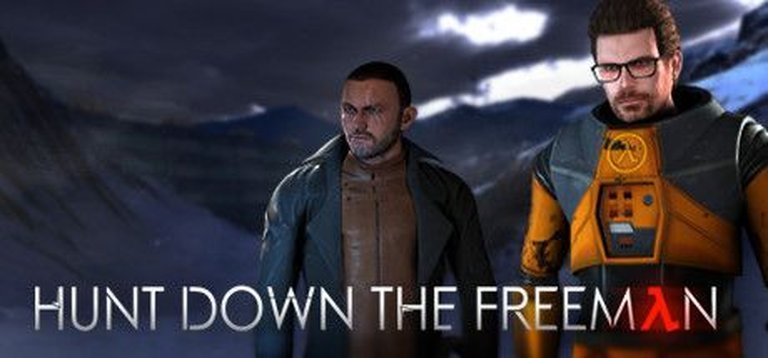
Hunt Down the Freeman is a first-person shooter fangame set in the Half-Life universe, where players control U.S. Marine Corps Sergeant Mitchell Shephard of the Hazardous Environment Combat Unit during the Black Mesa incident and subsequent events, navigating sci-fi futuristic environments filled with alien invasions, military conflicts, and parkour mechanics to hunt down and kill the protagonist Gordon Freeman.
Gameplay Videos
Where to Buy Hunt Down the Freeman
PC
Hunt Down the Freeman Free Download
Hunt Down the Freeman Cracks & Fixes
Hunt Down the Freeman Mods
Hunt Down the Freeman Guides & Walkthroughs
Hunt Down the Freeman Reviews & Reception
steambase.io (54/100): Player Score of 54 / 100. This score is calculated from 4,297 total reviews which give it a rating of Mixed.
imdb.com : Truly awful.
metacritic.com (52/100): User Score Mixed or Average Based on 103 User Ratings 5.2
Hunt Down the Freeman Cheats & Codes
PC/Windows
Press the tilde key ~ to the left of the 1 on the keyboard to bring up the console, type in sv_cheats 1 to enable cheats, and enter one of the following codes to activate it.
| Code | Effect |
|---|---|
| sv_cheats 1 | Enables cheats |
| noclip | No Clipping Mode |
| sv_gravity [-999 – 999999] | Adjust Gravity |
| impulse 195 | AI Node Information |
| impulse 196 | AI Node Information |
| impulse 197 | AI Node Information |
| impulse 199 | AI Node Information |
| impulse 101 | All Weapons and Ammo |
| -reload | Auto-reload Disabled |
| +reload | Auto-reload Enabled |
| impulse 109 | Control on-Screen Monsters |
| impulse 203 | Delete Monster/NPC from World |
| developer 0 | Developer Mode Off |
| developer 1 | Developer Mode On |
| god | God Mode |
| impulse 104 | List Global Entities |
| firstperson | Return to First Person View |
| lambert -1.0001 | See Things Brightly Without Flashlight |
| rate <0-3500> | Set Reload Speed; 0 is fastest, 3500 is default |
| r_fullbright 9 | Strange Colors and Wireframes |
| kill | Suicide |
| impulse 107 | Texture Name, While Looking at Object |
| thirdperson | Third Person View |
| host_framerate [0,1] | Toggle Game Speed |
| r_fullbright [0,1] | Toggle Light Amplifier |
| notarget | Stops NPCs from targeting you |
| maps | Shows a list of the maps in the game |
| shotosweapon | Fires the One Shot Barrel |
| hdtf_set_arms_skin <0-3> | Changes which gloves Mitchell uses. It has 4 options (0 – 3) |
| hdtf_smg1_pickable <0-1> | Changes if Mitchell can pickup the HL2 SMG. (0 is off 1 is on) |
| hdtf_smg1_shoots_grenades <0-1> | Switches what Altfire the SMG has. (0 for light 1 for nades) |
| hdtf_m16_carbine_pickable <0-1> | Changes if Mitchell can pickup the M16 carbine. (0 is off 1 is on) |
| hdtf_spas_picakble <0-1> | Changes if Mitchell can pickup the HL2 Shotgun. (0 is off 1 is on) |
Hunt Down the Freeman: Review
Introduction
In the annals of video game history, few titles evoke as much schadenfreude, meme-fueled infamy, and outright disdain as Hunt Down the Freeman. Released in 2018 as a commercial Steam fangame set in Valve’s sacrosanct Half-Life universe, it promised to flip the script on Gordon Freeman’s silent heroism by thrusting players into the boots of Mitchell Shephard, a vengeful U.S. Marine from the Hazardous Environment Combat Unit (HECU). Trailers teased cinematic cutscenes, sprawling post-apocalyptic vistas, and a plot weaving through Black Mesa, the Seven Hour War, and Combine-occupied Earth. Yet, what emerged was a buggy, bloated mess that became synonymous with “how not to make a game.” This review dissects its ambitions against its catastrophic execution, arguing that Hunt Down the Freeman endures not as a playable triumph, but as a stark cautionary tale of unchecked hubris in indie fangame development—a digital relic that exposes the perils of biting off more than a fledgling studio can chew.
Development History & Context
Royal Rudius Entertainment, a small indie outfit led by director, writer, and producer Berkan Denizyaran (aka “Frank”), birthed Hunt Down the Freeman from humble origins. Conceived initially as a Source Filmmaker machinima, it evolved into a full standalone mod/game using the Source engine—the same tech powering Half-Life 2. Denizyaran’s vision was audacious: an interquel bridging Half-Life and Half-Life 2, starring Mitchell Shephard, implied brother of Adrian Shephard from Opposing Force. A 2016 demo showcased early promise with high-fidelity cutscenes, but red flags abounded.
Crowdfunding via Indiegogo flopped spectacularly, raising just $12 of a $100,000 goal, forcing self-funding amid allegations of asset theft (denied by devs, who claimed permissions). Development involved up to 50 collaborators, including 80 credited talents—many YouTubers like Pyrocynical (Alex “Crew”), Colossal is Crazy (Captain Roosevelt), and Keemstar (the U.S. President)—but coordination faltered. A former dev later called it a “clusterfuck,” with underpayment or non-payment rampant. Technological constraints mirrored Source’s aging quirks: Havok physics, FMOD audio, and Bink videos strained a small team’s limits.
The 2018 landscape amplified its doom. Half-Life fandom hungered for official content (pre-Alyx), making fangames like Black Mesa darlings. Steam Greenlight (pre-Curator system) allegedly saw bot-voting accusations. Priced at ~$30 initially (now $1.49), its commercial status irked purists, contrasting free mods like Entropy: Zero. Post-launch patches added achievements mocking its flaws, while Operation Whiskey Freedom (OWF)—remnants of Royal Rudius plus volunteers—rolled out M3SA builds from 2022, fixing bugs and padding. Denizyaran’s jump to Activision Blizzard left the project orphaned, cementing its “abandoned trainwreck” status.
Narrative & Thematic Deep Dive
Hunt Down the Freeman‘s plot unfolds across three acts and two massive time skips (3 years, then 17), chronicling Mitchell’s odyssey from Black Mesa grunt to anti-heroic warlord. Prologue: During the Resonance Cascade, a helmeted HEV-suited figure (implied Gordon Freeman) crowbars Mitchell’s squad and scars his face, fueling a vow of vengeance. G-Man intervenes in an Albuquerque hospital, dangling “authority, power, and time” for Freeman’s head.
Act 1 (Seven Hour War): Mitchell escapes zombies and early Combine (Hunters, synths), allies with National Guardsman Nick, Black Ops Adam, Colonel Cue, Lt. Harvey, and Captain Roosevelt. Leaders die suspiciously, elevating Mitchell aboard the Avalon Vale. Act 2: In “New Alaska” (City 9), he razes a child-slave Cremator factory run by Boris, recruiting orphans as soldiers. Act 3: G-Man dispatches him to City 17; allying with promoted Boris, Mitchell raids Black Mesa East, Ravenholm, and Nova Prospekt—only for twists: Sasha (Boris’s daughter) reveals G-Man’s machinations; Adam assassinates her, framing Mitchell. G-Man confesses he orchestrated Adam’s impersonation to divide Combine forces, aiding Freeman indirectly. Mitchell executes Adam gruesomely, sets sail for the Borealis.
Thematically, it probes “villain protagonists” (You Are the Villain), revenge’s futility, and G-Man’s chessmastery—elevating him to near-omniscient manipulator (Gambit Roulette). Grey morality shines: HECU as genocidal cover-uppers, Mitchell enslaving kids post-rescue, humans as predatory as Combine. Echoes Metal Gear Solid V (scarred soldier builds child army). Yet execution falters: Dialogue is edgy drivel (“You fucked up my face!”), accents mismatch (British YouTubers as Americans), plot holes abound (pre-Resistance sprays, vending machines). Twists feel unearned—Freeman’s absence (Wolverine Publicity) betrays the title. Cutscenes (third-person shift) disrupt immersion, prioritizing SFM flair over interactivity. Ambition yields a convoluted mess, undermining themes of manipulation with its own narrative incompetence.
Gameplay Mechanics & Systems
Core loops ape Half-Life 2—linear FPS shooting, puzzles, vehicle segments—but innovate clumsily. Arsenal spans 20+ weapons (knives, M9, MP5SD, minigun, magnum hand cannon) in a backpack system (slots for melee/pistol/SMG/AR/shotty/throwables), enabling hyperspace arsenals. Parkour (holster-to-climb) adds traversal, prone crawling aids stealth, ADS leans for cover. Progression: No deep RPG; health packs, infinite-ammo setpieces.
Flaws dominate: Level design prioritizes scale over flow—Act 2’s vast, signpost-less Alaska wastes hours wandering (padding for refunds?). AI is artificial stupidity incarnate: Allies clump/stand still, enemies suicide-rush. Bugs abound (softlocks, invisible walls, unskippable waits). Escort missions (Humvee/train) improved post-launch, but Zerg Rushes (zombie waves, 15-min Hold the Line) grate. UI is sparse; no HUD bloat, but console reliance (noclip speedruns) reveals breakage. OWF fixes (tutorials, removed snipers) help, enabling <2-hour completions, but originals epitomize Fake Difficulty—prone tutorials sans hints, cracked floors demanding chandelier jumps. Amid Source familiarity, it’s a Frankenstein: borrowed animations (Payday 2 run, L4D zombie walks), janky parkour. Verdict: Tedious, unpolished loops squander potential.
World-Building, Art & Sound
Settings span Black Mesa corridors, Albuquerque subways (Artistic License—Geography: fake subway), Nevada deserts, Alaska tundras, City 17 staples (Ravenholm, Nova Prospekt). Post-Combine Earth feels lived-in via child factories, hanged Overwatch, but bloat dilutes: Empty expanses, Misplaced Wildlife (Antlions in snow). Visuals mix custom models (Mitchell’s scars) with assets (Black Mesa, L4D)—inconsistent polys, non-standard HECU camo. Cutscenes shine (SFM polish), gameplay muddies (draw distance hides landmarks).
Sound design leverages Source/FMOD: FMOD tracks with One-Woman Wail evoke dread, but temp files linger. Voicework polarizes—stellar Mitchell (Mick Lauer), wooden YouTubers (Pyrocynical’s thick Brit as Yank). G-Man’s flubbed “Black Messa” fixed later. Gunfire pops, zombie moans grate in repetition. Atmosphere builds via bleakness (child slavery, Roosevelt’s bisection), but bugs (endless loading, Convection Schmonvection) shatter immersion. OWF graffiti (“Where’s our money, Berkan?”) nods meta-critique. Overall, evocative seeds in barren soil.
Reception & Legacy
Launch was apocalypse: Steam “Overwhelmingly Negative” (1.2/5 MobyGames players, 0% Starburst critic: “perfect example of how not to design games”). PC Gamer likened it to “unfinished mod”; RPS called execution “haphazard.” YouTube essays (Pyrocynical, Yahtzee) memed it (“game SUCKS i go to bed”). Copyright gripes (stolen assets? Denied), Greenlight bots fueled fury—Valve tacitly approved, but silence spoke volumes.
Commercially? Meager; now $1.49. Legacy: Infamous benchmark for failure, spawning demakes (Hunt Down the Freeman Classic), parodies (Full Life Consequences style). OWF revitalized it—achievements mock self (Fcked face), M3SA trims fat. Influences? None direct; warns against commercial fangames sans polish (Black Mesa* succeeded free-to-paid). Cult following endures for irony, but it scarred Half-Life modding, predating Alyx‘s redemption arc.
Conclusion
Hunt Down the Freeman is a tragicomic artifact: Ambitious scope drowned in incompetence, its scarred face a mirror to Mitchell’s grudge. Strengths—cutscene spectacle, thematic intrigue—wither under abysmal design, bugs, and narrative snags. Post-OWF, it’s playable schlock; originally, unmitigated disaster. In history’s pantheon, it claims no throne—merely a footnote as the fangame that hunted refunds, reminding indies: Polish or perish. Verdict: 1.5/10—buy for memes, play Black Mesa for substance. A villain in its own story, unfit for heroism.